Some lesser-known history of the UT Tower
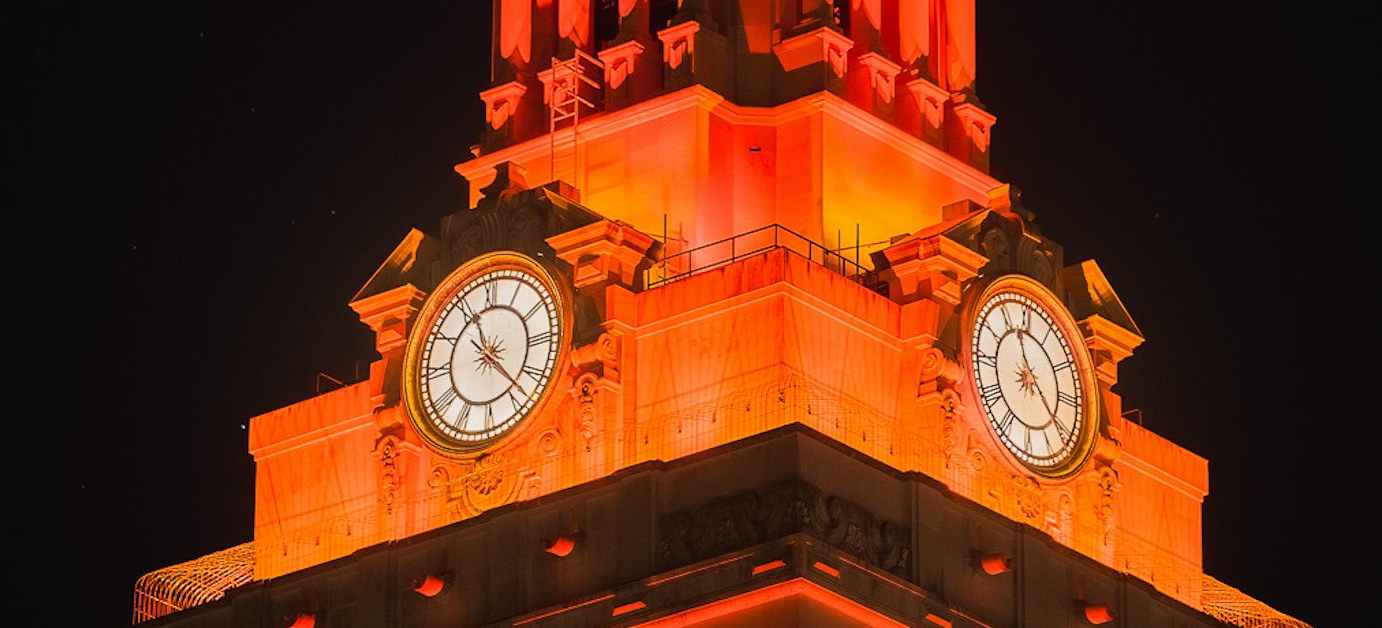
“Save the clock tower!” Like a scene out of the film Back to the Future, the University has been promoting its much-needed and ambitious restoration of the Main Building. Scaffolding has now engulfed the south side and work is at full-throttle: cleaning the limestone, removing the rust, and replacing the gold leaf.
Through the fall term, the University published several fine articles about the Tower, which you can find here. But such an iconic building has a broad history. Below are a few things you might not have heard about the Tower.
There’s a Tower Song
In 1936, the UT Theta Sigma Phi society for women journalism majors (today’s Women in Communication) created a campus variety show to raise $100 and send one of their members to Theta Sig’s national convention. The show was titled Time Staggers On, a spoof on the popular radio program Time Marches On, and was such a success it launched a 25-year campus tradition.
From 1937 to 1960, at the start of the academic year, interested groups of students submitted scripts of potential shows along with sample songs. The Theta Sigs reviewed the submissions, selected a winner, and awarded a cash prize. The chosen team then organized and performed their version of Time Staggers On in Hogg Auditorium the following January. The scripts and songs poked fun at campus life, and performances often played to sold-out audiences.
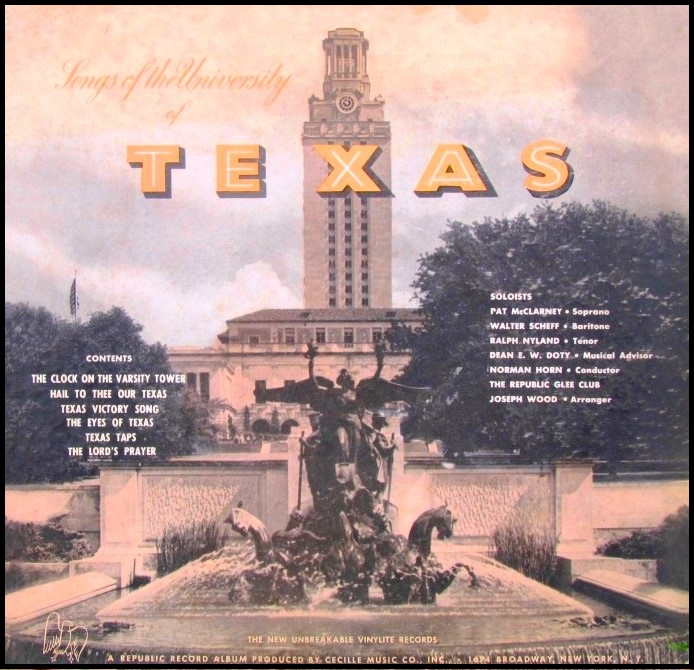
In the fall of 1939, UT student John Young composed a romantic ballad titled “The Clock on the Varsity Tower” that was part of the winning submission. The song was the hit of the show, was included in future UT songbooks, and could be heard on campus well into the 1950s. In 1948, Young’s tune was professionally recorded in New York for an album titled Songs of the University of Texas. You can listen to it here:
The Elevator Girls
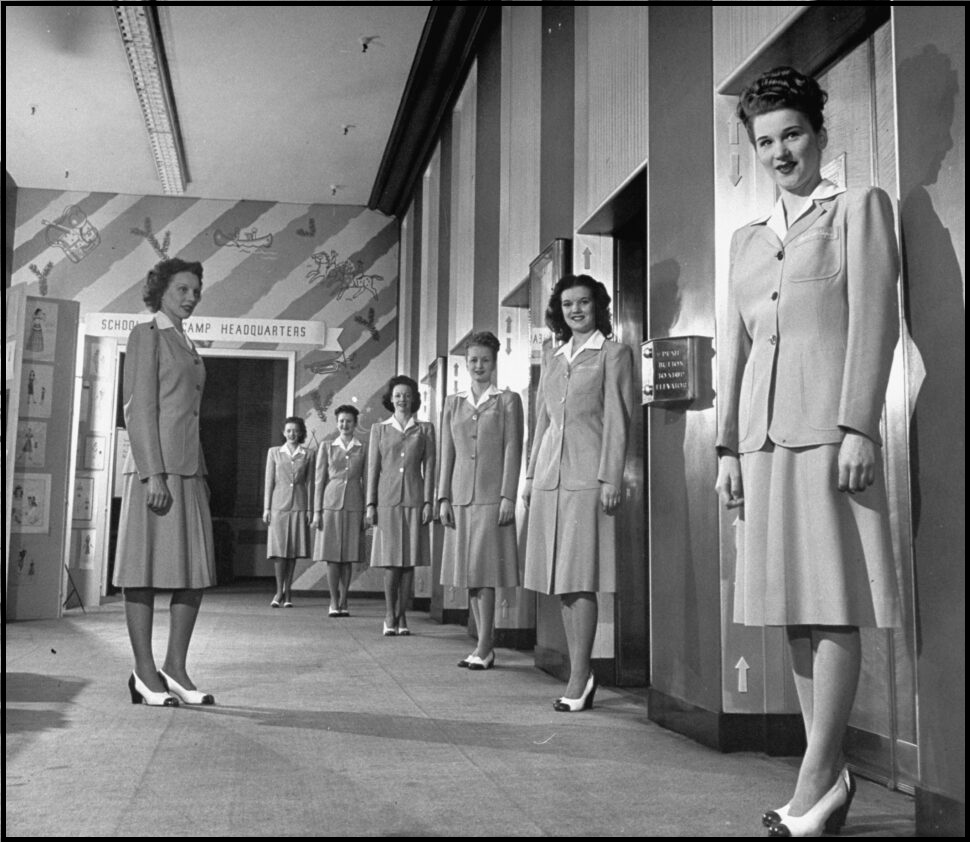
In the first half if the 20th century, elevator operators were a common sight in city skyscrapers, shiny department stores, and fancy hotels. Usually women, they were smartly dressed, provided customer service, and were trained to handle emergencies. When the Tower opened in 1937, the University employed “elevator girls” to run the Main Building’s five elevators.
More than simply pushing buttons, the girls knew the locations of all 117 offices, directed visitors to the rare books library or to a professor’s office, and watched to make sure an elevator car wasn’t overloaded. At the time, the Tower observation deck was open 9am – 5pm weekdays and was a “must see” for any Austin tourist.
Alice Peters, one of the original elevator girls, was proud to say she never experienced motion sickness in more than five years of trips up and down the Tower. The job did get monotonous at times, but for husband-hunters, had its perks. In the first few years, six of the elevator girls met their future spouses on an elevator ride.
(Above: A team of elevator girls pose for a group photo in Chicago’s Marshall Field department store in 1947. From Life magazine.)
“Figaro! Figaro! Feeee-ga-ro!!”
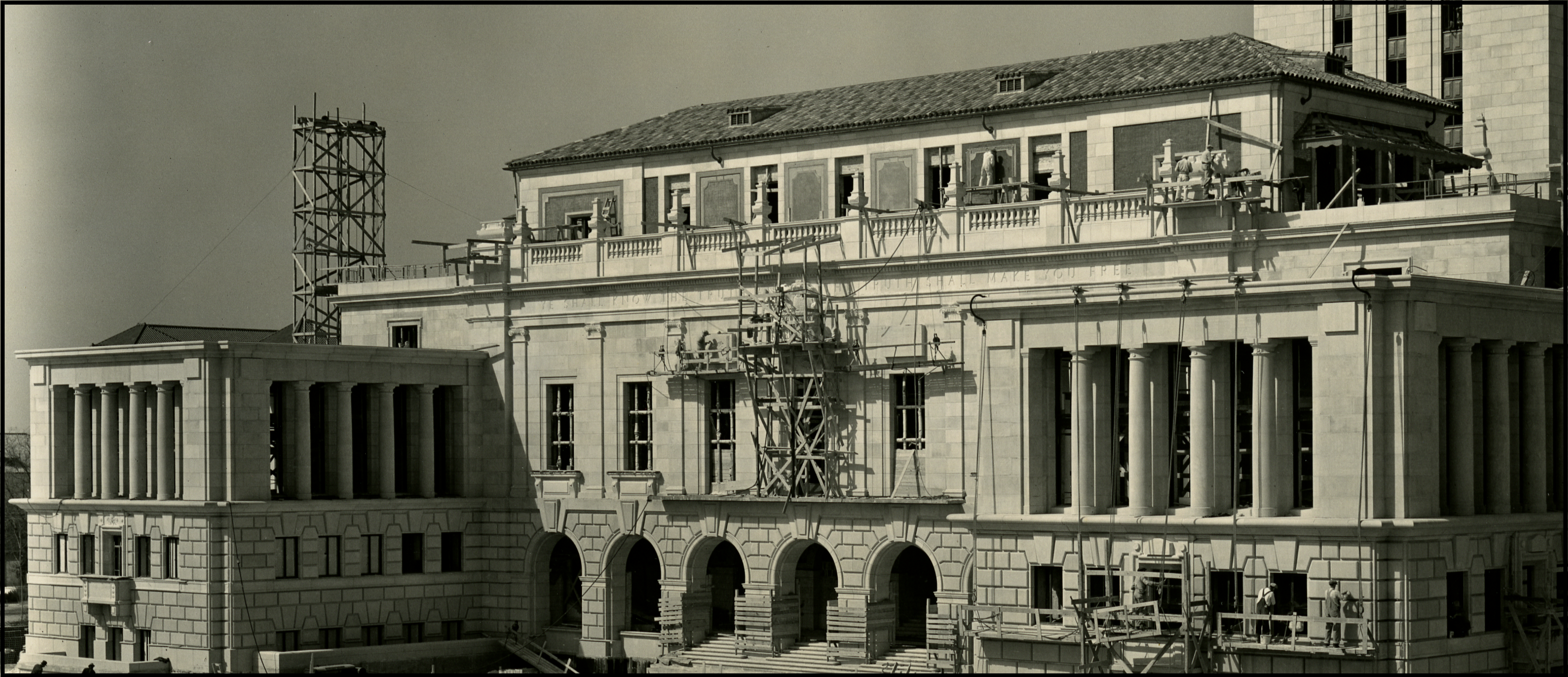
In 1936, while the Tower and south façade of the Main Building were under construction, Italian stone artists were brought to Austin to hand carve the decorative stonework. As the walls were installed, flat blocks of limestone were placed in the appropriate places, then the stone carvers transformed the blocks into the lamps of learning, faces of Athena, scallop shells, the University Seal, and other decorations seen on the building. To pass the time under the hot Texas sun, the Italian crew often sang favorite opera selections together, a treat for students passing by during a class change, or for those who paused to watch the construction in progress.
(Above, Italian stone artists work on the University Seal at the center of the south façade. Look closely, and you can see the flat, unfinished blocks near the top of the east and west extensions, which are now decorative lamps of learning. Photo from UT’s Alexander Architectural Archives.)

The Skatin’ Librarians
The Main Building and Tower opened in 1937 as UT’s central library, with the Tower holding the book stacks and reading rooms placed at the lower levels. Because it was a “closed-stack” library – where the bookshelves weren’t publicly open to browse – students had to find their selections in an enormous card catalog, complete a request form, and hand it to the librarian at the main desk in what is now the Life Science Library. Requests were sent up to the Tower floors via a pneumatic tube system, where library staff pulled the desired books from the shelves and sent them down to the desk on a special elevator. Because the work involved endless walking through the bookstack aisles, some of the Tower staff took to wearing roller skates to make the job easier.
An Air Raid Siren
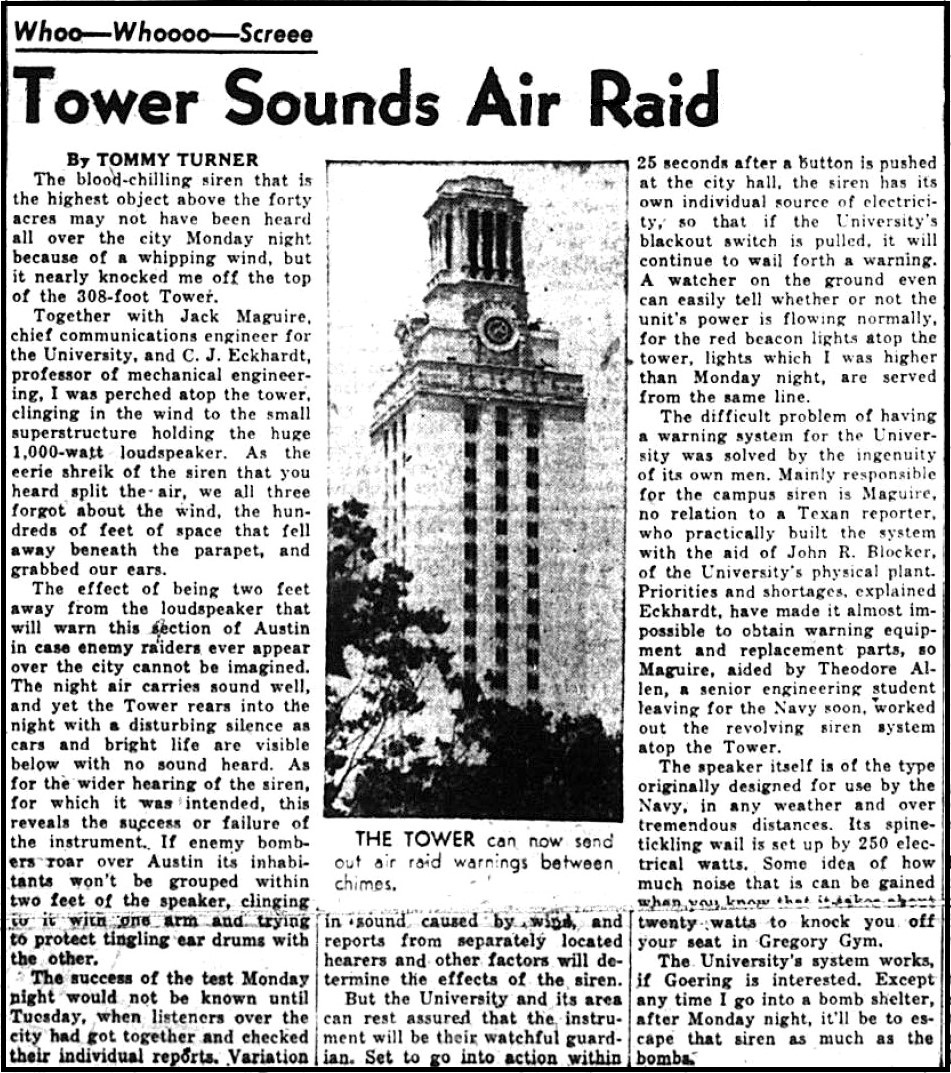
In 1941, soon after the U.S. entered the Second World War, Austin was deemed too close to the Gulf coast and within range of enemy bombers. An air raid siren was installed on the top of the Tower, with a 1,000-Watt speaker and its own power source. It could be switched on from the Main Building or, more important, from Austin City Hall, where any alerts of an impending attack would arrive first.
The city was also placed on a nighttime blackout. From January 25, 1942 to November 1, 1943 – about 19 months – both the Capitol dome and Tower were dark, though the Tower was allowed to shine for spring commencements and a Thanksgiving Day football victory over Texas A&M.
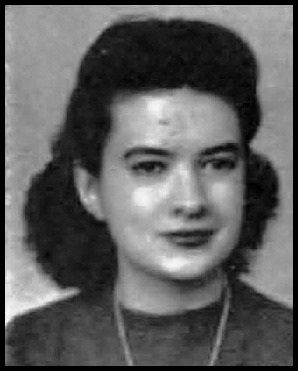
What the Tower Means to Me: Mary Brickerhoff
When the World War II blackout was lifted on November 1, 1943 and the Tower could be floodlit once again, student Mary Brickerhoff (image left) cheered via The Daily Texan newspaper. “The Tower isn’t a building. You thought it was? That’s natural, but the building part is only an optical illusion . . . The Tower is Texas, symbolically speaking, and it is at its most impressive and its most Texan when it is lighted up at night.”
“That tall column of stone,” Brickerhoff continued, “silhouetted against a blue-black night sky and looking as though it were lighted from inside transparent walls instead of from the outside, has been affecting many very different people in the same way for a long time. In our mind’s eye – or in what we have left of it after four years of study – we can see the Tower from a dormitory window on a night of our first year here. It was several blocks away then, and it looked big and impressive. But it wasn’t unfamiliar. Something about it said, “Don’t be scared. You’ll have both fun and trouble in this place, and when it’s all over you won’t want to go back and change anything. And the Forty Acres will mean more to you than anywhere you’ve ever been.”
Football Traffic Spotters
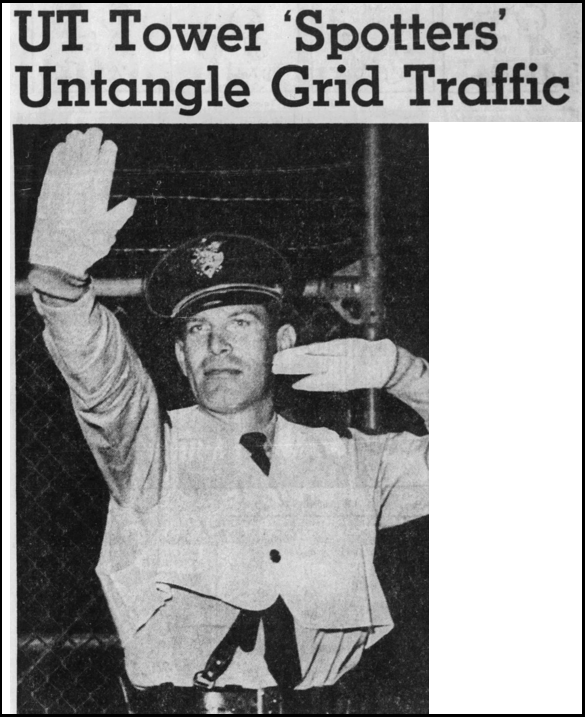
Starting in 1958 and continuing through the 1960s, the Austin Police Department took advantage of the view from the Tower observation deck to manage post-football game traffic leaving Texas Memorial Stadium. An estimated 30,000 cars were parked around the stadium, and APD Lieutenant J. T. “Buddy” Fann had the responsibility to have the traffic rush completed in just over half an hour. From his vantage point at the Tower, Fann was in radio communication with 15 three-wheeled motorcycle units who supported a 50-man traffic control crew. Trouble shooting from above, Fann looked for stalled cars, back-ups at traffic lights, or any other problems, and directed his team in order to keep the traffic moving.
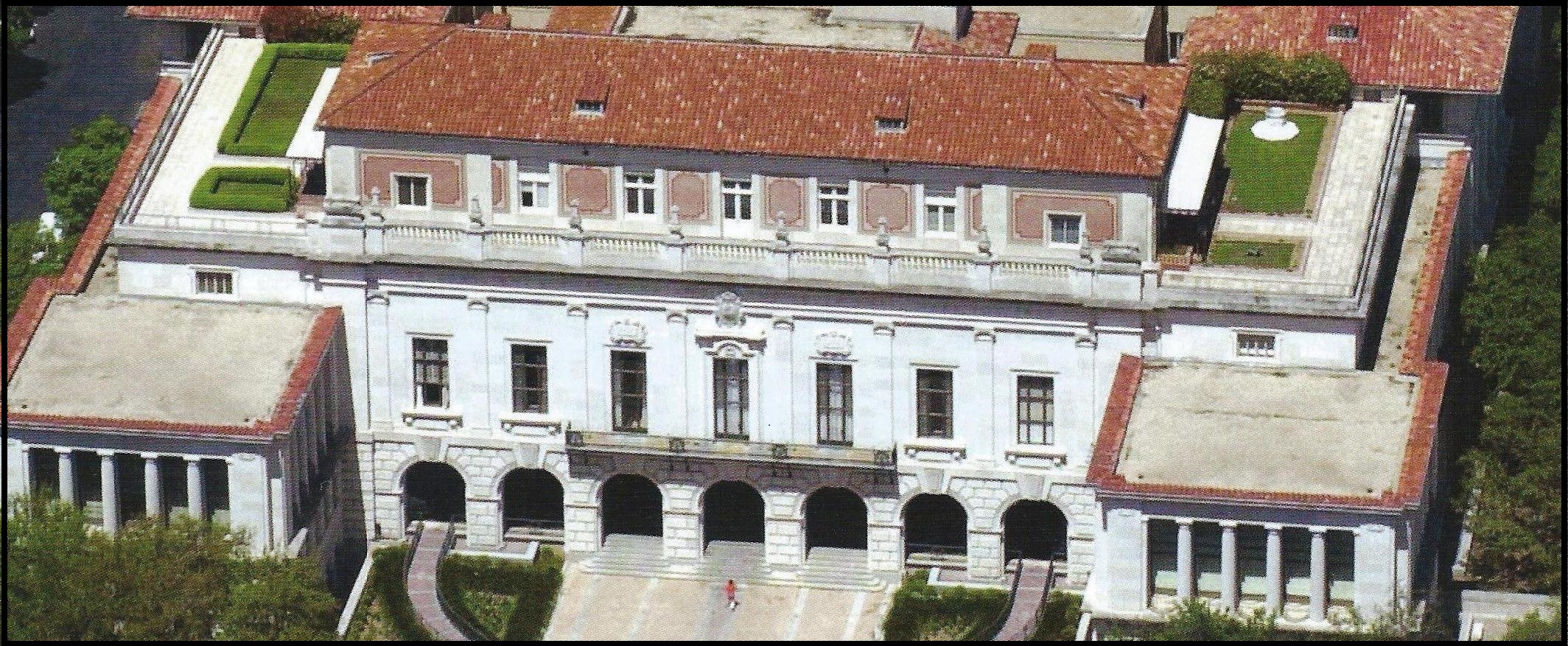
(Above: The University’s Rare Books Collection was originally housed on the fourth floor of the south side of the Main Building. Covered with a red-tile roof, it sported roof gardens on the east and west sides and was frequented by students and visitors. Today, the space is used by the president’s office.)
Turtles in the Roof Garden
One morning in the fall of 1937, Fannie Ratchford, a librarian in the University’s Rare Books Collection in the Main Building, was walking to work when she spied a male box turtle about to cross a busy street, which likely would have been fatal during the morning rush hour. She decided to rescue it, and finding no other suitable place along her commute, released the turtle in the east side roof garden.
When the Main Building opened, the University’s three rare book collections – the Wrenn Library, Aikten Library, and Stark Library – were symbolically housed “front and center” on the fourth floor of the Main Building, where the president’s office is today. The three libraries were the start of what is now the immense Humanities Research Collection at the Harry Ransom Center.
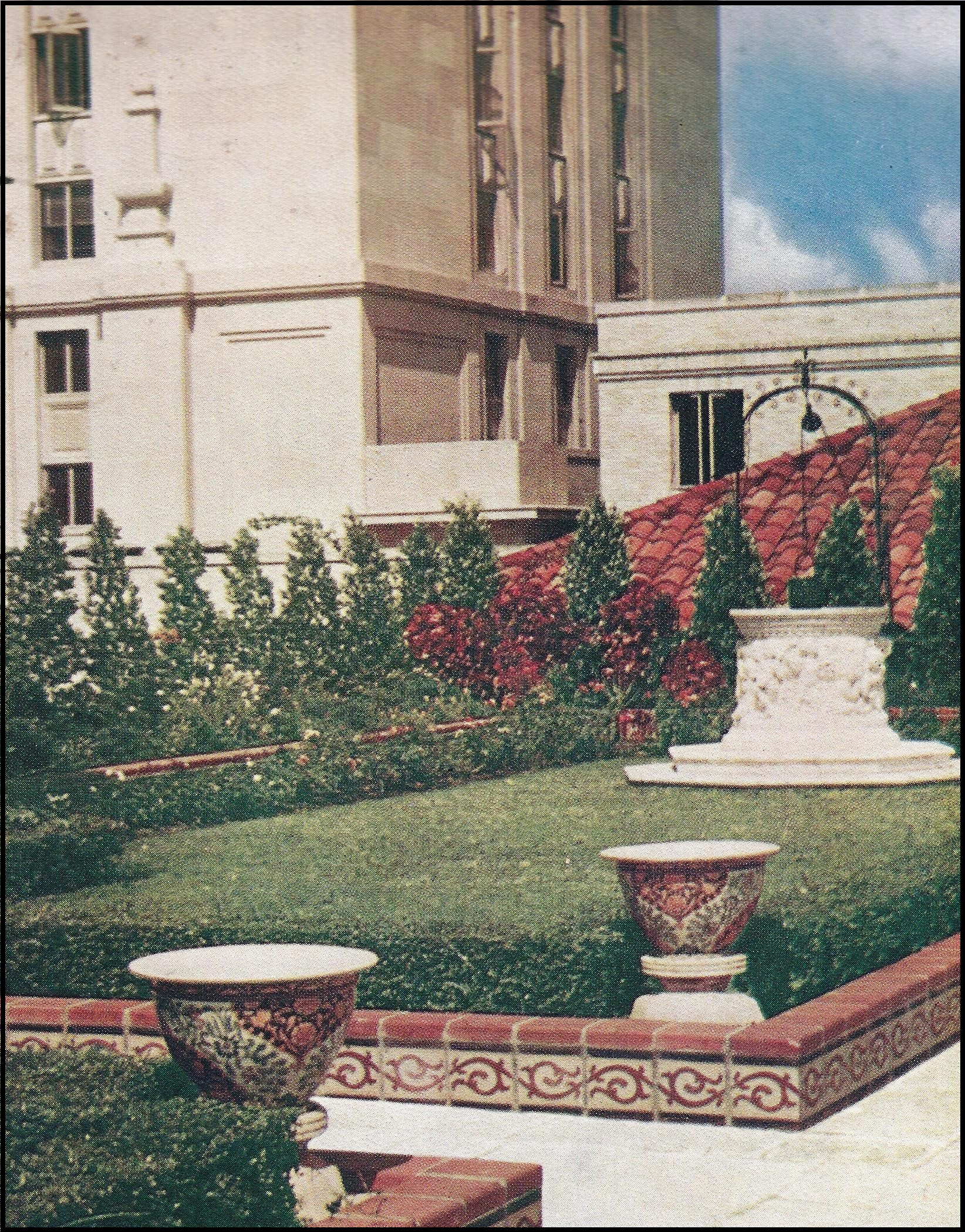
Along with rooms for the libraries, roof gardens were installed on the east and west sides. The east garden (photo at right), accessible from the Stark Library, boasted a single-piece white marble wishing well, intricately carved by Italian artist Aristide Petrilli in 1914. Visitors often tossed coins in the well, and the money was used to benefit the collection.
The following day, Ratchford was again walking to work and discovered a second box turtle near where she had found the first one. This was a female – the other’s mate? Ratchford decided to place the second turtle in the garden. If the pair weren’t already mates, they quickly became best friends as they were always seen together, browsing on the grass around the wishing well or on the flowers elsewhere in the garden. The library staff sometimes shared part of their lunches with the turtles as well. Ratchford dubbed the two Adam and Eve.
The turtles remained in the roof garden for some 30 years before they mysteriously disappeared – some fear turtle-napped – in the mid-1960s. Other turtles have lived in the garden, including a rather shy one called Epicurious who loved to eat figs provided by one of the librarians. In the 2000s, the roof gardens needed a renovation as moisture was leaking onto the ceiling of the floor below, and the turtles were moved to the biological ponds.

H-2-Orange
In July 2010, UT President Bill Powers and co-founders of the GSD&M advertising firm Steve Gurasich and Tim McClure announced a partnership to sell “H-2-Orange,” purified water packaged in a bottle that resembled the Tower. With the advertising slogan “Drink water. Bleed orange. Fund scholarships,” forty percent of the profits were destined to support scholarships and internships for UT students.
Critics pointed out that the bottles weren’t environmentally friendly, but H-2-Orange and its Tower bottle was soon found in the grocery stores around Austin, in vending machines on campus, and sold at UT Athletics events. Sales continued for about a decade before it was discontinued.

 The UT History Corner