
Above: Yale vs. Princeton on Thanksgiving Day, 1893, at the Polo Grounds in New York City. More than 40,000 attended the contest, including the fans who paid to sit on Coogan’s Bluff in the distance. At the moment this photograph was taken, the UT football team was playing its first-ever game in Dallas.
“Well, the foot ball fever has struck Austin at last,” declared the Austin Statesman in December 1893. For years, local citizens had been reading newspaper and magazine articles about a game called “foot ball” that had become wildly popular in the northeastern United States. “The game has taken a high place in the affections of the American undergraduate,” reported Century Magazine in 1887. “In the three colleges in which it is played most successfully, Yale, Harvard, and Princeton, the undergraduates would give up base-ball more willingly than foot-ball.” An Americanized version of the British sport rugby, spectacular contests between city or college teams drew enormous crowds. An annual Thanksgiving bout between Yale and Princeton had escalated to the point that it was played on neutral turf, at the Polo Grounds in New York City, in front of forty to fifty thousand spectators. Finally, on the sunny Saturday afternoon of December 16, 1893, the people of Austin were going to witness a genuine, bona-fide, actual-factual football game for themselves, as the University of Texas hosted the San Antonio Foot Ball Club.
~~~~~~~~~~
Technically, football had already been seen in Austin, though it better resembled the sandlot variety. In December 1883, less than three months after the University of Texas had formally opened, a group of UT students decided to have a football game. They were inspired, in part, by the reports of the Thanksgiving Day contests back East. With no other team available, one of the would-be players – law student Yancey Lewis – arranged a match with the Bickler School, a private preparatory academy in downtown Austin. Lewis had been a tutor at Bickler before he enrolled at the University. In a week, both schools had to form teams, learn the rules, and practice. The game was held on a less-than-ideal patch of pasture land near the present day Blanton Museum of Art. No one on the field had actually seen a football game, and there certainly weren’t any refs available to enforce the rules. No matter. Both sides muddled through, though when it was over, the Bickler School was victorious, two goals to none. And poor Yancey Lewis had suffered the worst of it at the hands of his former students. For the rest of the academic year, UT lost all interest in football.
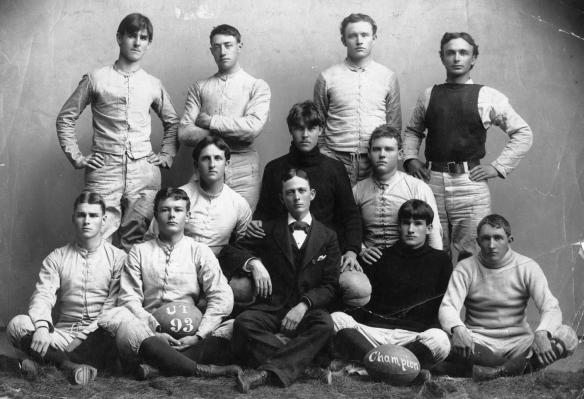
Over the next decade, football at the University was an on-again, off-again affair. Students would attempt an intramural game one year, then pass on it the next. Not until the fall of 1893, after men’s football clubs had been established in Dallas, San Antonio, and Galveston, did the University field its first “official” squad.

Above: The 1893 University of Texas football team.
The team’s debut was an away game against the undefeated and heavily favored Dallas Foot Ball Club on Thanksgiving Day, November 30, 1893. The University was a last-minute substitute for the Little Rock, Arkansas men’s club, which was unable to make the trip to Dallas. Instead, the UT squad and a group of supporters took the train north, and in front of 1,500 fans, pulled off an 18 – 16 upset. “Our name is pants and our glory has departed,” griped The Dallas Morning News.
Next on the schedule and just over two weeks later, on December 16, the San Antonio Foot Ball Club arrived in Austin to take on the University team.
~~~~~~~~~~
Football practice was held on the northwest portion of campus, where the Texas Union building currently stands, but the field wasn’t of the quality desired for a formal game. Wanting to be good hosts, the UT team acquired access to the professionally groomed fields at the new Zoo Park, just west of town at what is today the Lower Colorado River Authority (LCRA) complex next to the Tom Miller Dam. (If you’ve eaten at the Hula Hut restaurant, the fields would have been just across the street.)

Above: The original 1893 Austin Dam, replaced by the Tom Miller Dam in 1940. Zoo Park fields were across the street from the dam’s turbine generators, seen on the right.
In the summer of 1893, the city celebrated the opening of the ambitious Austin Dam. Made of granite, 60 feet high, and nearly 1200 feet long as it stretched across the Colorado River, it was at the time one of the largest dams in the world. The dam brought with it the promise of reliable electric power for the city and a potential economic boon. It also created a lake. Dubbed “Lake McDonald” for Austin Mayor John McDonald, who had convinced the city to build the dam, the lake offered novel recreational opportunities, including rides on a steamboat christened “Ben Hur.” Docked next to the dam, the boat – and the lake itself – soon became a popular getaway spot for the city. Within months, the surrounding acreage saw new development. Businessman Dick Bulian opened Bulian’s Garden Saloon and Picnic Grounds, a small zoo with Texas wildlife was accompanied it (though details are sketchy), and an athletic field was created, primarily for the Austin city baseball team, but used for other sporting events as well.
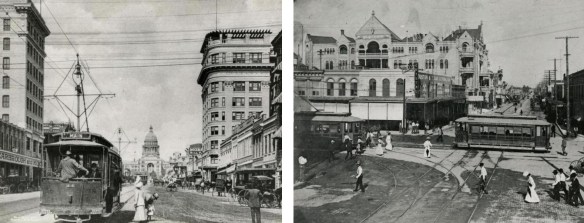
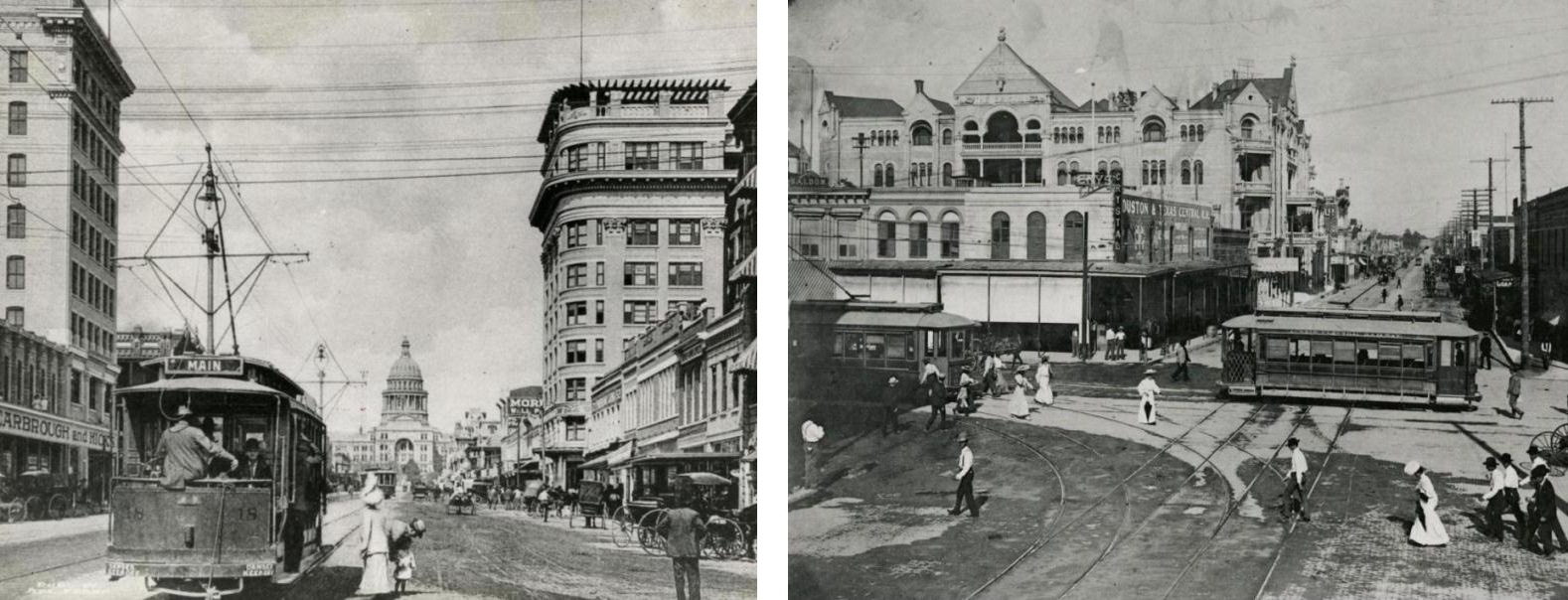
Public transportation to Zoo Park was provided by the Austin electric trolley system, which, thanks to the dam and its electric power, replaced the slow, mule-drawn streetcars. A special line ran west on Sixth Street and out along what is today Lake Austin Boulevard to deliver visitors to the dam and nearby attractions.

Above: Looking across the Austin Dam. The steamboat Ben Hur is docked on the left (where the Hula Hut restaurant can be found today) and the power house on the right. The Zoo Park athletic field was behind the power house. Poorly engineered and constructed, the Austin Dam failed in 1900 and was replaced in 1940 by the Tom Miller Dam, which created present-day Lake Austin. Click on the image for a larger view.
Below: The Austin electric trolley system was, in part, a result of electric power supplied by the Austin Dam. On the right, at the corner of Sixth Street and Congress Avenue, the tracks turned on to West Sixth and continued out along today’s Lake Austin Boulevard.
For more info, UT history professor Bruce Hunt has written about the Austin Dam here, and the city’s electric trolley system here.
~~~~~~~~~~
As most of Austin had never seen a football game, the day was full of surprises for the uninitiated. A few hours before the 3 p.m. start time, traffic picked up on the unpaved road out to Zoo Park. Additional trolley cars were added to accommodate the demand, which joined a steady caravan of horses and carriages, all full of people excited to see see the game. “The broad boulevard was alive with carriages and vehicles of varied types, all moving in the same direction,” reported the Dallas Morning News.
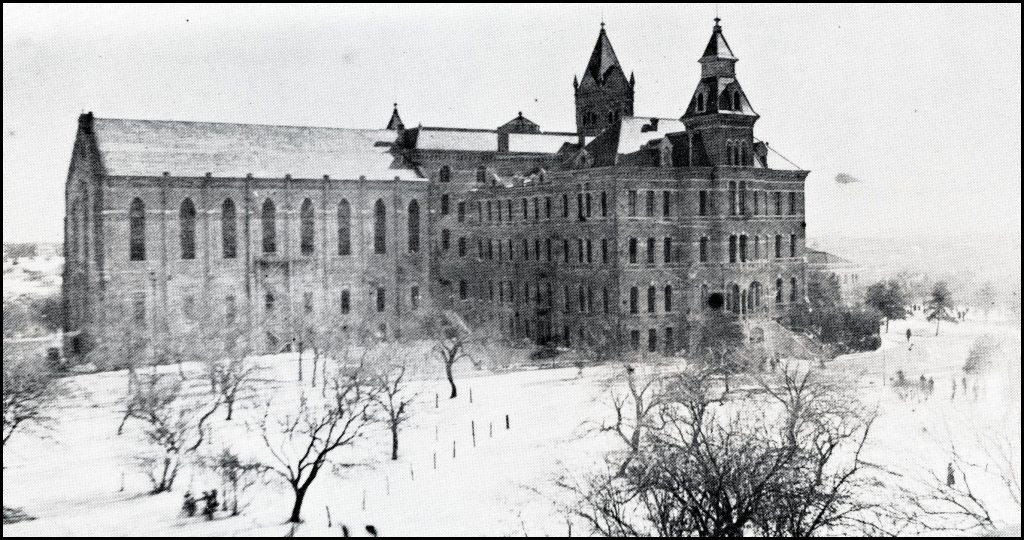
The University colors were everywhere. Ribbons were worn on lapels, tied on to canes, wrapped around hats, decorated horses, and woven into the wheels of carriages. But they weren’t the burnt orange seen today. In the 1890s, all four of UT’s buildings were constructed of pale yellow pressed brick and limestone trim. From a distance, the campus appeared gold and white, and the students decided to adopt the colors for the football team. While the official hues were listed as “old gold and white,” the ribbons were various shades of yellow. (How UT chose orange and white as its colors is here.)
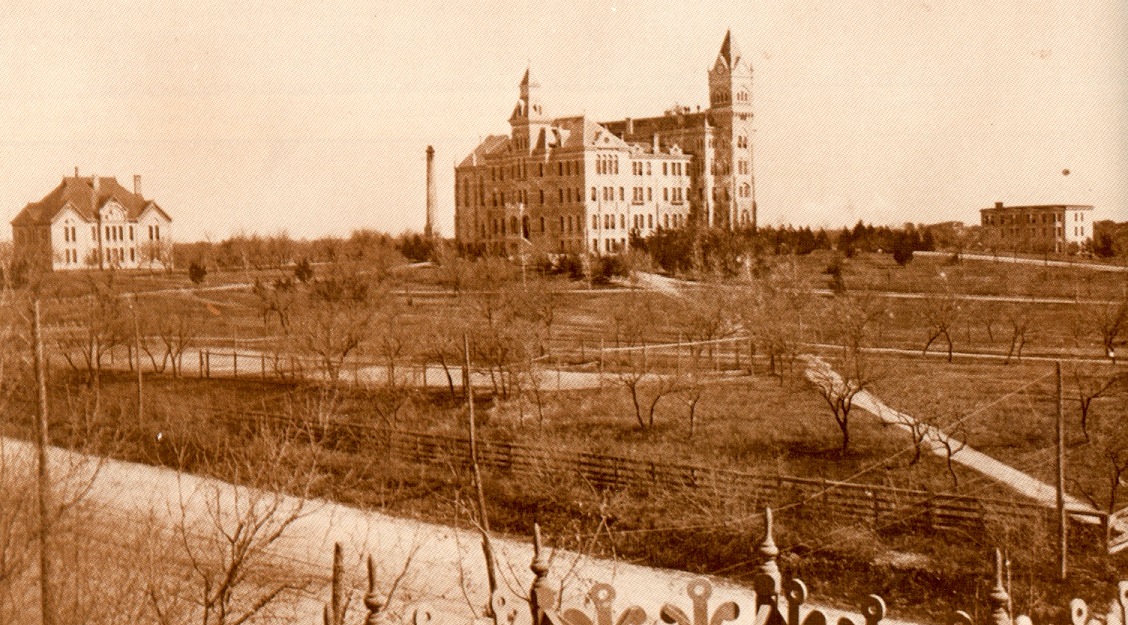
 Above: The UT campus in the 1890s, as seen from the southwest at the corner of Guadalupe and 21st Streets. From left, the Chemistry Lab building, smokestack of the small power plant, two-thirds of the old Main Building, and B. Hall, the men’s dorm. All were made from yellow pressed brick and limestone trim. The wooden fence along the perimeter kept out the local town cows. Click on the image for a larger view.
The Zoo Park field wasn’t equipped with bleachers. Instead, the crowd stood around the sidelines and jockeyed for the best views. Texas Governor James Hogg was among the spectators, though he remained atop a high spring wagon and enjoyed the game from its height.
As the masses grew, so did the noise. University supporters repeatedly broke into the ‘Varsity Yell, at the time UT’s first and only cheer:
Hullabaloo!! Hoo-ray! Hoo-ray! Hullabaloo!! Hoo-ray! Hoo-ray! HOO-ray! HOO-ray! Varsity! Varsity! U! T! A!
Each yell was followed by an onslaught of tin horns. The vuvuzelas of their time, tin horns were generally children’s toys, occasionally heard at parades. But UT students had brought them en masse to the game, and the commotion was more than an unnamed Austin Statesman reporter could bear. In his account of the day, the calm of the field was constantly interrupted by the “ungodly snort of the asthmatic tin horn.” That women students were using them defied all sense of social convention and certainly wasn’t considered ladylike. “The way some of those girls did blow was a caution,” continued the reporter. “With cheeks puffed out and eyes starting they tooted and tooted, at the same time putting unlimited confidence in the garments which so tightly fitted their trim figures. How the strain was stood in several instances is a mystery to the masculine mind.”
 A few minutes before the start, the University and San Antonio teams entered the field and were greeted by another round of cheers and horns. The players were all outfitted with the standard uniforms recommended by Spalding’s Official Guide to Football, then the sport’s most trusted reference. Along with a long sleeved jersey, according to the Guide, “the ordinary player should wear a canvas jacket … home-made or purchased … and lace up in front so that it can be drawn quite closely.” Trousers were to made of some “stout material” and well-padded, “quilting in soft material over the knees and thighs.” Long woolen stockings were often covered with shin guards, and leather shoes – “kangaroo skin preferably” – which were provided with a replaceable leather spike to prevent slipping, completed the outfit. Naturally, Spalding’s sold the equipment for a nominal fee.
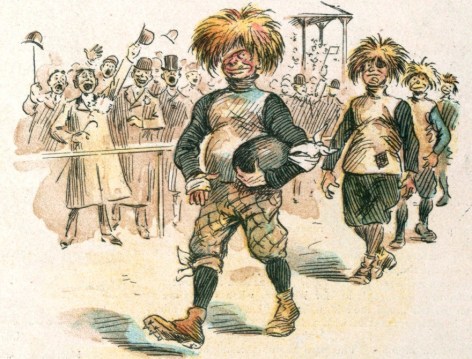
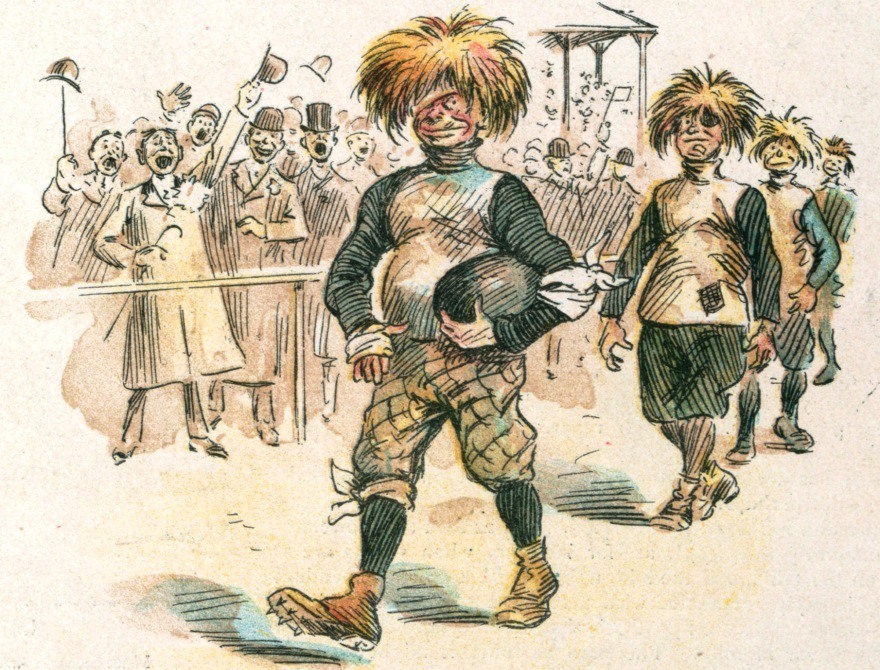
A glaring omission from the uniform was something to shield the head. While a few players strapped nose guards over their faces, most went without any protection. Instead, they grew their hair longer, and at game time wrapped bandages around their heads and over the tops of ears (to prevent ears from being pulled and torn), which pushed the hair up into a mop. The mat of hair was supposed to be sufficient cushioning to prevent severe injuries.
As football became more popular and college players grew their hair, the style became a trend. “Long hair the rage. The football players have set the fashion,” was the title of an 1893 article by the Dallas Times Herald. “An epidemic of long hair is upon us,” though it cautioned that not all who sported long hair were footballers. “The football man with his flowing locks is the hero of the hour, and so every young man must needs let his hair grow in the hope of making people think that he, too, is a leader on the gridiron field of mud and glory.”
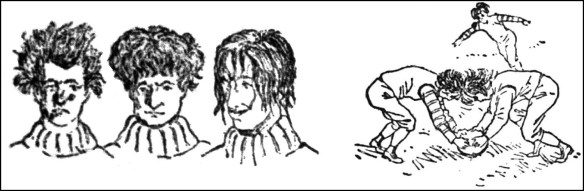
Above: From the Dallas Times Herald, “scrubbing brush, chrysanthemum, and mop varieties” of football hair styles, as well as an illustration on the “practical advantages of hair padding.” UT players preferred the chrysanthemum.
Below: An 1894 issue of Puck, a humor magazine published in New York City, ran a cartoon spoof on football players and their hair pushed up in to mops.
Heavy traffic out to the park delayed the arrival of the two referees by a few minutes, but the game was ready to begin at quarter past the hour. The San Antonio team won the coin toss and chose to take the ball. Unlike a modern kick-off, play simply commenced in the middle of the field. San Antonio led off with a flying wedge and gained 12 yards on the first play.
The flying wedge, a popular mass movement play introduced by Harvard in 1892, was used by both teams. As with many early football plays, it was inspired by war tactics. In this case, the wedge took its cue from Napoleon’s use of a heavy concentration of military force upon a single point of the enemy line. Ten men, tightly lined up in a “V” formation, ran full speed against a single defensive player across the line of scrimmage. The ball carrier was protected behind the “V.” In later years, the wedge was deemed too dangerous for football, especially when the players weren’t wearing headgear.
While San Antonio was successful early, it didn’t last. The UT players employed their own wedge – so effective in their upset victory against Dallas two weeks before – and scored two touchdowns in the first half. At the time, touchdowns were worth five points, with an extra point kicked afterward. At halftime, it was UT 12 and San Antonio 0.
The second half didn’t fare any better for the visitors. “At a glance, the most inexperienced eye saw that the ‘varsity men far outclassed their antagonists,” observed the Dallas Morning News. (The term ” ‘varsity,” with an apostrophe, was a commonly-used contraction of the word university.) Repeated fumbles by the visitors cost them two safeties, worth one point each. On the rare occasion when San Antonio captain Jack Tobin found himself with the ball and was running upfield, he was almost always stopped by UT co-captain Paul McClane. As the News reported, “before [Tobin] traversed three yards, Paul McClane tackled him and incontinently sat on his head til his compressed lungs, all filled with fine sand, could sound the wail of surrender – ‘down’.”
The University scored two more touchdowns, but extra point kicker Ad Day “seemed to have lost his rabbit’s foot,” as both of the kicks went wide left. In the waning seconds of the game, despite a valiant defensive effort by San Antonio, UT half back Dick Lee “made a pretty run, and by excellent interference and much shoving, reached the goal line just between the posts, and touched down again amid yells and horn music.” Day found his footing again, and made the extra point. The University had scored five touchdowns, three extra points, and two safeties, and defeated the San Antonio Football Club 30 – 0.
Governor Hogg remained an interested spectator throughout, and “cheered the boys when a telling play was made.” After the game, the governor was the recipient of both the game ball and an “impromptu oration” by the crowd. But the Austin Statesman reporter was through. Football was just to loud.
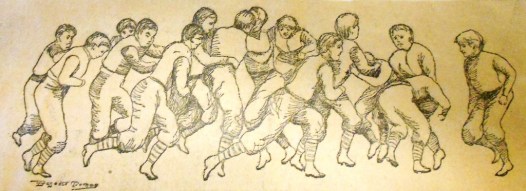
Above: Running interference for the ball carrier. From the Dallas Morning News.
Photo sources: The image of the 1893 UT football team and photos of the Austin electric trolley system were found at the Portal to Texas History web site produced by the University of North Texas, while the images of the Austin Dam can be found at the Lower Colorado River Authority’s Online History Center.


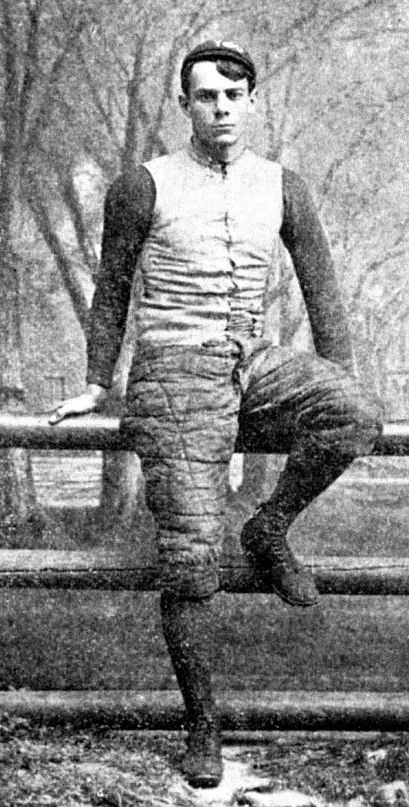
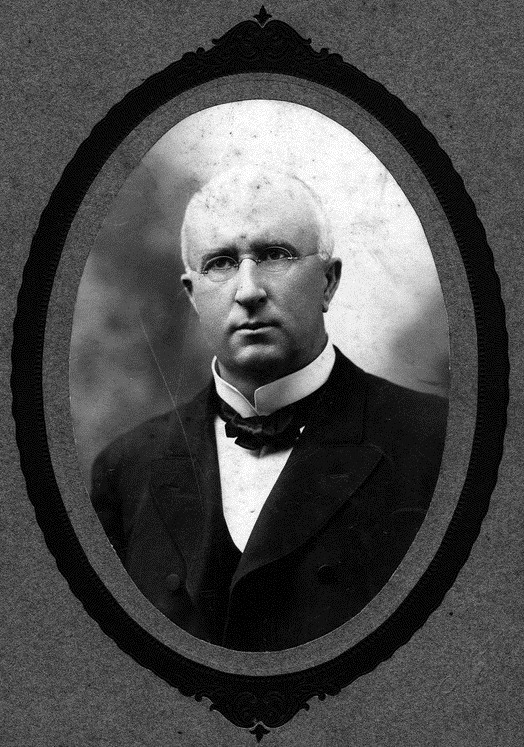 George T. Winston (photo at left) was appointed UT’s first full-time president in 1896, succeeding Leslie Waggener, who was then both Chairman of the Faculty and President ad interim. In the spring of 1897, Winston received a request from the students who believed that March 2nd, Texas Independence Day, should be an annual University holiday.





 The UT History Corner