Garrison Hall is 90!

garrison-hall-1926

Above: Garrison Hall, just before it was opened in 1926.

This year, Garrison Hall is 90 years old. Nestled in the southeast corner of the Main Mall, peeking out from behind a canopy of live oaks, the building is often overlooked in favor of its better-known neighbors, Battle Hall and the UT Tower. But Garrison Hall is an architectural gem with a distinctive history, a treasure on the campus for those who take the time to explore it.

~~~~~~~~~~

ut-campus-1920

Above: The University of Texas campus from University Avenue, circa 1920. 

In 1921, a crowded and growing University of Texas first acquired land beyond its original forty acres. A bill passed by the Texas Legislature and signed by Governor Pat Neff purchased property to the east and southeast. The campus tripled in size, and extended past Waller Creek.

The following year, the Board of Regents appointed Herbert Greene of Dallas as the University Architect. Greene succeeded Cass Gilbert, who had designed Battle and Sutton Halls, but because he was based in New York City, was a victim of mounting political pressure to have an in-state architect for the University. Greene was highly respected as a building designer, but his experience in campus planning was limited. In 1923, the regents recruited James White, an architecture professor at the University of Illinois, as the consulting architect who would provide an overall campus master plan.

White submitted his first campus scheme in fall of 1924. Eager to take advantage of the long, gently sloping hill that extended east into the new portion of the campus, White proposed a significant re-orientation of the campus, to face east instead of south toward downtown Austin, and designed a single mall, 175 feet wide, that connected the crest of the hill at the center of the Forty Acres – where the old Main Building stood and where the Tower is today – with Waller Creek at the bottom of the slope. Campus structures were arranged in a series of concentric rings that spread outward from the hilltop.

1924-10-18-john-white-ut-campus-master-plan

Above: John White’s 1924 campus master plan, which would have emphasized an east-west orientation. On the left, Battle Hall would have been enlarged and become the focus of a large square, while a broad East Mall would have continued down the hill to the right toward Waller Creek. The football stadium is at the bottom right. Below: The future position of Garrison Hall is circled. It was changed to an L-shaped building to help define the edge of the central square and the East Mall. Click on an image for a larger version.

1924-white-campus-plan-garrison-hall-placementWhite envisioned the University Library (today’s Battle Hall) as the focus of the campus, removed the Old Main Building entirely, and replaced it with a large square plaza, 450 feet long on each side. The library was to be enlarged so that its façade was roughly three times the length of the original building, and would be centered on the plaza’s west side. Across the plaza on the east end, two buildings were planted as part of the first concentric ring and also intended to visually define the width of the mall.

Surprisingly, the Faculty Building Committee, the University President and the Board of Regents all approved this radical new design, with a few important alterations. The two buildings immediately to the east of the central plaza, instead of being part of a circle, were retooled as L-shaped structures. One was to be placed near the southeast corner of the plaza and face the library; its north-south wing would define the limit of the plaza, while it east-west wing would define the boundary of the mall. As its counterpart, another L-shaped building was intended to be near the northeast corner of the plaza.

Once White’s campus plan was ratified, the regents declared a new classroom building (and a new home for the history department) its top priority, and directed the building planned for the southeast corner of the plaza to be constructed first.

garrison-hall-from-ut-tower-deck

Above: Garrison Hall seen from the UT Tower observation deck. 

Almost immediately, though, the administration began to have second thoughts. William Battle, Chair of the Faculty Building Committee, wrote to White, “The University has been facing Austin and the Capitol so long that it would not be easy to abandon this front even if it were thought desirable.” Within a year, the regents concurred, rescinded their decision, and asked White to try again. But the process for the new structure was well underway, and rather than wait for a new scheme, construction was allowed to continue. The building’s odd placement – it doesn’t line up with the entrance to Battle Hall or the flagpoles on the Main Mall – would be an issue for future campus planners.

~~~~~~~~~~

view-from-garrison-hall-1920sOpened in 1926 at a cost of $370,000, Garrison Hall was host to a collage of academic departments; English, government, psychology, sociology, philosophy, economics and history initially shared the facility, though the building was really always intended for history, and the other departments have since found lodgings elsewhere on campus. The building’s namesake, George P. Garrison, joined the University faculty in 1884, served as the first chair of the history department, and was a founding member of the Texas State Historical Association.

Above: The 1920s view of the campus from the north side of Garrison Hall. Old Main is on the right, with the library (Battle Hall) across the mall. Click on image for a larger version.

1925-garrison-hall-cornerstone-ceremonyThe cornerstone, as with the cornerstones of most of the buildings on the Forty Acres, is hollow, something like a permanently sealed time capsule. Among the objects placed inside: a 1925 Cactus yearbook; a catalog, course schedule, and student directory for the 1925-26 academic year; an alumni directory, copies of The Daily Texan; a souvenir “Book of Views” of the University; a source book on the history of Texas; and articles and letters authored by George Garrison.

Right: Images from the cornerstone ceremony in December 1925.

Along with its unusual location, Garrison’s ornamentation also represented a departure from earlier UT buildings. Classical icons adorn architect Cass Gilbert’s Battle and Sutton Halls. Owls, an ancient symbol of Athena, the Goddess of Wisdom, were placed under the eaves of Battle Hall, while Sutton Hall was decorated with scallop shells, emblematic of Venus, the Goddess of Truth and Beauty.

garrison-hall-longhorn-skull

garrison-hall-austin-windowGarrison Hall continued the same Mediterranean motif of Gilbert’s designs, constructed of Lauder limestone quarried from France, multi-colored bricks similar to Sutton Hall, and a red-tile roof imported from Spain. Its ornamentation, though, is unmistakably “Texan.” Limestone carvings of longhorn skulls, along with terra-cotta cacti and bluebonnets decorate the entrances. Imprinted below the eaves and corner windows are the names of founders of the Republic of Texas, among them: Houston, Austin, Burnet, Jones, Travis, and Lamar.

Above: The names of the founders of the Republic of Texas appear on the building, along with 32 cattle brands. Here is the “W” of the King Ranch.

Most striking are the 32 terra-cotta cattle brands, carefully chosen among hundreds of candidates, to represent various periods of the cattle industry in the State of Texas. Garrison Hall is the only college building anywhere to have cattle brands on its outer walls. The unusual choice received national press while the building was under construction.

garrison-hall-cattle-brands-st-louis-times-dispatch

Above: The inclusion of terra-cotta cattle brands on a college building to mark the history of the Texas cattle industry received national press. This is a clipping from the Saint Louis Times-Dispatch.

The idea came from Dr. William Battle, then chair of the Faculty Building Committee. Though he was, ironically, a professor of Greek and Classical Civilization, Battle claimed not to be “stuck on” classical icons for UT buildings, and suggested the use of images that pertained to the academic departments housed inside them.

garrison-hall-linoleum-tileInside, more than 3,500 square feet of linoleum tile was used in the extra-wide hallways. Greene advocated using “battleship green,” but Battle was concerned that the color wouldn’t hide the dirt, scuffing, and general wear as well, and preferred brown. In the end, a compromise was reached, and both colors were used. Rooms were equipped with ceiling fans, and a modern water cooling system was installed for the drinking fountains to make the un-air conditioned building bearable in the warmer months.

~~~~~~~~~~

garrison-hall-1930s

Once opened, the broad arched doorway on the north side of the building soon attracted a population of bats, and the attention of Goldwin Goldsmith, then the head of UT’s Department of Architecture and for whom Goldsmith Hall is named. A brief letter exchange between Goldsmith and Battle, found in the University Archives, reads:

October 28, 1931

To: Dr. William Battle, Chairman, Faculty Building Committee

Dear Dr. Battle:

I noticed that the north entrance to Garrison Hall is a harboring place for bats. It is evident to the senses of both sight and smell.

Goldwin Goldsmith

~~~~~

November 8, 1931

My dear Goldsmith:

Thanks for your letter about bats. I do not see how to protect entrances from these loathsome creatures, but Miss Gearing tells me that the Comptroller’s office has an excellent way of dealing with them. It is apparently by using fire extinguishing apparatus.

Yours very truly,

W.J. Battle

~~~~~~~~~~

Paul CretPaul Cret (photo at right), appointed in 1930 to replace James White as consulting architect, developed his own campus master plan, which included the Main Building and Tower, and attempted to resolve the issue of Garrison Hall’s placement. Born in Lyon, France and trained at the Ecole des Beaux-Arts in Paris, Cret has immigrated to the United States and oversaw the architecture school at the University of Pennsylvania when he was hired by UT. With an emphasis of straight lines and balanced masses, he placed the flagpoles on the Main Mall to line up with the entrance of Battle Hall.

To anticipate future growth, Cret suggested adding wings to existing structures, rather than construct new buildings in open areas that might disturb the layout of the campus. Garrison Hall was included in the idea. Though not implemented (at least, not yet), Cret envisioned a north wing to Garrison Hall that would allow its main entrance to be re-positioned where it would still be in the center of the front façade, and also line up with Battle Hall.

paul-cret-1933-master-plan-1

Above: A bird’s eye view of Paul Cret’s campus plan, with a close-up of the Main Mall. To plan ahead for growth, Cret advocated adding wings to the W.C. Hogg Building and Garrison Hall. This wouldn’t disturb the overall plan – actually, it better defined the start of the East Mall – but the wing to Garrison would also allow the front door to be moved to the north and centered with Battle Hall and the flag poles.

Below: A closer look at the W. C. Hogg Building on the left with a wing extending south, and Garrison Hall on the right with an addition to the north and its front entrance relocated.

cret-campus-plan-garrison-hall

Source: Detail from 1933 University of Texas Perspective of Future Development, The University of Texas Buildings Collection, The Alexander Architectural Archive, The University of Texas Libraries, The University of Texas at Austin

garrison_hall-burnet

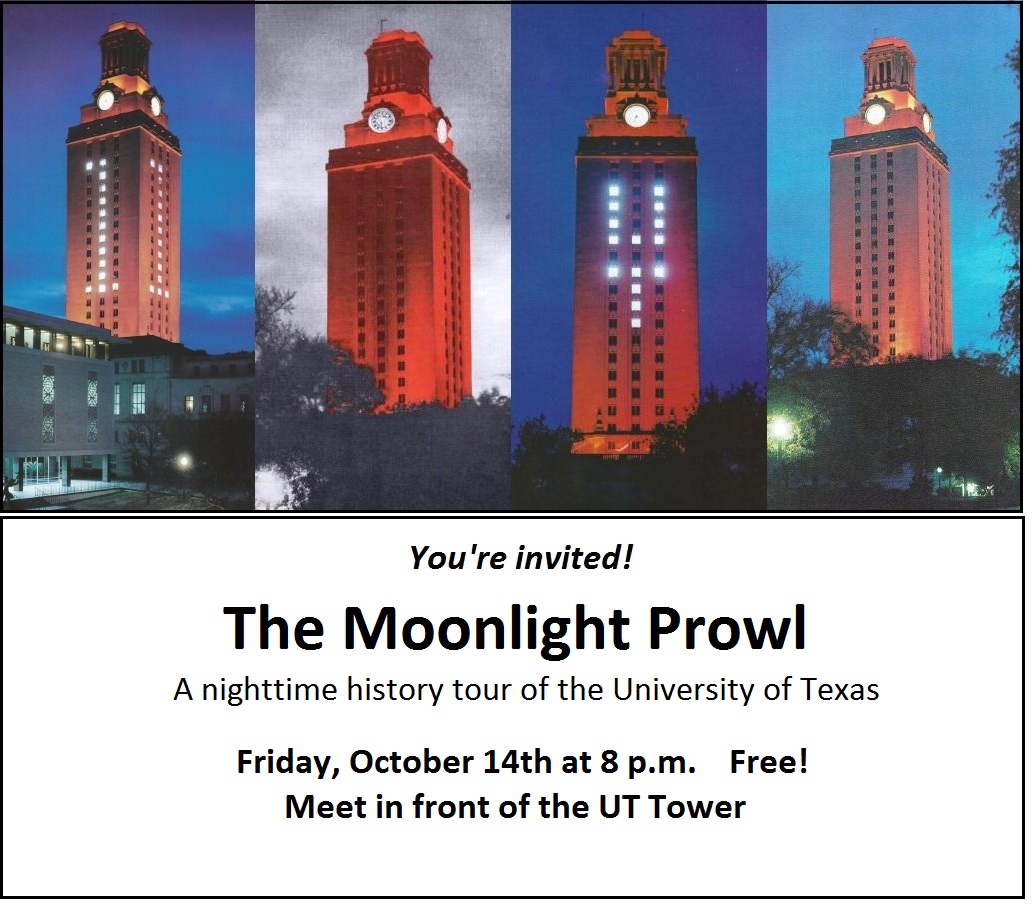
Moonlight Prowl on October 14th

moonlight-prowl-oct-14-2016

It’s been a busy fall semester for the Moonlight Prowl. Eight tours were held in September, including a group of 130 students and parents who gathered for a Prowl during UT’s Family Weekend. Several more are set for October.

The next “all-comers” Prowl – open to anyone interested – is scheduled for this Friday, October 14th, the night before the Texas vs. Iowa State football game. We’ll gather on the Main Mall in front of the Tower at 8 p.m.

For all the particulars, see the Moonlight Prowl information page.

RSVPs are appreciated, but not required. You can send me a quick note here, or RSVP via a Facebook event.

The weather forecast is for partly cloudy skies, and it’ll only be two days before the full moon. A great night to wander the campus and discuss some UT history!

Hope to see you October 14th,

Jim


Old Main.1910s.Postcard.2.

Above: The University’s old Main Building, where the Tower stands today.

The Inscription

main-building-quote

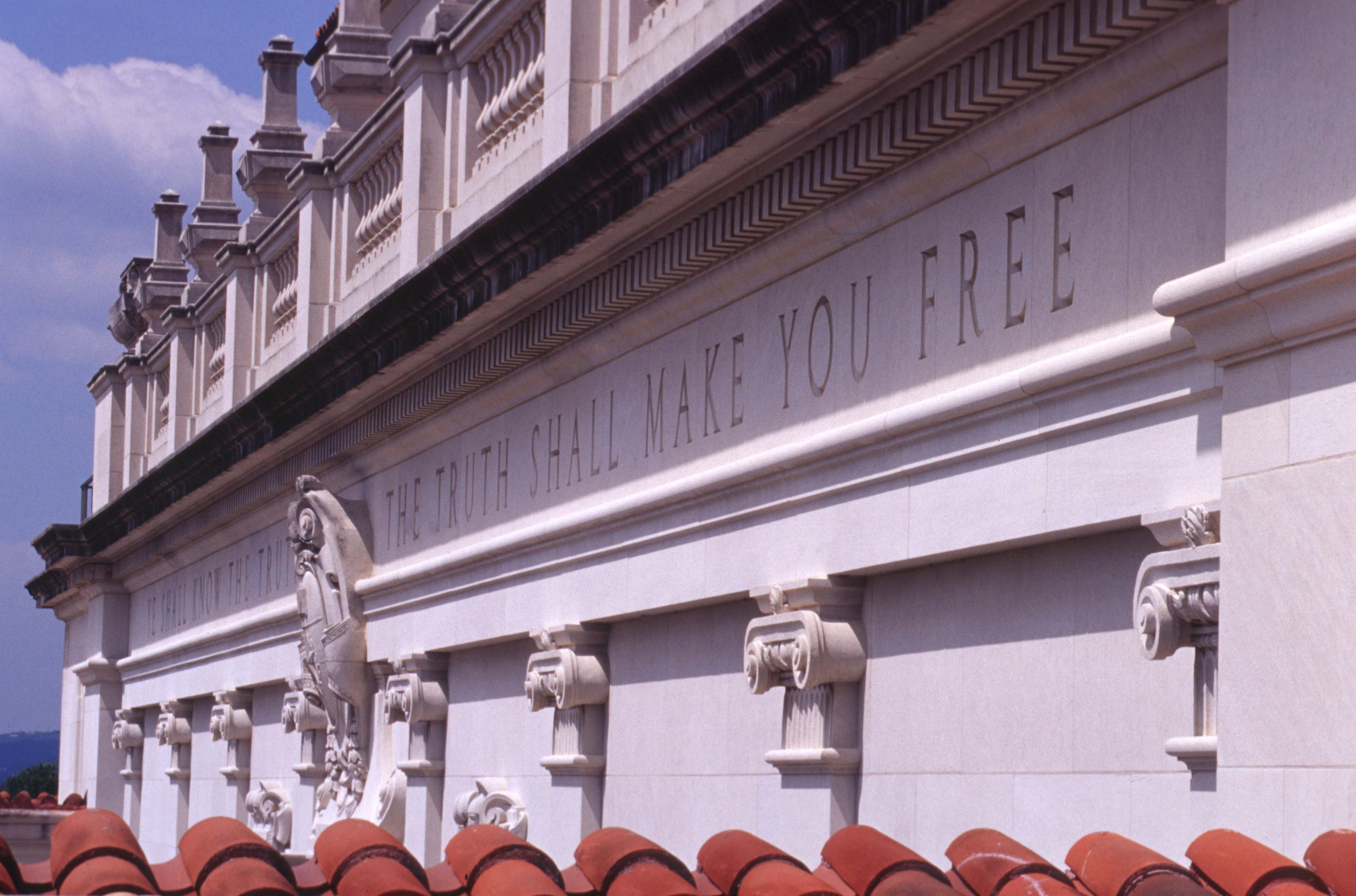
Above: Perhaps the most-read inscription on the University of Texas campus, “Ye shall know the truth and the truth shall make you free,” above the entrance to the Main Building.

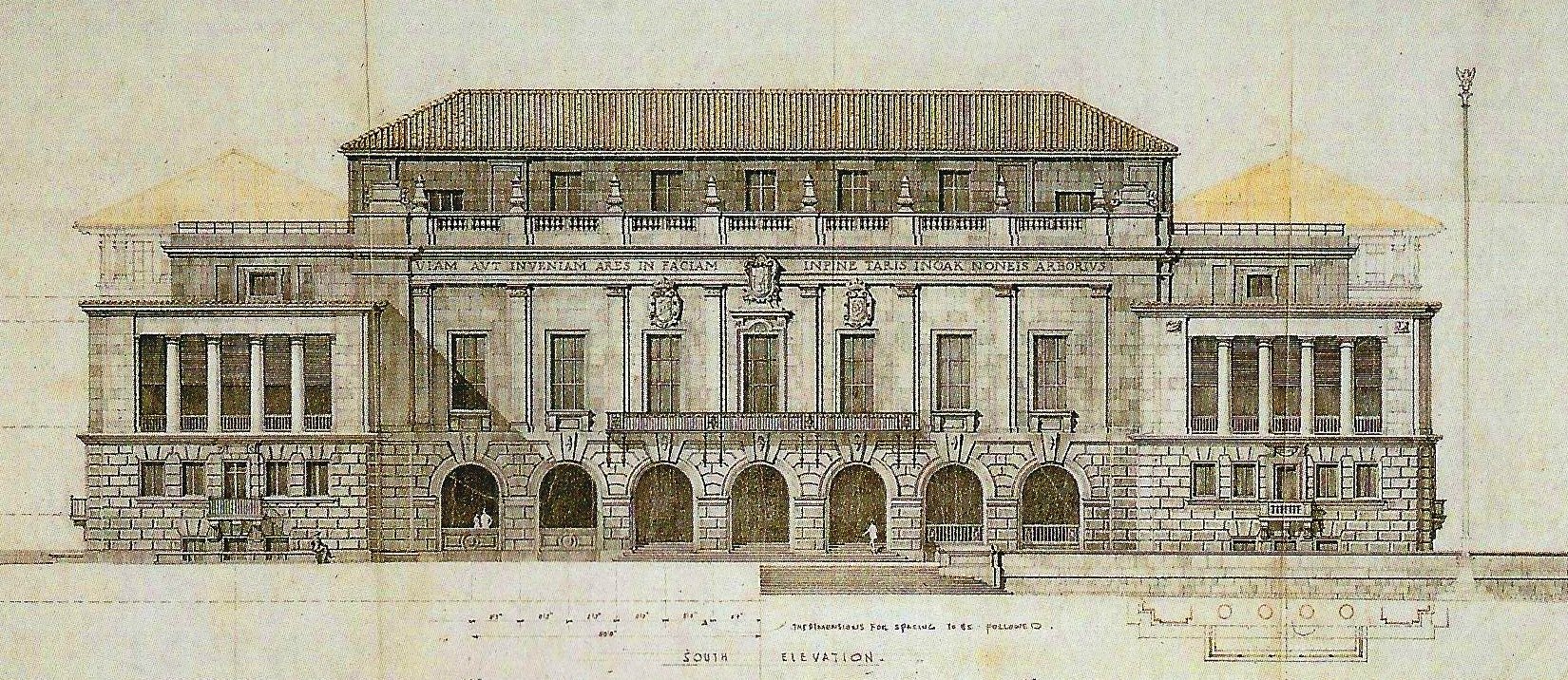
After much rumination,” wrote Dr. William Battle on April 10, 1935, “I suggest the following as an appropriate inscription for the front of New Library.” Battle chaired the Faculty Building Committee, and as the construction of the Main Building and Tower – which would serve as the University Library – was well underway, the committee needed to make decisions about some of the ornamentation. Specifically, the text for the signature engraving that would adorn the south façade of the building.

The choice was overdue. “I wrote you some time ago about the inscriptions for the Administration-Library building,” prodded architect Paul Cret the previous December, “and to determine the size of the letters, joining of the stones, etc., we need the ne varietur text of the frieze inscription of the south elevation.” The ne varietur, or “not to be altered” script could be up to 108 letters and spaces in length, either one sentence or two, though as the design called for the inscription to be divided by a rendering of the University seal in the middle, Cret advised that it would be “difficult to find two suitable sentences of the same length. We feel that a single sentence gives more leeway.”
main-building-facade

Above: The south elevation of the Main Building, designed by architect Paul Cret. Click on the image for a larger version. Source is listed below.
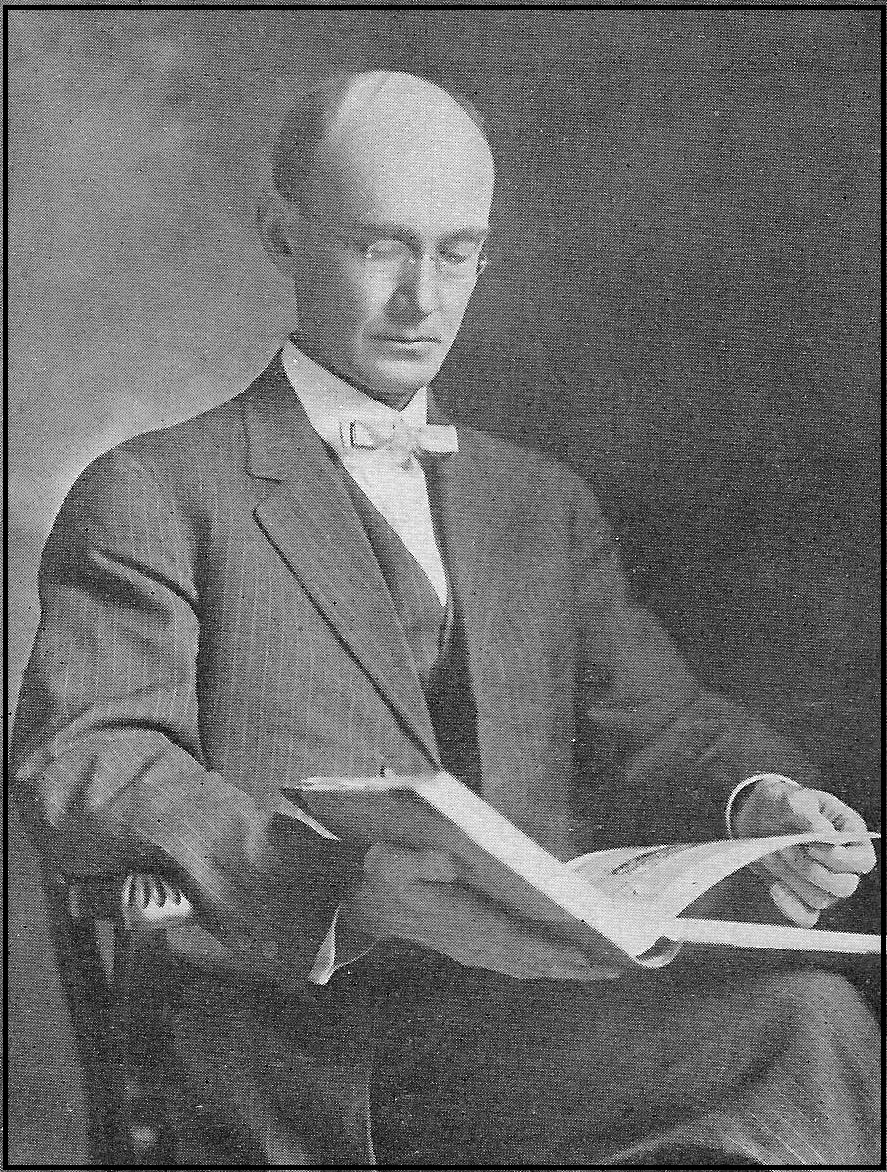
william-battleBattle, who had joined the faculty as a professor of Greek and classical studies in 1893, was highly respected on the Forty Acres. He’d served as Dean of the University (today’s Office of the Provost) and Acting President, created the UT seal, founded the University Co-op, and initiated a campus directory. His greatest contribution, though, was to chair the Faculty Building Committee from 1920 – 1948. Battle’s lifelong interest in architecture was almost as great as his fascination with Ancient Greece and Rome, and he took great care to ensure that the design of the campus and its buildings were both appropriate to their setting in Texas, and reflected the high aspirations of the University. When considering the text of the primary inscription on what was intended to be the iconic building of the University of Texas, Battle was not to be rushed.

His suggestion was:

“The records of the past shall give light and courage to them that come after.”

As Battle explained, “This seems to me to really convey the purpose of the Library and what should be its result. The words carry a formal, rather stately manner suggested obviously in the King James version of the Bible.” The sentence was Battle’s own creation, not a biblical quote, and he hoped it would evoke a similar gravitas. “The locution ‘them that come after’ by its ancient flavor ought to stick in the memory,” Battle explained.

The proposal garnered a less-than-enthusiastic response from the committee, but Battle had such stature and influence on the campus that many on the committee were reluctant to voice their opinions directly. Instead, they asked fellow committee member John Calhoun for help.
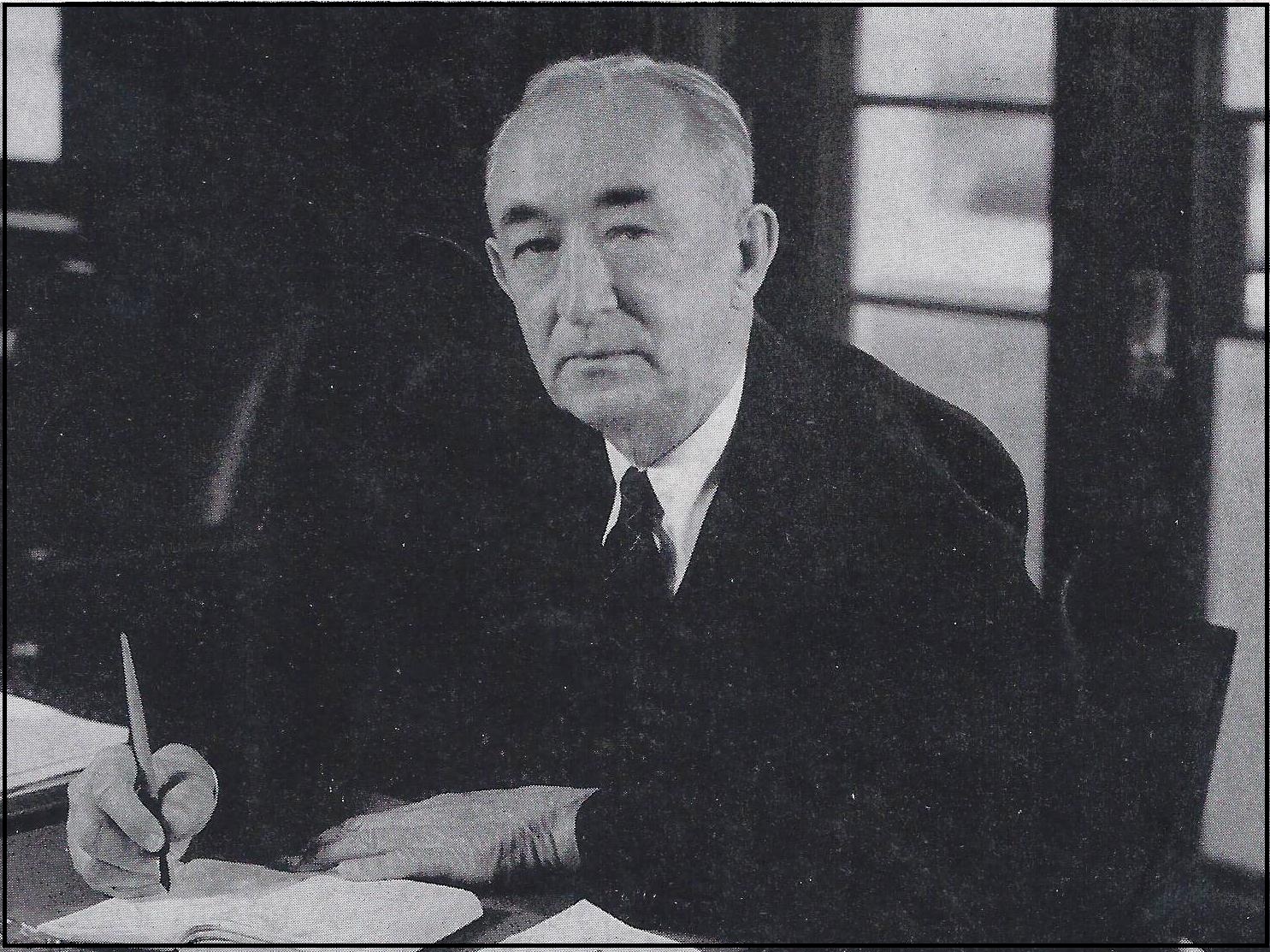
john-calhounA longtime friend and trusted colleague, Calhoun was a UT graduate who joined the mathematics faculty in 1909, was appointed the University’s comptroller in 1925, and later served as president ad interim. With a passion for oak trees, Calhoun was primarily responsible for the planting of live oaks around the perimeter of the Forty Acres, along the South Mall, and elsewhere on the campus. In the 1950s, he created a valuable detailed map of every campus tree and its history, still used by UT’s Office of Landscape Services. Calhoun Hall on the South Mall is named for him.

Calhoun penned a tactful letter to Battle. “After pondering for some little time over your suggested inscription,” he wrote, “I have tried my hand a little to see whether or not there might be some slight change made, keeping the idea, which I think excellent, intact. The reason that I think some change might be considered is the fact that in your inscription you say that ‘records’ shall give ‘light’, and while records are frequently enlightening it seemed to me that the metaphor is a little strained.”

Calhoun offered a few variations:

  • “The light of the past shall guide the feet and strengthen the hearts of them that come after.”
  • “The light from the past shall guide and hearten them that come after.”
  • “The light of experience is the guide and inspiration of the future.”
  • “Light of past ages shall illuminate the paths of the future.”

Battle appreciated the feedback, but was rather attached to his initial idea. He acquiesced a little and changed the phrase “shall give light and courage” to “shall bring light and courage,” but that was as much as he was willing to concede. In an effort to bring Battle around, Calhoun provided an alternative, “Ye shall know the truth and the truth shall set you free,” found in the Book of John in the Bible. The suggestion wasn’t meant to be a religious message; Calhoun simply thought it was an appropriate description of University students engaged with the library.

A month passed before Battle returned to the topic. “Had we not better be reaching some conclusion as to the inscription on the front of the Library?” he wrote the committee on May 14th. “It seems highly appropriate for the inscription to indicate the character of the building as a library.”
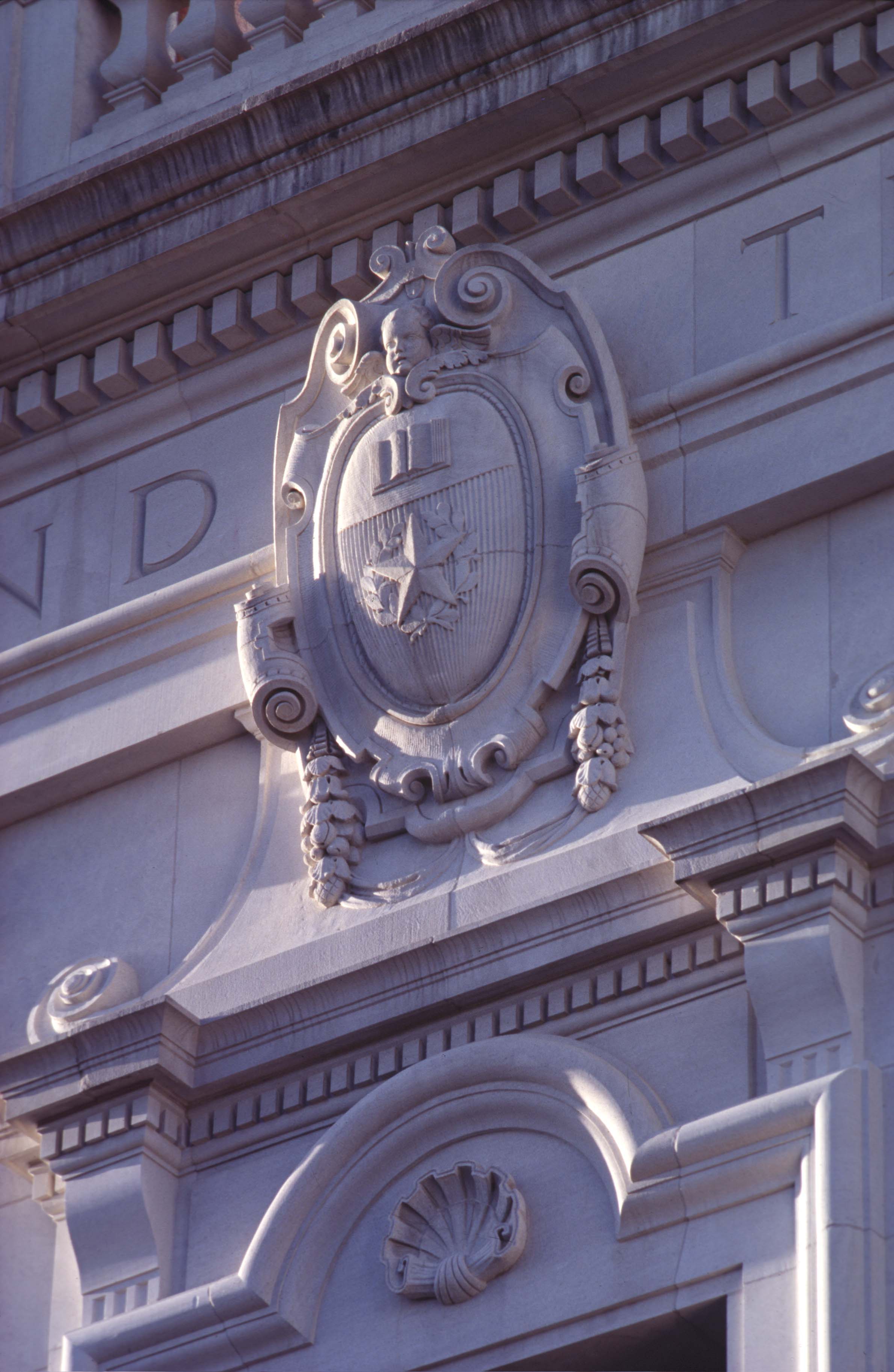
ut-seal-main-building-south-facadeBattle repeated his initial submission, but partially conceded,” I still think my first suggestion good, but I am not sure if the second is not after all preferable: Ye shall know the truth and the truth shall make you free, or, “Cognoscetis Veritatem et veritas liberabit vos.” The last was a Latin translation.

Battle continued, “Truth and freedom are so essentially the foundation of education, character, and progress that the injunction to seek truth as a means to freedom is as splendid a call to youth as we can make. Its form is perfect, its source is not a drawback, and it has the weight of nearly two thousand years acceptation.”

The biblical quote was brief, inspiring, and easily understood. And from a practical angle, it was composed of two clauses and twelve words, which fit well for the elevation design.

The committee met May 20, 1935 to make a decision. Battle handed each member a sheet of paper with three choices, though from the wording he seemed to still be encouraging his initial creation. The page read:

“W. J. Battle’s suggestion for the Library front inscription:

The records of the past shall bring light and courage to them that come after

Another suggestion:

Ye shall know the truth and the truth shall make you free

Or better:

Cognoscetis Veritatem et veritas liberabit vos

In the end, the committee favored the English version from the Book of John. With UT President Harry Benedict’s support, the Board of Regents gave its official approval on September 28th.
main-building-inscription-view-from-east

Source for Paul Cret drawing: Main Building and Library extension, Comm. 282, sk. no. 36, Paul Philippe Cret Drawings – Copyright held by H2L2 Architects/Planners, The Alexander Architectural Archives, The University of Texas Libraries, The University of Texas at Austin.