In the 1930s, the University built a one-of-a-kind planetarium.

 Few could claim to have moved the heavens, but Ernest Keller was one of them.
At his command, 4,000 stars in dozens of constellations were kindled. Nine planets and 26 moons stirred, then raced along their orbital paths. Brilliant comets with their long tails careened through the solar system. And all of it was sped up so that the events of a year could be viewed in a minute.
In the 1930s, under the guidance of Professor Keller, the University of Texas invented a planetarium unlike anything yet seen.
~~~~~~~~~~
 Astronomy at UT is as old as the University. The Board of Regents, at its inaugural meeting in November 1881, wanted an astronomy professor on the original faculty, but funding issues forced a delay. No matter. When the University opened two years later, physics professor Alex McFarlane and math professor George Halstead, teaching in the west wing of the old Main Building (photo at left), incorporated some astronomy topics in their courses. A few students took more than a passing interest, including William H. P. Hunnicutt, who was awarded a special Certificate of Proficiency in Astronomy by the regents in 1887.

Above: Brackenridge’s telescope gift was recorded in the handwritten minutes of the Board of Regents’ April 1896 meeting: “To the School of Physics – An equatorial telescope, five inch object glass, mounted on a tripod.”
A decade later, in the spring of 1896, Regent George Brackenridge of San Antonio presented the UT physics school with a five-inch refracting telescope mounted on a tripod. “Now that we are provided with the means for work, why not organize such a class?” urged the Alcalde, a student newspaper that preceded today’s Daily Texan (and not to be confused with the alumni magazine of the same name). The telescope was stored in the regents’ meeting room in Old Main, but without an astronomer on the faculty, nothing more could be done. A month later, the Alcalde prodded, “The telescope recently given to the University by Mr. Brackenridge is still reposing in the regents’ room.” It would repose another three years before it was finally put to use.
 In 1899, Harry Benedict was hired as an instructor of applied mathematics and astronomy for an annual salary of $1,200. A University alumnus, he was already well-known on the Forty Acres. Benedict earned his bachelor’s and master’s degrees in civil engineering at UT, but had also been bitten by the astronomy bug, and in 1894 left Austin to join the staff at the prestigious McCormick Observatory at the University of Virginia. After two years, friends urged him on to Harvard, where he completed a Ph.D. in mathematical astronomy in 1898.
“Dr. Harry Y. Benedict, Instructor in astronomy, has been at the University for the past month getting his work in hand for the next year,” reported the Austin Statesman in September 1899.” He has overhauled the handsome telescope of the University, and has it in good condition for making observations.”
 Though he was officially on the faculty of applied mathematics, Benedict was, in effect, a one-man astronomy department. For the next quarter century, he taught a series of astronomy courses, gave public lectures (some illustrated by lantern slides), and was the go-to expert for the local press. Benedict often invited classes to his home just north of campus to view the night sky through the Brackenridge telescope, and sometimes hosted telescope parties on the campus. It wasn’t long before his branch of the faculty was renamed the Department of Applied Mathematics and Astronomy. Left: A 1910 announcement for a public astronomy lecture, held in the auditorium of Old Main.
Along with his teaching duties, Benedict proved to be an able administrator. He was promoted to full professor, served as the first Director of University Extension, then concurrently as the Dean of the College of Arts and Sciences and the Dean of Men before the regents named Benedict to the post of University President in 1927, the first UT graduate to become its chief executive.
~~~~~~~~~~
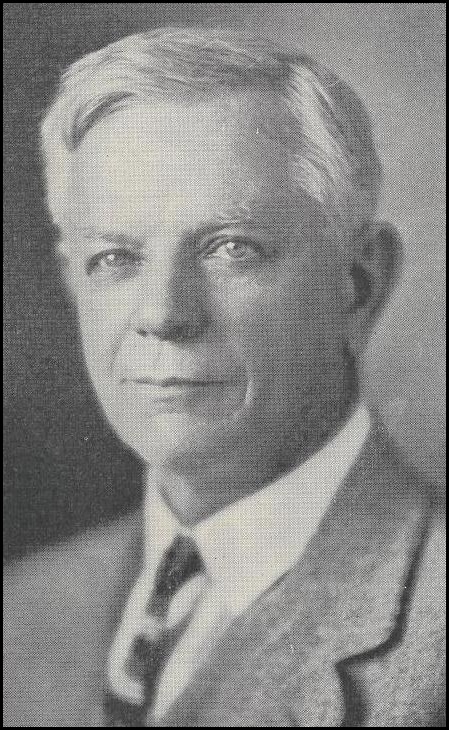
 Once Benedict moved into the president’s office – then located on the first floor of Sutton Hall, in what today is the architecture graduate student lounge – it quickly became apparent that there would be little time for astronomy. Instead, Ernest Keller (photo at right) was hired in 1928 to take the reins.
A newly minted Ph.D. from the University of Chicago, Keller was excited about teaching astronomy on the Forty Acres. For those potentially intimidated by mathematics, he added a nearly math-free, popular astronomy course which quickly filled with 200 students. The old Brackenridge telescope, though, was still the only one available, and it was clear that the University needed to upgrade.
In 1933, a new Physics Building – today’s Painter Hall – was opened along 24th Street. Located between the Biological Labs Building to the west and chemistry’s Welch Hall to the east, the three became known as UT’s “science row.” At the insistence of President Benedict, a three-room, $15,000 observatory was installed on the roof. Its centerpiece was a 12-foot long refracting telescope with a nine-inch objective lens, a significant improvement from Brackenridge’s 1896 donation. Keller was named Director of the Student Observatory, and the new instrument was a boon for his astronomy courses as enrollment continued to climb.
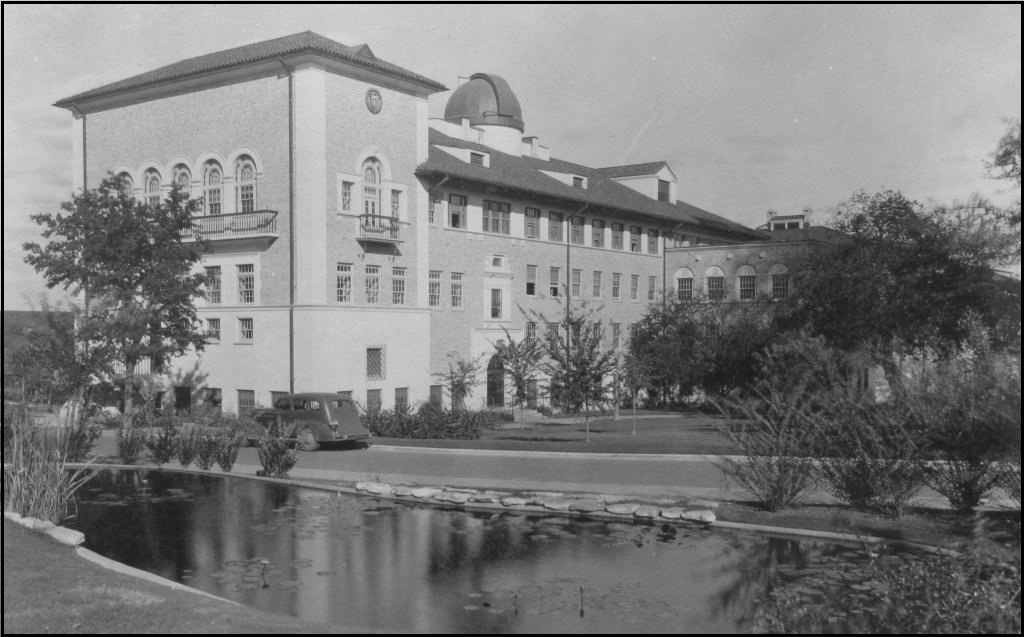
Above: The newly opened Physics Building – today’s Painter Hall – with its copper-domed observatory on the roof.
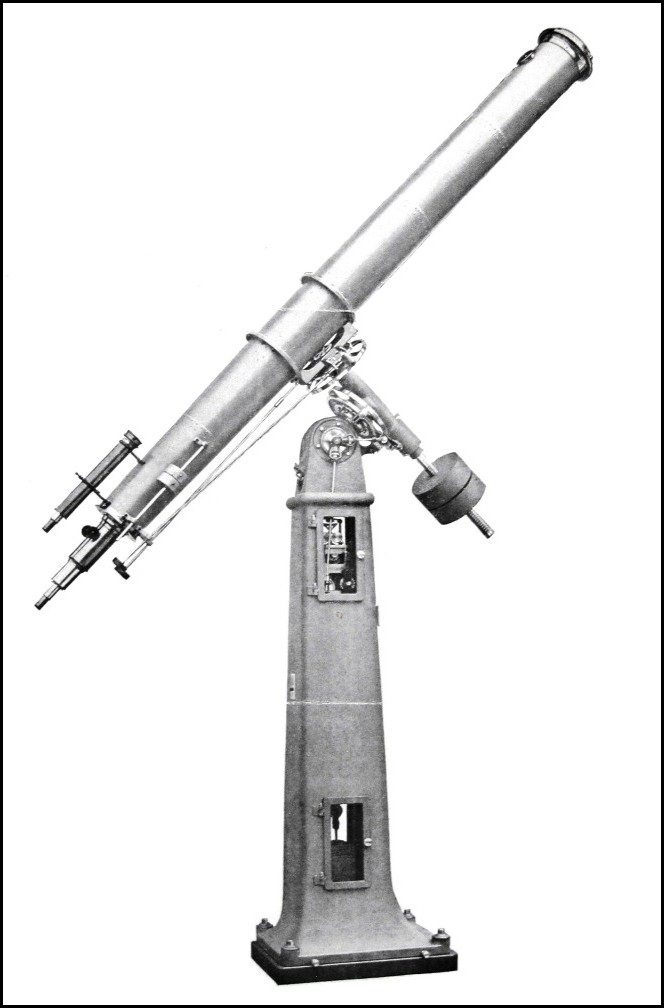 Left: The nine-inch telescope was produced by the Warner and Swasey Company from Cleveland, Ohio..
With new momentum behind the astronomy program, Keller went in search of a teaching tool to augment his classroom, something that would vividly illustrate the motion of the planets and their relation to the stars. A planetarium would be ideal.
The modern version of a planetarium, a domed theater where the night sky is optically projected on the ceiling, was invented in Germany in the early 1920s. It quickly became popular throughout Europe, and the following decade crossed the Atlantic to the United States. Keller took a keen interest in the opening of the Adler Planetarium in Chicago in 1930, and read about others being planned or under construction in Philadelphia, Los Angeles, and New York.
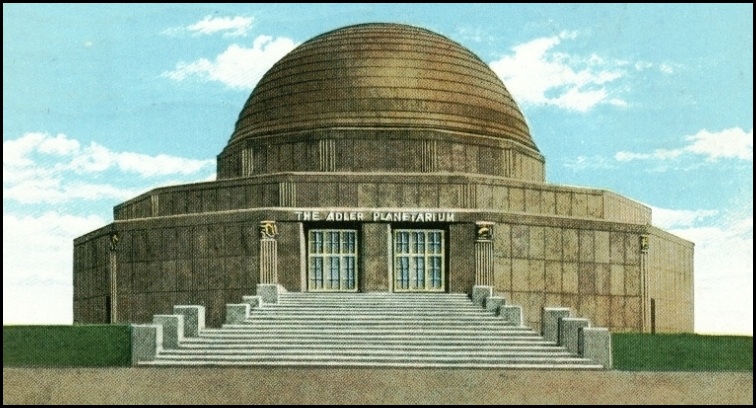
Above: The Adler Planetarium in Chicago.
A planetarium for the University was unlikely. The funding troubles that had confronted the Board of Regents in 1881 were again an issue, though in the 1930s the source was the Great Depression. For two years, from 1933-1935, wages for all state employees, including UT faculty and staff, were reduced as the Texas Legislature struggled to balance the budget. Keller’s $3,000 salary was lowered to $2,100. A planetarium was considered a luxury.
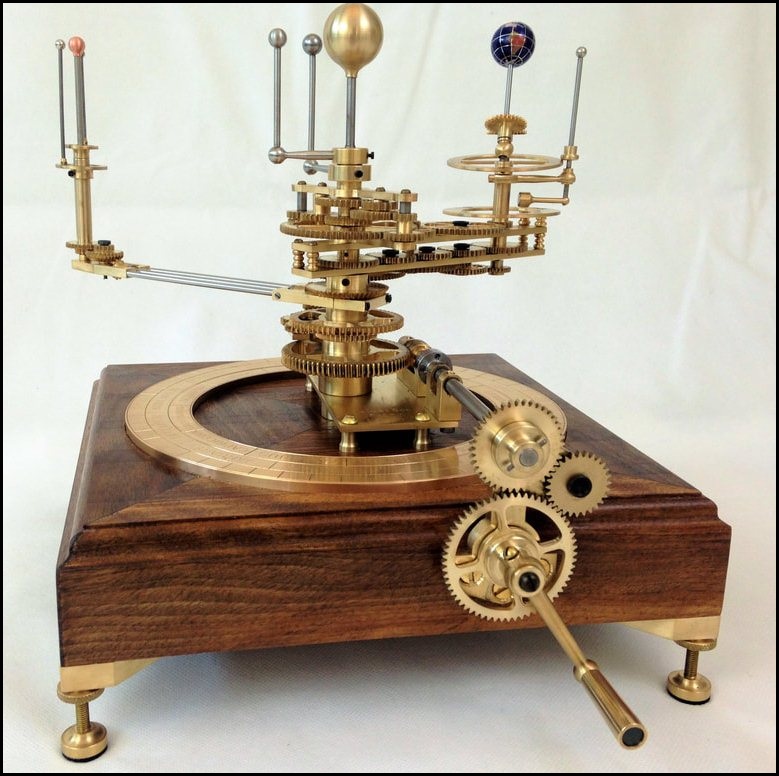 No matter. Keller approached President Benedict with a proposal to build something less ambitious on a slim budget. The idea was really an elaborate “orrery,” a mechanical model of the Solar System (photo at right). Keller’s version would be vertically mounted on a large board, with the planets moving in their orbits along grooved tracks, but with the addition of thousands of stars, drilled into the board and illuminated from behind, of both the northern and southern constellations. From the front, he proposed projecting the images of comets to demonstrate how they passed through the solar system. (The term “orrery” comes from 18th-century Britain, when Charles Boyle, the Fourth Earl of Orrery, commissioned what is considered the modern version of the device.)
Benedict lent a sympathetic ear to Keller’s idea, and not simply because of the president’s own passion for astronomy. A few years earlier, Texas banker William McDonald left an unexpected $800,000 gift in his will for UT to build a formal observatory. Through a partnership with the University of Chicago, Keller’s Alma Mater, the upcoming McDonald Observatory was under construction on Mount Locke in West Texas. When completed, it would house the second-largest telescope in the world, and was certain to boost interest in astronomy on the Forty Acres.
At the same time, the University had been asked to participate in the upcoming Texas Centennial Celebration in 1936. From June through December, the campus was to become an enormous exhibit hall, with detailed displays in various buildings on Texas culture, history, fine arts, and science. (Gregory Gym was transformed into a natural history museum, with a model of a dinosaur standing guard out front.) The planetarium, along with an exhibit on the McDonald Observatory, could be a major attraction, and further showcase UT’s efforts to become a world-class research university.
Benedict approved the project with a $1,500 budget. The planetarium was to be located in the reading room of the old Library – today’s Battle Hall.
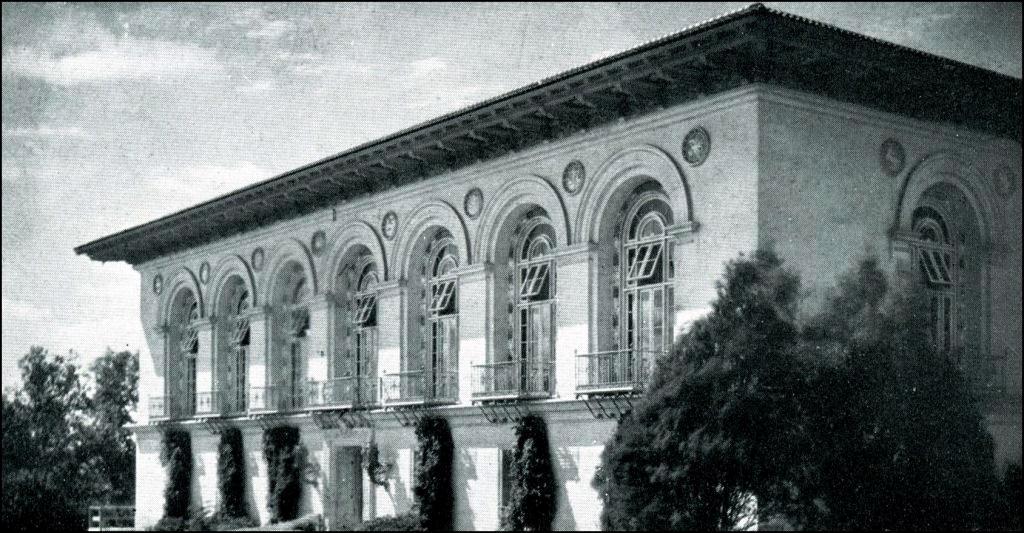

Top: The planetarium was assembled in the old Library Building, today’s Battle Hall. Above: The Daily Texan headline isn’t quite correct. The planets, not the stars, would be in motion in the planetarium.
~~~~~~~~~~
Keller recruited mechanical engineering professor Alex Vallance to help with the design, and construction began on the chilly and cloudy Wednesday, January 23, 1935. Over the next eighteen months the project involved the University carpenter, painter, cabinet maker, physics department machine shop, several faculty members, and more than 20 students hired part-time through a Federal Emergency Relief Administration (FERA) grant, one of the many New Deal programs created by President Franklin Roosevelt.
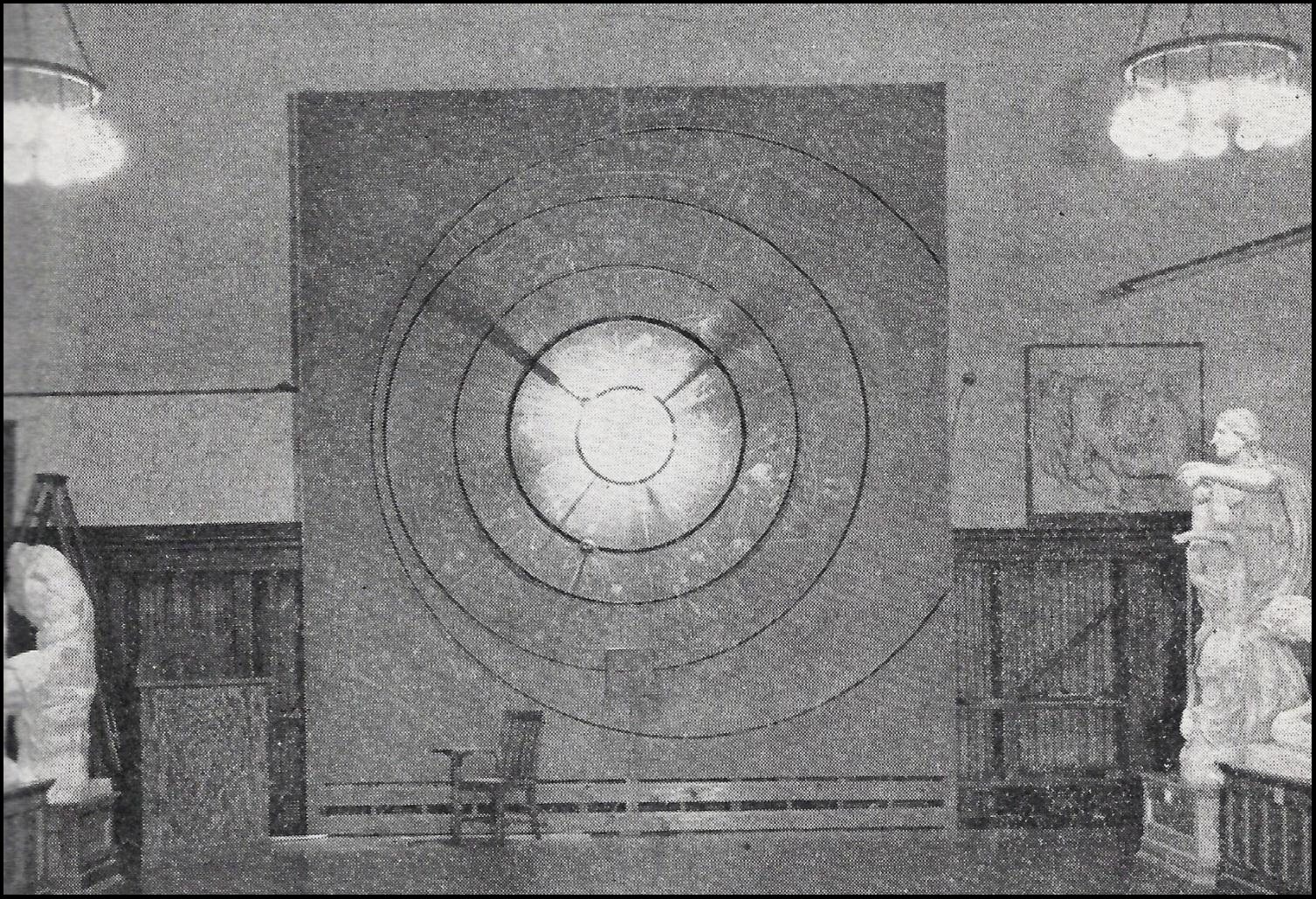
Above: The planetarium, still under construction, on the south end of the reading room. When completed, it was provided with a nicer base and framed by green curtains. The Greek statuary was relocated to the north end of the room.
The planetarium was placed on a square vertical board, 20-feet on a side, and painted a deep blue. Just over 4,000 holes, from ¼ to 1/32 of an inch in diameter, were drilled into the board to display stars seen in both the northern and southern hemispheres. The holes were lit from behind by 62, 60-watt bulbs encased in light-tight containers. “The stars of the planetarium are not made by projecting beams of light onto an interior dome, as in the Adler Planetarium,” reported The Daily Texan, “but by projecting light through the plane of the system by reflecting it along glass tubes from a central source.” Divided into a dozen sections, all of the stars could be lit at once, or only those seen from the Earth on a particular night. A revolving switch allowed the lit stars to vary by month once the planets were set in motion.
In the center of the board was the Sun, a bright, 500-watt bulb, around which nine planets (including Pluto) and 26 known moons both rotated on their own axes and revolved about the Sun on tracts. The planets were made to scale out of thin glass spheres coated with mercury, which better reflected the “sunlight” and could be easily seen. “The smallest spheres are clearly visible, when illuminated, at a distance of a hundred feet,” Keller wrote in a special article for Popular Astronomy magazine. The largest planet, Jupiter, was seven inches in diameter.
 Right: The primary drive that powered the planets on their orbits around the Sun.
Behind the scenes was a ¾ horsepower motor central drive, along with smaller motors to operate each planet and its moons. Dozens of brass and steel gears and sprockets, all custom made on campus, along with more than 400 feet chain were required. Larger rotating parts were mounted on rubber bases to reduce vibrations and potential noise. The planetarium had two speeds. A year could be made to pass in a minute, or at a faster pace, in 20 seconds.
From the front, Keller designed a “comet projector.” He described it as an optical device “which projects a portion of a lantern slide of a comet in such a manner that the tail of the comet extends outward from the miniature Sun as the comet traverses its orbit.”
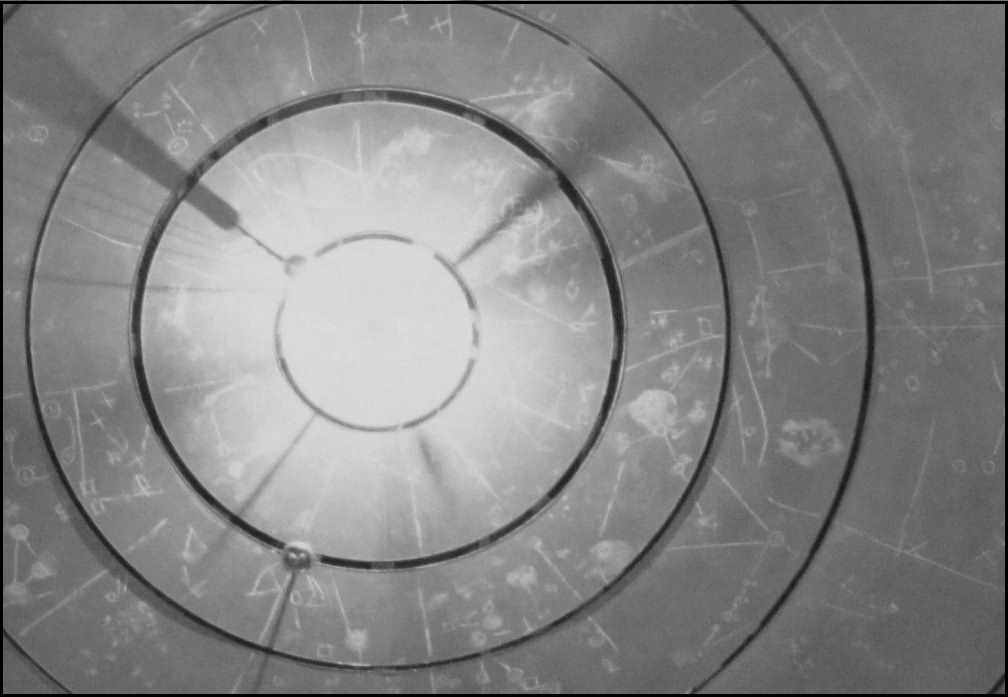
Above: Still under construction, chalk was used to outline constellations before star positions were drilled into the board. In this photo, the smallest “ring” is the orbit of Jupiter, which can be seen in the upper left. Saturn is the next planet and easily visible at lower left. The inner planets – Mercury, Venus, Earth, and Mars, are washed out in the photo by the 500-watt bulb acting as the Sun.
~~~~~~~~~~
 The planetarium was debuted to the University Science Club and faculty on May 3, 1936, before it publicly opened the following month with the campus-wide Texas Centennial Celebration. Three nights each week – on Tuesday, Thursday, and Saturday – two showings were held, at 8 and 9 p.m. “The lecture makes the heavens take on a new and brighter aspect,” reported the Austin Statesman. Much of the presentation was centered on the motions of the planets and comets over the previous century, from 1836, when Texas became an independent nation, to the 1936 centennial year.
 Along with the planetarium, visitors were treated to an intricate, electrically powered, working model of the McDonald Observatory (photo at right). Built by the Warner and Swasey Company in Cleveland, Ohio, 4 ½ feet tall by 50-inches in diameter, it was shipped to Austin in four boxes with express instructions not to touch anything until a company representative arrived to unpack and assemble it. (Today, the model resides at the McDonald Observatory’s visitor center.)
Next to the observatory was a replica of Mount Locke, with the layout of the buildings, equipment, and roads planned for the observatory site. It was built by students in the School of Architecture, and funded with a National Youth Administration grant, another New Deal program.
Following the planetarium show, everyone was invited to stroll over to the Physics Building to look through the nine-inch telescope. Jupiter, with its colored bands and four bright Galilean moons, was in the right place in the sky for easy viewing.
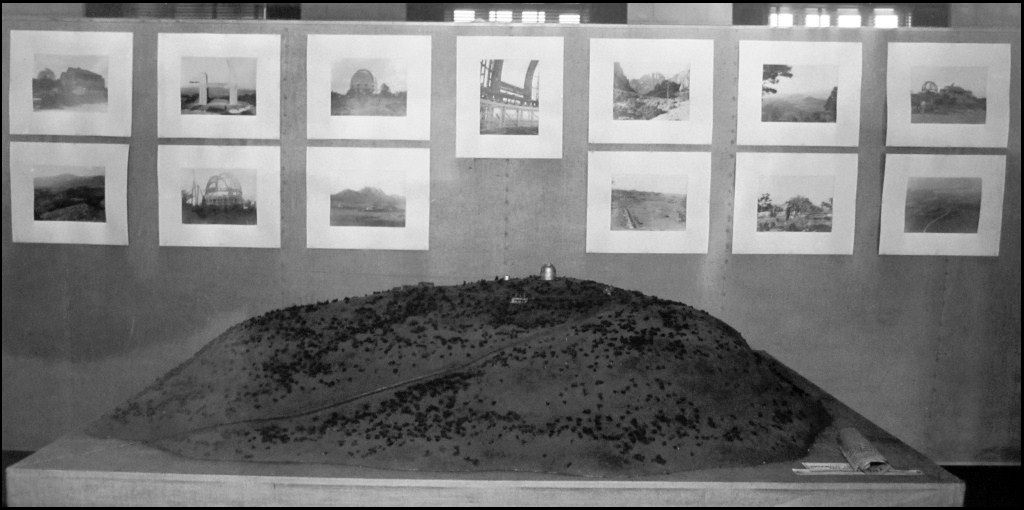
Above: A model of the McDonald Observatory on Mount Locke, created by students from the School of Architecture.
Keller’s planetarium was a great success. Crowds through the summer averaged 150 persons each night, and while public attendance tapered off once school began in the fall, it continued to be popular until the Texas Centennial exhibit closed in December. For the next several years, the planetarium was used for its intended purpose, as a teaching tool for astronomy classes.
Keller, though, didn’t remain at the University. In 1940, with the threat of the United States becoming involved in a second global conflict, he was hired as a consulting mathematician for the Curtiss-Wright Corporation, then the largest producer of military aircraft in the nation. With Keller’s departure, and with the University soon focused on World War II, the planetarium was neglected and fell into disrepair.

Years later, in 1946, a Texan reporter took note of the forgotten machine. “On the second floor of the old Library Building, surrounded by bulletin boards and diligent art students, rests a weird-looking object of yesterday’s fame – a planetarium.” Too large to relocate to the Physics Building, Keller’s creation was eventually dismantled. The heavens moved no more.







 The UT History Corner