Funeral for an Outhouse

George Town Funeral.1905Above: Students hold a funeral service for the beloved “George Town.” Buildings from left: north wing of Old Main, Chemistry Lab Building (burned in the 1920s, where the biology ponds are today), smoke stack of the first power house, Littlefield Home in the distance, and the newly finished Engineering Building (now the Gebauer Building). Click on the image for a larger view.

At first glance, the image is a somber scene. It’s grainy and poorly focused. A lack of shadows suggests it was a gloomy, overcast day, and the mostly barren trees imply the photograph was taken in winter or early spring. At the center, a group of about twenty-five men, dressed in dark suits and hats, have solemnly gathered in front of what looks like a gravestone. But don’t be fooled, as this was no ordinary memorial service. The hurried photographer captured one of those rare student shenanigans: a funeral for an outhouse.

In April, 1900, when severe storms and flood waters destroyed the original Austin Dam (since replaced by the Tom Miller Dam), the city’s water supply and, in turn, the sewer system, were unreliable for several years. Of course, this affected everyone on campus, especially the occupants of B. Hall, the University’s first residence hall for men. As a proactive measure, temporary restroom facilities were built just west of the dorm.

Made of brick with a simple wooden roof, most agreed the outhouse was an eyesore, though according to UT student Victor “Dutch” Lieb, “It was sort of an institution.” The building was dubbed “Georgetown,” not as a slight to the city thirty miles north of Austin, but to poke fun at Southwestern University. In 1885, UT played its first ever baseball game in Georgetown against Southwestern. The game didn’t go well for UT, though it brought about the first appearance of orange and white as the University’s colors. Since then, UT and Southwestern had maintained a spirited baseball rivalry. (Given the feelings most Longhorns have about the University of Oklahoma, a similar temporary facility on campus today might lovingly be called “Norman.”)

By 1904, University officials thought the outhouse was no longer needed, and over the week-long break for Christmas holidays, a few students who’d remained in Austin were recruited to raze the structure with the help of a telephone pole battering ram. When B. Hall residents returned after the New Year, they discovered their institution gone, but not forgotten.

George Town.Epitaph.1.Shortly after spring classes were underway, Lieb and fellow engineering student Alf Toombs decided to honor the privy’s passing with a formal ceremony. “It took about ten seconds in those days to organize a funeral cortege,” Toombs later recalled. “Dutch was the sky-pilot and I was the choir leader.” Lieb fashioned a large wooden marker with the painted epitaph: “Sacred to the memory of George Town. He is not drunk, but slippeth.” Meanwhile, Toombs recruited the funeral party. When all was ready, the group formed two columns, then marched out from the newly finished Engineering Building (today’s Gebauer Building) while singing the well-known and venerable hymn, “Nero, My Dog, Has Fleas.”

Once assembled in front of the marker, “Reverend Dutch” uttered a short prayer, led another song, then turned the program over to Toombs, who eloquently expounded upon the virtues of the late Mr. Town and his unselfish devotion to mankind. Toombs described at length how “George” had been “a sheltering friend to many in need, at times of their most poignant distress.” Apparently the eulogy brought tears to the eyes of many of the listeners.

Early spring flowers, swiped from groundskeeper Harry Beck’s campus gardens, were laid on the ground in front of the marker. The ceremony concluded, Toombs remembered, “We left the hallowed spot with the consciousness that another worthy deed had been done where so many had been done before.” The group made their way to Weilbacher’s Confectionary and Soda Fountain downtown to drink a toast to the dearly departed.
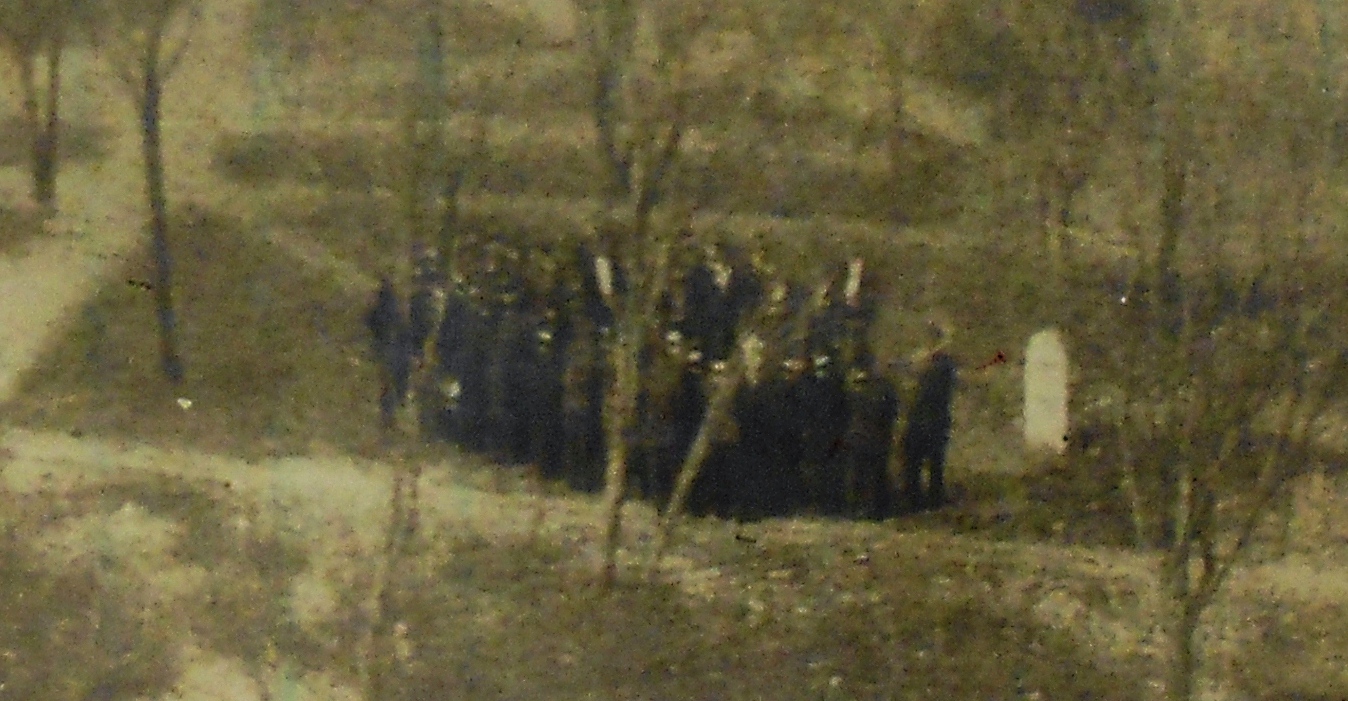
George Town Funeral.1905.Close up.

Above: Victor Lieb and Alf Toombs lead a memorial service for the late “George Town.”
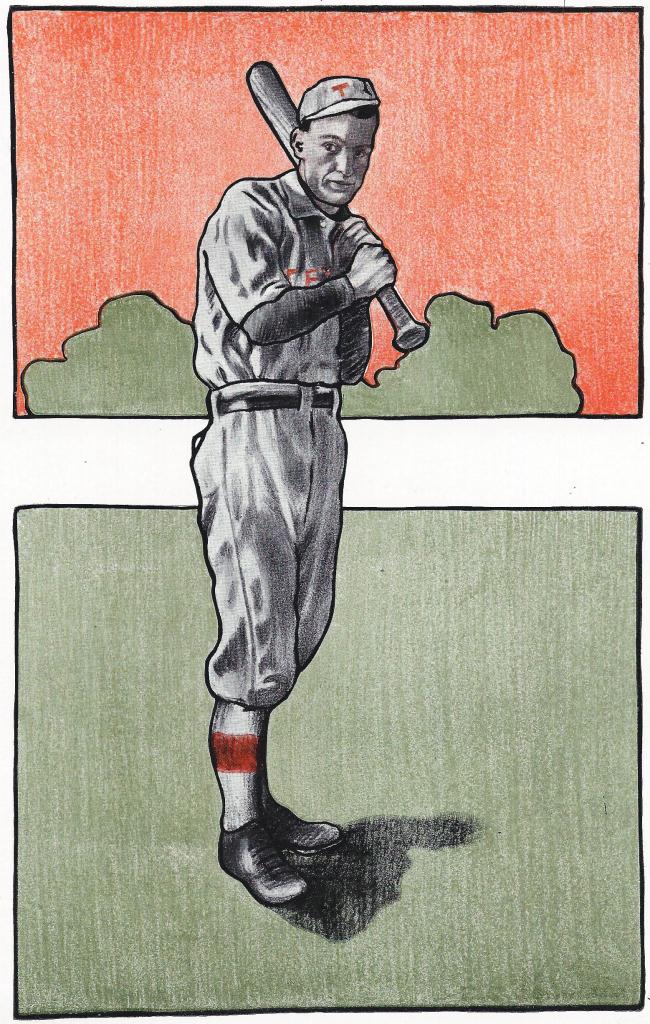
How to Save Baseball

1906 Cactus.BaseballIt’s mid-June, and Longhorn baseball fans are jubilant over the team’s record 36th appearance in the College World Series. They have good reasons to be happy. Over the last 108 seasons, the team has had but five coaches: Billy Disch, Bibb Falk, Cliff Gustafson, Augie Garrido, and second-year coach David Pierce (Blair Cherry stepped in for Bibb Falk for part of World War II and coached the team from 1943 – 1945), who have collectively compiled six national championships and more than 70 conference titles, a unique and remarkable achievement in college baseball.

For the veteran fans who fill the stadium seats each spring, the team’s history, coaches, and names of players who went on to the major leagues are all familiar. But almost no one remembers the senior UT student whose quick – and perhaps desperate – actions saved the baseball program from being cancelled outright. The achievements of UT baseball might never have happened, or at least would have been delayed, if it hadn’t been for Maurice Wolf.

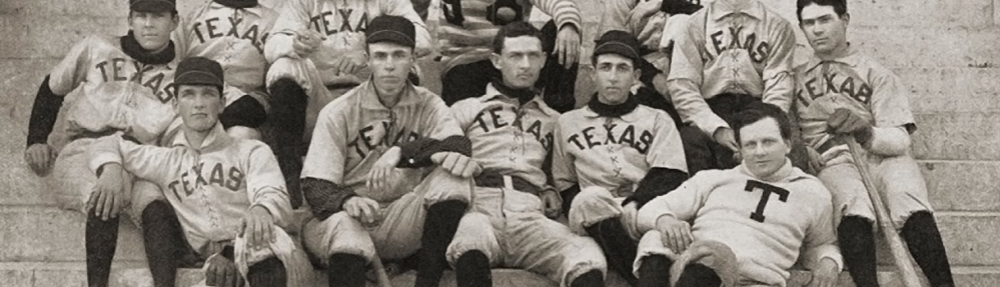
1906 Cactus.1905 Baseball Team

In early January, 1906, the prospects of a baseball season were dim. The University’s Athletic Council, chaired by math professor (and future UT president) Harry Benedict, had officially adopted a policy of “no cash, no schedule.” While football had been marginally profitable, other sports were usually in the red, and baseball was the worst offender. A $1200 deficit plagued the ledger. In the past, faculty and alumni members of the council often donated out of their own pockets to keep the athletic ship afloat, but Benedict was determined not to let serving on the council “run the risk of personal ruin.” The deficit had to be erased before Sewell Myer, the student manager of the baseball team, was allowed to set-up a schedule.

Baseball wasn’t all that popular with the general faculty, either. Too many players had run afoul of academic eligibility rules. Only a few years before, on an out-of-state road trip, an ineligible player boarded the train and suited up for play with his costs covered by his teammates, despite being expressly prohibited from doing so by the University president. If the $1200 could not be raised or guaranteed, both the Athletic Council and the faculty were ready to discontinue baseball.

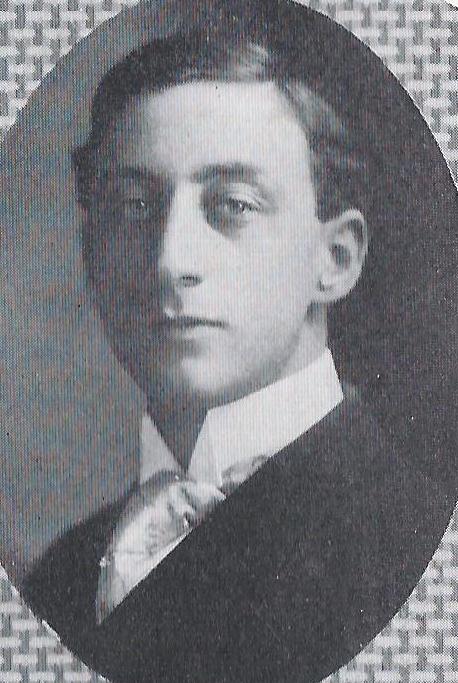
1906 Cactus.Maurice WolfThe students didn’t want to lose the team, and searched for for a quick solution. After some delicate diplomacy and uneasy agreements, $900 was promised from library deposits. The final $300 was pledged by 30 students who signed an agreement to pay $10 each by May 1st if needed. Among them was Maurice Wolf (pictured), who was told that the bond was simply a formality, the team finances would be fine, and the money wouldn’t actually have to be paid.

The Athletic Council accepted the solution, and Sewell Myer set out to arrange a schedule, but because of the late start, there were fewer opponents available. The team managed an eight-game, out-of-town trip to Texas A&M, Louisiana State, and the University of Mississippi, and the UT hosted Kansas, Baylor, Saint Edward’s, Southwestern, and the Austin League Team. But as with previous years, some of the best players collided with faculty regulations and had to be benched. Rain cancelled one of the games against Kansas and another with Baylor, which hurt the all-important gate receipts. Texas swept a home series with Texas A&M to finish with a 10-9 record and claim a winning season, but it also ended with a $500 deficit. The $10 pledges due on May 1st would have to be filled.

As might be expected, the students weren’t prepared to pay. At the time, $10 was a sizable sum. It would more than cover a month’s rent and meals at B. Hall, the men’s dorm on the campus. If Maurice and the others were unable to find the money, not only would their reputations suffer, but an exasperated faculty was more than ready to shelve baseball.

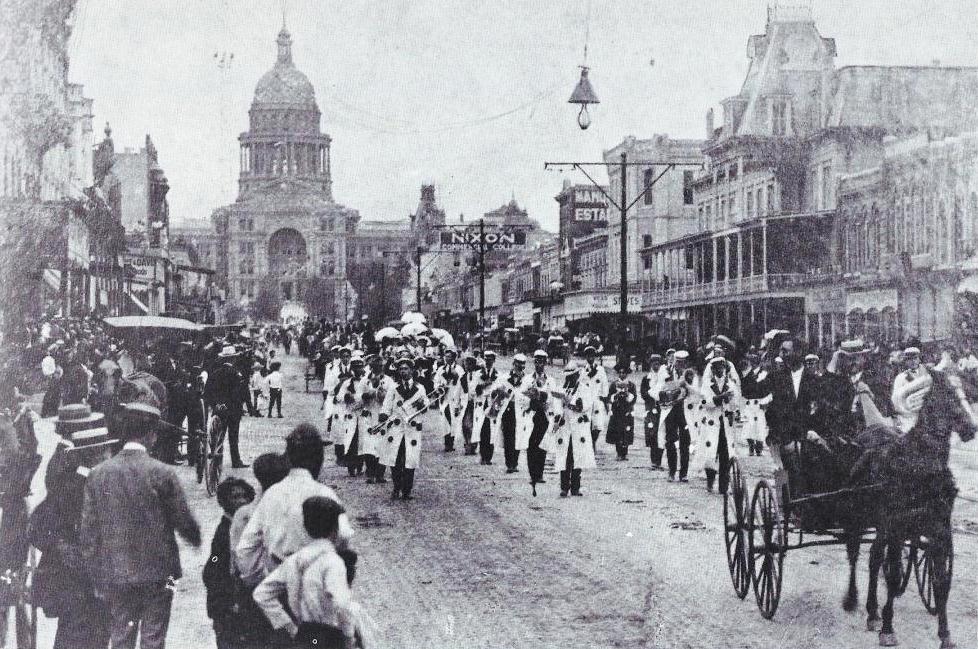
To rescue the program, Maurice convinced his fellow students to host an ambitious fundraiser in the form of a circus performance. Dubbed the “Varsity Circus,” the entire campus helped with organization and preparations, and within a few weeks all was ready. Late on the warm afternoon of Friday, May 25, a circus parade proceeded down Congress Avenue, much to the delight of thousands of spectators. The participants included the University Band, posing as a “celebrated musical company from Italy,” automobiles decked out in University colors with campus coeds as “Duchesses of Marseilles,” a troupe of clowns, acrobats, wild elephants, camels, lions, and bears (UT students in homemade costumes), “Ben Hur and Ben Hill” riding Roman chariots, and other eclectic acts.

1906 Varsity Carnival Parade

Above: The Varsity Circus parade strolled down Congress Avenue. The University Band, dressed in white jackets and colorful buttons, posed as a musical group from Italy. Behind them, UT co-eds, dressed as “Duchesses from Marseilles” and carrying parasols, rode in a decorated automobile. Ahead of the band in the horse-drawn cart rode Maurice Wolf, who concocted the idea as an athletics fundraiser. Click on the image for a larger view.

With the parade finished, the public made its way to the campus and Clark Field, the University’s first athletic field, where the O’Donnell Building and the Gates-Dell Computer Science Complex stand today. There they found a “promenade of curiosities,” where for one thin dime a person might get a glimpse at the bearded lady, the human frog, “Ana Conda Baby,” the wild man (who some discovered was actually baseball umpire Speilberger in disguise), a living mummy from Egypt, and other wonders. Refreshments could also be had at modest prices.

The circus proper began at 8 p.m., as more than 1,200 onlookers stood, sat on the ground, or packed the single, inadequate set of stands. The acrobats were in top form, the wild animals knew their routines, the chariot races across the field were exciting, and the clowns kept everyone in stitches. After the acts, the University Band and Glee Club gave a performance, and everyone reluctantly left for home sometime around midnight.

The hero of the day was Maurice Wolf, who had devised, engineered, and produced the spectacle, and the results were gratifying. The Varsity Circus raised enough funds to retire the athletic debt, provide a $150 contribution to the band, and another $100 to the glee club. The University of Texas baseball team would continue for another year, and the Varsity Circus became a biennial tradition well into the 1920s.

The University Learns of D-Day

D Day Extra.Austin.June 1944 In the early morning hours of Tuesday, June 6, 1944, Austin was literally under a dark cloud. A late night thunderstorm had cooled the first 90-degree day of the year, and doused the city with some welcome rain. On the University of Texas campus, many students were still awake. It was the dreaded last week of class for the spring quarter, always full of tests and term papers. And as final exams loomed on the horizon, everyone was looking forward to a break over the weekend, when Tommy Dorsey and his famous orchestra would be the headline act for the All-University Dance at Gregory Gym Friday evening.

To stay alert through long hours of study, most students relied on a steady diet of coffee and big band dance music on the radio. But on this night, the lightning interrupted reception, and the radios sputtered and crackled with storm static.

At 2:30 a.m., about the time when most stations and their sleepy announcers prepared to sign off, a gentleman from New York abruptly interrupted the programming: “We take you now to London.”

Soon after, the steady voice of Colonel Ernest DuPree, from the Supreme Headquarters of the Allied Expeditionary Force (SHAEF), calmly read official communiqué number one. “Under the command of General Eisenhower, Allied naval forces, supported by strong air forces, began landing Allied armies this morning on the northern coast of France.”

Finally, after months of waiting, speculation, and false alarms, D-Day had arrived.

~~~~~~~~~

UT World War II ROTCSince December 1941, when the United States entered the second world war, the University of Texas campus had been transformed to support the war effort. The academic calendar was compressed to permit additional terms – some as short as three weeks – to allow students to complete more courses sooner and graduate in 3 ½ years. Research, especially in natural sciences and engineering, was mostly war-related and classified. A Naval ROTC unit was created, but was absorbed into the V-12 program in 1943, which was designed to recruit and prepare officers for the Navy, Marines, and Coast Guard. It was headquartered at the Littlefield Home, which for a time boasted two anti-aircraft guns on the front lawn and a firing range in the attic. All UT students were required to attend physical education classes and survival training. Theater students and the University’s Curtain Club entertained soldiers at area military bases and hospitals, and the Texas Union even set up a regulated dating service, matching UT co-ed volunteers with locally-stationed GIs. An air raid siren was installed in the UT Tower, and at times, everyone had to seal their windows at night and tape over headlights when Austin was under a blackout.

Social life continued on the campus, but took on a wartime theme. The weekly All-University Dances, either at the Texas Union ballroom or Gregory Gym,  were very popular, though the dances were always accompanied by collection drives. Collections for aluminum, rubber, and books and magazines to send to soldiers oversees were the most successful. As the war continued, gas rationing required some of the popular dance bands to shorten their tours (Tommy Dorsey arrived in Austin by train), and required UT students to rely on local talent or supply their own.

One solution was the “Longhorn Room,” which debuted in the Union ballroom on Saturday, November 14, 1942 to a sold out crowd. Decked out with wagon wheels, cedar posts, bales of hay, and red-checkered tablecloths, the ballroom was transformed into a student-run, western-styled nightclub. Couples (no stags allowed!) were charged fifty cents, and could reserve tables in advance. Music was supplied by the Union’s record player. Student groups volunteered to set-up and decorate, wait on tables, tend bar, and clean up afterward.

The highlight of the evening was the half-hour variety show, which was often unpredictable. A sorority might perform a short musical, complete with costumes and dancing, or individual students would entertain the crowd with stand-up comedy. Occasionally the Longhorn football team brought down the house with their version of the Can-Can.

~~~~~~~~~

With the announcement that a European invasion was underway, the campus began to stir. Lights were turned on, roommates pushed out of bed, and the news yelled down hallways in campus dorms. Everyone was glued to their radios – television wouldn’t arrive in Austin until 1952 – which offered a constant stream of updates and initial first-hand accounts. Announcers often interrupted bulletins with new bulletins. General Eisenhower himself addressed the citizens of occupied Western Europe, “Although the initial assault may not have been made in your own country, the hour of liberation is approaching.”

At 4:30 a.m., the All-Saints’ Episcopal Church, just north of campus, began to ring its church bells, and awakened all of the residents in the Scottish Rite Dormitory across the street. Other churches did the same, both in Austin and across the country. (In Houston, most retail stores would remain closed for the day as 445 churches opened for 24-hour prayer vigils.) About the same time, west campus fraternity and sorority houses, along with some private residences, received telephone calls from an anonymous, almost-hysterical woman, who shouted, “The invasion is here! The invasion is here!”

Ironically, among the last to receive word was the Naval V-12 unit housed in Andrews Residence Hall. Because they were under a strict schedule with lights (and radios) out at 10 p.m., the members of the naval unit had managed to sleep through most of the night. It wasn’t until “limber-lunged Gordon,” a newsboy for the Austin Statesman, passed by the residence hall. He was selling a tabloid-sized newspaper extra at 5:30 in the morning. “Extra! Extra! Invasion on!” yelled Gordon as he walked the puddled streets. In a few minutes, the lights of Andrews were aglow.

1944.V 12 Units on Main Mall

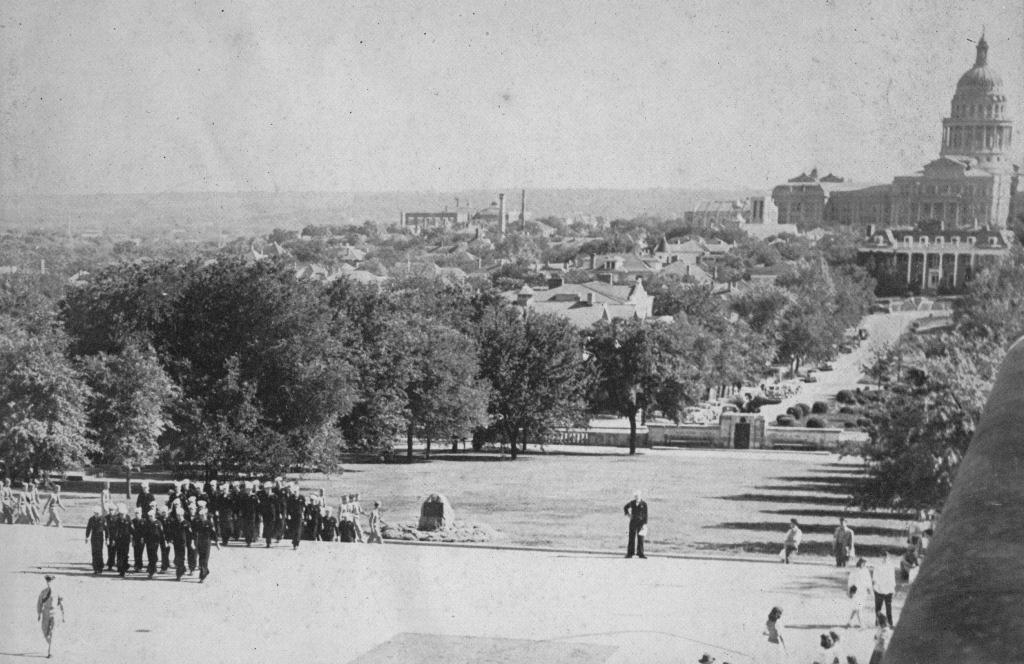
Above: In 1944, with a grand view of the South Mall and Texas Capitol beyond, University students enrolled in the Navy’s V-12 program march in formation on to the Main Mall. Click on the image for a larger view.