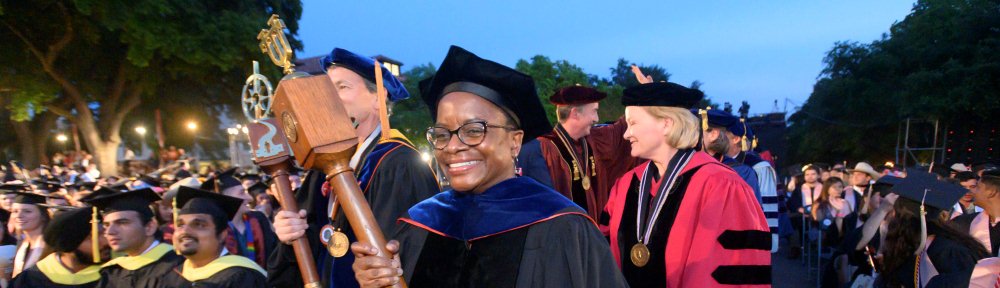
The Texas Exes marks its 140th year.

Bright blue skies and uncomfortably warm temperatures greeted the second annual University of Texas Commencement in June 1885. “Rain is falling in different portions of the state,” reported The Austin Daily Statesman. “It is asked to put in its presence here without delay.” Held over three days, commencement was a lively affair, crammed with receptions, banquets, a grand Commencement Ball, and more than its fair share of oratory. Among the speech-makers was new law graduate Thomas Watt Gregory (a future U.S. Attorney General and Gregory Gym’s namesake), whose eloquence thoroughly impressed his audience. “At times he rose to fine oratorical heights,” lauded the Statesman, “and prudently eschewed from his discourse the tinseled vaporings which generally characterize commencement efforts.” To beat the summer heat, the formal graduation ceremony was held Wednesday morning at 11 a.m., June 17, at Millet’s Opera House downtown. Ashbel Smith, chair of the Board of Regents, conferred 20 law degrees and presented the University’s first Bachelor of Arts degree to Samuel Clark Red.
After lunch, the 1885 graduating class re-convened in the history lecture hall of the west wing of the old Main Building. (Image above left.) Made of pale-yellow pressed Austin brick, limestone trim, and a grey slate roof, the collegiate Gothic west wing was the only structure on the young 40-acre campus. With the academic year ended, the building was nearly empty. Only a row of horses and horse-drawn carts parked at the west entrance betrayed the activity inside. As it was still many decades before modern air conditioning, windows were opened to encourage a cross-breeze and make the hot afternoon a little more tolerable.
The 1885 class was joined by their counterparts of the year before, the 13-member inaugural class of 1884. Once assembled, the group worked through the afternoon to create the University of Texas Alumni Association. A constitution was debated and adopted, which limited membership UT graduates. John Stone was elected the first president, with Gregory chosen as vice president. Robert Walker, the group’s new secretary, dutifully took minutes and began to collect alumni records on index cards. Future annual meetings were scheduled to coincide with June commencement, and John Cobb was asked to be the alumni speaker for the 1886 graduation. Among the founding members of the Association, the oldest was 24.
One hundred and forty years later, the Texas Exes boasts more than 116,000 members globally, open to all ex-students and friends of the University. While the Association’s rich and colorful history is too long to be posted here, below is a smattering of lesser-known pieces of the Texas Exes story.
The Alumni Association couldn’t fund its first scholarship.

At its June 1899 meeting, the Association voted to award a $100 scholarship to the incoming freshman with the highest overall score of UT’s entrance exams in English, history, and math, and appointed a committee to oversee the funding and selection. As in-state tuition was free until the 1920s, the scholarship would help pay for textbooks and living expenses.
The scholarship was to be financed through membership dues to the Association and was widely advertised in newspapers across the state. By the end of the summer, however, only about 60 alumni had paid their $1.00 annual dues, not enough to fulfill the scholarship. Since the Association had committed to it, the scholarship was awarded anyway to Conrad Shuddenmagen of Gonzalez. The committee made up the deficit among themselves, and then began to solicit scholarship funds for future years, both through handwritten letters and personal visits to fellow alumni.
Above right: A handwritten letter on Alumni Association stationery discussing how to raise funds for the first alumni scholarship.
Today, the Texas Exes annually awards $2.6 million in scholarships to about 800 UT students, with over $750,000 contributed by volunteers in local chapters and networks, much as they did 140 years ago.

Above: The Fountain of Energy at the 1915 San Francisco World’s Fair.
The Alcalde alumni magazine was featured in the World’s Fair.
The Alcalde alumni magazine made its debut in 1913 (see Birth of the Alcalde Magazine) and its high typographical quality and use of monotype for its cover and other graphics quickly garnered national attention. In 1915, it was a showcase publication in the printing exhibit at the San Francisco World’s Fair, as well as the San Diego Panama-Pacific Exhibition in 1916.

Alumni missed meals to build the Texas Union.
In 1928, the Texas Exes launched the Union Project, an ambitious $500,000 fundraising effort to build today’s Texas Union (photo above), Hogg Auditorium, and Gregory and Anna Hiss Gymnasiums. After the stock market crashed the following year, much the project had to be completed during the years of the Great Depression. When the economy worsened, some alumni were forced to default on their pledges. “My children come first now, and it is hard for me to do what is necessary for them – at times impossible. I am very sorry,” wrote Zulieka Adams from Mexia. Other alumni skipped meals in order to save up for their annual pledge payments.
When the Union opened in 1933, the Association moved in to the space just above what today is the Cactus Café. It’s currently a study area, but visitors can still see the fireplace at the north end that was part of the small alumni lounge. Go out into the lobby – named the Presidential Lobby for the wood-carved portraits of University presidents on display – and find the names of Association presidents hand painted on the ceiling beams directly in front of the ballroom, as well as above the hallway that leads to the north. (At last check, the names had been kept up-to-date.)
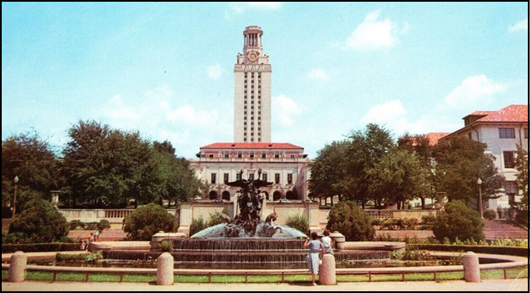
The Texas Exes created UT’s first academic recruitment program.
In the 1950s, it was common practice for Ivy League and other private universities to visit Texas for what was called a yearly “talent search” and recruit many of the best high school students away from the state. Ed Schutze, a 1948 UT graduate and president of the Texas Exes Dallas Chapter, grew concerned and discovered that nearly 10% of the top Dallas area high students were going “back East” to college. Texas laws prohibited the University from using state monies for a counter program, so Schutze decided to create one of his own. In 1957, he convinced several UT administrators and student leaders to visit Dallas and spend time with a specially invited group of high school students. Along with discussions about academic opportunities in Austin, the group saw a short film – “This is Your University” – which had been funded, in part, by the Texas Exes. (See “This is Your University” on YouTube, with scenes of the campus filmed in the 1950s.)
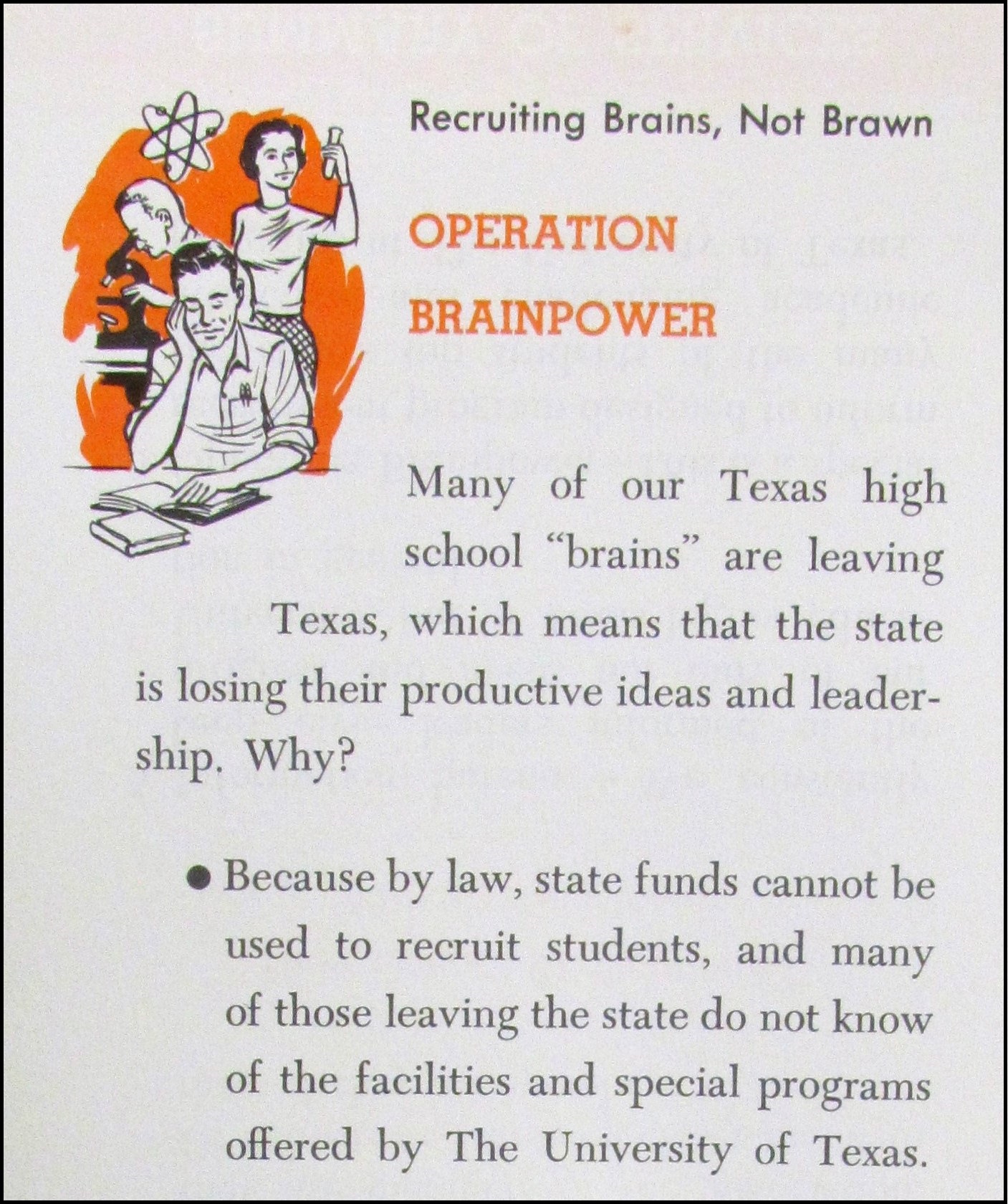
Above: Part of an explanation of “Operation Brainpower” in a 1960s Texas Exes membership solicitation.
Schutze’s idea was a hit, and the following year, as the University celebrated its 75th anniversary, the Texas Exes provided financial support for what became “Operation Brainpower” and added programs across the state. In 1959, an Alcalde magazine article on this new idea of “recruiting brains, not brawn” drew the eye of then U.S. Senator Lyndon Johnson. He thought the effort set an example that many state universities could follow, and had the article placed in the Congressional Record.
“Operation Brainpower” was a great success, and continued through the 1960s.
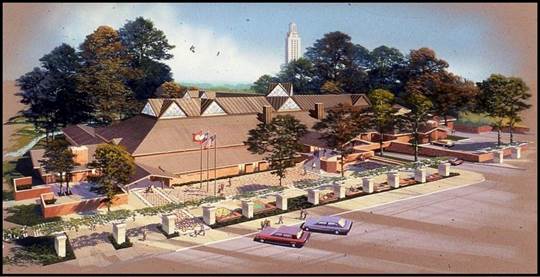
Above: The 1988 architectural rendering of the Alumni Center expansion.
The Alumni Center was inspired by geodes.
As the Association’s first permanent home, the Alumni Center opened in 1965 (see “On Building an Alumni House”), but within 20 years was deemed too cramped for the ever-growing alumni programs. Discussions on a major expansion to the building culminated in the 1990 opening of the Vernon F. “Doc” and Gertrude Neuhaus addition. The $7 million renovation more than tripled the available space in the building, provided for an in-house caterer, and added underground parking.
In the 1960s, architect Fred Day designed the Alumni Center as a sprawling, single-story ranch house with comfortable rooms and a pleasant, simple courtyard. Charles Moore, the architect of the 1990 expansion, wanted to keep the theme. “It’s a building that has to do with people’s memories,” said Moore. “What we’ve tried to do is stay with the mood of the existing building but add a set of dramatic spaces.” Moore, though, was famous for his sense of whimsy, and his design, especially for the main rotunda and concourse, was inspired by geodes.

Popular in natural history stores or geology fairs, geodes are best known as hollow rocks filled with quartz or amethyst crystals. Moore imagined a geode cut in half with the flat side down. If it were large enough, a person could walk through it with the crystals overhead. For the expanded Alumni Center, Moore’s musings resulted in the sharp-angled windows, tiered concourse ceilings, and hints, especially in the rotunda, of images of longhorns. According to Moore, it was meant to be “a colorful, multifaceted surprise, reflecting light from every angle, and embedded with the symbolism of the University of Texas.”
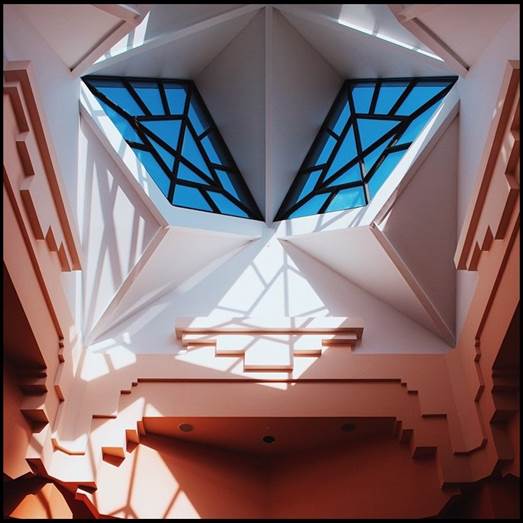
Above: A view of the Alumni Center rotunda in its original orange shades. The sharply angled windows, inspired by crystals found in a geode, cast a variety of light and shadows. You’ll also see the familiar shapes of longhorns in the center and the corners.
 The UT History Corner
Thanks, Jim. Great article.
Peggy