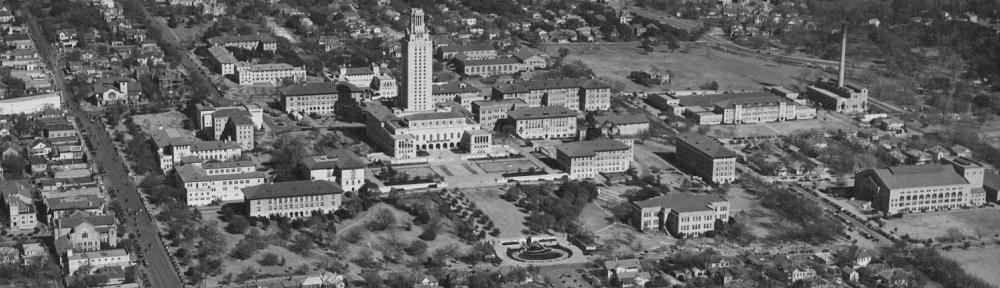
The Alumni Center turns 60!

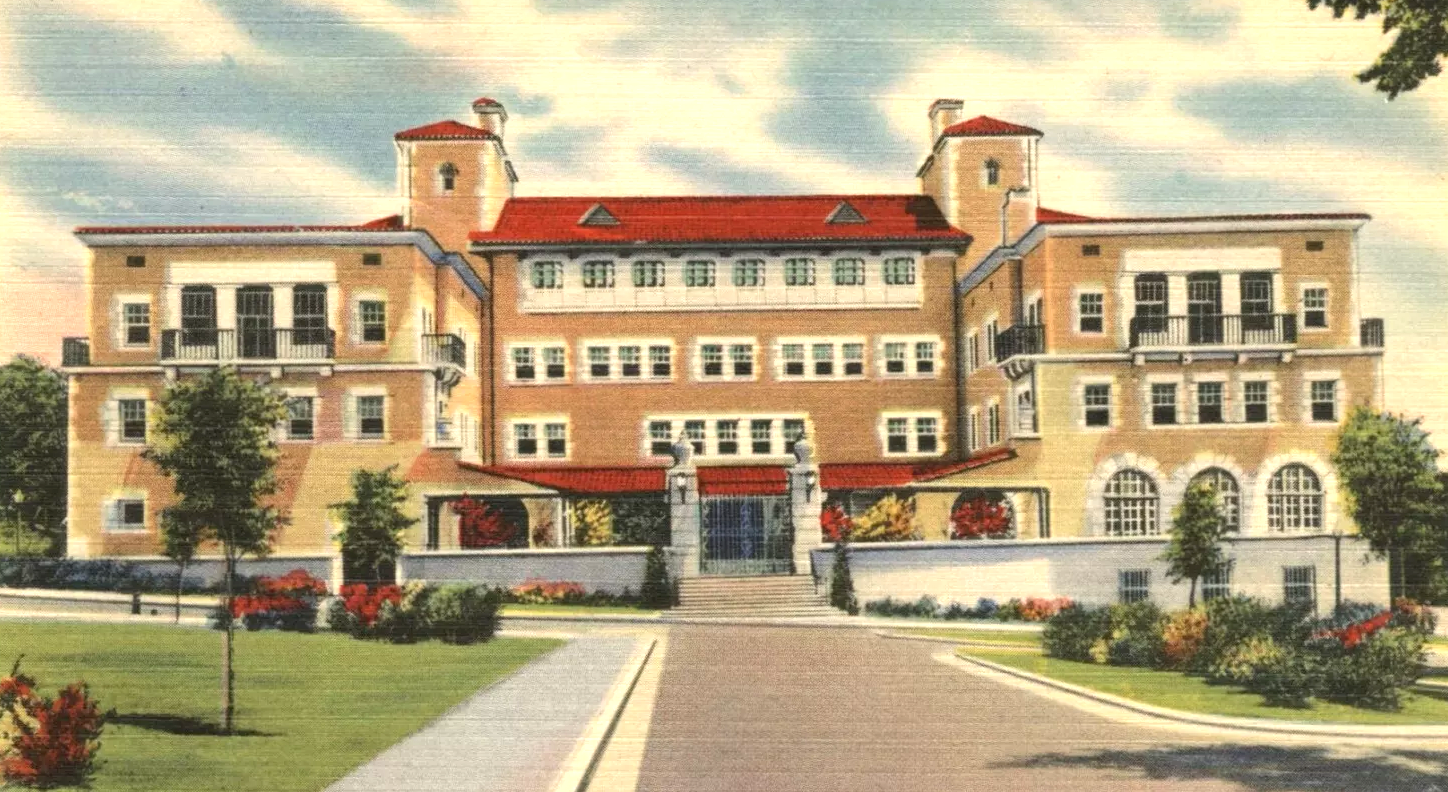
Above: A color rendering of the UT Alumni Center.
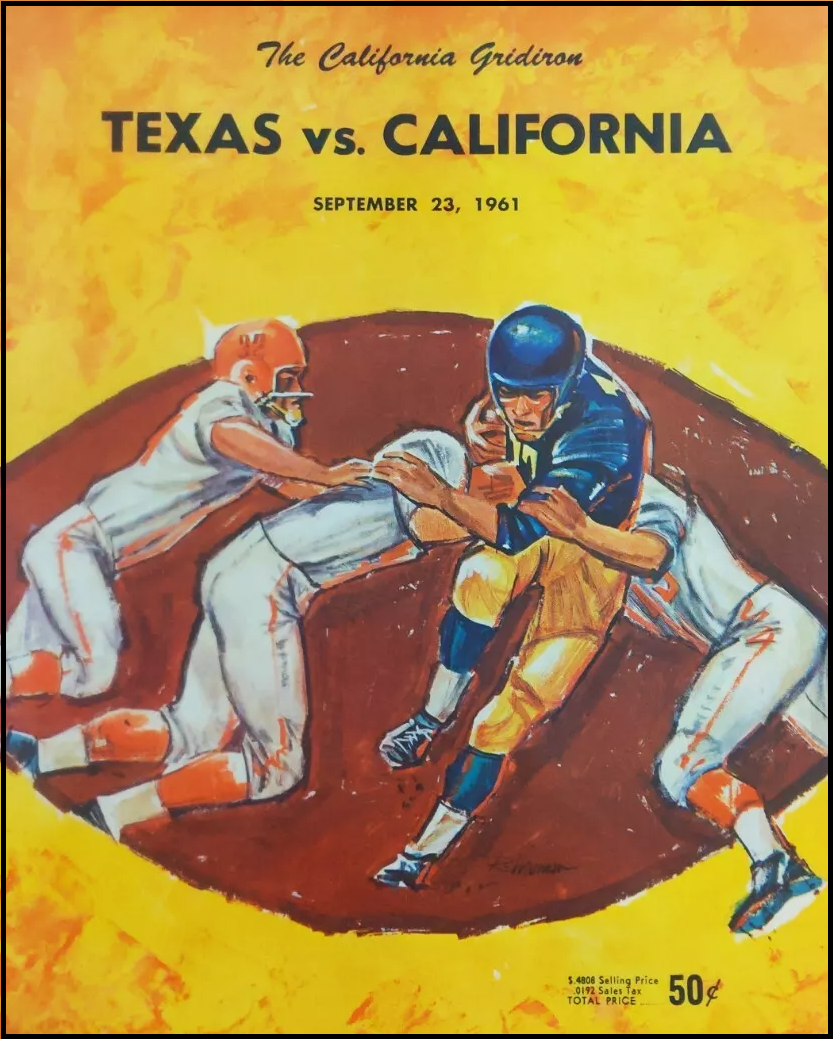
“California, here we come!” The fourth-ranked University of Texas football team opened its 1961 season against the Golden Bears of the University of California. Played at Cal’s Memorial Stadium in Berkeley, UT’s Ex-Students’ Association – the Texas Exes – wanted more orange-minded fans in the seats and chartered its first-ever football weekend excursion. For just under $200, the package included round trip airfare from Austin to San Francisco, a two-night stay in the new Jack Tar Hotel (then billed as the most modern hotel in the world – a television in every room!), ground transportation to Berkeley, and a ticket to the game. The 80 available spots sold quickly. John Holmes, a Houston lawyer and the Association’s president, was one of the first to register.
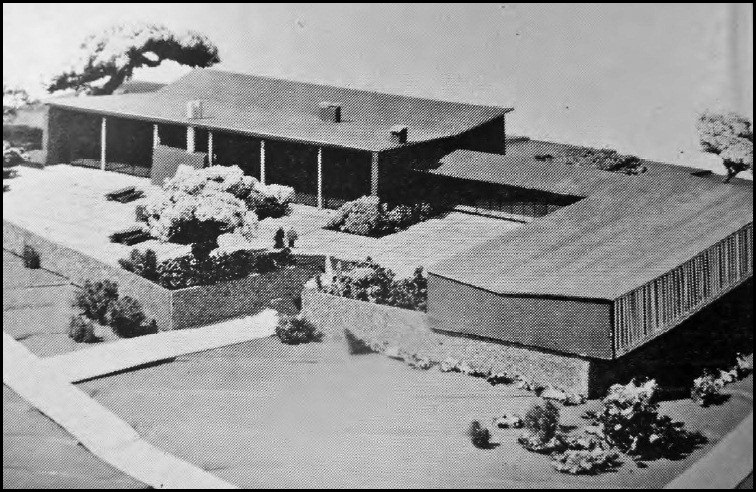
The trip also included a pre-game welcome luncheon at Cal’s Alumni House. (Photo at right is of the architectural model.) Opened seven years before, in 1954, the building was called a “house” as it was deemed a place where “alumni throughout the world can come and feel at home – at home because they are in a spot on the campus that belongs to them, was created for them, and in tribute to their accomplishments however large or small.” Outfitted with alumni association staff offices, conference rooms, a lounge, and a kitchen, the Alumni House had become a busy and important gathering place on the campus. It also left a strong and lasting impression on John Holmes. While Texas football easily won the day 28 – 3 (though the talk of the game was about the dancing girls hired as substitute UT cheerleaders, (see The Longhorns’ Secret Weapon), Holmes was excited about the possibility of creating an alumni house in Austin, and spent the return flight conferring on the subject with Association Executive Director Jack Maguire.
~~~~~~~~~~~~~~~~~~~~

The idea of an alumni house was the solution to a nearly 80-year issue: where to place a wandering alumni association. Founded in June 1885, the Association was homeless for its first 28 years until October 1913, when the University designated room 119 in the old Main Building (photo at left) as the “Alumni Room.” The former office of UT President Sidney Mezes, it measured 25 x 15 feet, was equipped with tables, chairs, bookshelves, and its own candlestick telephone (a luxury in 1913). The walls were crammed with pennants and banners, and photos of Association presidents, University faculty, class portraits, and athletic teams.
The room, though, was only used for four years. When Governor James Ferguson threatened to shut down the University over a controversy in 1917, the alumni rallied to protect their alma mater and set up temporary headquarters off campus in the Littlefield Building downtown. Two years later, after Ferguson had been impeached and World War I ended, the Association moved to the YMCA Building at the corner of 22nd and Guadalupe Streets.

In the 1920s, it ventured a little farther into West Campus, where it purchased the quaint, Victorian-styled Waggener Home (above right), once owned by UT’s first president Leslie Waggener, at the corner of 23rd and San Antonio. It was here that the Association launched the Union Project, an ambitious, and at times, heroic, fundraising campaign through part of the Great Depression that built Gregory and Anna Hiss gymnasiums, Hogg Auditorium, and the Texas Union.
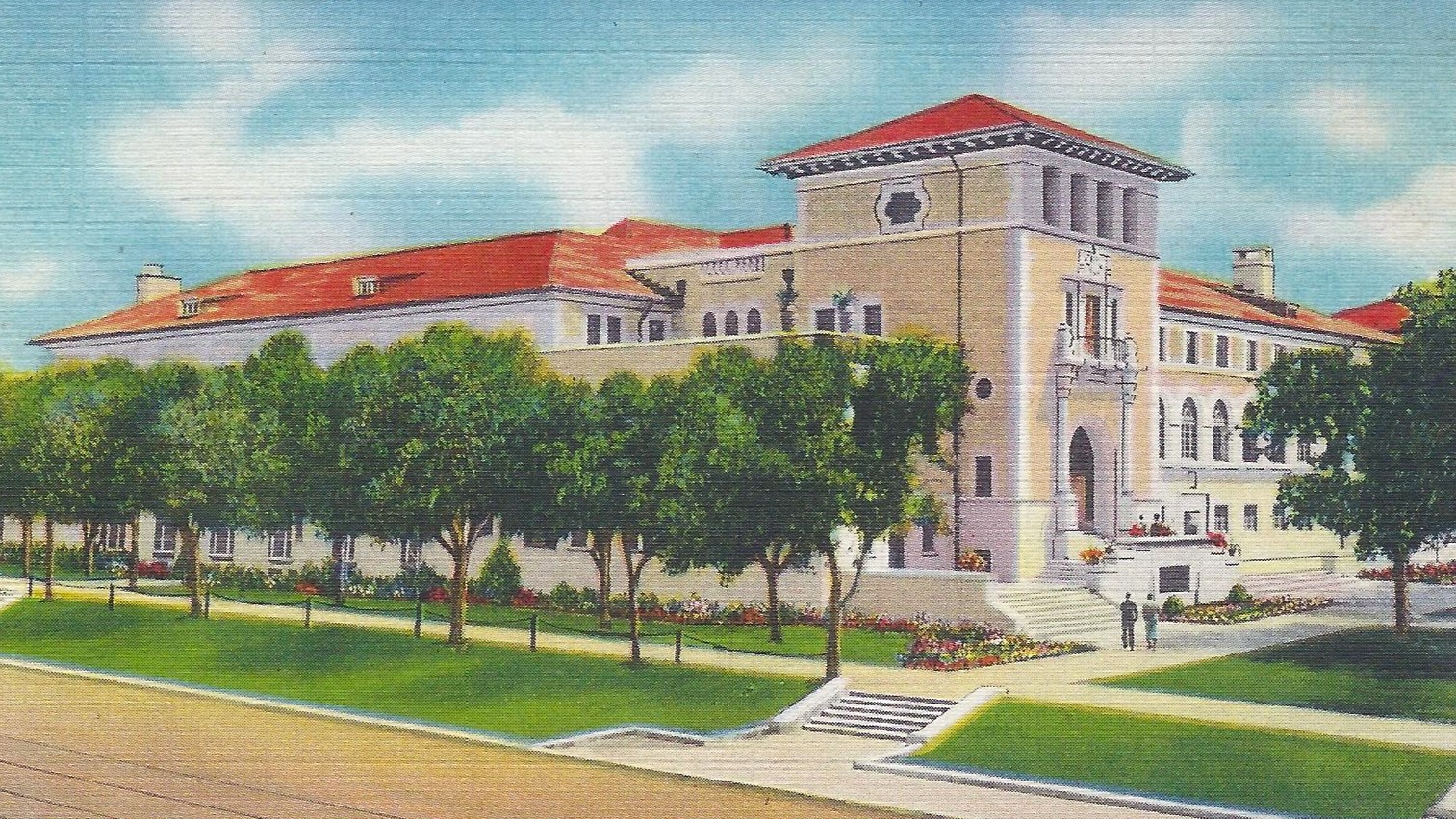
When the Union building opened in 1933, the Association returned to campus with office space on the building’s second floor, now used as a student study room next to the Union ballroom. (You’ll still find the names of Association presidents painted on the beams above the ballroom entrance.) But after World War II, when a flood of returning veterans on the G. I. Bill created a boom in college enrollment (see Life in Cliff Courts) – and thereafter swelling the ranks of alumni – the Association soon discovered it needed more space.
Talks with University officials in the late 1950s led to the idea of the Association taking over the Littlefield Home at 24th and Whitis Streets. It was easily accessible near the edge of campus and already had a small parking lot, but extensive renovations would be required before the building was ready. In 1958, as a temporary measure, the staff was moved to the west-side basement of Mary Gearing Hall, then used by the Department of Home Economics and is today the headquarters for the School of Human Ecology. The place was a little roomier, but the “mole hole,” as it informally came to be known, was difficult to find, and was certainly not suitable for the activities of a growing alumni association. After three years in its so-called “temporary” quarters and with no progress toward the use of the Littlefield Home, a permanent solution was desperately needed.
~~~~~~~~~~~~~~~~~~~~
Following his trip to California, Holmes wasted no time on the Alumni House idea. The day after his return to Texas, he conferred with other Association leaders, named a committee to investigate possibilities, and initiated a conversation with UT administrators. The point of contact from the University fell to UT System Vice Chancellor Larry Haskew, who moved the process along quickly.
Five weeks later, at the end of October, Haskew had prepared a draft report for the Board of Regents, which declared that “an Alumni House of distinctive character and outstanding convenience is of great importance to The University and that one should be provided as soon as possible.” The alumni committee and administration had investigated several options. The Littlefield Home was still a possibility, but serious design and financial obstacles existed. The group also looked at existing homes in the area, including the Delta Tau Delta fraternity house still located just north of campus, but the consensus was that a new facility, designed specifically for the needs of the alumni, was the best solution.
The desired location was the mostly-vacant lot on San Jacinto Boulevard, across the street from the football stadium. The area was still occupied by a pair of temporary men’s dormitories, former World War II Bachelor Officers’ Quarters that had been relocated to campus to accommodate the post-war growth in enrollment (see Life in Cliff Courts), but the dorms were scheduled for demolition. The space had been informally earmarked for a second student union building, but Haskew wrote, “This latter use would be enhanced, actually, by location there of Alumni House,” which implied that the alumni association and the Texas Union might join forces again in the future.

To help financially, the administration proposed using $110,000 from the Lila B. Etter trust fund, a bequest from the daughter (left) of former UT president Leslie Waggener. The alumni could add any amount desired, and the building would be known as the Etter Alumni House. Once completed and occupied, the Association would pay back the $110,000, without interest, at $5,000 per year.
The Board of Regents gave an initial green light to the project at its November meeting, and then formally approved use of the Etter fund and the San Jacinto location on February 3, 1962, a day after the Alumni Council had officially voted its consent. The local firm Jessen, Jessen, Milhouse and Greeven was brought aboard as the consulting architect, and Fred Day, a 1950 graduate of UT’s School of Architecture, was hired to design the building.
~~~~~~~~~~~~~~~~~~~~
By June 1962, initial ideas had been discussed and approved, but the proposed sketch was unlike anything yet seen on the campus. “I’d feel safer,” Haskew wrote to Chancellor Harry Ransom and UT President Joe Smiley, “if both of you would look at the plot design and building schematics for the Alumni House . . . My reaction is highly favorable, but the conception . . . is unusual enough to warrant advance cognizance of top administration before architects proceed with preliminary plans.”
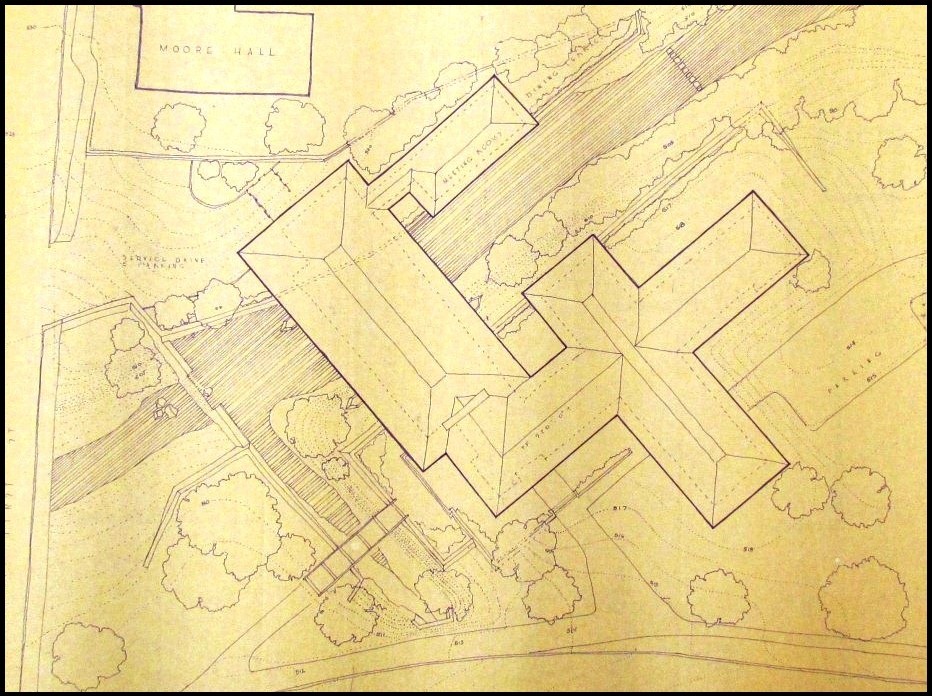
Above: Fred Day’s initial plans for the Texas Alumni House. In this image, 21st Street runs along the left border with part of the Moore-Hill Residence Hall at top left, while San Jacinto Boulevard – with the stadium across the street – is at the bottom. Click on the image for an expanded view. Source: University of Texas Buildings Collection, Alexander Architecture Archives, University of Texas Libraries.
Haskew was prudent to call for “advance cognizance,” as Fred Day’s design was a bold one. The building didn’t simply nestle alongside the dappled and meandering waters of Waller Creek; the creek was the centerpiece of the plan. Day’s Alumni House resembled a squared “C” shape, with the central portion spanning the water. The entrance, lobby, and Association staff offices were in the east wing, nearest to San Jacinto Boulevard. On the far bank, the west wing housed a series of conference rooms with Creekside views, along with an extended outdoor dining terrace shaded by live oaks. Connecting the two wings was a grand main lounge and dining room, equipped with a catering kitchen. Visitors to the lounge would gaze out of full-length windows on either side to see Waller Creek pass underneath the building.
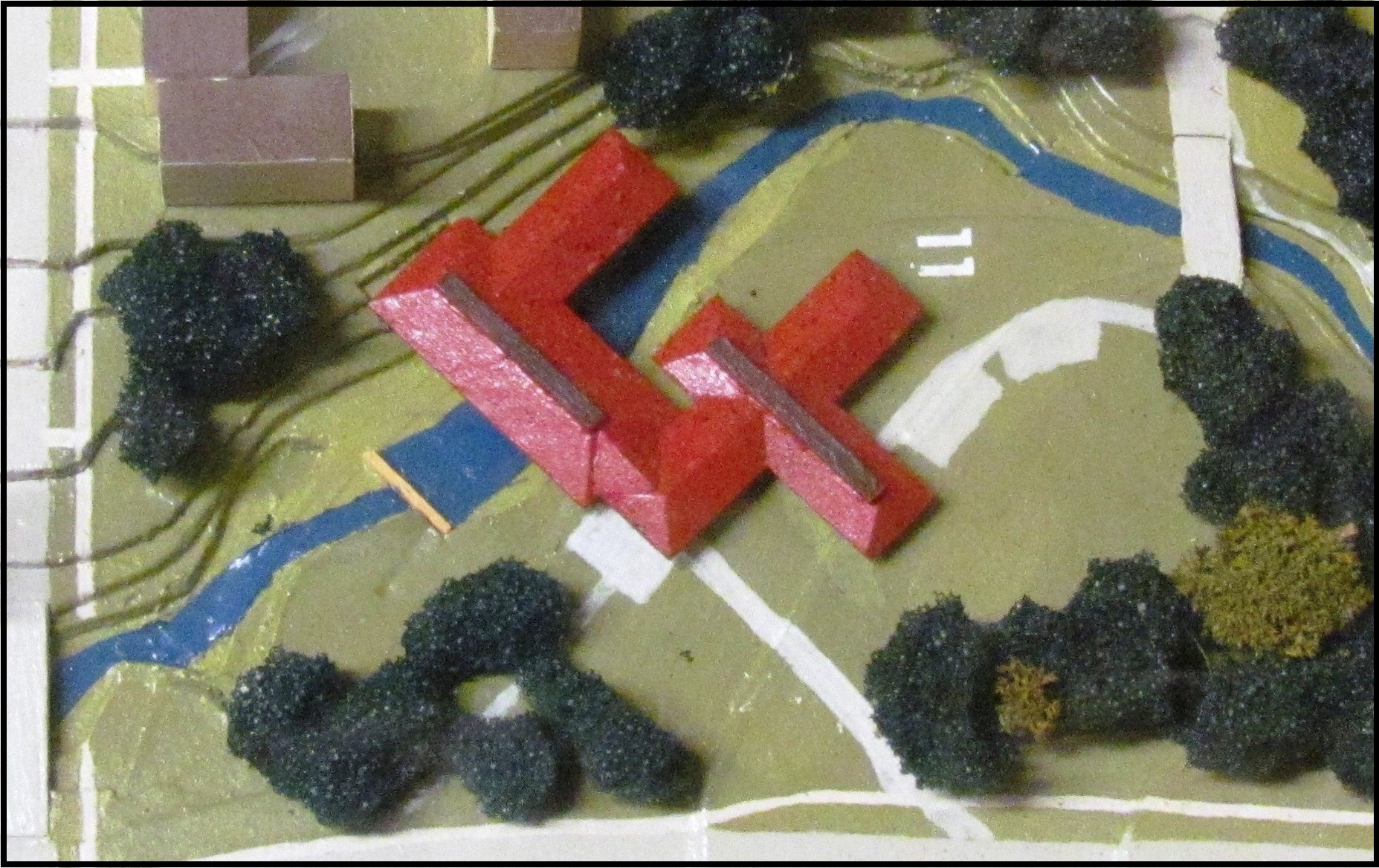
Above: View of the Alumni House footprint with the Main Lounge spanning Waller Creek. Photo from a portion of a 1962 campus master plan model.
To ensure enough water was present, a small dam was planned just downstream from the building that would both back up the creek and add a waterfall. A second partial barrier, installed upstream in the form of a stepping stone bridge, provided foot access across the creek and created an artificial rapids.
Day purposely located the building near the south edge of the property, where the slope of hill on the west side of the creek was a little less steep. The remaining land was reserved for parking and future expansion.
A first birds-eye rendition of the Alumni House was ready in August and a formal announcement made to the press. The reported cost varied from $250,000 – $300,000. The actual estimate was near $260,000, which required the alumni to raise $150,000 and add it to the $110,000 from the Etter fund.


Top: A detailed view of the proposed Alumni Center, with some color added by the author to better distinguish the location of Waller Creek and the outline of the building. The east wing, in the shape of a “+,” housed offices for staff and a vault to safeguard the original alumni records, then kept on index cards. Above: A cutaway view of the main lounge, which used about 2/3 of the central wing. Beyond the doors was a smaller dining/meeting room, with a kitchen behind the wall on the far side. Click on an image for a larger view.
~~~~~~~~~~~~~~~~~~~~
With the 1962 fall semester underway and Fred Day at work on formal building plans, attention turned on fundraising. Holmes appointed a fundraising committee with former Association President Sterling Holloway as chair, while former Texas Governor Allan Shivers oversaw the acquisition of special gifts. Popular Dean of Student Life Arno Nowotny was named vice chairman.

There were discussions with university officials on whether to concentrate on a few large donations or make a general appeal to all alumni. In the end, both strategies were used. In October and November, luncheons for prospective donors were held in cities throughout the state, including: Dallas, Houston, Austin, San Antonio, Corpus Christi, El Paso, Tyler, Midland, and others. On the agenda were talks by Harry Ransom, Allan Shivers, Arno Nowotny, Sterling Holloway, and Jack Maguire.
In concert with the fundraising luncheons, the November issue of the Alcalde alumni magazine featured a second, more detailed rendition of the building, which was now formally styled the “Lila B. Etter Alumni Center.” Included in the magazine was a general appeal for donations. Members of the Association also received letters which asked if they “could spare 144 bricks?” as a minimum $10 contribution would purchase those materials, a square yard of carpet, or two gallons of paint.

Above: Part of the 1962 Alumni Center fundraising solicitation mailed to Association members. Click on an image for a larger view.
Along with alumni donations, additional contributions came from some unusual sources. In January 1963, Allan Shivers, American Airlines president C. R. Smith, and actor Rip Torn, all UT graduates, represented the University on “Alumni Fun,” a popular weekly quiz show broadcast on ABC. The team won $4,700, which was donated to the building fund. Along with quiz show winnings, the Canteen Company of America, one of the largest providers of vending machines in the United States, donated a week’s proceeds from three of its most popular coffee machines on the UT campus, and presented the alumni with $410 in dimes.

Above: Allan Shivers, C R Smith, and Rip Torn compete for the University of Texas in ABC’s Alumni Fun quiz show in January 1963.
By mid-spring 1963, the campaign was a success. More than 3,000 alumni had sent contributions from $1 and greater, including three $10,000 donors, six $5,000 donors, and 25 alumni who gave $1,000 each. The new Alumni Center seemed assured, and a groundbreaking ceremony was promptly scheduled for 11:30 a.m. on Saturday, April 6th, on the banks of Waller Creek. A large sign on the property announced the future home of the Ex-Students’ Association and told passersby to expect to see the Alumni Center within the year.
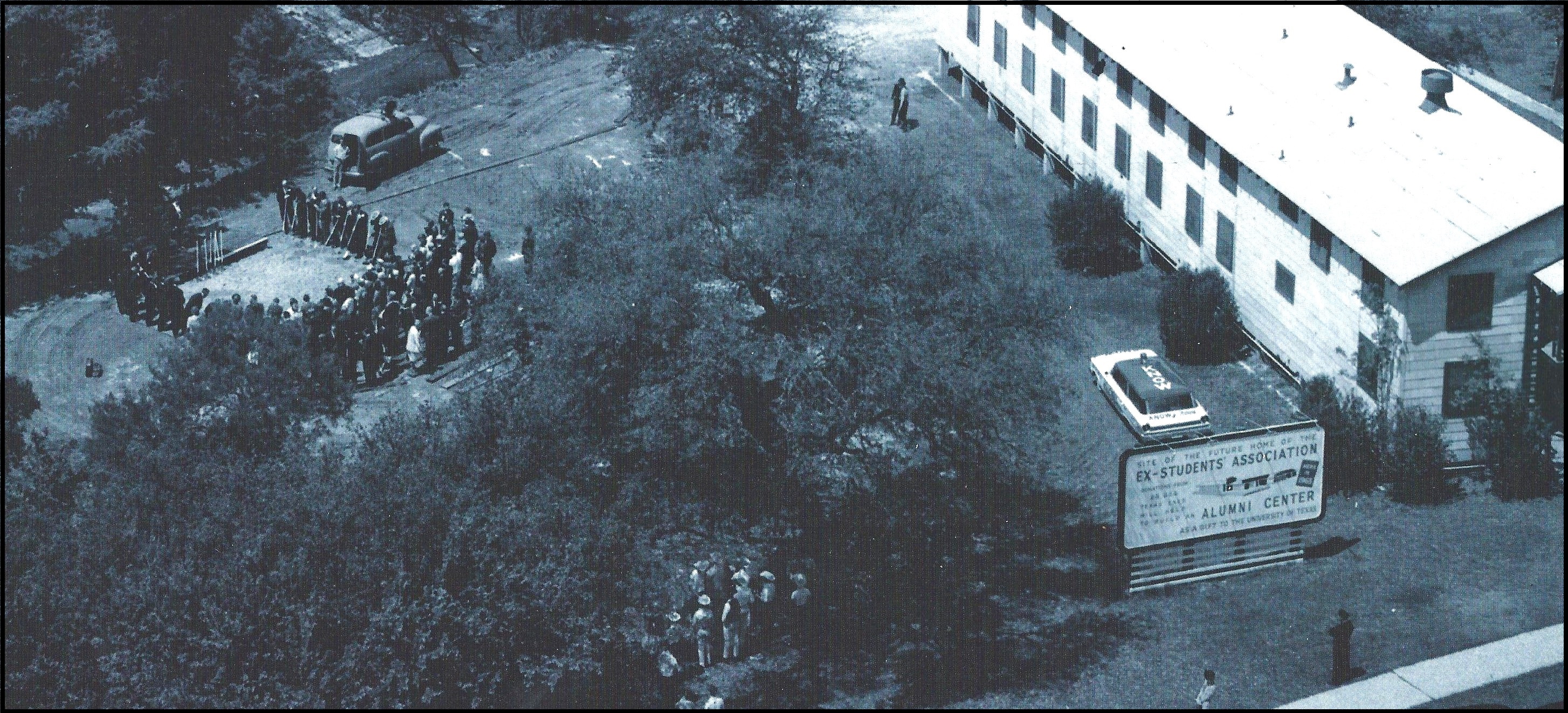
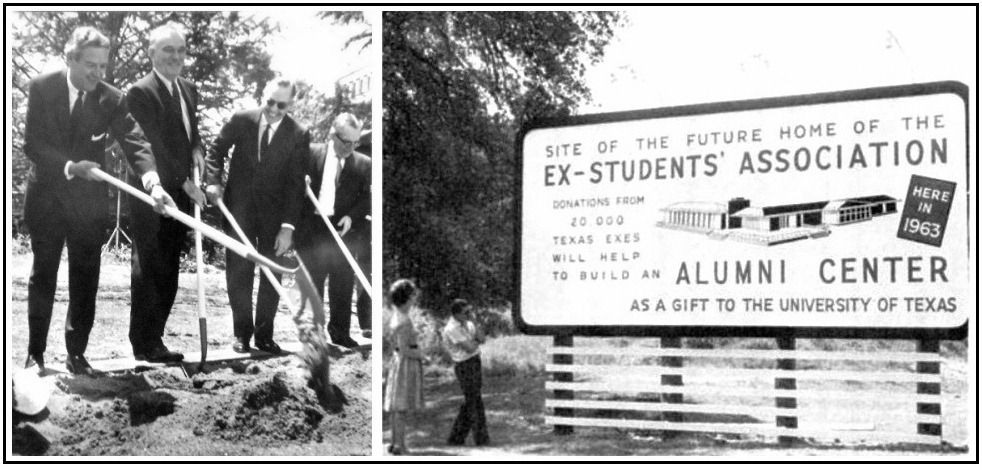
Top: A groundbreaking ceremony was held on the Waller Creek site on April 6, 1963. On the right is one of two post-WW II temporary dorms that were scheduled for removal. Groundbreaking participants included UT alumnus and Texas Governor John Connally, Board of Regents chair W. W. Heath, UT President Joe Smiley, and Dean Arno Nowotny.
~~~~~~~~~~~~~~~~~~~~
The great setback came a few weeks late. After contractor bids were opened, the cost of the Alumni Center as designed was far greater than anyone anticipated, specifically the transformation of the western bank of Waller Creek to make room for the west wing and dining terrace, the extensive use of retaining walls, and a redirected tributary to the creek so that it would remain behind the proposed dam. Through the summer of 1963, architect Fred Day attempted to rescue his design. He shortened the west wing and reversed its direction, and then removed it outright while still preserving the main lounge over the creek. Neither brought the costs down to acceptable levels. Unwilling to reopen the fundraising drive, the Alumni Center committee reluctantly abandoned the initial plans and sent Day back to the drawing board.
Through the fall, Day worked on new plans for the building, placed it alongside Waller Creek instead of over it, and preserved the elements used in the initial designs. The single main lounge and dining area was divided into two connected rooms at right angles, and then joined to a larger structure around a simple square courtyard with a fountain. The plan afforded ample light throughout and office windows that faced either the courtyard or outside, while the main lounge and the dining room were nudged close to the edge of Waller Creek for the best views. A walled patio adjoined the main lounge to make room for larger alumni events.

Above: With construction underway at last, a new sign replaced the original.
Construction finally began on April 27, 1964, just over a year after the groundbreaking. The Association staff moved into its new quarters the following February, and it was officially opened Saturday, April 3, 1965, as part of the annual Round-Up Weekend. In the morning, the graduating classes of 1940 and 1915 used the building to begin their 25 and 50-year reunions, and then joined a larger crowd outside in front for the dedication ceremony, which included performances by the Longhorn Singers and the Longhorn Band.

Above: The Alumni Center dedication program cover.
Executive Director Jack Maguire addressed those assembled: “Many years ago, Edgar Guest wrote a poem which began, ‘It takes a heap of livin’ to make a house a home.’ Today we are dedicating a very beautiful house . . . It’s a heap of a house, and we invite you to do a heap of living in it. The best invitation I can extend to you is a line which was used to introduce the 1915 Cactus. ‘The gate is down – ride through.’ Today the gate to the Lila B. Etter Alumni Center is down. Ride through it – any and every time you are here.”
~~~~~~~~~~~~~~~~~~~~
A Tour of the Lila B. Etter Alumni Center

When completed, the new Alumni Center was a 14,400 square-foot beige brick building with brown concrete roof tiles that best resembled a ranch house nestled in a grove of mesquite, live oak, and pecan trees along Waller Creek. With its use of natural materials, textured brick, and local stone, along with its residential-like impression, one visitor simply described it as “Southwest ease.” It was meant to be both a casual, welcoming place for visiting alumni, as well as a functional facility for the Association staff. Inside was a large main lounge, a dining room with a catering kitchen, two conference rooms, 11 private offices, a vault to store the all-important alumni files, a printing and mailing room, three patios (including a central courtyard), and a 25-car parking lot on the north side.
It was also unabashedly the University of Texas Alumni Center, full of what some called “Longhornisms.” The breaks along the edge of the roof, for example, weren’t for style, but held orange floodlights (image above). Just as the UT Tower had its victory lights, the Alumni Center glowed orange – including the central courtyard – after nighttime football victories and for other special occasions.

Most visitors entered the building from San Jacinto Boulevard through a pair of massive oak doors with Texas-size brass handles. On the door itself was a “T” plate to which a perpendicular “U” was attached and used as the handle. Once inside, the entry foyer (image below), with its terra-cotta floor tiles, lamps, and chairs, was meant to evoke a home rather than a more formal University building.
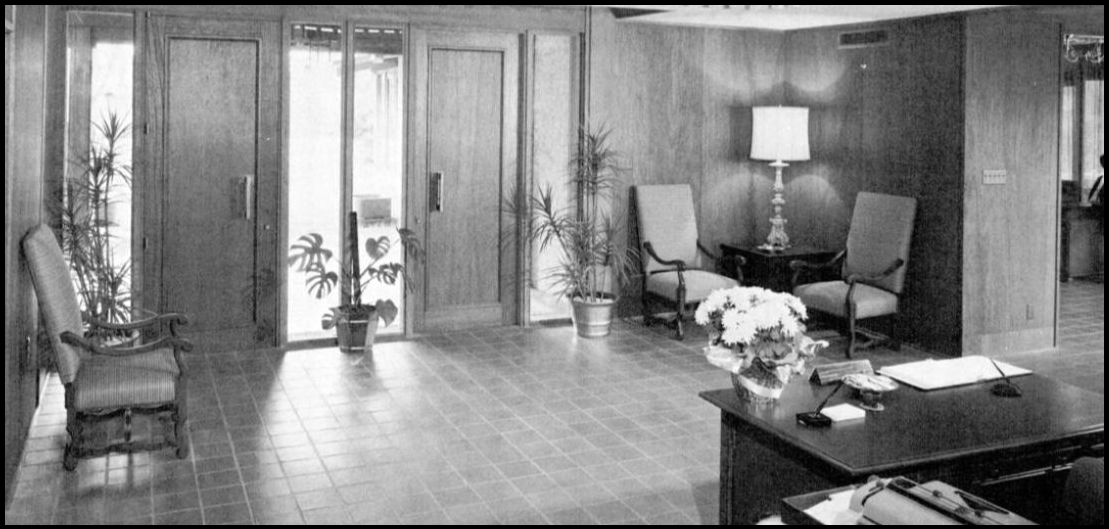
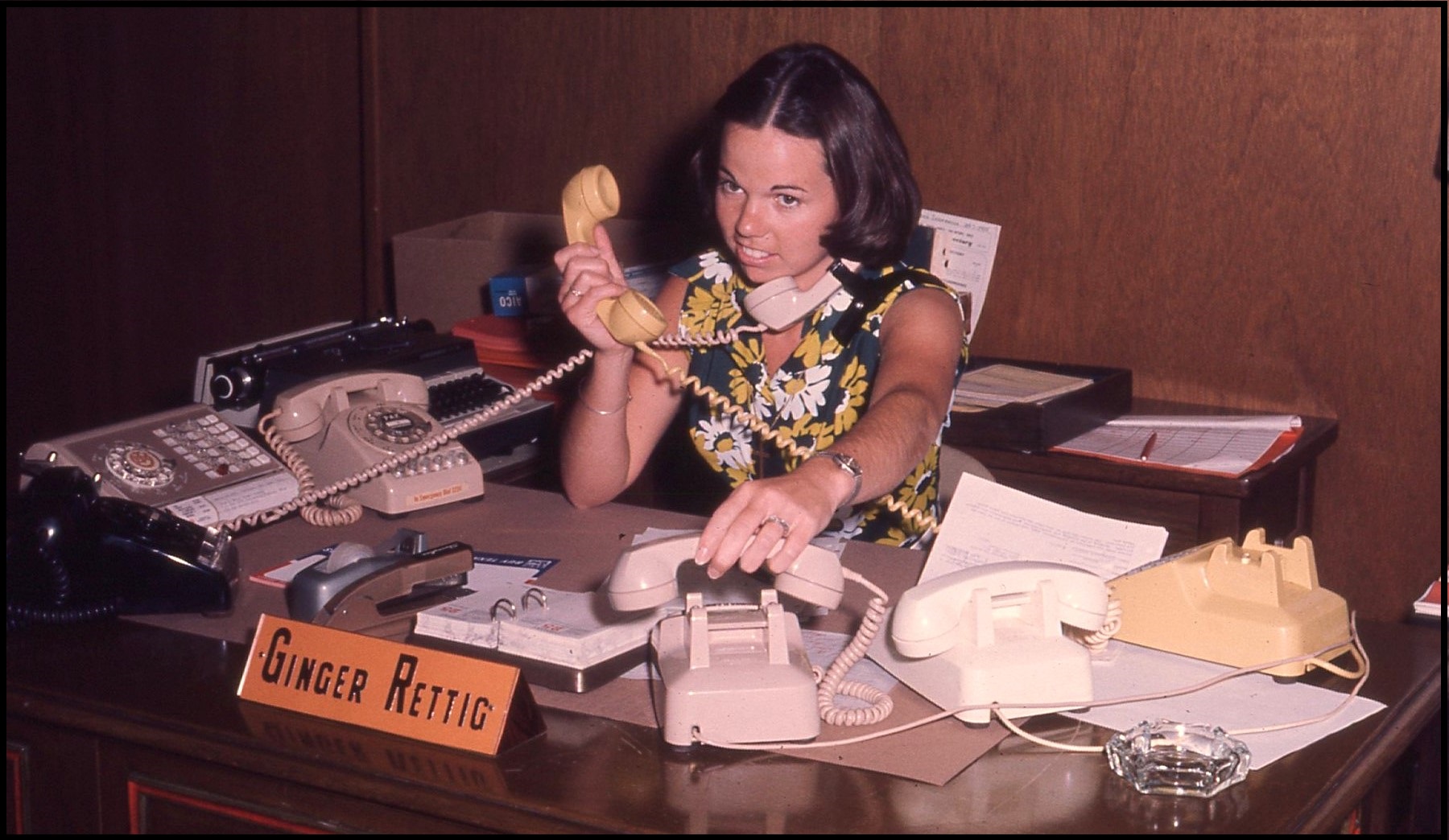
Above, Ginger Rettig in charge at the foyer receptionist desk. “Ancient technology” abounds here, including rotary dial phones and typewriters. And notice the ash tray on the desk at lower right. At a time when smoking was more accepted and common, visitors could smoke indoors, and ash trays were a normal and functional part of the furniture. After the 1990 expansion of the Alumni Center, the wall behind the receptionist desk was replaced with the stairwell that leads to the second floor.

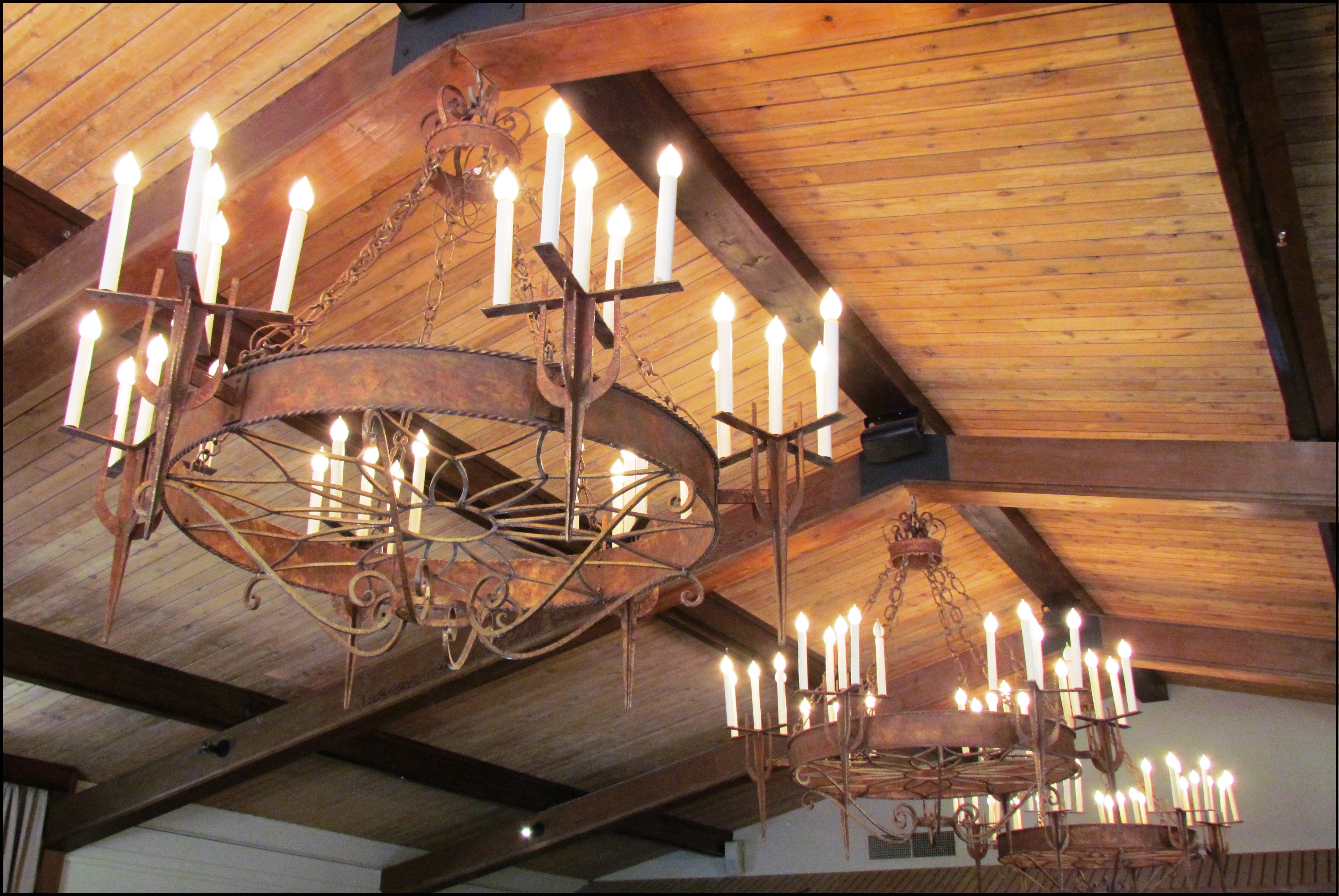
Once past the foyer, the spacious main lounge was the showpiece of the Alumni Center. With a 15-foot vaulted and beamed ceiling, tall windows provided plenty of light and invited visitors to gaze out on Waller Creek. A six-foot fireplace with a Texas granite hearth commanded the east side of the lounge, and mahogany-paneled walls completed the room. Interior designer Arthur Watson, Jr. decided on the furnishings and called it “Early Texas” style, a blend of American West and Spanish Colonial. Along the walls were eight antique brass sconces from Spain, and suspended from the ceiling by heavy chains were wrought-iron chandeliers with gold and copper leaf finish, custom-made in Mexico. Looking closely, a visitor would likely notice the interlocking UTs that supported the candle light fixtures (image above left).
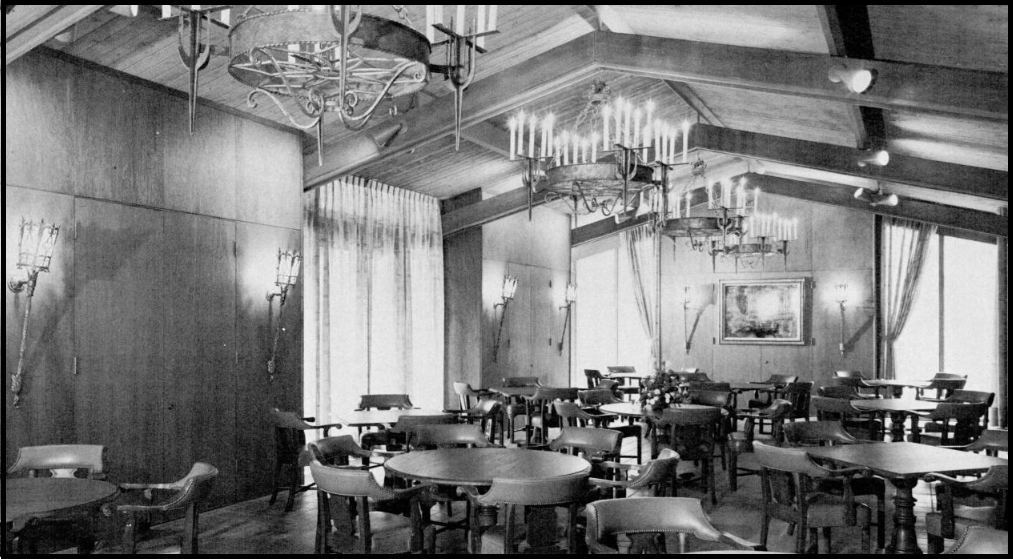
Next to the Main Lounge was the Dining Room, with matching mahogany walls, sconces, and chandeliers. Equipped with a catering kitchen on the north side, the original furniture was purchased from the Texas Pavillion of the 1964 New York City World’s Fair. For years, the Dining Room was used for lunches, served from 11:30am – 1:00pm, at first catered the Driskill Hotel, then the Victorian Hotel in downtown Austin, and finally by University Housing and Food. The meals were especially popular with faculty on the east side of the campus. Today, the room is still popular and used by the Texas Expresso Café.
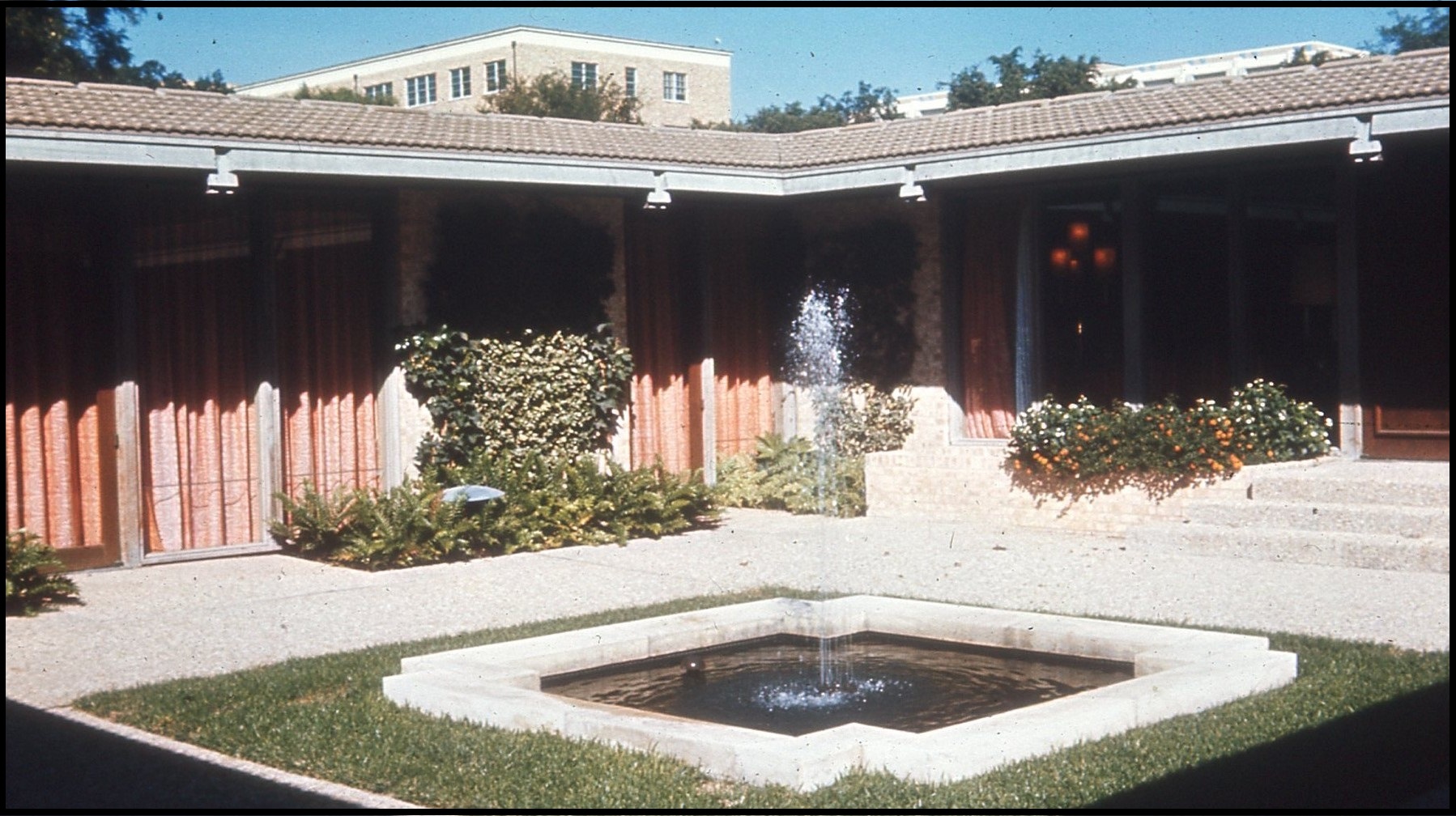
Just north of the lounge is the central courtyard with a simple fountain. Here, too, the breaks along the edge of the roof housed orange floodlights. The courtyard provided an outdoor extension to the lounge for large events, created easy access to other parts of the center, and provided sunlight to the conference rooms and offices that bordered it. Today, the courtyard has been enclosed by the Frank Denius Concourse.
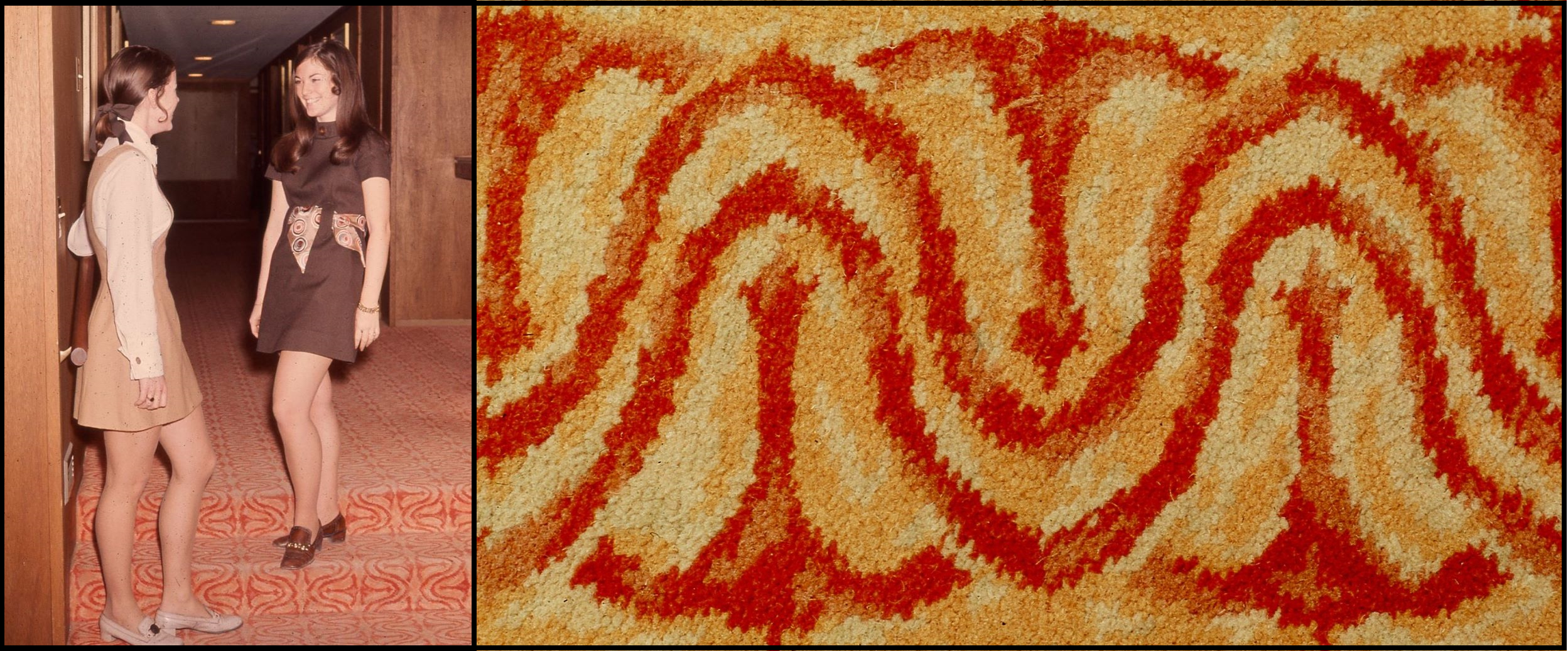
The carpeting in the Alumni Center was one-of-a-kind and woven in Scotland. Designed by Arthur Watson, it, too, was a “Longhornism” with a series of wavy U’s interspersed with Ts. The same design was used for most of the window drapes and some wall coverings.

Inside the office of the Executive Director, where orange was the rule. Eight-foot longhorns were mounted above the double doors that led out to the courtyard, and the carpeting and drapes matched those in most of the rest of the building. Seated is Director Jack Maguire (second from right, smoking a pipe) and future executive director Roy Vaughan (with the cigar).

At left: A different drapery design was used for the Main Lounge, which featured a repeating pattern of orange and white U’s and T’s (which look a bit like longhorns), surrounded by football shapes.
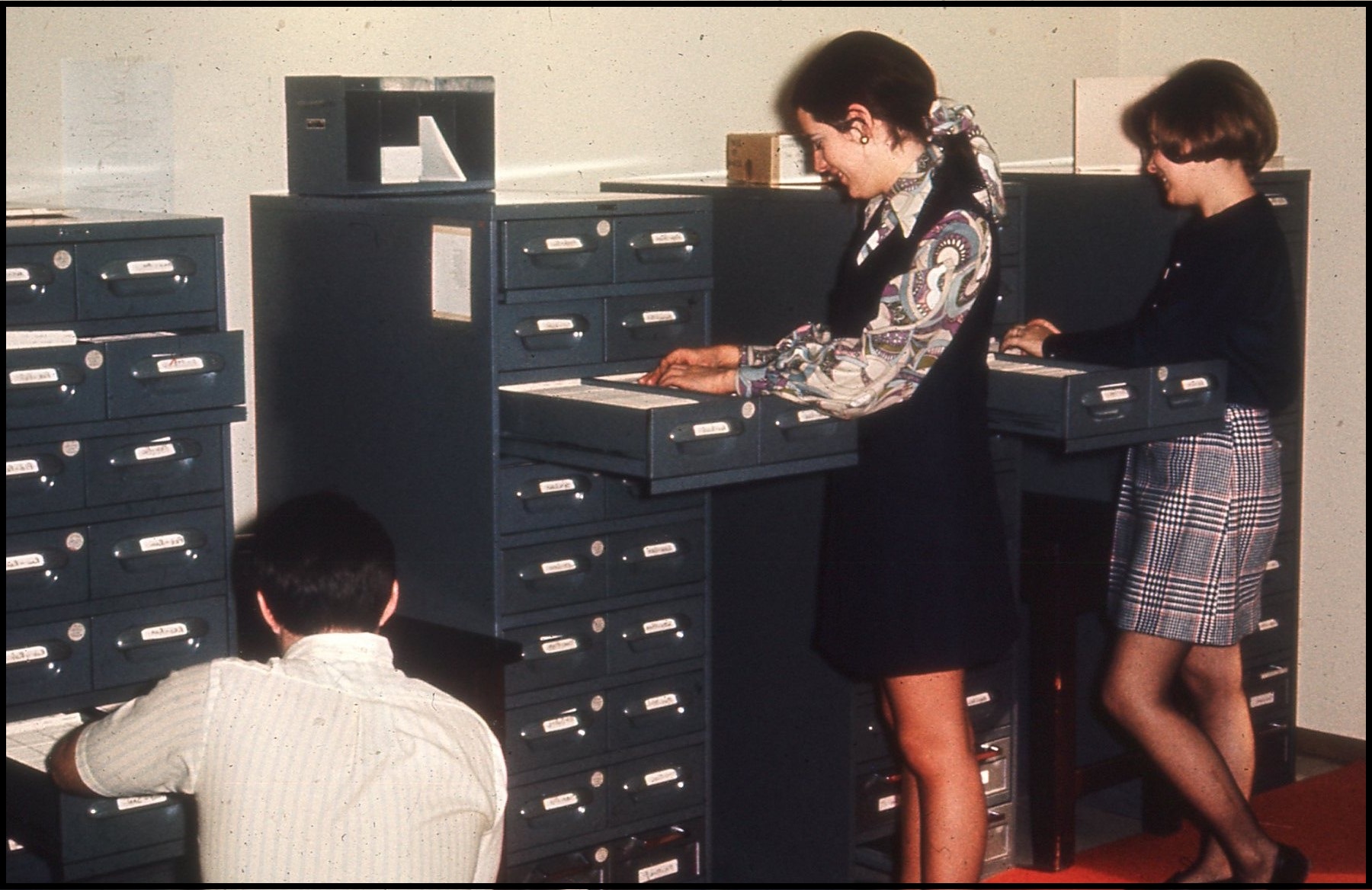
A fireproof vault in the building safeguarded the original alumni records, which had been preserved and updated on index cards for decades. By the early 1960s, more than 175,000 records were being digitally stored on room-size IBM computers.


The alumni records office and printing room in the rear of the building was always a hectic place. While the Alcalde magazine was published off-site, most of the membership solicitations and newsletters were printed and mailed in-house, along with publications for other University schools and colleges. (For many years, the Association printed the very first alumni newsletter for the business school, known as The Ex-Citer.) This area is now the Myers Library and Executive Director’s office. At left, Association staff member Phil Cornejo ran the main printer while wearing an orange apron bearing the new Texas Exes brand (see How to Brand the Alumni).
Sources include: The UT Presidents’ Office Records and Ex-Students’ Association Records, part of the University Archives preserved at the Briscoe Center for American History; architect Fred Day’s drawings for the Alumni Center in the UT Buildings Collection at the Alexander Architectural Archives; California Alumni Association, 2011 Alumni House Historic Structure Report; the Alcalde magazine; and the Austin American-Statesman and The Daily Texan newspapers.

 The UT History Corner