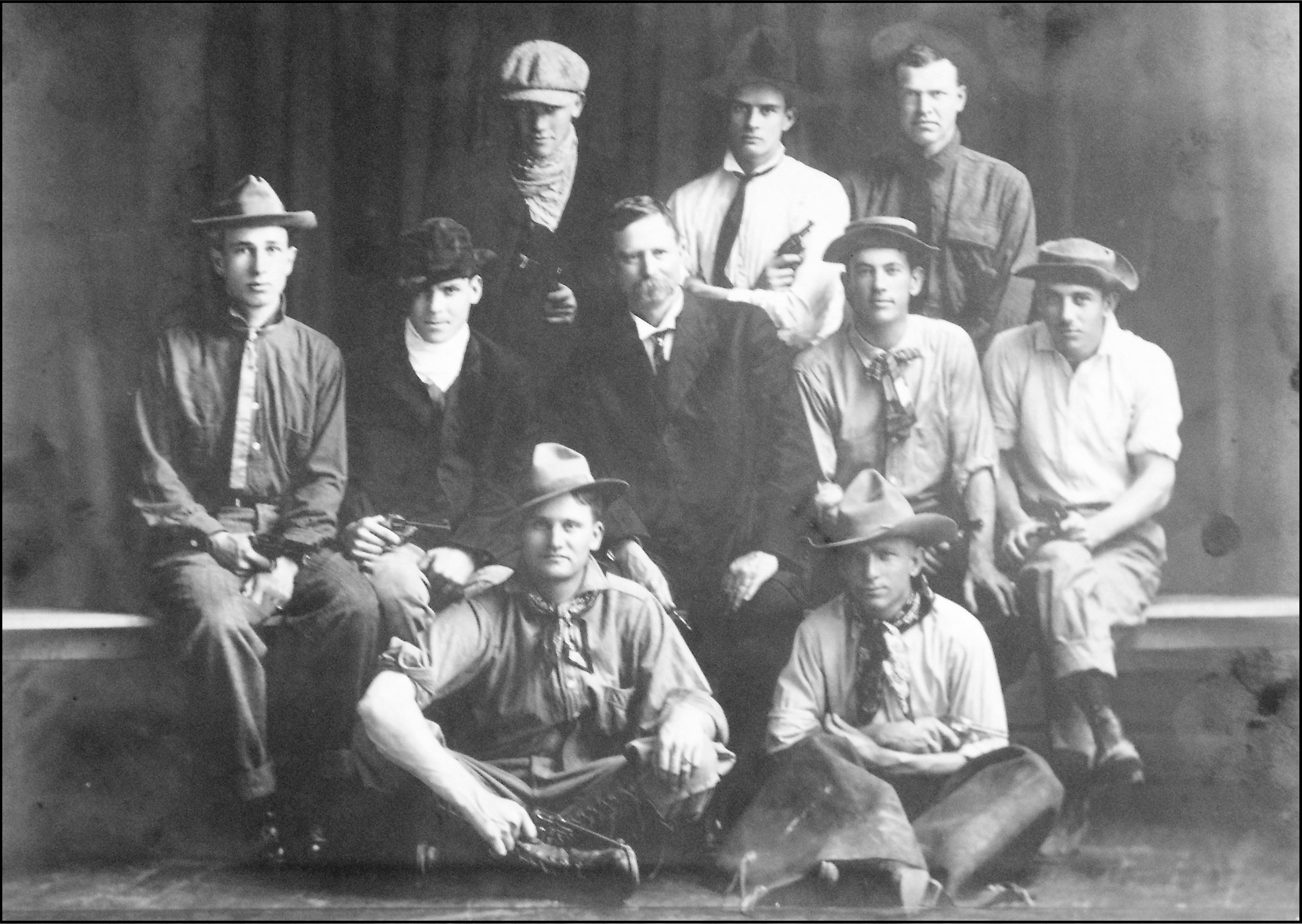
Dean Thomas Taylor (center), and the nine “Taylor’s Bandits” unmasked. Yes, each of those UT students is brandishing a six-shooter (with blanks!). Click on the image for a larger view.
Engineering Dean Thomas Taylor was in a considerable predicament.
It was a balmy spring Monday evening, April 1, 1912, when the University faculty gathered for their monthly dinner. A mostly-social event, it was scheduled at the University Club, located just west of campus on San Antonio Street. Though the meal was funded through club dues, the professors from each academic department took turns as hosts, and were responsible for the menu and post-dinner entertainment. This might include a musical performance or skit by the host faculty, a special lecture, or a debate. This particular evening, it was the law department’s turn, but the professors had devised something rather sinister: they planned convene a surprise kangaroo court and place the engineering dean on trial.
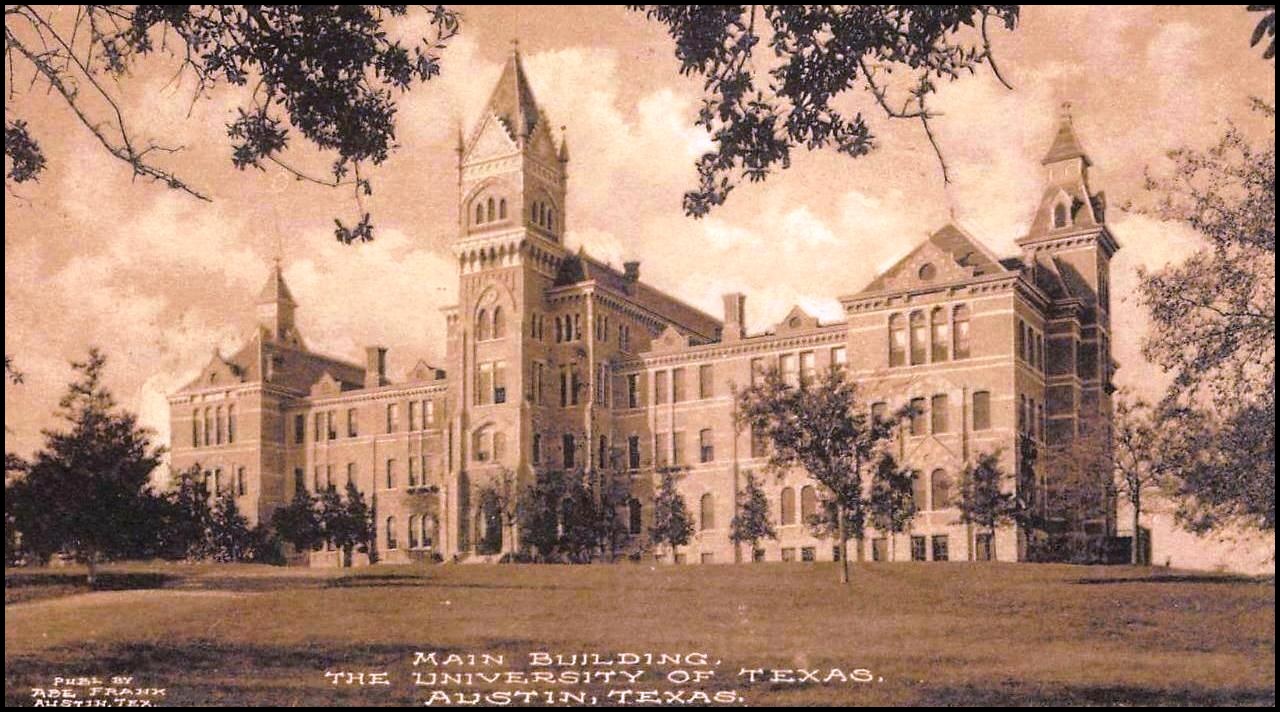
Above: A 1912 postcard of the University’s Old Main, where the Tower stands today.
The faculty organized an all-male University Club in December 1904, both as a social outlet and to network with college-educated men in Austin. They found a house on the corner of 17th and Lavaca Streets, and chose Professor Will Battle – namesake for Battle Hall and the Battle Oaks – as the group’s first president. After just over a year, better quarters were found closer to campus at 23rd and San Antonio Streets, with a third move several years later to a two-story house at 2304 San Antonio. (Today, the site is just behind the Castilian dorm, where the Pi Beta Phi sorority house now stands). Its proximity to the Forty Acres greatly increased membership and attendance.
The clubhouse included rooms for receptions, lounging and reading, playing billiards, and cards. A stocked kitchen was next to an over sized dining hall, and several rooms on the second floor were rented to new faculty members who were just getting settled in Austin. There were Christmas parties for members and their families that featured a visit by Santa Claus, receptions for visiting professors in town to give a campus lecture, post-debate dinners for the UT Debate Team and their opponents (which, on several occasions, came all the way from Oxford University), and costume balls for members and spouses (though history professor George Garrison and his wife never seemed to want to dress up).
Tuesdays were mostly reserved for the University Ladies Club, composed of wives of professors and women faculty and staff. Each spring, the women hosted a Bluebonnet Card Party, which often had 15 tables of bridge being played simultaneously, and with each table decorated with baskets full of hand-picked Texas bluebonnets.
_______________
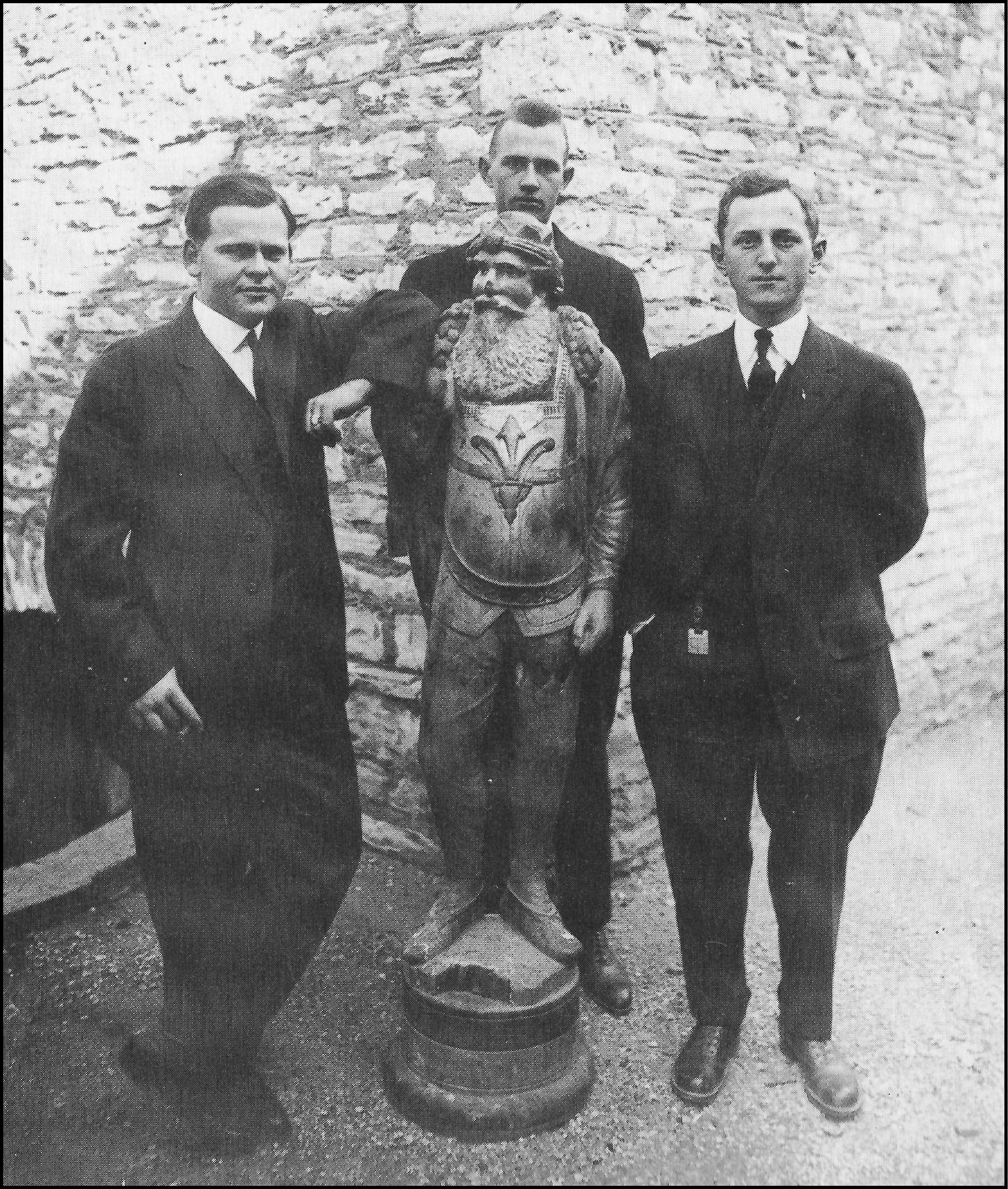 As the faculty arrived for their monthly dinner, that it was held on April 1 made it all the more special for the engineers. Starting in 1908, the day was reserved to pay tribute to Alexander Frederick Claire – or “Alec” for short – as the “patron saint” or mascot of Texas engineering students and alumni. In that year, students “borrowed” a wooden statue from a local beer garden, declared it to be the likeness of Alec, paraded the figure around the campus on the morning of April 1, swore allegiance to their mascot on “holy” calculus books, and promptly cut classes for the rest of the day. For the present Cockrell School of Engineering, the first day of April is still revered as Alec’s Day, and the statue is on display in the engineering library. (See: The Thrilling Adventures of Alec!)
Above left: UT engineering students stand with the original likeness of Alec. The current statue is on display in the engineering library.
At the same time, the law and engineering departments had been longtime, mostly-friendly rivals, and the 1912 law faculty saw the date as a ripe opportunity. They planned to have the red-haired Dean Taylor stand trial for some invented vagrancy, and once convicted, Taylor would be assessed a dinner for the law faculty at the dean’s expense.
As there were only five law professors, others were recruited to join in the fun. Medieval history instructor Augie Krey and history professor Charlie Ramsdell were named “sheriffs” and would arrest and secure Taylor, while Harry Benedict, Dean of what was then the College of Arts and Sciences, was given the title “Foreman of the Jury” and was to lead the audience to an inevitable guilty verdict.
Benedict held a PhD in astronomy from Harvard, but had earned both bachelor’s and master’s degrees in civil engineering at Texas under Dean Taylor, and wasn’t about to be branded a traitor. Benedict quietly informed Taylor of the law faculty’s dastardly plans, and Taylor arranged for a group of nine trusted engineering students – later dubbed “Taylor’s Bandits” – to rescue him at the appropriate time.
As the dinner began, there was a feeling of pleasant anticipation among the law faculty. The engineering professors possessed a similar feeling, but for an entirely different reason.
Just as the main courses were finished and dessert was to be served, the kangaroo court was sprung and the sheriffs ordered to take Taylor into custody and seat him in a chair at the front of the room. Taylor, who’d recently become a car owner, was promptly accused of “auto-intoxication” and “insolent indifference to the whims, fancies, and wishes of the University Club.” The audience, with a collective tongue-in-cheek, recoiled in horror at learning of the charges.
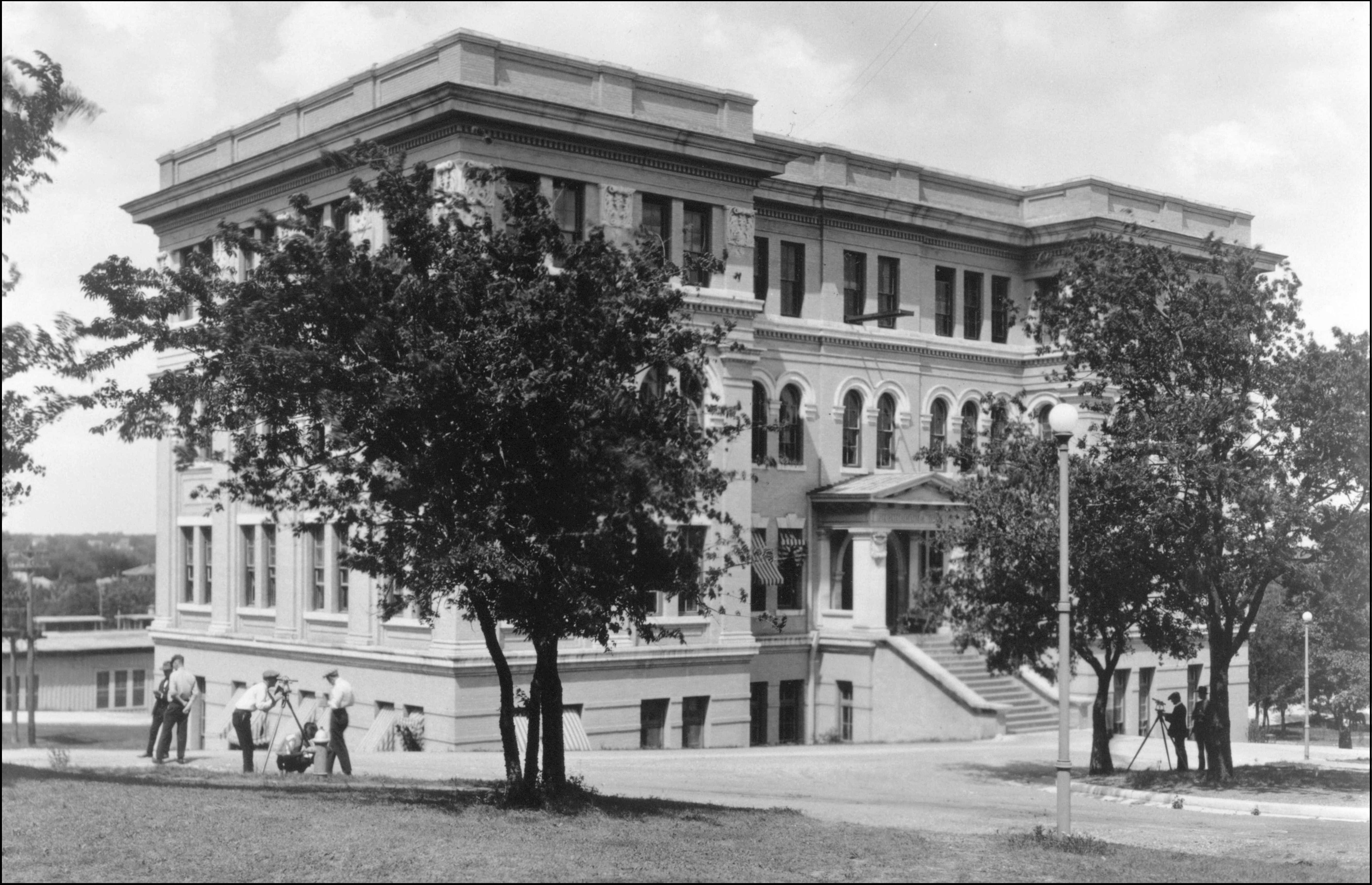
Above: The Engineering Building (today’s Gebauer Building) was just east of Old Main.
At that point, the court’s proceedings were abruptly pre-empted. A signal by engineering professor Ed Bantel brought the nine masked bandits screaming into the room from the kitchen where they’d been hiding. All were armed with actual six-shooters – loaded with blanks! – and the “courtroom” was suddenly filled with shouting and shooting, gun smoke and mayhem. (In the 1910s, most UT students hailed from farms and ranches, some raised in log cabins, so that owning a six-shooter wasn’t uncommon.) Taylor was hustled out of the dining room, and while the “sheriffs” tried to retain their charge, they were no match for the determined bandits. Taylor was led out of the clubhouse and hurried off to the University campus for the protection of the Engineering Building (today’s Gebauer Building).
A few days later, Dean Taylor did indeed host a dinner at his expense, but it was for his faithful bandits.
 The UT History Corner