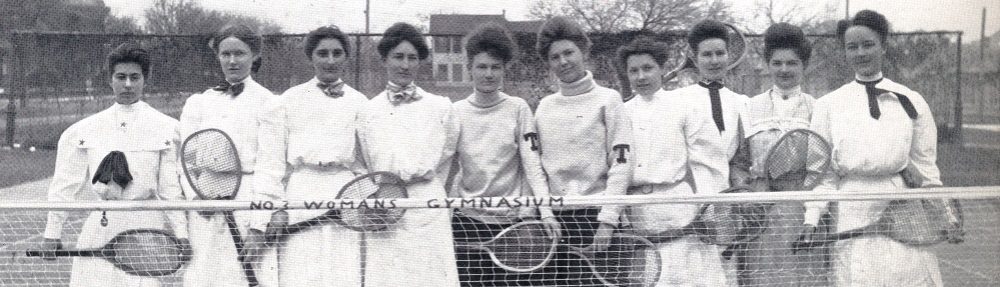
Or, How April 1st became a UT Holiday
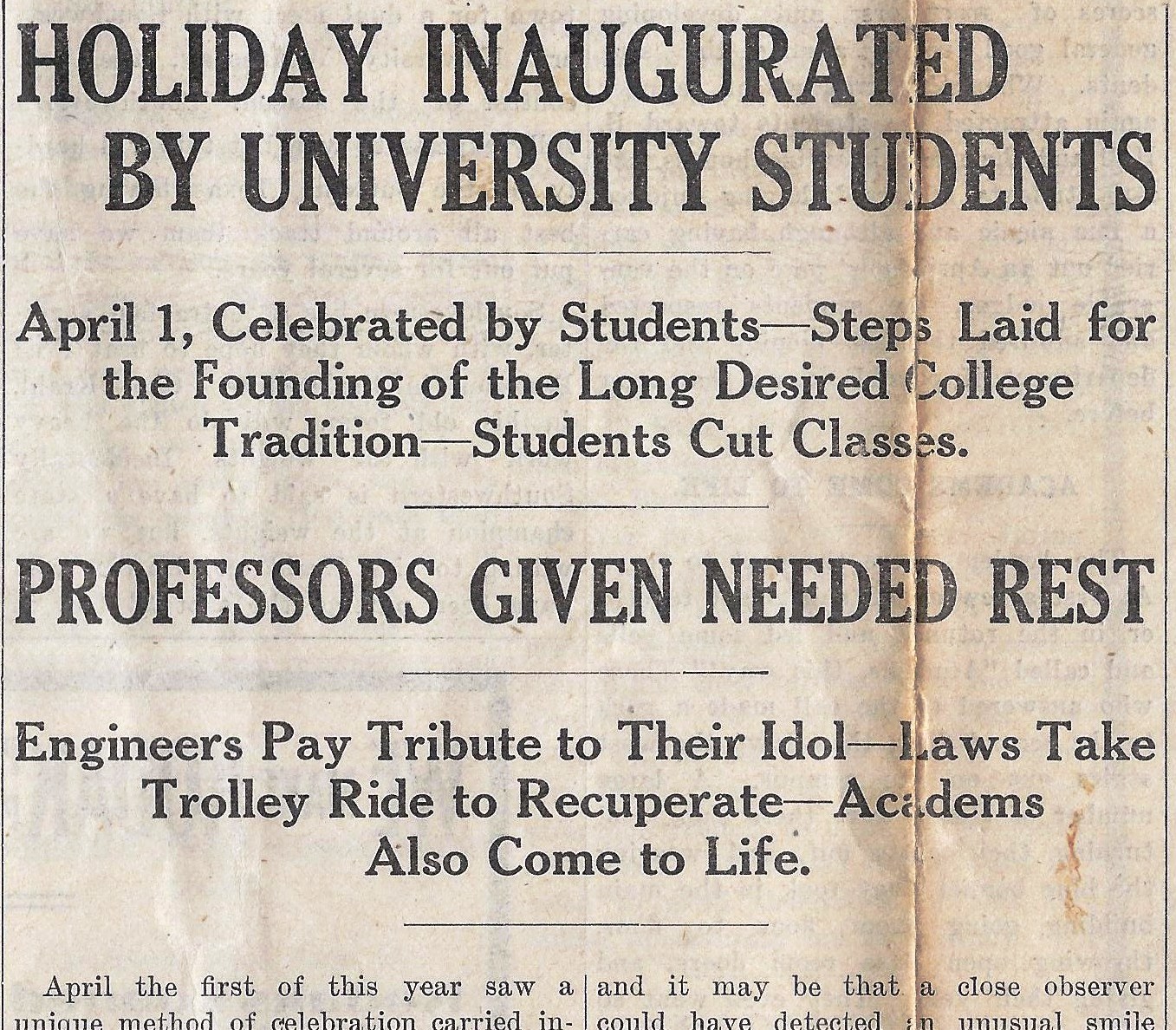
Above: Headlines from The Texan in April 1908. “Holiday Inaugurated” – “Professors Given Needed Rest.” How considerate of UT students to give the faculty a day off!
All hail UT’s patron saints!! Among the schools and colleges on campus, a few have taken on mascots which have affectionately been promoted to patron saints. The law school has its staid Peregrinus, business boasts the wily Hermes, architecture claims the mysterious Ptah. But the best-known is the patron saint of the Texas engineers: Alexander Frederic Claire, or simply, Alec. His arrival created an annual UT holiday.
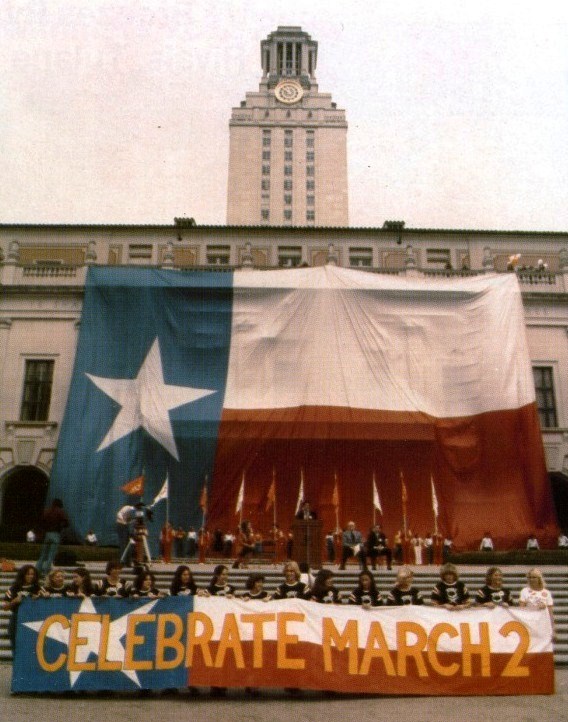
When the University first opened in 1883, the academic calendar of choice was the quarter system, and holidays were in short supply. The fall term opened in early October, with final exams completed just in time for Christmas. Winter classes resumed the third or fourth day of January and ran through mid-March. And without a pause, the spring term began immediately after winter finals and continued mercilessly until the first week of June. In the spring, students were permitted only two days to catch their breath: March 2nd in honor of Texas Independence Day, and April 21st for San Jacinto Day.
In 1908, the start of spring classes was joined by a student movement for a third spring holiday, preferably April 1st, which was about halfway between the other two. Officially, the faculty opposed the idea, though professors did nothing to prevent the cause from gaining momentum. As the students began to organize, there were indications that if their request was refused, they would simply stage group walkout for the day.
About the same time, UT engineering students received an invitation from their counterparts at the University of Missouri to travel north to the Show Me State for St. Patrick’s Day. Since 1903, Missouri engineers have declared St. Patrick to be one of their own, and have used March 17th to celebrate.
As for the Texas engineers, they’d already claimed a patron saint. Since 1901, Alexander Frederick Claire – or “Alec” – was the main character in Hi Ho Balls, a favorite song of the engineers. But Alec was known in name only. There was neither an appropriate physical rendering, nor a special day, for UT’s patron saint.

The invitation from Missouri, along with the students’ request for a holiday, sparked an idea. If the Missouri engineers take a day off to honor their patron saint, why not dedicate the first of April as a day of homage to Alec?
On the evening of March 31st, student members of the TECEM Club – which stood for Texas Engineers: Civil, Electrical, Mining – gathered for their weekly meeting on the second floor of the Engineering Building (today’s Gebauer Building). The group’s purpose, according to Dean Thomas Taylor, was to “promote practically everything but learning and scholarly attainments.”
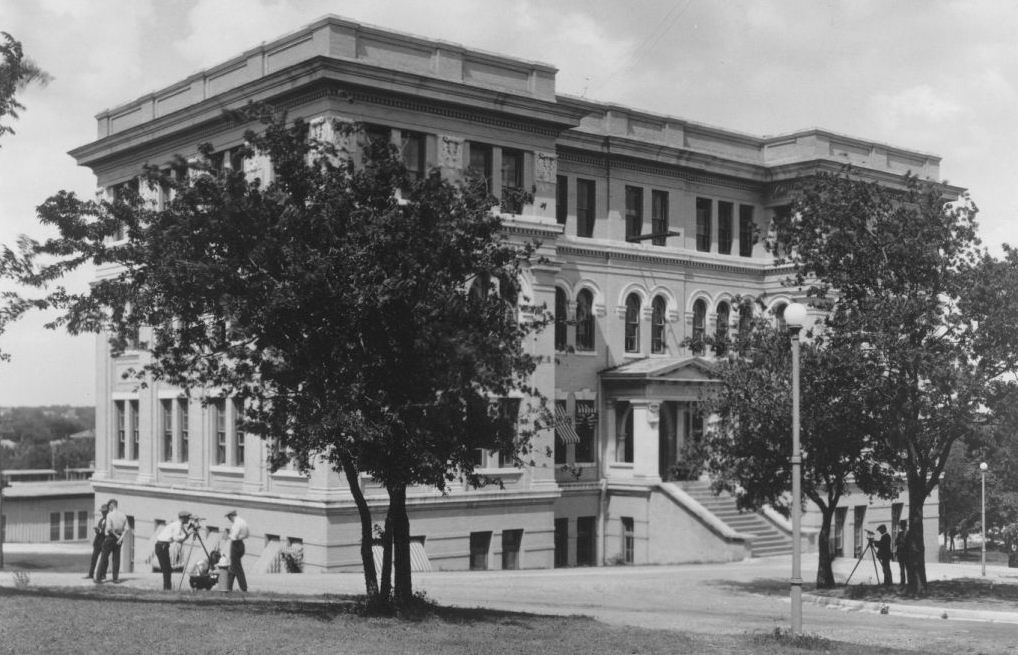
Above: students practice surveying in front of the old Engineering Building, today’s Gebauer Building, just east of the UT Tower.
First on the agenda was to make plans for April 1st. To encourage their fellow students to cut classes, the group wanted to smuggle a few stray dogs up to the top floor of the old Main Building, tie tin cans to their tails, and let them loose during the first class hour at 9 a.m. It was hoped the ruckus would create enough chaos to disrupt classes for the day. The group adjourned to find the required canines, but the neighborhood dogs weren’t very cooperative, and the idea was dropped due to a lack of volunteers. Instead, the club adjourned to Jacoby’s Beer Garden, just south of the campus on Lavaca Street.
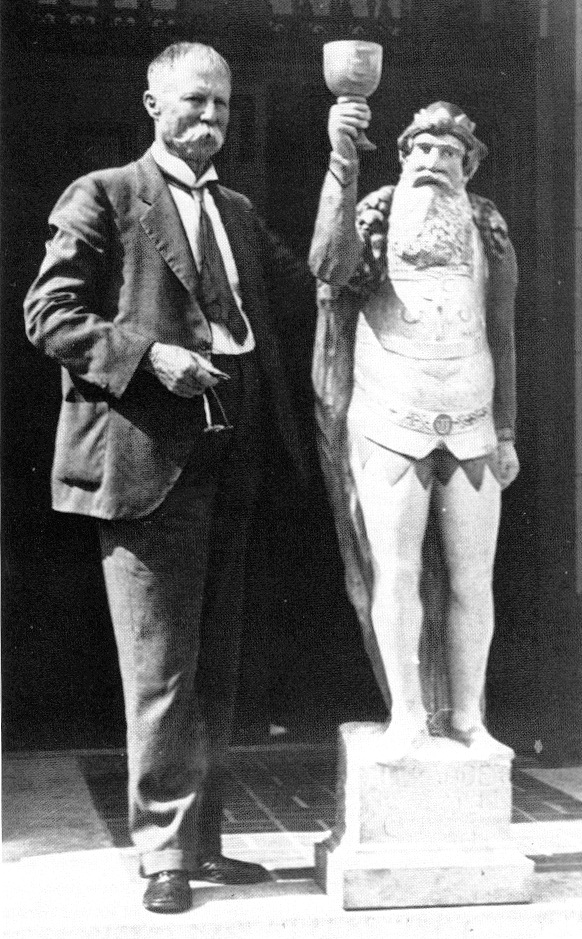 Just after midnight, as the group was about to depart, they spied a wooden statue under a porch shed near the exit. Meant to promote Falstaff Beer, it was a chubby, medieval character. After a quick conference, the group decided to “borrow” the statue and quietly spirited it away to old B. Hall, the men’s dorm, where they perfected plans for the next day. (Photo at left: Engineering Dean Thomas Taylor stands next to Alec in the 1930s.)
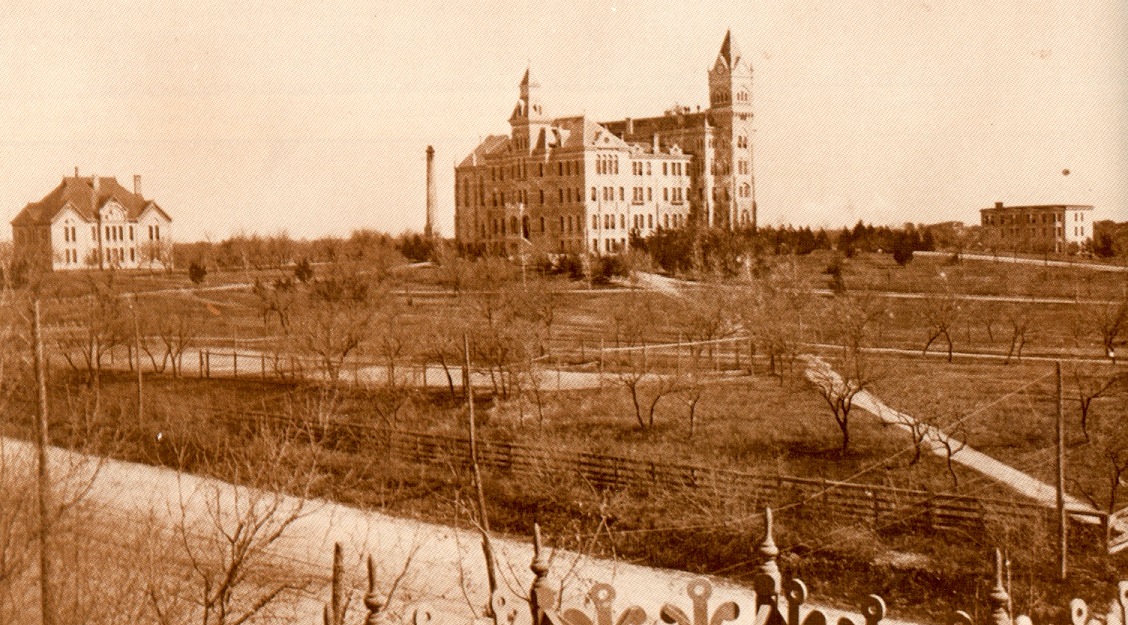
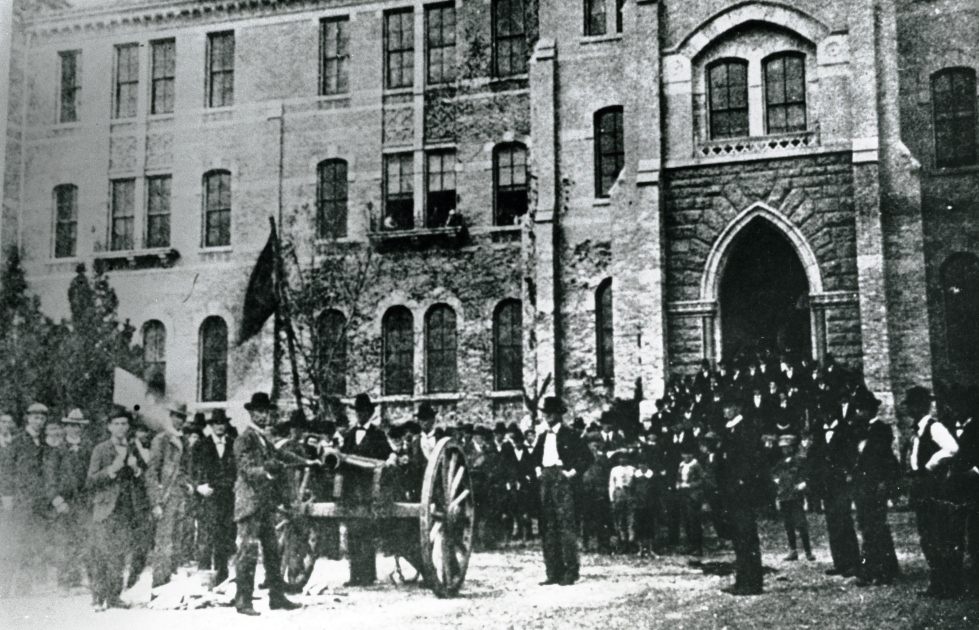
On the sunny and humid morning of Wednesday, April 1st, everyone in the Engineering Building knew “something was up.” Professor Bantel went to his office and locked the door, while Dr. Benedict, who had scheduled a quiz for his first class, failed to show up at all. The engineering students gathered in front of the building and lined up in rows of four, while a few created a makeshift band from some tin horns, hastily crafted kazoos, and an improvised percussion section of trash cans and lids. At precisely 9 a.m., a noisy procession set off across the campus. The engineers marched around the perimeter, entered into the west wing of the old Main Building, through the central rotunda, then out the south main door. There, the group formed a circle around the new likeness of their patron saint.
In front of Old Main, Alec was formally unveiled as a handkerchief tacked on to his head was removed with great flourish. Sophomore Joe Gill spoke eloquently on the life of Alec, who, Gill claimed, was the founder of engineering science. It was Alec who created the Pyramids of Egypt, the Hanging Gardens of Babylon, and the Great Wall of China. Alec himself surveyed and built the roads of Ancient Rome, dug the Suez Canal, and invented the T-square, the original model still on display in the United States Patent Office. Alec’s achievements were so moving to Gill, he was reportedly overcome with emotion several times and had to constantly wipe away a stream of tears from his face.
Following Gill’s tribute, the engineering students filed past their patron saint one-by-one. Each placed a small bouquet of hand-picked bluebonnets at the base of the statue, then swore allegiance to Alec with their right hand resting on a “holy” calculus textbook.
The ceremony concluded, senior engineers promptly kidnapped Dean Taylor (who had neglected to lock his office door) and went for a picnic at Bull Creek. The rest of the engineers set out for a trip to the Austin Dam and a day of swimming. Not wanting to be left out, law students abandoned their classes en masse and turned the city’s electric street cars into roving party vehicles, while the Academic Department (Arts and Sciences) went as a group to Sixth Street. Though it was never officially approved, for years April 1st became an annual “cut class” day.
The celebration for Alec also became an annual ritual, much to the chagrin of the rival law students, who had designs on the statue for their own purposes. (Read more on the origin of the UT engineering – law rivalry.)
In the spring of 1913, while Alec was resting comfortably at the foot of the stairs to the Engineering Building, law students captured the patron saint took him to a farm near Pflugerville. Placed in a pig sty and knee-deep in swine, Alec was photographed for the Cactus yearbook. “This,” claimed the lawyers, “shows Alec in his true element.”
“No!” retorted the engineers. “That is Alec feeding the laws.”

Above: In November 1913, engineers celebrated the rescue of the original Alec after the laws took the patron saint to farm in Pflugerville.
In 1916, armed with the knowledge that Alec had initially been “borrowed” from Jacoby’s Beer Garden, the statue was kidnapped again when the laws approached Mr. Jacoby’s widow and “legally purchased” the statue from her. Armed with a bill of sale, the laws brought Alec before the Justice of the Peace, had him declared a vagrant, and sent him to the city jail. Dean Taylor and the engineers appealed to Governor James Ferguson, who issued a full pardon, and warned Alec to beware of “out-law-yers.”

Above: After being declared a “vagrant” at the hands of the law students, Governor James Ferguson issued a pardon to Alec in 1917. Click on the image to see a larger version.
Because the laws still held a bill of sale, Dean Taylor elected to retire the original statue. In 1917, Alec’s right leg was cut into small strips, branded “CELAFOTRAP” (“Part of Alec” spelled backwards) and sent to Texas Engineers fighting in the American Expeditionary Force during the First World War A second statue was created by local woodcarver Peter Mansbendel. The new Alec was kept locked in a vault in the Littlefield Building downtown, where he could make a short but safe trip to the annual Engineer’s Banquet at the Driskill Hotel next door.
A decade later, on February 21, 1927, the evening of an Engineer’s Banquet, the Laws took Alec once again. Sixteen law students climbed up a fire escape to enter a hotel room guarded from the hallway by Dean Taylor and several engineers. The laws dismembered the statue, sent the head to Governor Daniel Moody, and delivered other pieces to law alumni. The torso was hung in a tree on the campus for a brief time, then disappeared, only to turn up years later in the Law School library.
Governor Moody returned Alec’s head to Dean Taylor, who commissioned a third rendering by Austin master woodcarver Peter Mansbendel, who incorporated the head and other salvaged pieces of the patron saint.
 As retirement approached, Dean Taylor was very secretive about Alec. The statue was seen in public only a few times, always surrounded by an armed guard of engineers. After Taylor’s death in 1941, Alec remained in hiding, stored by the Texas Memorial Museum in a house north of the campus. Some journalism students discovered him there in 1964, after a report that someone had spotted a coffin in the basement. Alec was restored, and in 1972 was put on display in the engineering library. (Photo at left: Alec secured in a glass case with a concrete base in the engineering library.)
In March, 1987, word reached the College of Engineering that the dismembered torso of the second Alec had recently been discovered in the Tarleton Law Library, an opportunity the engineers couldn’t resist. On March 30th, David Walker and Chris Flynn, then engineering seniors and members of the newly formed “Order of Alec,” approached Julia Ashworth, an archivist at the law library. The two claimed to be from the Cactus yearbook, and asked if they could take a photograph of the torso. Ashworth agreed. Making the excuse that there wasn’t enough light in the library, Walker persuaded Ashworth to take the torso outside. Once outdoors, three masked “unknown and unnamed ruffians” rushed by, grabbed the torso and disappeared.
The events seemed far too coincidental. Law School Dean Mark Yudof wrote a scathing memo to his engineering counterpart, Dean Earnest Gloyna, demanded the torso’s return, and labeled the scandal “Gloynagate.”
On April Fool’s Day, Gloyna was subpoenaed, along with a few engineering student leaders, to appear in court. The laws argued the engineers had waited too long to claim ownership of the torso, and demanded Alec be returned to them.
The two groups met in court on Friday, April 3rd. On one side were the “law nerds” while others wore buttons that read “unknown and unnamed engineering geeks.” Judge Harley Clark (who, as head cheerleader in 1955 introduced the “Hook ’em Horns” hand signal) presided, and listened to both arguments. In the end, Clark made no decision of ownership, hoped that Alec’s “thieves” would keep him safe, and that the rivalry between the two schools would continue.
Today, Alec, along with the recovered torso, are stored in sealed exhibit cases in the engineering library. The statue is bolted to the display case, which has a heavy concrete base.
Alec is safe, for now.

Above: The recovered torso and pieces of the original Alec statue – included one branded “CELAFOTRAP” – are on display in the engineering library.

 The UT History Corner