The Texas Exes Logo turns 60

It’s a one-of-a-kind. If you’ve spent any time on the University of Texas campus, you’ve likely seen it: the curious horseshoe logo of UT’s Ex-Students’ Association – popularly known as the “Texas Exes.” It guards the entrance to the Alumni Center. Association members are familiar with it on their membership cards, auto decals, and life member keytags. But in the course of its 60-year history, the symbol has also appeared on everything from matchbook covers to wine bottles, and from cookbooks to class rings. And, it’s been to the moon and back.
How did the logo get its start? It was imagined on the roads of East Texas, born in a $5.00 class competition, and for decades, its author was unaware of the success of his creation.
~~~~~~~~~~~~~~~~~~~~

For the University of Texas, the 1964 fall semester was an eventful and historic one. Football fans were still aglow after the team won its first-ever national title the previous season. Just across the street from the stadium, work on a new Alumni Center was nearing completion. The alumni association staff was preparing to move from its cramped temporary quarters in the west-side basement of Mary Gearing Hall. Next to the Tower, the Undergraduate Library and Academic Center was the latest building on the campus. It was UT’s first “open stack” library, where students had direct access to the bookshelves and audio-visual materials. The library’s architectural design, though, drew plenty of supporters and detractors, and their views were regularly published in The Daily Texan’s editorial pages. After years of petitions, protests, and, at times, tense discussion, the Board of Regents voted to integrate the University’s residence halls. For the first time, African American students resided in Kinsolving, Moore-Hill, and Simkins (today’s Creekside) dorms.
Above left: The Tower with its first-ever “number 1” and the newly-opened Undergraduate Library.
At some point during the semester, Jack Maguire, the Ex-Students’ Association Executive Director, and Field Representative (and future executive director) Roy Vaughan went on a road trip to visit towns in Northeast Texas and Shreveport, Louisiana. “It was a club trip,” Vaughan explained during a recent conversation. The two visited with local alumni clubs, or chapters. Since it was so long ago, he wasn’t sure of the exact date, but likely in early November.

Driving through the pine and live oak forests just outside of Gilmer, Texas, Maguire brought up the topic of a logo and why the Association should have one. The Alumni Center was about to open, a young “Flying Longhorns” travel program (introduced in 1961) was growing quickly, and there were some 150 alumni clubs worldwide. In 1958, the Association launched “Operation Brainpower,” UT’s first academic recruitment program, meant to bring outstanding Texas high school graduates to Austin and counter similar recruitment efforts made by Ivy League universities. And in the spring of 1964, a few months prior to Maguire and Vaughan’s club trip, the Association opened a 360-acre guest ranch for alumni and families dubbed the “Corral of the Longhorn” near Wimberley, about 35 miles southwest of Austin. With all of these varied activities, and more, an appropriate logo to visually unify everything was needed.
Above right: An Alcalde alumni magazine ad for the Corral of the Longhorn. Starting in 1964, the ranch resort was used for alumni family vacations, Association meetings, continuing education programs, UT music camps, student organization retreats, and other events. Ultimately, it turned out not to be financially viable and was closed in 1968.
Vaughan, riding in the passenger seat, began to draft some logo ideas and tried to incorporate “UT” with “Texas Ex.” For decades, the Cactus yearbook and other University publications featured renditions of side-by-side or interlocking UT’s, many with a western or ranch theme. Vaughan experimented with one that included an upside-down horseshoe as the “U.” “It was just a variation of a UT logo,” said Vaughan.

Above: Variations of interlocking UTs have appeared in the Cactus yearbook and other University publications, and often followed a western theme, including a horseshoe, a cactus and longhorn head, and a fence post. Click on an image for a larger view.
~~~~~~~~~~~~~~~~~~~~

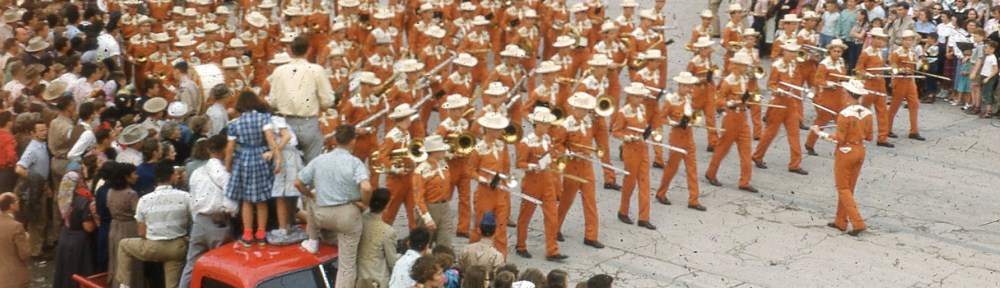
It’s no surprise that for the University of Texas, imagery and ideas from the Old West of the late 19th and early 20th centuries – with its ranches, cowboys, and cattle drives – pervades the campus culture. The mascot is the longhorn, and the Longhorn Band marches in western-style uniforms and cowboy hats. There are student organizations named Silver Spurs, Cowboys, Wranglers, and Lassos. Cattle brands adorn Garrison Hall and were once painted on the walls of the Chuck Wagon, a short-order diner at the Texas Union where the Cactus Café is today. (You can still see the colorful ranch-motif decorations on the ceiling.) The Brackenridge Residence Hall sports icons of ranch life, and since the 1990s, the annual moving in day for UT housing is called “Mooov-in.” University publications, especially for new students, have often continued the theme, with some promoting the idea of “branding” first-year students as longhorns, such as the 1954 “Howdy Week” brochure for new students (above left).

Above: Go to the Cactus Cafe in the Texas Union and look up! You’ll find the original, intricate ceiling decorations – ropes, boots, cactus, six-shooters, spurs, longhorn skulls and more – when the space was the Chuck Wagon, a popular short-order diner from 1933 – 1974.
For the Ex-Students’ Association of the mid-1960s, the soon-to-be-opened Alumni Center was designed, in part, to resemble a large ranch house. The Alcalde magazine titled its class notes section – personal updates about alumni listed by graduation year – as the Class Corral. The largest event of the year was called Round-Up, an annual spring alumni reunion created in 1930 by then Association President Bill McGill. On a ranch, a round-up is a gathering all of the cattle in one place in order to count them and make sure they’re all properly branded. McGill thought the term appropriate to “round up the longhorn alumni” and provide an opportunity for them to reconnect with themselves and the University.
~~~~~~~~~~~~~~~~~~~~
Back in Austin after their club trip, Maguire and Vaughan continued to discuss a logo. It needed to be distinctly Texan, and the western motif was an obvious good fit. Following in the spirit of the Round-Up event, the two agreed the symbol should resemble a cattle brand, what longhorn alumni would symbolically wear when they became Texas Exes. Sketches were traded back and forth. “We tried a version without the horseshoe,” explained Vaughan, “but Jack didn’t like it.” Nothing was finalized, however, and the logo remained unfinished.
After the New Year and start of the 1965 spring semester, the Association staff was focused on relocating from Mary Gearing Hall to their new digs next to the stadium. The move was to be completed by February 8, less than two months before the Alumni Center dedication ceremony on Saturday, April 3, which also coincided with Round-Up weekend. Given all of the usual turmoil that accompanies breaking down, moving, and setting up new offices, as well as tidying up the final details for the new building, there was scarce time to work on advertising the spring Round-Up. It created an ideal opportunity to involve students with Association activities. The staff contacted a professor at UT’s art department who was teaching a design class. A promotional Round-Up flyer was needed to send out to the alumni. Might this be a class assignment?


The professor agreed, but turned it into a competition between the students. The winner would receive $5.00 from the Association (worth about $50 today) and have their design mailed to thousands of alumni, a nice highlight for a young college graduate’s resume. The staff sent over a few guidelines about the Round-Up cattle ranch theme, along with the sketches for an Association logo as an alumni brand.
The chosen entry was drawn by graduating senior Jan Gosnell (images above and left). “Much to which I think was the dismay of our design instructor, I won,” Gosnell relayed in a recent email. The flyer’s cover featured the text “ROUND-UP ‘65” over an image of a pair of cowboys branding a longhorn, with the Texas Capitol and UT Tower in the distance. On the reverse was a listing of the weekend’s events and Gosnell’s creation of a “UT – EX” horseshoe logo. The brand wasn’t simply a solid color, but was purposely splotched or textured, as if seen on a longhorn hide. The flyer was printed and mailed in late February or early March.

Above left: Jan Gosnell’s textured alumni brand. Above right: The listing of Gosnell’s new employment in the November 1965 issue of the Alcalde, which provided the only clue as to who had created the final version of the alumni association logo.
Gosnell, from Corpus Christi, earned his Bachelor of Fine Arts degree in painting, drawing, and art history. He included the Round-Up flyer in his portfolio for job interviews, and it wasn’t long before he’d found employment in Houston. The Alcalde announced his new job in its Class Corral section the following November. (Author’s note: This single-sentence mention in an out-of-the-way corner of the alumni magazine turned out to be crucial to learning the origin of the brand!) After a couple of years, Gosnell was recruited as an instructor at the University of Mississippi, then wound up heading north to Arkansas to continue his career. Unfortunately, he lost touch with the University of Texas and what became of the alumni logo.
~~~~~~~~~~~~~~~~~~~~
For the Association, a prime opportunity to promote the new brand appeared soon after its debut. Before the start of the 1965 fall semester, the UT Athletics Department, unhappy with the previous food and drink supplier, asked the Association to take over concession sales for football, basketball, and baseball until a better solution could be found. (The Association managed concessions for the next two years, through the 1965 and 1966 football seasons.) Most of the profits went to support UT Athletics, though University student and civil organizations who worked as vendors could raise funds for their groups. Both UT’s Varsity Singers and Austin-area Boy Scout troops participated, among others.

By the time fall classes began, an orange-painted metal version of the brand was hung on the front of the Alumni Center, next to the main entrance. (Image above.) As football season neared with a home game against Tulane on September 18, the staff was feverishly redesigning both the concession stands and vendor uniforms. The brand appeared on the signs under the stadium that listed menu choices and prices, and on the backs of bright orange jackets and vests worn by the vendors who wandered the seating sections. It was printed on the soft drink cups and the popcorn paper bags. “We hope the public will be patient with us this first game,” Maguire told the Austin American-Statesman.

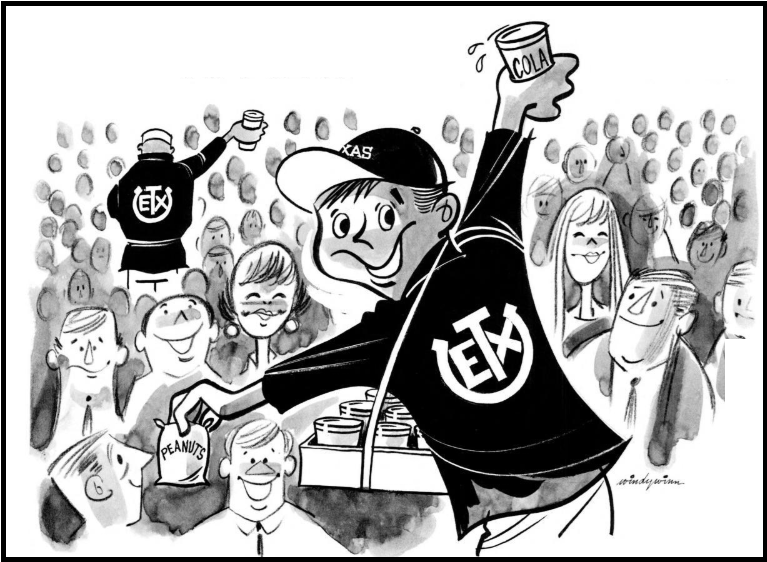
The response was a positive one. The Texan called it a “pleasant surprise,” and explained, “Fans who have attended past games will remember that the concessions were handled by a private firm and that the uniform of the day for the vendors was usually a pair of blue jeans and a T-shirt . . . He cannot help but notice the bright orange jackets and white pants of this year’s vendors.” Decades before Coach Mack Brown made “wear orange” a mantra for Longhorn fans, the orange vests of the vendors made it easy to find them in the crowd. To the more than 60,000 fans who packed Texas Memorial Stadium for each home game, the logo was ubiquitous. As alumni associations are always seeking ways to raise awareness among alumni and students, it’s difficult to imagine a better scenario.
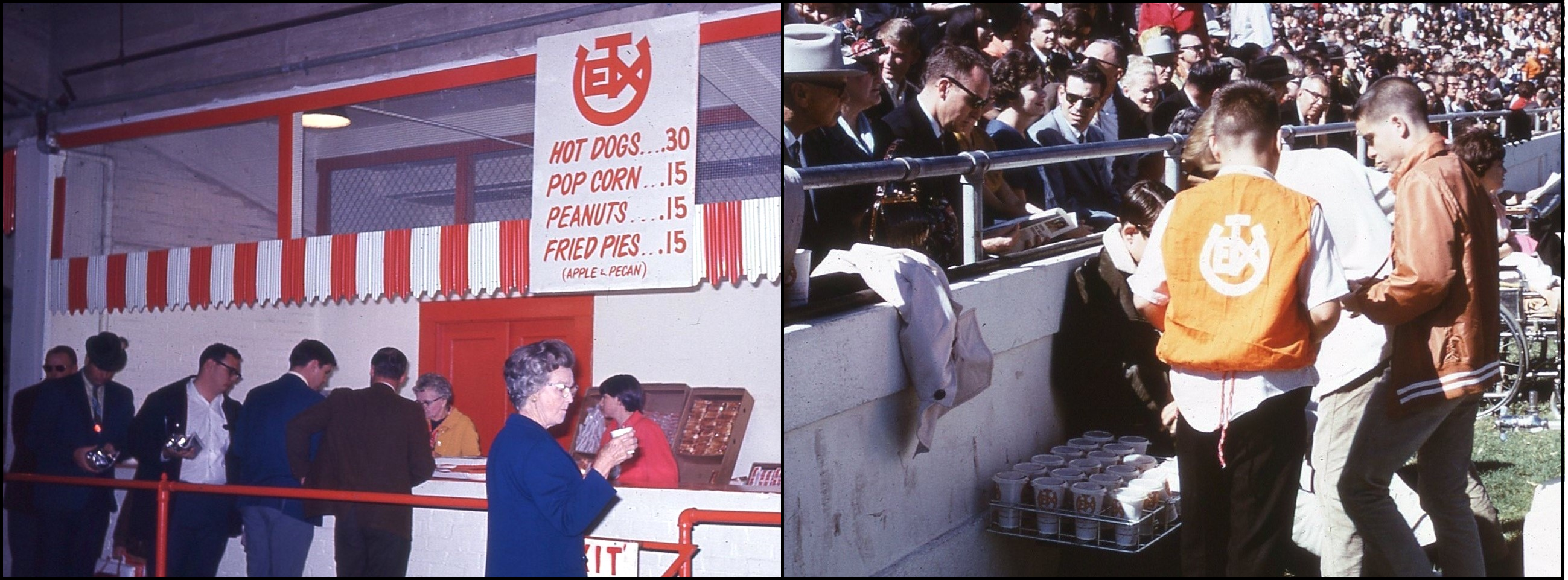
Above: Normally drab concession areas were spruced up with orange and white. Vendors wore bright orange jackets or vests with the brand to be easily seen in the stadium.
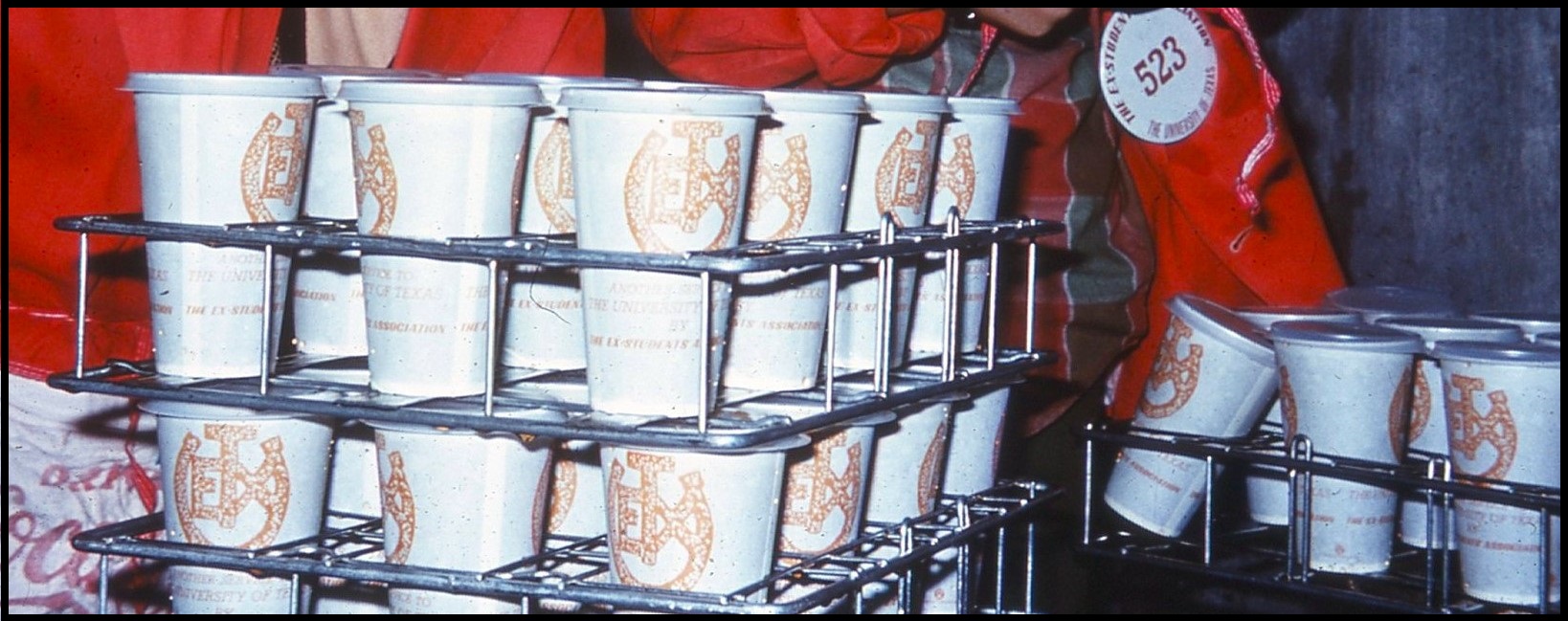
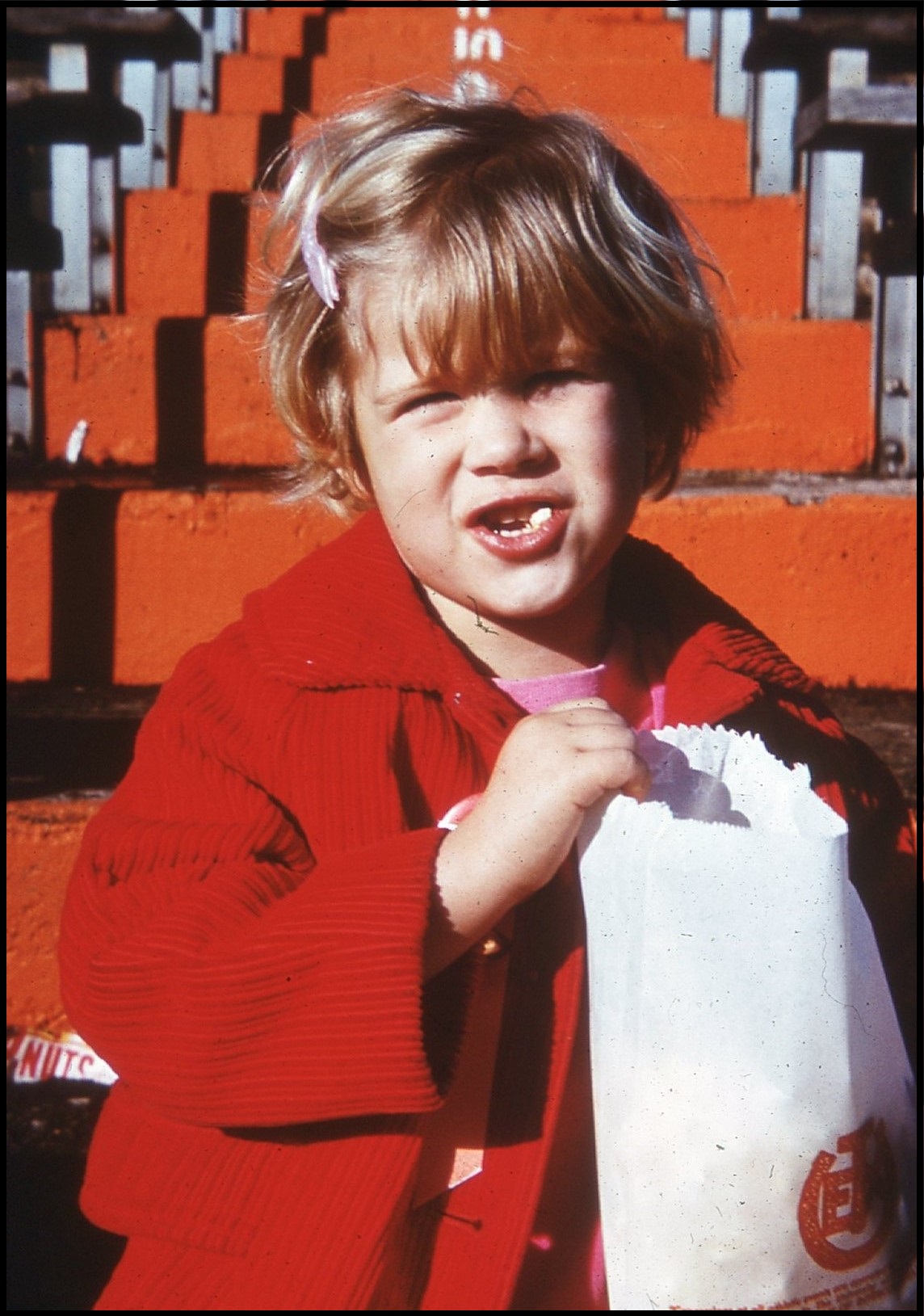
Above and left: Paper drink cups and popcorn bags were printed with the logo. In case there was any doubt as to whom it belonged, the text below the brand read: “Another service for the University of Texas by the Ex-Students’ Association.” Click on an image to see a larger view.

By 1967, the brand was appearing in a variety of locations. As pictured above, it was printed in the Alcalde magazine more often. Here, the ten-dollar bill with a logo as a head was part of a special feature titled, “My Tex-Ex Ten: what’s it buying for me?” A series of caricatures showed how the $10 annual dues was spent on various Association efforts. The example above referred to maintaining alumni records using 1960s room-size computers and punch-out computer cards. As the Flying Longhorn travel program continued to grow, it added bus tours to Texas destinations, and showed off the brand on highways throughout the Lone Star State. Here, a bus on the Big Bend Tour makes a stop at Terlingua, Texas. At a time when cigarette smoking was popular, matchbook covers were an easy and common promotional item, and the Association had several designs that featured the logo. In the version pictured, a person could order 50 matchbooks for $3.50 and have their name custom printed in the white space below the brand (which folded over the matches).


The Alcalde magazine’s promotional ad for the 1967 Round-Up (image above) not only reinforced the idea of the logo as a cattle brand, it foreshadowed the debut of a newly-created Association award. The Top Hand Award was first presented to Reese Cleveland and Sterling Holloway in the fall of 1967 for “extraordinary service to the Ex-Students’ Association.” The name was derived from the top ranch hand or cowboy, usually the foreman, and the person to whom others see as a leader and trusted to complete the task at hand. As seen above, the award itself consisted of a miniature version of a UT – Ex branding iron mounted on a walnut base.
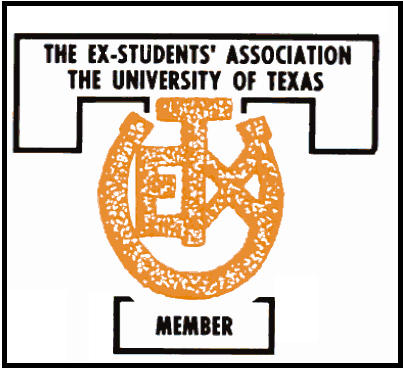
In presenting the award, Maguire said, “This is a registered branding iron. Unless you are a rancher – or an alumnus of the University of Texas – it probably doesn’t mean much to you. It is simply an inverted horseshoe with a block T and E and X inside it, and to those with orange blood, it reads ‘UT – Ex.’ The brand is the official symbol of the Ex-Students’ Association.” The Top Hand Award is still given today.
The following year, 1968, the brand appeared on the increasingly popular membership car decals (image upper right). It replaced a drawing of the “Hook ‘em Horns” hand sign on the similarly-designed original sticker. A few years later, the decal was extended widthwise – in the size seen today – with the brand on the left-hand side.

Above: UT aerospace engineering graduate Alan Bean on the moon as part of the Apollo 12 crew. During the 1970 Distinguished Alumni Awards, Bean (right) presented the flag predominately bearing the Association brand to Executive Director Jack Maguire.
In October, 1969, Apollo 12 astronaut and 1955 UT graduate Alan Bean wanted to take a copy of “The Eyes of Texas” with him to the moon during his voyage in November, but the memento had to satisfy the weight and size requirements to fly on the spacecraft. With the deadline to prepare a copy of the song looming, the Travis County Texas Exes worked quickly for three days to have the music and lyrics of “The Eyes,” along with the Association brand, screen-printed on a flag of lightweight silk that could be folded and rolled to be no larger than a cigarette. The flag made the journey and returned to Earth with the crew.
Bean was a recipient of the Association’s Distinguished Alumnus Award in October, 1970. At the ceremony, held in Gregory Gym, he presented the framed flag to Jack Maguire with its dedication: “To the 250,000 alumni of the University of Texas, this flag was with us to the Ocean of Storms, Moon, Nov., 1969.” Less than five years after Gosnell drew it, the brand had not only been seen throughout Texas, but had traveled 478,000 miles to the moon and back. (The flag was hung in the Alumni Center, but has since, unfortunately, been lost.)
~~~~~~~~~~~~~~~~~~~~
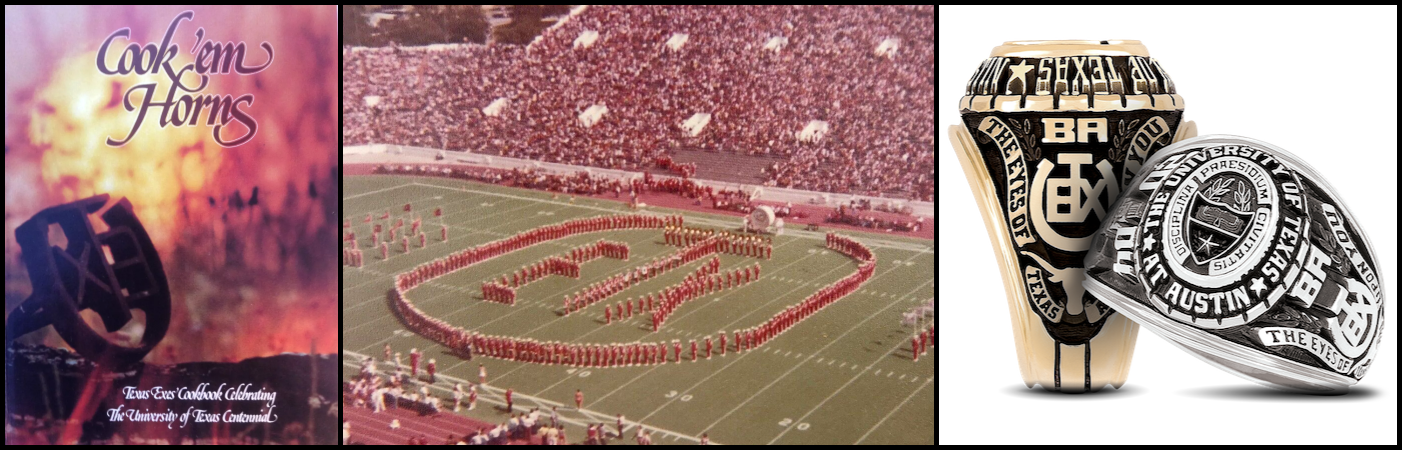
Above: The 1981 Cook ‘em Horns cookbook, published by the Association with more than 700 recipes gathered from alumni worldwide, included the brand on its cover. A 1977 halftime show by the Longhorn Band. Since 1997, class rings have featured the brand on one side.
Today, after 60 eventful years, the Association brand is deeply embedded with the traditions of the University. It’s been printed on objects as small as golf balls and spread across a football field for a Longhorn Band halftime show. It has appeared on 5K race shirts, adorned wine bottle labels, embellished cookbook covers, and been held high by local alumni chapters and Flying Longhorn tour groups the across the globe. In 1996, the Association became the sole provider of class rings. A student committee discussed the ring design and placed the brand on one side. The rings were made available in spring, 1997, and now, nearly 30 years later, tens of thousands of University of Texas graduates carry the symbol of the Association with them.
~~~~~~~~~~~~~~~~~~~~

In the meantime . . .
Jan Gosnell had an outstanding career as a commercial artist, teacher, and author. Based in Fayetteville, Arkansas with his wife, Mary, he earned his Master of Fine Arts degree from the University of Arkansas. His work has been featured in more than 20 exhibitions as far away as Chicago, and about half of them have been solo shows in Arkansas, Baton Rouge, and Houston. (An article about his 2019 exhibit, “Good Humor,” is here.) Twice, in 1979 and 1981, Gosnell was named the best editorial cartoonist in the state. He’s published two books: Shape Makes the Man, a series of humorous drawings based on physician and psychologist William Sheldon’s theory that associated physique with personality; and Sidney the Sock Cannibal, a children’s book that explained the mystery of missing socks in the laundry. In 1982, a Civil War television miniseries, “The Blue and the Gray” was filmed primarily in Arkansas (though the story actually takes place in Virginia), with its primary character a newspaper and artist correspondent. Gosnell was hired to produce the artwork that appeared to be drawn by the character.
Despite his success, Gosnell was almost entirely in the dark as to what happened to his alumni brand. When contacted through email, he responded: “As they say, you could have knocked me over with a feather!” Gosnell relayed details of the flyer competition and sent a copy of his design, but it was 20 years before he saw his logo at the entrance to the Alumni Center. “You can imagine my amazement, when, upon a return visit to Austin in the 80’s, to see the huge metal rendition of my creation.” After being informed that the brand had been to the moon, appeared on class rings, and that there was an entire Texas Exes collection of shirts, hats, and glassware at the University Co-op, Goswell remarked that the Association “got a pretty good deal” for its $5.00 prize.
~~~~~~~~~~~~~~~~~~~~
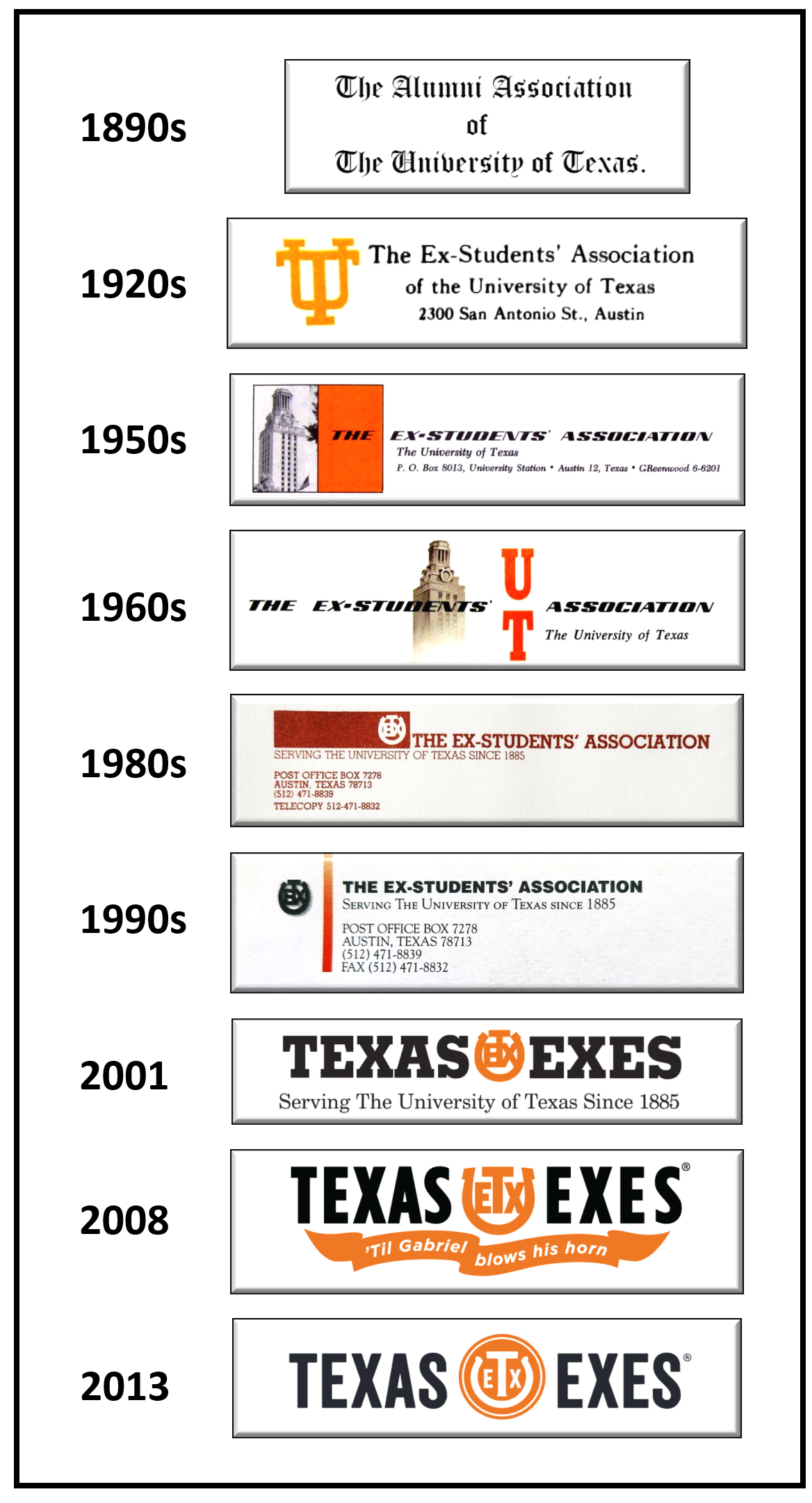
Through the years. Below is a partial look at the Association letterhead from the 1890s to the present (complete from the 1980s forward). At its annual meeting in June, 1912, the alumni voted to expand membership from graduates-only to anyone who had attended the University, and changed the name of the group to the Ex-Students’ Association. In 2001, the decision was made to de-emphasize the formal name – The Ex-Students’ Association of The University of Texas (a mouthful!) – with the better-known and more popular moniker Texas Exes. (Find out more about the name change in the May 2001 Alcalde magazine, starting on page 6.) Revisions to the brand in 2008 and 2013 have widened the “U” to make the “E” and “X” easier to read, but it has lost some of its original cattle brand appearance.
~~~~~~~~~~~~~~~~~~~~

Above: Old and new. In August, 2019, the current version of the Association brand was placed above the trellis entrance on San Jacinto Boulevard, though the original version can still be seen in the background on the Alumni Center.
Special thanks to Roy Vaughan, Jan Gosnell, Carol Barrett, and Jamie Puryear!
 The UT History Corner