The Halloween Donkey

DonkeyAll Hallow’s Eve has once again arrived in Austin. Ghosts, witches, zombies, and other ghoulish creatures will soon wander the neighborhoods, plying their trade in search of sugary treats, or gather by the thousands on Sixth Street for some late night revelry.

Such was not always the custom. “Trick or treating,” as a modern tradition, has only been around since the 1930s. A century ago, Halloween in Austin usually meant mischief, at least for those living near the University of Texas campus. A favorite practice was the mysterious disappearance of items, from yard decorations to signs to delivery wagons, which were quietly spirited away overnight, only to reappear somewhere on the Forty Acres, waiting to be reclaimed by their owners.
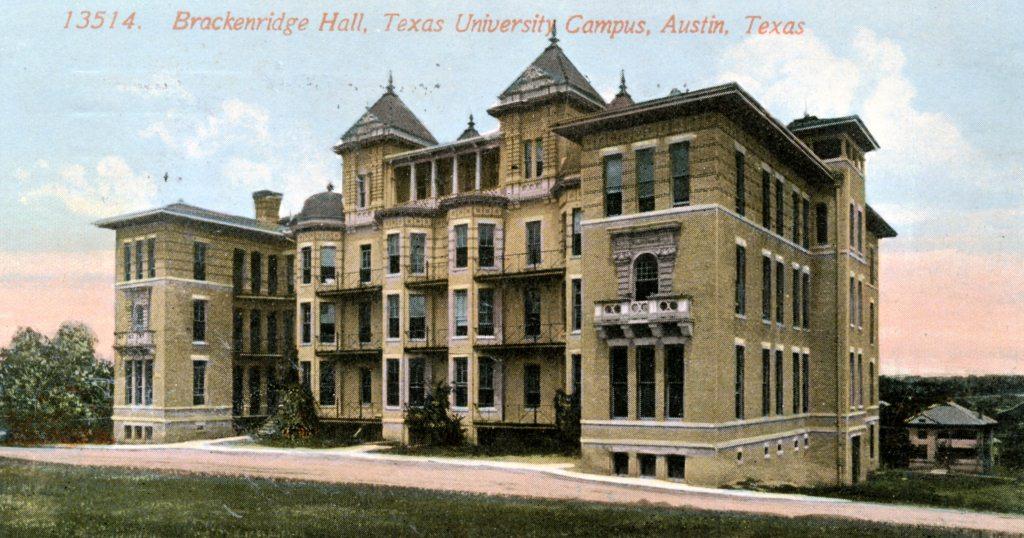
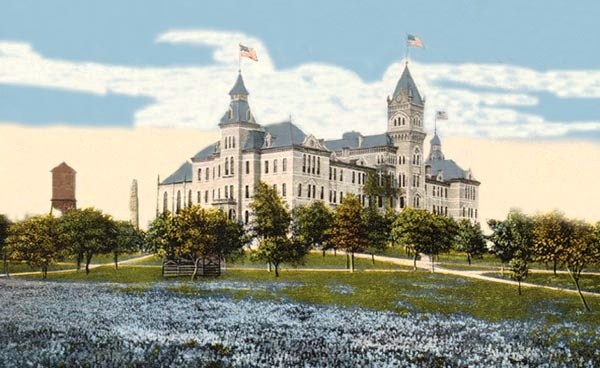
B Hall Color PostcardOn Halloween night 1906, about a half hour before midnight, engineering sophomore Alfred “Alf” Toombs entered the north door of B. Hall on the ground floor. B. Hall (photo at right) was the first men’s dorm on the campus, and the bottom floor housed both the kitchen and dining room. At the late hour, the room was dark, but as Toombs pulled on the door handle, there was some resistance. At first he thought he’d encountered a fellow student leaving the building at the same time.

Instead, Toombs discovered a donkey hitched to the doorknob on the inside. The animal belonged to Mrs. Carothers, head matron of the Woman’s Building (the women’s dorm), and was the pet of her two children. Evidently, the donkey had been kidnapped from his stable and was an unwilling participant of some Halloween shenanigans.

“I suppose that the parties who had left him there thought they had done their best by him,” recounted Toombs, “but I felt sure that better disposition could be made of his presence.”
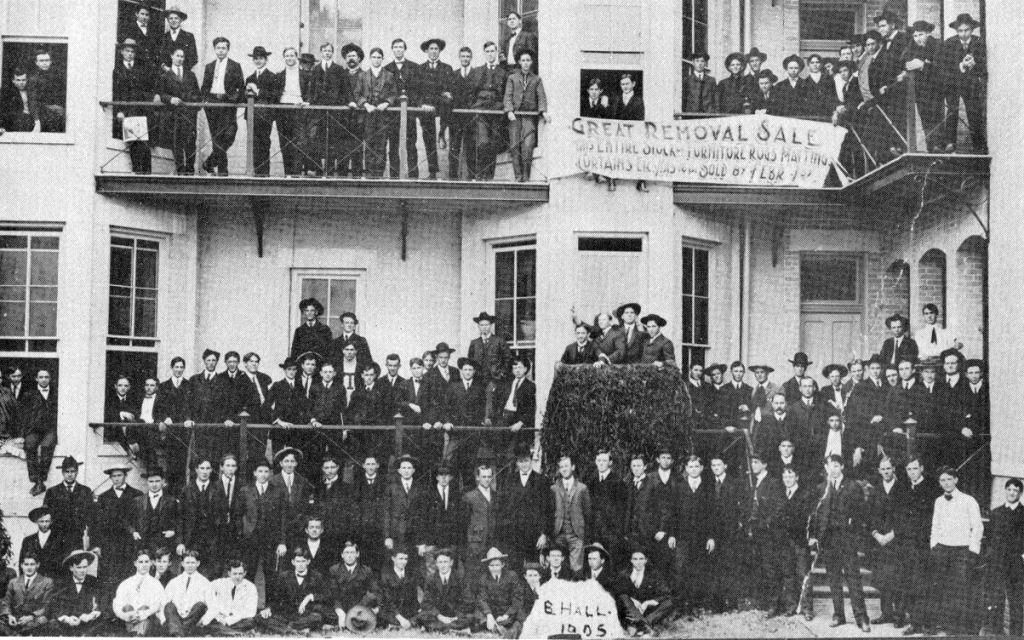
B Hall Residents 1905

Above: B. Hall residents pose for a group photo.

Toombs went upstairs to consult with his fellow B. Hall residents. Among the suggestions was to place the animal in the vestibule of the Woman’s Building, where his presence would surely produce the kind of unrest intended “to remind some unfortunate that Halloween was once more with us.”

Some of Toombs’ cohorts voiced doubts that the donkey could be persuaded to climb the fourteen steps at the entrance to the building to reach the vestibule. To make sure the animal was ready, the group decided to first “rehearse” on the steps of the Engineering Building (today’s Gebauer Building), and then walk across campus for the final performance.

UT Campus 1905

The campus in 1906. B. Hall, the men’s dorm, is on the far right, while the Woman’s Building, placed as far away as possible across campus, is on the left. The Engineering Building (today’s Gebauer Building), is just to the left of B. Hall.

With plans made, a group of six B. Hallers led the donkey out of the dorm to the Engineering Building, a short walk to the northwest. With a little pulling, pushing, and half-lifting, the animal climbed the steps and demonstrated his abilities. The students led the donkey back down again, and started out for their goal.

Along the way, the group met up with Gene “Deb” Debogery, a genial fellow denizen of B. Hall who called himself the “East Texas Crow” because of his frequent, raucous “cawing” in imitation of the species. Debogery was also an avid baseball fan, though not as good a player. He was often found in front of B. Hall playing catch with someone, and at the same time either endangering the health of fellow students walking to classes, or breaking windows in the hall.

On this occasion, Debogery had been out celebrating the evening and “was fairly well organized,” according to Toombs. Deb enthusiastically volunteered to help, though the rest of the group quickly realized that any chance of quiet had been lost.

Womans Building Entrance

Unlike the rehearsal at the Engineering Building, the donkey was far more reluctant to climb the stairs of the women’s dorm (photo at left). After several attempts, the group resorted to lifting the animal’s front two legs completely off the ground and pulling on a long rope which had been passed behind the donkey’s back legs. Subtle it wasn’t, but the job was completed and the vestibule was reached.

But once on the top step, Deb discovered that the latch to the front door was unlocked, and soon insisted that their charge be taken inside and tied to a stair post. To pacify Deb, the others put him in charge of the task.

The reluctant donkey was pushed inside to the spacious front lobby of the Woman’s Building, but the clatter predictably woke some of the residents. A light appeared at the top the stairway, and the commanding voice of Mrs. Carothers soon followed. “Who’s there?!” she demanded, “And what are you doing?”  A few tousled heads poked out over the banister, and one belligerent maid let fly a hairbrush at the intruders. One of the men answered that they’d brought another boarder, to which Mrs. Carothers retorted that the dorm was full. No matter. The donkey was secured to the stair post and the group quickly decamped.

water-tank-band-hall-at-baseThe evening’s adventures were not quite complete, however. As the B. Hallers made their escape out the front door of the Woman’s Building, they were confronted by the University’s night watchman who had witnessed the whole escapade. He retrieved the donkey, led him easily down the stairs, and told the students that the animal would be secured to prevent further antics. The watchman intended to place the animal in the new band house, a makeshift structure set up under the campus water tank as a place for the University Band to rehearse.

Above right: The old water tank, placed on the north side of campus (about where the Painter Hall parking lot is today), with a temporary band hall installed at its base. The University Methodist Church and Littlefield Home can be seen behind it, with 24th Street heading downhill to the right. Click on an image for a larger view.

The donkey, by now tired of being led around, refused to enter the darkened confines of the band room outright. “We’ll help!” volunteered the B. Hall contingent. Unaware of the trap that was being set, the night watchman agreed, and pulled the animal from the front while the group pushed from behind. Of course, once the watchman and the donkey had entered the band house, the door was quickly closed and padlocked. The two spent the rest of the night together, mourning their plight and leaving the campus unprotected.

More Postcards for the UT History Corner

Main Building and Tower.1930s

Perusing old postcards is a great way to explore the University’s history. Since the UT History Corner is intended to be a resource on the subject, the postcards section under the “Images” portion of the web site has been expanded.

Though postcards have been around since the 1840s, the U.S. Post Office was initially the only establishment allowed to print them. The first souvenir cards it published were views of the popular 1893 Columbian Exposition in Chicago. In 1898, the monopoly was broken when Congress passed the Private Mailing Card Act, and over the next few years, entrepreneurs began to print cards with local scenes and attractions, selling them to tourists who would then mail them to friends and family back home. For Austin and the University of Texas, postcards began to appear at the start of the 20th century.

You’ll find the postcard section on the UT History Corner divided into three pages (links provided below):

Postcards 1: 1900 – 1920s

Postcards 2: 1930s – 1940s

Postcards 3: 1950s – 1970s

Use the “Images” menu near the top of the web site to navigate from one page to another, and you can always click on a postcard to see a larger version of it.

Have fun exploring!

UT Stadium and Campus.1960s.

World War II and the Longhorn Room

West Mall.Texas nion.1942

The Texas Union and the West Mall in 1942. Students crossed Guadalupe Street at the direction of a lone traffic signal, set on a pole. In the spring and summer, the rectangular grassy spot just behind the traffic light was planted with flowers to form a large “U T.”

When the United States formally entered World War II in December, 1941, campus life abruptly changed to support the war effort. The academic year was altered to permit additional short terms just after Christmas and over the summer, so that students who might be drafted could graduate in just under three years. Special courses were added to train military personnel, and research became almost exclusively war-related. A Naval ROTC unit was headquartered in the Littlefield Home, with two anti-aircraft guns placed on the front lawn of the Victorian mansion, and a practice firing range in the attic. By 1943, ROTC had been absorbed into the Navy’s V-12 program, which brought thousands of officer candidates to the campus.

Despite the seriousness of the times, students still found ways to have fun, and much of the University’s social life centered on the Texas Union.

During the war, the Union was a place to both participate in the war and escape from it. The U.S. armed forces opened a recruitment center in the building. Classes in first aid, bandage rolling, and how to be an air-raid warden were common. The Union was also the drop-off site for an endless series of collection drives. Aluminum, rubber, and books and magazines for soldiers overseas were the most successful.

An appeal to collect silk, though, was not as popular. Because silk burned without smoking, it was needed to make gun powder bags for ammunition. Silk shirts and women’s hose were requested, but campus co-eds were not eager to donate. “Too many girls are sitting on silk,” admonished The Daily Texan student newspaper. “Campus co-eds are either not taking the trouble to turn in their old hose, or are looking forward to a cold winter.”

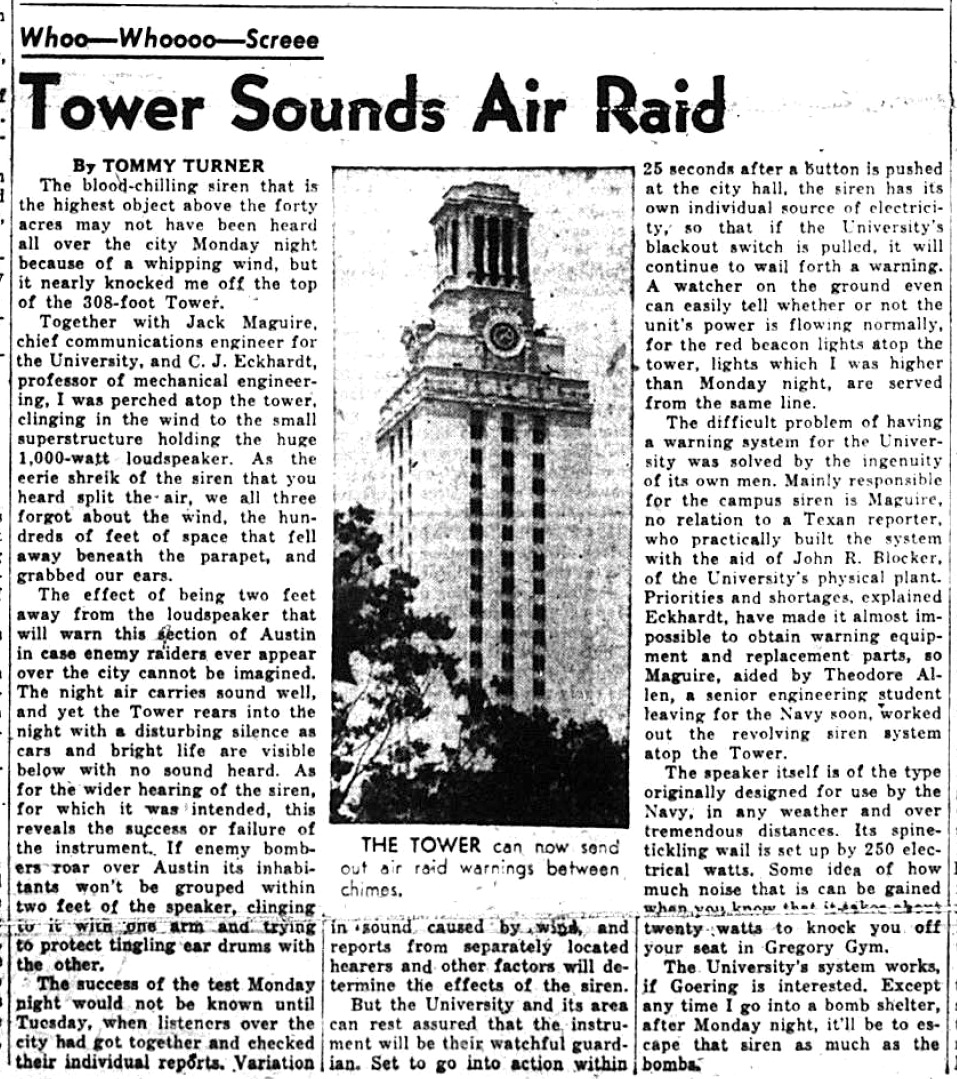
DT.Nov 17 1942.Tower Air Riad Siren Test.

An air raid siren was installed on top of the UT Tower, while instructional classes on how to be an air raid warden were held in the Texas Union. The article is from a November 1942 issue of The Daily Texan. Click on the image for a larger view.

In the fall of 1942, the War Effort Council, a committee that coordinated student war activities, looked for a way to solve an issue caused by the war. The all-University dances, held every weekend in the Union Ballroom, were extraordinarily popular through the 1930s. Jazz greats such as Benny Goodman and Duke Ellington brought their bands to the campus, and revenue from the dances allowed the Union to remain self-supporting. With the onset of war came gas rationing and tire shortages. Dance bands could no longer easily tour the country; University students had to rely on local talent or supply their own.

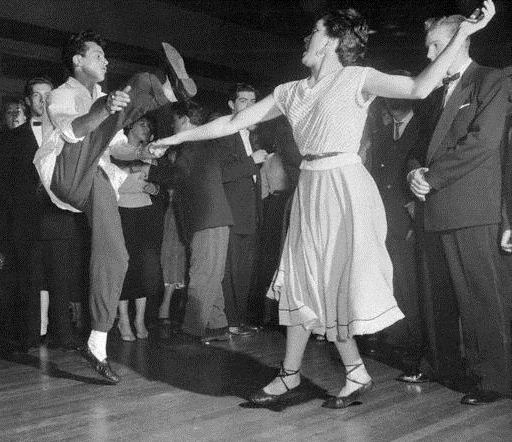
UT_Swing_DancingThe “Longhorn Room” debuted Saturday evening, November 14, 1942, to a sold out crowd of 600 persons, including UT President Homer Rainey and his wife. Decked out with wagon wheels, cedar posts, bales of hay and red-checkered tablecloths, the Union’s ballroom was transformed into a western-styled nightclub. Couples (no stags allowed!) were charged fifty cents, and could reserve tables in advance. Music was supplied by the Union’s record player. “Music for dancing will be furnished by 120 records and patrons are asked to make requests for their favorite tunes,” announced the Texan. Student groups, including the Texas Cowboys, Alpha Phi Omega, Orange Jackets, and Silver Spurs, volunteered to set-up and decorate, wait on tables, tend bar, and clean up afterward.

The highlight of the evening was the half-hour variety show, which was often unpredictable. A sorority might perform a short musical, complete with costumes and dancing, or individual students would entertain the crowd with stand-up comedy. Occasionally the football team brought down the house with their version of the Can-can.

The bar was strictly non-alcoholic. Soft drinks and milkshakes were sold for a dime a glass. But it sparked the creation of a new concoction called “Kickapoo Joy Juice.” Made from orange juice, ice cream, coconut, and milk, it was “guaranteed to lift the drinker by his shoelaces, set him on a little pink cloud, and let him down easy.”

The Longhorn Room continued in the Union for the duration of the war and attracted national attention. National periodicals Downbeat, PIC and Mademoiselle printed features, while Downbeat judged the Longhorn Room as “one of the most unique entertainments in American colleges.”

Freshman Class President Kidnapped!

The attempted abduction of the wily Winchester Kelso.

1915 Cactus.Winchester Kelso.Class Excuse.300.

Above: A photo of  Winchester Kelso, placed over his class excuse card, which reads: “Mr. Winchester Kelso has been granted leave of absence because of being kidnapped as President of the Freshman Class.” The note was initialed “H.T.P.,” by Dean (and future Plan II honors program founder) Hanson Tufts Parlin. 

~~~~~~~~~~

“Once upon a time, in Egypt, four or five thousand years ago,” joked Professor Harry Benedict, “some careless upper classmen, not knowing what they were starting, kidnapped a Freshman class president and held him out on a Nile sand bar until the grand march at the Freshman dance was over. Little did these careless Egyptians realize what they had done. Their Sophomore successors, being like sheep, were predestined to steal Freshman presidents to the end of time.” Benedict, a future UT president, was a keen observer of campus life and knew it didn’t take much to start a college tradition. “If a Sophomore does anything one year,” Benedict explained, “all other subsequent Sophomores have to do exactly the same thing with pathetic fidelity. There is no escape; “It is the custom,” is the mandatory reason.”

~~~~~~~~~~

It was a chilly evening on Thursday, February 26, 1915, as Winchester Kelso leisurely finished his dinner at the Cozy Corner, a popular café along the Drag at the southwest corner of 24th and Guadalupe Streets. A first-year University student from San Antonio (his boyhood home still stands, remodeled as a bed and breakfast), Kelso had been elected freshman class president. Sitting at the café and chatting with friends, the discussion no doubt turned to Friday night’s Freshman Ball, the social event of the year for UT greenhorns. As the freshman chief executive, Kelso and his date had the honor of leading the Grand March, a traditional promenade around the dance floor to open the evening.

There were a few on campus, though, who wanted to prevent young Mr. Kelso from fulfilling his Freshman Ball duties. A group of sophomores, always eager to prove their class’ superiority, thought it would be a great sign of supremacy if the freshman class president were forced to miss his Grand March debut, and conspired to remove Kelso from the campus environs until the last dance had ended. Besides, this is what previous sophomore classes had done. It was the custom.

At the Cozy Corner, just as Kelso finished his evening meal, at least a dozen sophomores burst into the café, lifted Kelso from his seat, and took him outside to a waiting automobile. “The freshman showed much resistance at the beginning of the struggle,” reported The Texan student newspaper, “but was soon overpowered by his captors.” The car spirited Kelso to a campsite about five miles north of Austin, where he was to remain, in a tent and under guard, until late Friday night.

As Benedict later described it, Kelso, confined to quarters, “consulted the Book of Customs” and discovered “that while it is the custom for the Freshman president to be captured, it is not the custom for him to remain so.” Because it was nighttime, Kelso decided to create a diversion by tossing small objects out of the back of the tent, which caused enough noise in the woods that worried sophomores thought a rescue party was approaching. A few left the campground to investigate, and with the number of guards reduced, Kelso bolted out of the front of the tent and into the darkness. He managed to elude a search by frantic sophomores, who eventually gave up and went home, and left Kelso stranded in the forest.

“Effecting his escape by means of a bold ruse,” stated the Cactus yearbook, “the Freshman Prexy lost his way and wandered about for some time in the country.” It was only a few days before a full moon, but the added light didn’t help Kelso’s sense of direction. Well after midnight, he stumbled upon the tracks of Missouri-Kansas-Texas railroad (popularly known as the K-T, or “Katy”) and discovered he was a dozen miles from Austin. Kelso followed the tracks through the night, and returned to the Capital City about 5 a.m. the next morning.

Wasting no time, Kelso went directly to his boarding house, gathered his suit, some food supplies for the day, and other items he’d need for the ball, told a few trusted freshmen of his plans, and then hurried downtown. Because the University didn’t yet possess any facilities suitable for a class dance, the Knights of Columbus Hall on Ninth Street had been booked for the Freshman Ball.

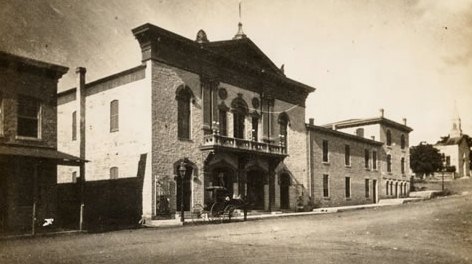
Millet Opera House.Knights of Columbus Hall

Ninth Street in downtown Austin. The popular Millet Opera House is center, while the Knights of Columbus Hall is two buildings to the right, on the corner. Image found in the Austin History Center.

Kelso found someone who let him in to the building. He went upstairs to the attic, found a large trunk, and in it hid himself, napping through the day. Twice searching sophomores arrived to check the premises, but left convinced Kelso was elsewhere.

Friday evening, freshmen couples arrived at the dance hall in horse-drawn carriages, only to meet a team of sophomores guarding the entrance. They searched each carriage and questioned the occupants, determined to prevent the class president from attending. As the starting time for the ball neared, the sophomores became more confident that their efforts were successful. But when the music began, the wily Winchester Kelso, none the worse for his adventure and dressed in his best suit, strolled downstairs to meet his date and lead the Grand March.

The Littlefield Gateway

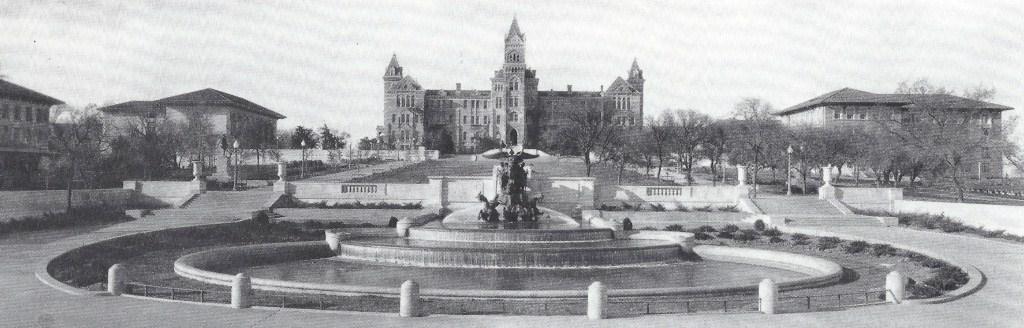
Littlefield Fountain and Old Main

The newly installed Littlefield Gateway in 1933, with the old Main Building in the background. This campus scene was a short-lived one. A year later, Old Main was razed to complete the current Main Building and Tower. Click on the image for a larger view.
[August 2015: An expanded history of the Littlefield Gateway was posted here.]

It’s a long-standing question frequently heard on the Forty Acres: why is a statue of Jefferson Davis on our campus, and placed next to, of all people, Woodrow Wilson? The fountain and statues on the South Mall – collectively known as the Littlefield Gateway – have been praised and condemned since they were installed in the early 1930s. Their presence is the result of an extended conflict between two very different University regents who, by chance, had the same first and middle names: George Washington Littlefield and George Washington Brackenridge.

George W LittlefieldBorn in Mississippi in 1842, George Littlefield moved to Texas when he was six years old, and grew to cherish his Southern ancestry. He defended the Confederacy during the Civil War, rose to the rank of Major, and then returned to Texas to make a fortune in the cattle business with ranches in West Texas and New Mexico. He arrived in Austin in the 1880s and founded the American National Bank, which was eventually housed in the Littlefield Building that still stands at Sixth Street and Congress Avenue. Late in his life, Littlefield became a regent and benefactor to the University.

Brackenridge was a decade older than Littlefield, was born and raised in Indiana, and had attended Hanover College, Indiana University, and Harvard University. When Brackenridge was 21-years old, his family moved to southeast Texas, and he became a surveyor in Jackson County. But at the outset of the Civil War, while his three older brothers enlisted in the Confederate Army, Brackenridge became both a Union sympathizer and war profiteer, and smuggled cotton through Brownsville and around the Union blockade along the Gulf Coast to New York. After the war, he moved to San Antonio, founded a bank of his own, and ran the city water works. Brackenridge was appointed early on to the UT Board of Regents, and served for a record 27 years.

Because of the choices each made during the War Between the States, neither man held the other in high regard. According to Robert Vinson, president of the University from 1916-1922, “Their dislike of each other was profound. When Mr. Brackenridge spoke of the University of Texas, he emphasized the word University. Major Littlefield emphasized the word Texas.”

In the early 1900s, UT enrollment passed 1,000 students and was steadily increasing. Brackenridge realized the University would eventually outgrow its 40-acre campus, and in 1910, donated 500 acres of land to the University along the Colorado River. Known today as the Brackenridge Tract, it’s used primarily by the Brackenridge Field Laboratory, married student housing, and the Lions Municipal Golf Course. He had planned to purchase an additional 1,000 acres and eventually move the University to the 1,500-acre site, where it would have room to grow for generations. (In contrast, 50,000 UT students today occupy a campus of about 400 acres.)

Littlefield HomeThe idea was popular with Austinites. Local newspapers printed cartoons of UT students jumping out of classroom windows for a quick swim in the Colorado. But Littlefield, whose mansion (photo at left) was just across the street from the University, would have none of a “Brackenridge campus,” and searched for ways to prevent a migration.

The need of a larger campus resurfaced in 1919, after the conclusion of World War I. Veterans returned from the trenches in Europe to fill universities across the country, Texas among them. Relocating the University to larger quarters was again discussed. To head off a potential move, Littlefield contacted Pompeo Coppini, an Italian-born sculptor living in San Antonio. Littlefield proposed to build an arch at the South entrance of the University to serve as a gateway to the campus. On it would be figures important to Texas and Southern history. While it was a memorial in appearance, it was also another nail intended to secure the campus from moving to the Brackenridge Tract.

Coppini built a model of the arch that was featured in an exhibition in Chicago, but the sculptor informed Littlefield that its construction would cost more than the $250,000 Littlefield was willing to spend. Coppini offered the idea of a fountain instead, and at the same advised against a memorial to the Confederacy. “As time goes by,” Coppini argued, “they will look to the Civil War as a blot on the pages of American history, and the Littlefield Memorial will be resented as keeping up the hatred between the Northern and Southern states.” Instead, Coppini proposed to honor those who had fought in the World War, as “all past regional differences have disappeared and we are now one welded nation.” A compromised was reached, and Coppini set out to design the Littlefield Memorial Gateway.

Coppini’s intent was to show the reunification of America in World War I after it had been divided in the Civil War. The scheme centered on a 100-foot long rectangular pool of water. At its head, in an elevated pool to create a cascade, was the bow of a ship, on which stood Columbia, symbol of the American spirit. Behind her were representatives of the Army and the Navy. The ship was to be pulled by three sea horses. As Coppini saw it, the fountain group showed a strong, united America sailing across the ocean to protect democracy abroad.

Littlefield Gateway.Original Design.1920.

Coppini’s original 1919 design for the Littlefield Gateway. Steps on either side of the fountain rose to a small plaza, bounded by two pylons, in front of which stood the statues of Jefferson Davis and Woodrow Wilson. Click on the image for a larger view.

Immediately behind the fountain, Coppini created a small plaza bracketed by two large pylons or obelisks, symbolic of the North and the South. In front of each he placed the statues of two “war presidents”: Jefferson Davis, President of the Confederacy at a time when the country was deeply divided, and Woodrow Wilson, leader of a reunified America during the world war. The remaining statues of Lee, Reagan, Johnston and Hogg were staged on either side of the fountain, and were Littlefield’s choices of important men in the history of Texas and the South.

The contract was drawn, signed, and accepted by the UT Board of Regents in April 1920. Just in time, as Littlefield’s health was failing badly. He died peacefully the following November, but had anticipated what Brackenridge might do after his passing, and left nothing to chance. His will included $500,000 toward the construction of a new Main Building, $300,000 and land for a women’s dormitory (now the Alice Littlefield dorm), and $250,000 for the Littlefield Gateway, all of which were contingent upon the University staying where it was for the next eight years. Just hours before he died, Littlefield made one last donation: his Victorian mansion would be turned over to the University subject to Mrs. Littlefield’s life interest.

Brackenridge was unprepared for this turn of events. He had hoped to combine Littlefield’s gifts with his own to build a new campus on the banks of the Colorado. With his diminishing assets at just under $1.5 million, Brackenridge would barely be able to make up for the Littlefield donations that would have to be forfeited if the campus moved. Brackenridge fretted, worried about his money, and grew seriously ill. He died in December 1920, just over a month after Littlefield.

Austin Statesman.Jan 21 1921.pg1.

The debate over whether to move the University campus to the Brackenridge Tract was front-page news in the Austin Daily Statesman for most of the spring of 1921.

Despite the setbacks, UT President Robert Vinson, a longtime supporter of Brackenridge’s vision, was unwilling to give up the dream of moving the University to a spacious, riverfront campus. As planned, a bill to relocate the University was submitted to the legislature in January 1921. It received solid support from the regents, Governor Pat Neff, and the local press. But once the bill was read and debate ensued, some legislators saw an opportunity. If the campus were to be moved anyway, why keep it in Austin? One proposal would have allowed any city that could guarantee 500 acres and $10 million to be placed on a ballot, and a statewide election to decide the location.

Once the possibility of losing the University became known, the citizens of Austin quickly united against the whole idea, and vilified Vinson for opening a Pandora’s box. The bill to relocate the campus was defeated. Land was purchased east of the Forty Acres, and the campus was extended down the hill to Waller Creek. Littlefield had won.

Littlefield Fountain ContructionAlmost 10 years were required for Coppini to complete the statuary for the Littlefield Gateway. The project was delayed by a bronze workers strike, and cost overruns seriously threatened Coppini’s design. To save money, the regents proposed to strike out the planned obelisks, an idea supported by then UT President Harry Benedict, who thought they would block the view of the old Main Building. Coppini passionately argued that losing the pylons would destroy the intended symbolism, but to no avail. The obelisks were omitted.

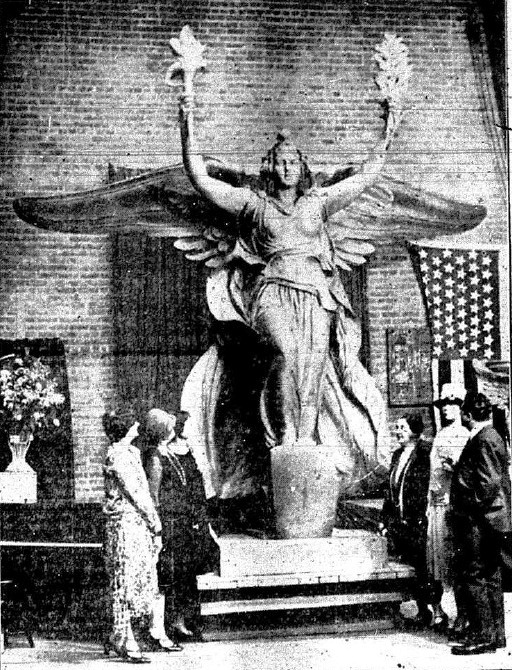
Photo above: Visitors inspect Coppini’s work at his studio in the 1920s. The figure of Columbia, symbol of the American spirit, carries the torch of freedom in her right hand, and the palms of peace in her left. 

By 1930, most of the statues had been delivered to Austin, and were temporarily on display in the Capitol rotunda. About the same time, the University hired Paul Cret, an architect from Philadelphia, to develop a new campus master plan. Cret was responsible for much of the layout of the campus as it is today. He designed the Main Building and Tower, Texas Union, Mary Gearing Hall, the “six pack” on the South Mall, and many others.

Littlefield Gateway and Old Main

The Littlefield Gateway was installed on the campus in 1932 and the fountain activated for the first time in spring of the following year. In this image, just to the right of Old Main, the Geology Building, now the W. C. Hogg Building, is under construction.

Cret reviewed the plans for the Littlefield Gateway, and thought the six statues surrounding the fountain were too crowded. To give each figure its own space, Cret spread the statues out along the South Mall, but at the same time hopelessly blurred the symbolism of the Jefferson Davis and Woodrow Wilson figures that Coppini had intended. The fountain was finally constructed in the fall of 1932, and was turned on in March 1933.

Years later, in a letter to state senator Grady Woodruff, Coppini lamented, “After years of fighting, I was forced to accept the dismemberment of my original planned memorial, throwing to the four winds my conception and making of the various pieces of bronze just a senseless decoration of the campus.”

Littlefield Fountain 1940

For many years, the Littlefield Fountain contained cattails, lily pads, and other varieties of flowering water plants. Click on image for a larger view.

Cicero Quote

Behind the Littlefield Fountain, and not as well-known to those on campus, a brass door leading to the underground pump room bears the names of 97 persons from the University who lost their lives in World War I. Flanking the sides of the door, inscribed in the limestone, are a pair of quotes by Cicero on patriotism. Here, “Brevis a natura nobis vita data est, at memoria bene redditae vitae Sempiturna,” translates as, “Short is the life given to us by nature, but the memory of a life nobly surrendered is everlasting.” 

Audio Comes to the UT History Corner

???????????????????????????????

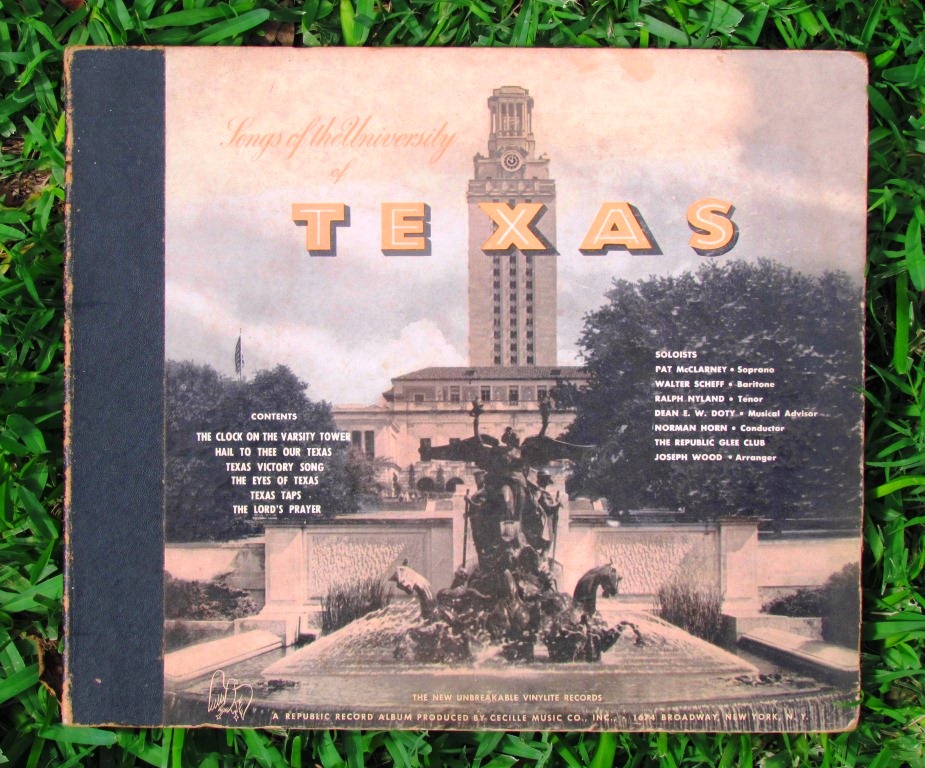
With a battered and worn cover after more than seven decades, Songs of the University of Texas contains early recordings of UT favorites, along with some tunes that haven’t been heard on the campus since the 1950s.

The UT History Corner is more than a blog; it’s intended to be an expanding resource for those interested in exploring the University’s past. To compliment the traditions, images, and resource areas already on the web site, a new audio section has been added.

Songs of the University of Texas is a three-record set of 78rpm discs recorded sometime in the mid-1940s. Curiously, the songs weren’t performed by a UT student group, but arranged and recorded in New York City by the Republic Glee Club, whose members were often heard on popular national radio shows. E. William Doty, the first dean of UT’s College of Fine Arts (and who held the post for 34 years), is listed as “Musical Advisor.”

A pair of tunes will be familiar: The Eyes of Texas and Texas Taps (better known today as Texas Fight!). While the songs were arranged specifically for the New  York performers, the age of the recording still might tell us a little as to how the songs were initially sung.

The other three selections are: The Clock on the Varsity Tower, Hail to Thee our Texas, and The Victory Song. John Young, a 1940 fine arts graduate, wrote Clock as a ballad to his sweetheart. The two met on the Main Mall in front of the Tower, and the clock chimed just as they were introduced. The composer of Hail to Thee is unknown, though the song has the feel of a traditional, Ivy League college piece, sung by an a Capella choir in a grand auditorium. The upbeat Victory Song by George Hurt was used as a second UT fight song, and was a staple at football rallies and games into the early 1960s before it disappeared.

1940 Songs of the Forty Acres

Along with the recordings, a 4 x 6 inch pamphlet, titled Songs of the Forty Acres, was printed at about the same time. It contains about 20 tunes, many of them Texas folk favorites – including Git Along, Li’l Dogies – but the music and words to the UT songs on the records are also included. Those pages have been scanned and posted to the audio section, so listen, sing along, or find a piano and play these old college songs yourself!

To listen to Songs of the University of Texas, click here.

Waggener Hall

?????????????????????????????????????????????????????????????

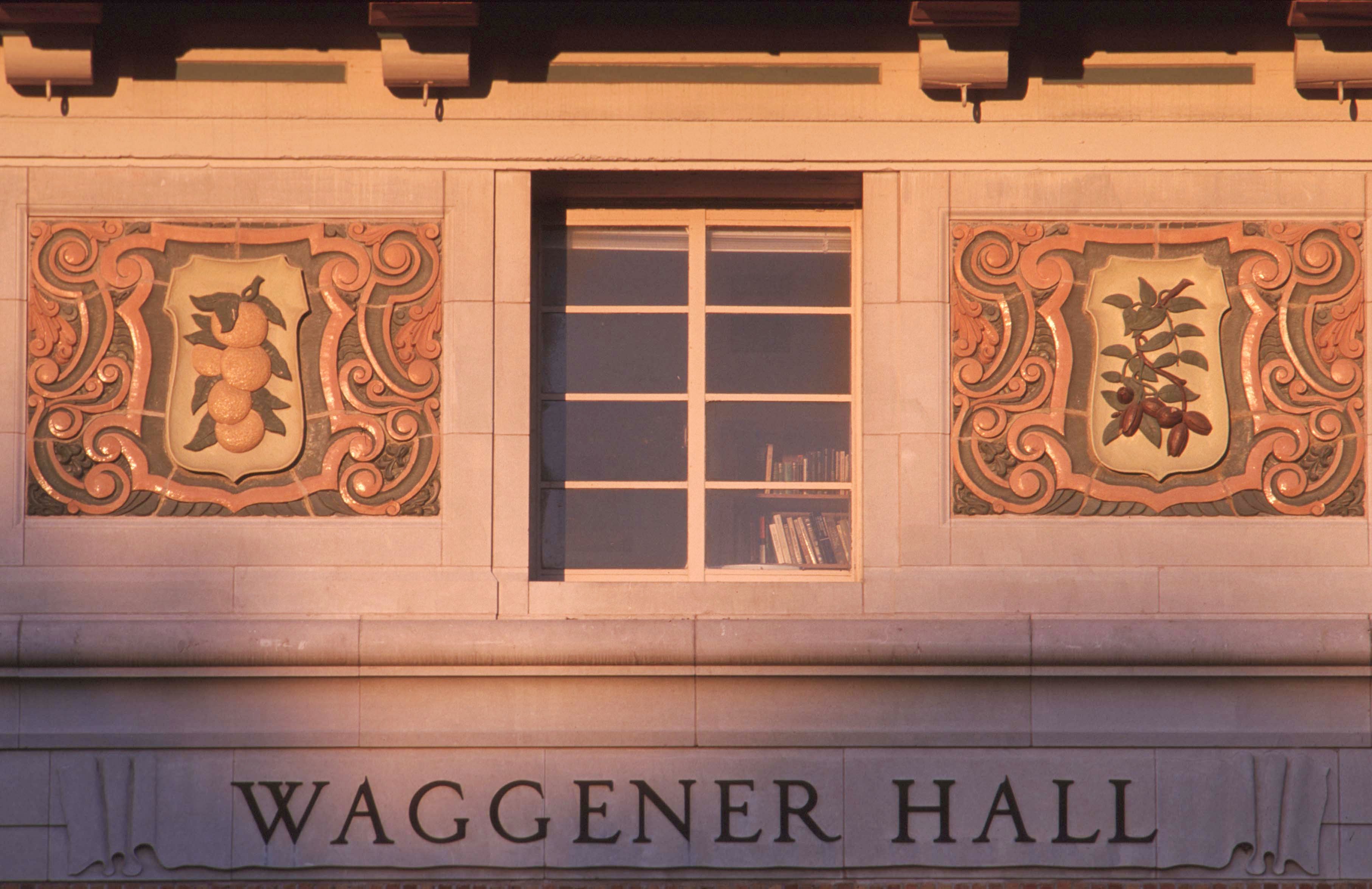
With images of oranges (left) and pecans (right), Waggener Hall was originally home to the School of Business Administration.

Down the hill and to the east of Garrison Hall, standing proudly along Speedway Street, is Waggener Hall. The building was named for Leslie Waggener, a professor of English and one of the first eight members of the faculty when UT opened in 1883. Waggener served as faculty chair for a decade, and as president ad interim in 1895.

Dedicated on April 15, 1932 at a cost of about $350,000, Waggener Hall replaced a series of cheap wooden shacks that once lined Speedway. They were initially built as barracks for World War I, and were refitted ( poorly) as classrooms as enrollment soared after the war.

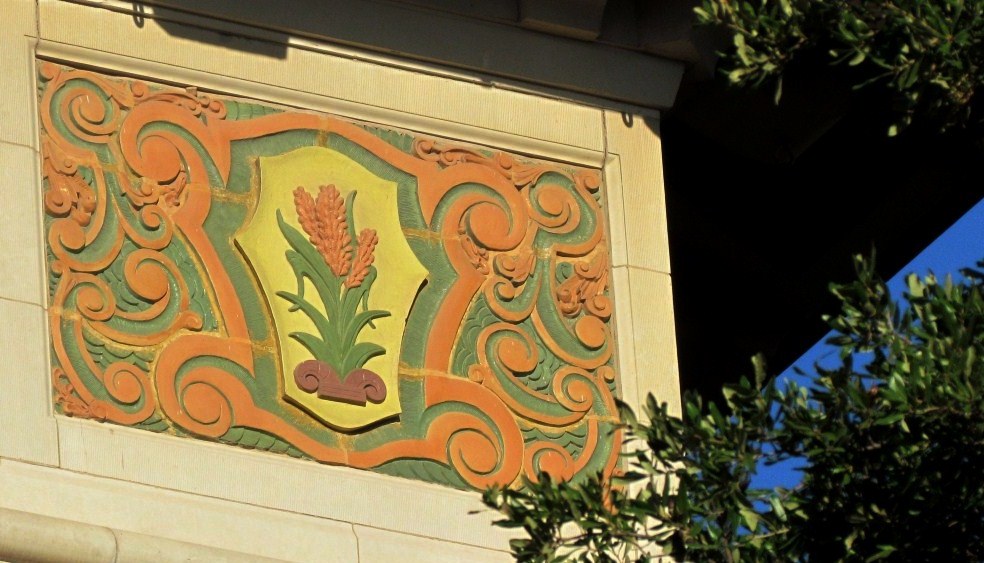
Designed to blend in with the familiar Mediterranean Renaissance style of other campus structures, Waggener Hall was constructed of white limestone, multi-colored brick, and a broad red-tile roof. The clean lines and sharp details were a welcome addition to the Forty Acres, and the twenty-six terra-cotta medallions that adorned its walls sent a clear message as to the purpose of the building. Each represented an export of Texas at the time: oil, cotton, lumber, corn, pecans, and cattle, among others.

The building was ostensibly designed for the School of Business Administration, but for several years had to share its quarters with the English, math, and public speaking departments, along with an anthropology museum housed on the top floor. Business Dean John Fitzgerald had a library room installed on the north end of the second floor, today used by the philosophy department. Un-air conditioned until the late 1950s, classrooms were outfitted with ceiling fans, and windows were opened on warm days.

waggener-hall-architectural-image

Above: An architectural rendering of Waggener Hall. 

Waggener Hall.1930s

Above: A busy Waggener Hall in the 1930s.

1937-waggener-hall-typing-class

Above: Waggener Hall was home for business typing classes like this one in 1937.

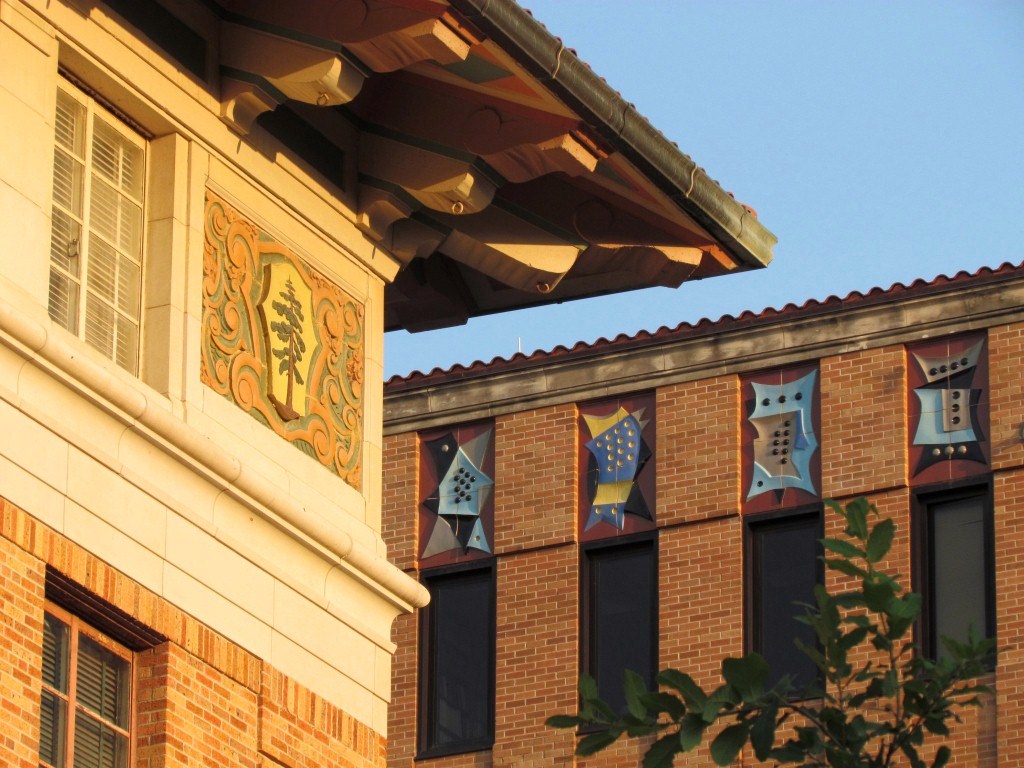
Just under the eaves of the building are twenty-six terra-cotta representations of Texas exports. Some are easy to recognize: an oil rig, cotton, pecans, and peaches. But there is also a tree, meant to represent lumber, bees for honey, and bricks and a trowel to indicate masonry.

waggener-hall-wheat-architectural-drawing

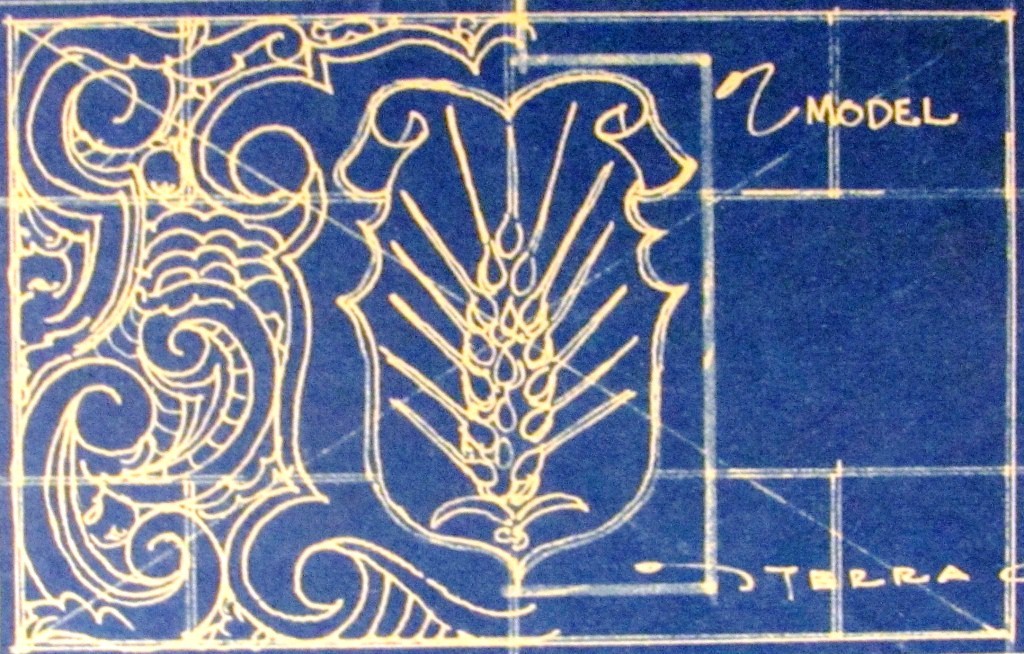
Above: The architectural drawing for a terra-cotta medallion to represent wheat. The final designs were often different from the initial concepts, now seen on the northeast corner of the building (image below).

waggener-hall-wheat

waggener-hall-cotton

Above: Cotton has long been an important product of Texas. While most of the building’s ornamentation is agricultural, if Waggener Hall were designed today, a very different series of exports would be represented.

Business moved next door to the more spacious Business-Economics Building in 1962, and the Waggener Hall was remodeled for other uses. Today, the departments of philosophy and classical studies call the building home, and an extensive Classics Library can be found on the first floor.

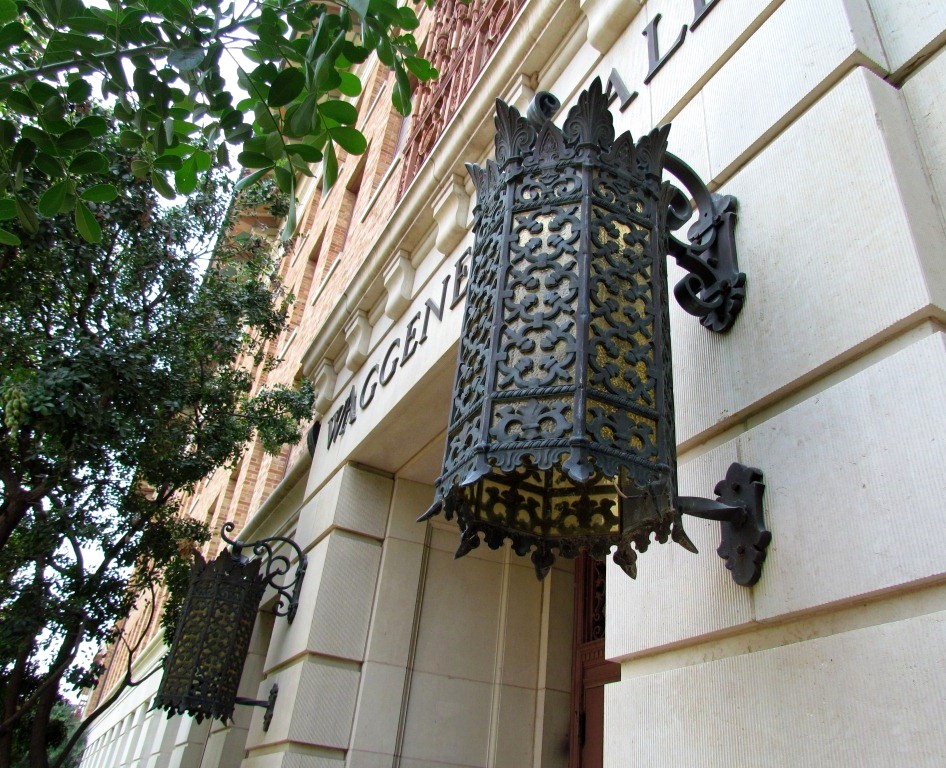
IMG_0642Above: Imposing Mediterranean light fixtures guard the east entrances to Waggener Hall. 

Waggener.Fallout Shelter ImagesAbove the doorways to the stairwells are signs that indicate Waggener Hall was once designated as a fallout shelter. A common sight on the campus at the height of the Cold War, these 1950s markers are among the very few that haven’t been removed or destroyed, and provide a layer of history to the building. (See “Better Hid than Dead” for a history of UT fallout shelters.)

Waggener Hall.Faculty Mail.May 18 2013.This ornate brass “faculty mail” box is found on the first floor, and is the last of its kind on the campus.

Waggener Hall and Business SchoolAbove: Old and new. Waggener Hall was headquarters for the School of Business Administration for three decades until it moved into the Business-Economics Building (today’s Kozmetsky Business Center) in 1962. While Waggener is adorned with Texas products, the colorful ceramic pieces on the current business building are meant to be more abstract. Created by retired UT art professor Paul Hatgil, the rows of small, raised circles were meant to be reminiscent of buttons, as the many inventions of the 1950s had transformed the modern world into what was then called a “push button society.” 


The Bare Facts of Streaking

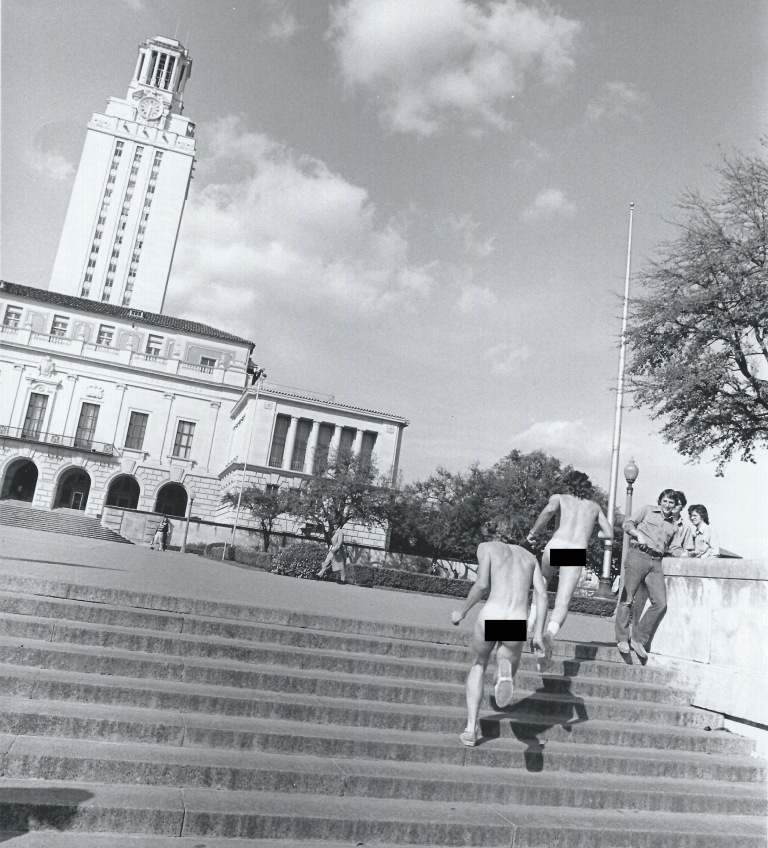
Streaking.1974.Main Mall

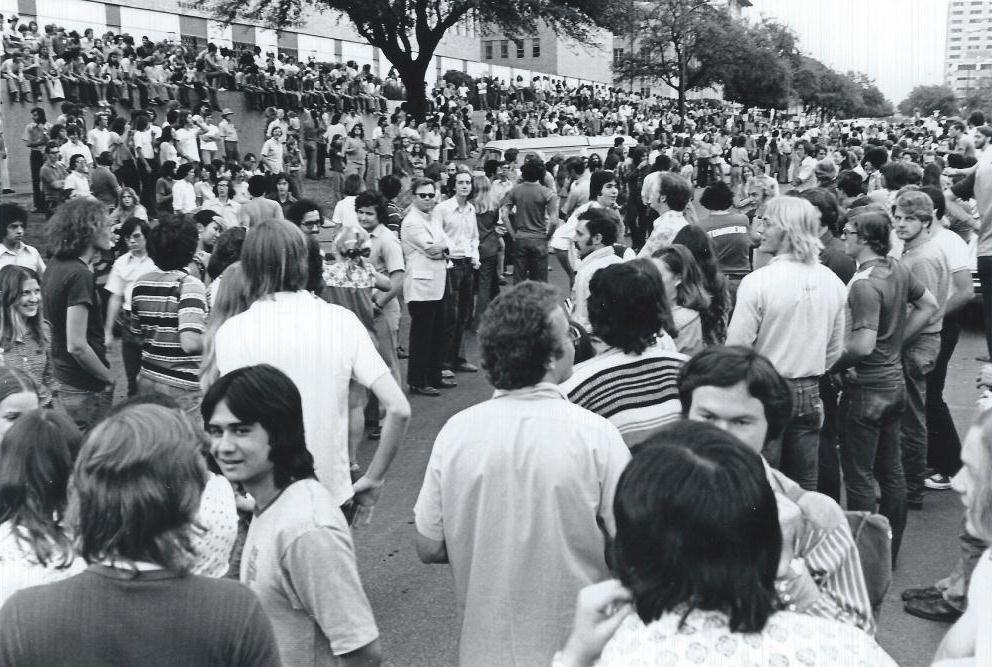
Streakers on the run! A scene on the Main Mall in the spring of 1974.(The author has censored images to avoid unnecessary controversy.)

Famed journalist (and UT alumnus) Walter Cronkite labeled it “a grand spring adventure,” while Tonight Show host Johnny Carson declared it offered a whole new meaning to the term “big man on campus.” In the tradition of student shenanigans, it was worthy of its predecessors: night shirt parades, phone booth pile-ups, car-stuffings, and panty raids. For college students in the spring of 1974, the fad of the moment was streaking.

The University’s first documented “streaker” was seen dashing across the South Mall on the unusually warm afternoon of February of 5th. Wearing nothing more than a grin, a photo of the event was published on the front page of The Daily Texan, which claimed any photographs were “taken by curious onlookers who felt the run might have historical significance.” At a time well before smart phones with cameras were available, just how the bystanders knew to be on the mall at the right time with their cameras loaded and ready remains a mystery.  But once begun, the streaking craze quickly became, well, fashionable.

For the next several months, evening “streak-ins” were a regular feature on the campus, most common on the street between Moore-Hill and Jester Center residence halls, or at the corner of 21st and Speedway Streets, in front of the business school. At times, hundreds of spectators gathered and chanted “Streak! Streak!” as daring exhibitionists obliged. Most streakers appeared in small groups of two or three, though occasionally twenty to fifty at a time were reported. Some rode bicycles – or motorcycles – and a few carried bags of candy to toss to the appreciative crowd.

Streaking.1974.Streak In Spectators.

Above: Hundreds of spectators gather on Speedway, between the business school and Gregory Gym, to watch an upcoming “streak-in.” Below: Later the same evening, a streaker with cowboy hat and boots. Only in Austin.

Streaking.1974.Streak In Texan Streaker

Those more daring streaked in daylight, some from the Main Building, along the West Mall, to Guadalupe Street, but more common was the post-lunch “One O’clock Streak” down the South Mall. Professors who taught in classrooms that faced the mall often had to wait a few minutes before the lecture began, as students were peering out of the windows instead of waiting in their seats.

One notable incident occurred March 1st, in Dr. Michael Spiegler’s psychology class in the main lecture hall of the Business-Economics Building. (It’s now the Kozmetsky Business Center, though the auditorium disappeared after a 1990 renovation.) A lone streaker entered the classroom, ran across the stage behind Dr. Spiegler, then darted up the center aisle and made his getaway. The streaker wore a white mask and was described only as having blond hair and tan lines.

As might be expected, the Dean of Students office took a dim view of college scholars traversing the campus in nothing but good intentions. It promptly outlawed the practice and announced that disciplinary action would be levied against any student caught streaking. At first, UT Police officers set out to simply catch, arrest, and fine individuals for public nudity, but streakers weren’t likely to have their University IDs on hand. Besides, students learned to avoid capture by recruiting several fully-clothed friends to run with them as a moving barricade. Wanting to avoid physical force, the police turned to cameras and photographed faces for later identification.

Fines for streaking were usually $50, but could amount to as much as $200. In response, the Association of Streaking Students – or A.S.S. – was organized and accepted donations to help their fellow streakers financially.

Stores on the Drag weren’t about to be left out of the hijinks, and soon students were sporting t-shirts which announced themselves as “Streaker Peepers,” or members of the “Longhorn Streaking Team.” Weekend Streaker Sales touted prices reduced to the bare minimum.

The fad wasn’t just popular in Austin. Other member schools of what was then the Southwest Athletic Conference eagerly participated. Streakers were reported at Texas A&M, Texas Tech, and in the more conservative hallways of Baylor. Streak-ins became such a regular occurrence at Southern Methodist University in Dallas, onlookers brought dates. The SMU Mustang band sometimes serenaded the crowd with music from “The Stripper,” and, of course, campus security always attended.

By mid-March, streaking had become so common in the United States, the National Safety Council reportedly released a list of safety tips. The council urged everyone to wear sneakers for protection and better traction “for that all important speed.” Wearing reflector tape was also advised for nighttime streaking. Where to place the tape was not specified, though the council’s report mentioned “tail lights.”

In April, students at Texas Tech goaded their fellow Southwest Conference schools to see which could get a streaker to safely cross their own campus first. This was a daunting task to those in Lubbock, as the Tech grounds were quite expansive. The gauntlet, though, was taken up by those in Austin. Less than a week after the challenge had been issued, an unidentified UT student, clad only in his Longhorn spirit, hopped out of a car parked in front of the Littlefield Fountain at 2 a.m. and quickly made his way north to the Kinsolving Dormitory. Verified by witnesses, students at the University of Texas claimed the first and only Southwest Conference Streaking Title.

Unfortunately, the University administration opted not to honor the victory with a floodlit orange Tower.

How “Texan” is the UT Tower?

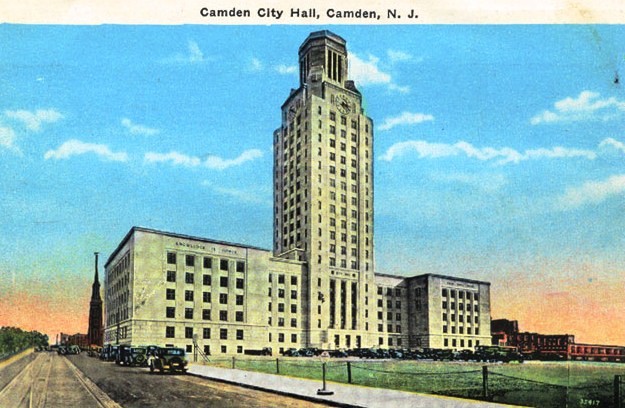
City Hall.Camden NJ.4.

Above: Does this building look familiar? Brace yourself…

The Tower. It’s the signature, iconic symbol of the University of Texas. Bathed in warm orange lights to announce academic honors and sports victories, crowned in fireworks for spring commencement, it’s been a backdrop for freshman convocations, football rallies, concerts, and demonstrations. Architect Paul Cret intended the Tower to be the “image carried in our memory when we think of the place,” though author J. Frank Dobie, incensed that a state so rich in land would build something better suited to New York City, branded it a “toothpick in a pie.” While a college is sometimes described as being housed in a metaphorical “ivory tower,” the University of Texas doesn’t settle for expressive substitutes. We have a tower all our own.

What will surprise many is that the Main Building and its 27-story Tower, now so identified with Texas, is actually a blend of many sources, most of them not from the Lone Star State. And the proudest of Longhorns may cringe to learn that part of the inspiration for the building’s design came from, of all places, New Jersey.

Paul CretThe building’s designer was Paul Cret (pronounced “Cray”). There’s a persistent campus myth that he attended Rice University in Houston (more on that here), but Cret was born in Lyon, France, graduated from the prestigious Ecole des Beaux-Arts in Paris, and immigrated to the United States. When he was hired to be the consulting architect for the University of Texas in 1930, Cret headed the architecture school at the University of Pennsylvania in Philadelphia and maintained an active private practice. His office was on Market Street downtown.

Completed in 1937, the Main Building was both the University’s central library and focus of Cret’s campus master plan. As the monumental structure on the Forty Acres, the architect was careful in his choice of materials and talent. Some of this was recruited from Texas, but much of the building, both physically and conceptually, arrived from beyond the state’s borders.

Visitors to the Main Building will likely recognize the Austin shell stone – locally quarried limestone packed with fossilized shells – used to frame the doorways in the building’s front loggia. Inside, the Magnolia Gray marble along the walls of the “grand stairway” was shipped from West Texas. And some of the bricks from the old Main Building, made in Austin, were recycled for the inner walls and air shafts of the new structure.

Robert Leon White, a UT graduate and member of the architecture faculty, contributed to the design of the interior of the building, and served as supervising architect for its construction. Peter Mansbendel of Austin, an internationally-known master artisan in the first half of the 20th century, was responsible for most of the elaborate wood carving in oak and walnut.

Aside from those few native sources, much of the rest of the building is from outside Texas. The walls of the Main Building and Tower were constructed of Bedford, Indiana limestone, known for its hardness and durability. The Mediterranean red-tiled roof, a defining characteristic of most UT buildings, was authentic, as the tiles were shipped from Spain. Marble used for the steps, floor, and benches in the loggia, the steps of the grand stairway, and even the water fountains, is from Tennessee. In the reading rooms, a variety of other marbles, from light grey to rose to charcoal, were imported from such faraway places as Missouri, New York, and Vermont. The ornate brass light fixtures found throughout the building were designed by Edwin Cole of Chicago.

Tower Consruction 1935.A

Above: Construction of the Main Building in 1935. The Tower’s book stacks were designed by Snead and Co. Ironworks from New Jersey.

The Tower itself was initially intended to house the library’s book stacks, and Cret hired Snead and Co. Ironworks from Jersey City, New Jersey to design and construct them. The company was world-famous for its innovative approach to library shelving and published two books on the subject. Its clients included the Library of Congress, Harvard, Stanford, and Cornell Universities, along with the Vatican Library. Built of cast iron, the Tower’s infrastructure supported the 27-floors, four-faced clock, and belfry, as the Indiana limestone was wrapped around it.

???????????????????????????????

Above: One of several proposed versions UT’s Main Building and Tower. Copies are on display in the Tower’s observation deck. The originals are preserved in the Alexander Architecture Archive in Battle Hall.

What of the Tower’s design? Cret sketched several possibilities, including a Tower that was a short, wide, solid mass (pictured). But the version most popular with the Board of Regents happened to be one that was, in part, inspired by the newly completed city hall building in Camden, New Jersey.

That the appearance of the Main Building was influenced by other structures shouldn’t be a surprise. As with writers, artists, or musicians, it’s not unusual for architects to be inspired by ideas from colleagues or predecessors. The University’s first library building, created by Cass Gilbert and today known as Battle Hall, took its cue from the Boston Public Library.

Camden, New Jersey sits directly across the Delaware River from Philadelphia, and the Camden City Hall building was constructed from 1928 – 1931, just as Paul Cret was hired by the University of Texas. The architects for Camden’s building, Alfred Green and Byron Edwards, learned their trade from the Beaux-Arts Institute of Design in Philadelphia, founded by graduates of the Ecole des Beaux-Arts to train American architects in the French method. Cret was both a patron and guest lecturer of the Institute, and interacted regularly with Green and Edwards throughout their careers.

Made of light gray granite, the City Hall was (and still is) the dominant sight on the Camden skyline. It was an object of great interest during its construction, and Cret was able to view its progress from his Market Street offices as he contemplated the plans of a new library in Austin.

City Hall.Camden NJ.3.

 Above: A post card view of Camden’s City Hall. The physical similarities between it and the UT Tower are too numerous to dismiss. Along with the general shape of the tower, clock, and belfry, the massing of the lower part of the building – even the rustication of the first two floors – resemble the Main Building in Austin. 

UT Tower and Camden City Hall

Attack of the Academs!

Academs

All hail the University of Texas professor! Tireless researcher, espouser of knowledge, valiant defender of free inquiry, appointed distributor of homework and grades, and, on occasion, “other duties as assigned.” From time to time, faculty members have been required to perform above and beyond their usual academic roles.

In the early years of the University, the 40-acre campus was a magnet not only for aspiring scholars, but the town cows, which were free to wander and graze about Austin. The campus sported a wealth of wildflowers, newly-planted pecan and oak trees, and lush English ivy that tenaciously clung to the walls of the old Main Building (where the UT Tower stands today), all of which was an irresistible treat for the four-legged visitors. The munching and mooing, though, was a distraction to lectures. Professors had to regularly interrupt their classes, meet in front of Old Main, and as a group, shoo away the boisterous bovines. It was, perhaps, good practice for herding longhorn students through their degree requirements.

By 1915, the University of Texas boasted 2,300 students, most of them divided into three departments: law, engineering, and academic. The Academic Department included the “arts and sciences” curriculum offered today by the Colleges of Liberal Arts and Natural Sciences, and was contained almost exclusively in Old Main. The engineers were housed in what today is the Gebauer Building, and the old Law Building, once nestled into the southeast corner of the campus, was removed in the 1970s and replaced by the Graduate School of Business (GSB).

Two of the departments – law and engineering – have had an ongoing rivalry for more than a century. Most of the time it’s been a good-natured feud, though there have been episodes that would better be described as all out rumbles, and which required faculty intervention. The Academic students, informally called the “Academs,” typically remained neutral, and were either too busy pursuing their degrees or visiting Scholz’ Beer Garden to bother.

Texas Independence Day on March 2nd often provided an excuse for student shenanigans, and professors were always wary as the day neared. It was one of only two spring holidays and had been loudly celebrated by the University since 1897, when a group of law students borrowed a brass cannon from the Capitol, fired it repeatedly on the campus, and nearly broke out the windows of Old Main. (See How to Celebrate Texas Independence Day)

WaterTankFightEarly in the evening of March 1, 1915, UT President William Battle made a harried call to all faculty still on the campus. The engineers and laws were at it again at their usual spot: the old water tank. Placed on the north side of the campus, about where Painter Hall is today, the tank was installed in 1904 as a safety measure against water shortages that plagued Austin at the time. It was never used for its intended purpose, but its 120-foot perch was an instant hit with students, who dared to climb the tank’s legs and paint class initials on its walls. Almost always, the perpetrators were from the law or engineering departments. (See Rumble at the Water Tank)

Professors arrived at the tank to discover a full-blown scuffle in progress. The engineers held the high ground – at the top of the tank – while the laws were determined to dislodge them. The law students were having trouble, though, as the engineers had come prepared with an ample supply of eggs acquired from the University Cafeteria. Dropping the “hen fruit” from the tank’s platform discouraged any would-be climber.

The faculty immediately took control and sent the students home, though not before several professors were splattered with egg yolk, including English professor and future Plan II founder Dr. Hanson Parlin. Determined to prevent any more activity that evening, four members of the faculty remained on the grounds: Harry Benedict, who taught applied mathematics and astronomy, and was Dean of the University (what would be the provost today); Edward Bantel, a civil engineering professor and the Assistant Dean of the Engineering Department; Hyman Ettlinger, an instructor of applied math; and Milton Gutsch, who taught Medieval History. A spotlight owned by the electrical engineering department was hastily installed on the roof of the Engineering Building and pointed north to illuminate the water tank. The foursome settled into the northwest corner room on the first floor, where they kept watch throughout the night. According to all accounts, they found a chess set to help keep them occupied. Card games, such as poker, had been specifically prohibited on the campus by the Board of Regents.

1913 Cactus Yearbook.Engineering Building.

Above: The Engineering Building, today’s Gebauer Building. With a makeshift spotlight installed on the roof, the four faculty members stayed in the room on the first floor (one floor up from the ground floor) seen on the far left corner. From there they could look north to the water tank.

At the first sign of daylight on March 2, and satisfied trouble had been averted, the four bleary-eyed instructors decided it was finally safe to return to their homes. Three of them –  Benedict, Ettlinger, and Bantel – elected to make a final pass in front of Old Main before they wandered off to the west and north campus neighborhoods where most of the faculty lived.

The Victorian-Gothic old Main Building featured a tall central tower with two shorter towers at the east and west entrances. Atop each of the towers was a short flag pole. As the three ambled to the west side of the Old Main, which was out of the line-of-sight of the Engineering Building, they discovered, much to their chagrin, a large flag hung on the western pole, with the rope flying loose in the wind. Fluttering in the pre-dawn breeze, the flag read “Academs 1915.” The Academs had struck at last!

Old Main and Water

Above: The Old Main Building, where the UT Tower stands today. Flags are flying from each of its three towers, with the west wing on the left. The water tower can be seen to the north, while the Engineering Building is out-of-sight, behind Old Main to the east. And yes, there were lots of bluebonnets on the campus in the spring. (For more on that topic and the bluebonnet chain tradition, go here.)

If the flag remained, there would be a new round of class rushes, and the all-night vigil would have been for nothing. There was but one choice: the flag had to be removed.

Resigned to the task at hand, the three ascended to the top of the central tower of Old Main, climbed out of the window onto the roof, and precariously made their way to the west wing. The flag’s untied halyards were flapping in the wind, four to six feet from the roof’s edge. What to do? The three pondered a moment, and hatched a plan to remove the flag and preserve the campus peace.

Academ

Above: Three UT faculty take a precarious early morning walk on the roof of Old Main. This drawing, along with one of the accounts of the story, was found in the Thomas Taylor papers in the Briscoe Center for American History, which houses the University Archives. Taylor was the first dean of engineering studies, and an avid recorder of UT student life.

There, on top of the west wing of the old Main Building, a little after 6 a.m. on March 2, and after having been awake all night, Benedict (a future UT president), grabbed the coattails of  Ettlinger, who in turn had a firm grip on Bantel’s right ankle. Standing on his left leg, Bantel leaned out over the roof, and after a few tries, successfully grabbed the rope and secured the offending flag from its pole.

And what of the water tank incident? Six students were brought before the Faculty Discipline Committee and were suspended and banished from the campus for two weeks, though one of the offenders was defiantly seen on the Forty Acres almost any time of day. When confronted about his trespass, he argued that there was a U. S. Post Office in the rotunda of Old Main, and as a United States citizen, he had a right to mail letters, check his post office box, and attend to any other postal matters that he desired.

The faculty, perhaps tired of shooing away belligerent cattle from the campus, took no further action.