Our “Hook ’em” Hand Sign is 70!!

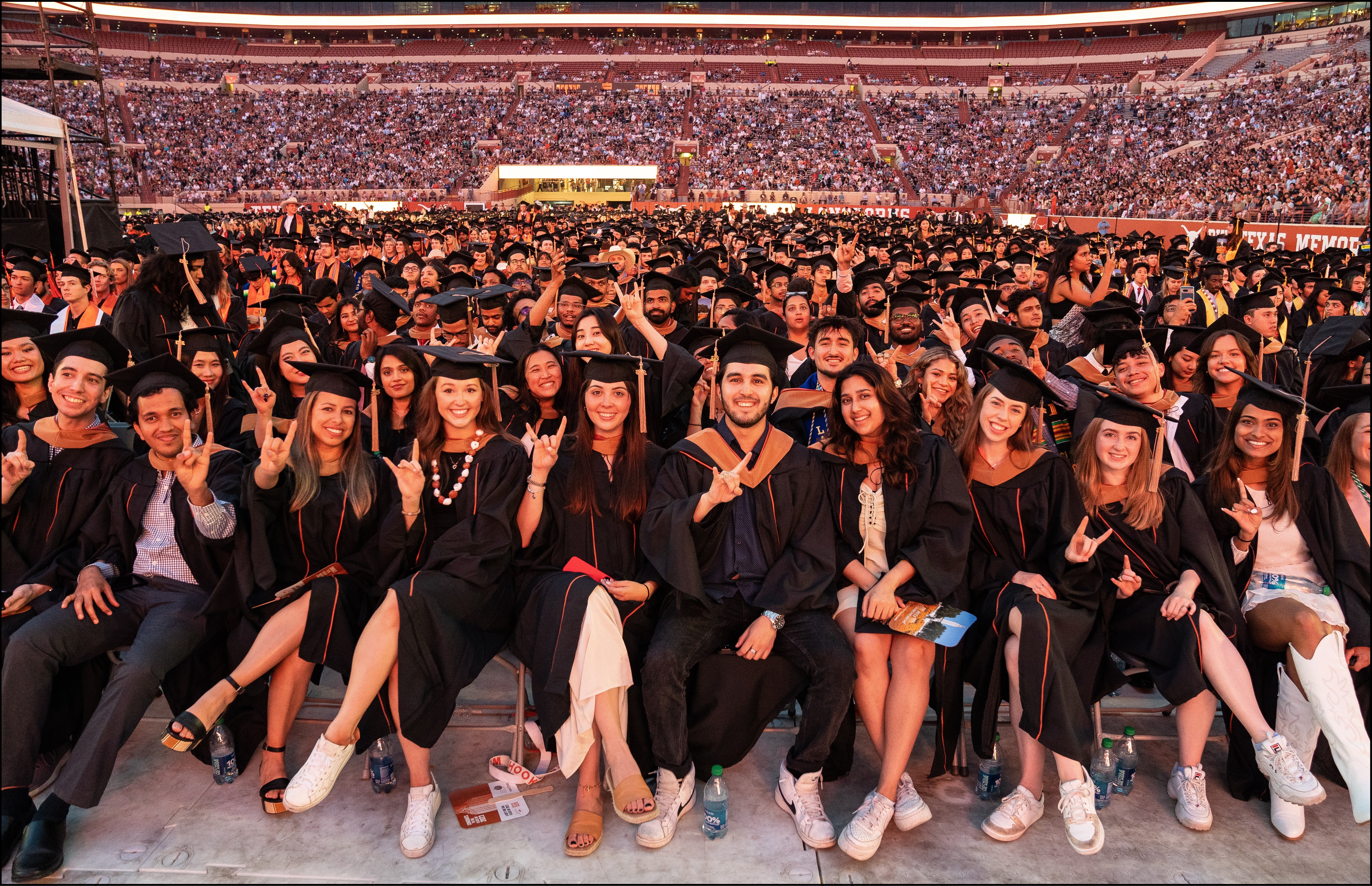
Above: Harley Clark, flashing the Hook ‘em Horns hand sign at the 2013 Gone To Texas freshman convocation. Harley passed away in October 2014. Photo by Marsha Miller

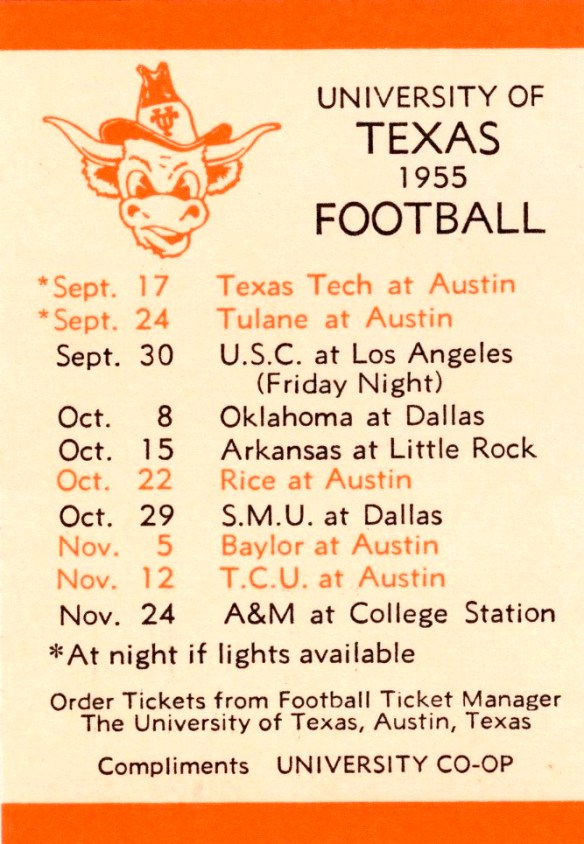
1955FootballScheduleWith a perpetual twinkle in his eye, Harley Clark loved to tell the story. It was the second week of November, 1955, and the University of Texas football team, “high on brain power, but low on brute force,” was preparing for an important contest against the 6th ranked TCU Horned Frogs. The game was to be played in Austin on Saturday afternoon, November 12th, at the usual 2 p.m. kick-off.

The UT squad hadn’t fared all that well. Over the summer of 1955, Texas Memorial Stadium was outfitted with lights and night games were played for the first time, but the team was 4-4 overall and 3-3 in the Southwest Conference. All was not lost, however. League front runner Texas A&M was on probation for recruiting violations and not eligible for post-season play. If Texas could pull a mighty upset over TCU and then win out, the Longhorns would spend New Year’s Day at the Cotton Bowl in Dallas.

The week before the game, Texas fans did all they could to support the team. Signs were hung on the Texas Union. Impromptu football rallies were held almost every night in front of Hill Hall (later expanded to Moore-Hill), the residence for most of the athletes. The red candle tradition was employed. First used in 1941 to “hex” the Texas Aggies, candles burned brightly in store windows along the Drag, in offices downtown, and in homes all over Austin. Local businesses found it difficult to keep red candles in stock.

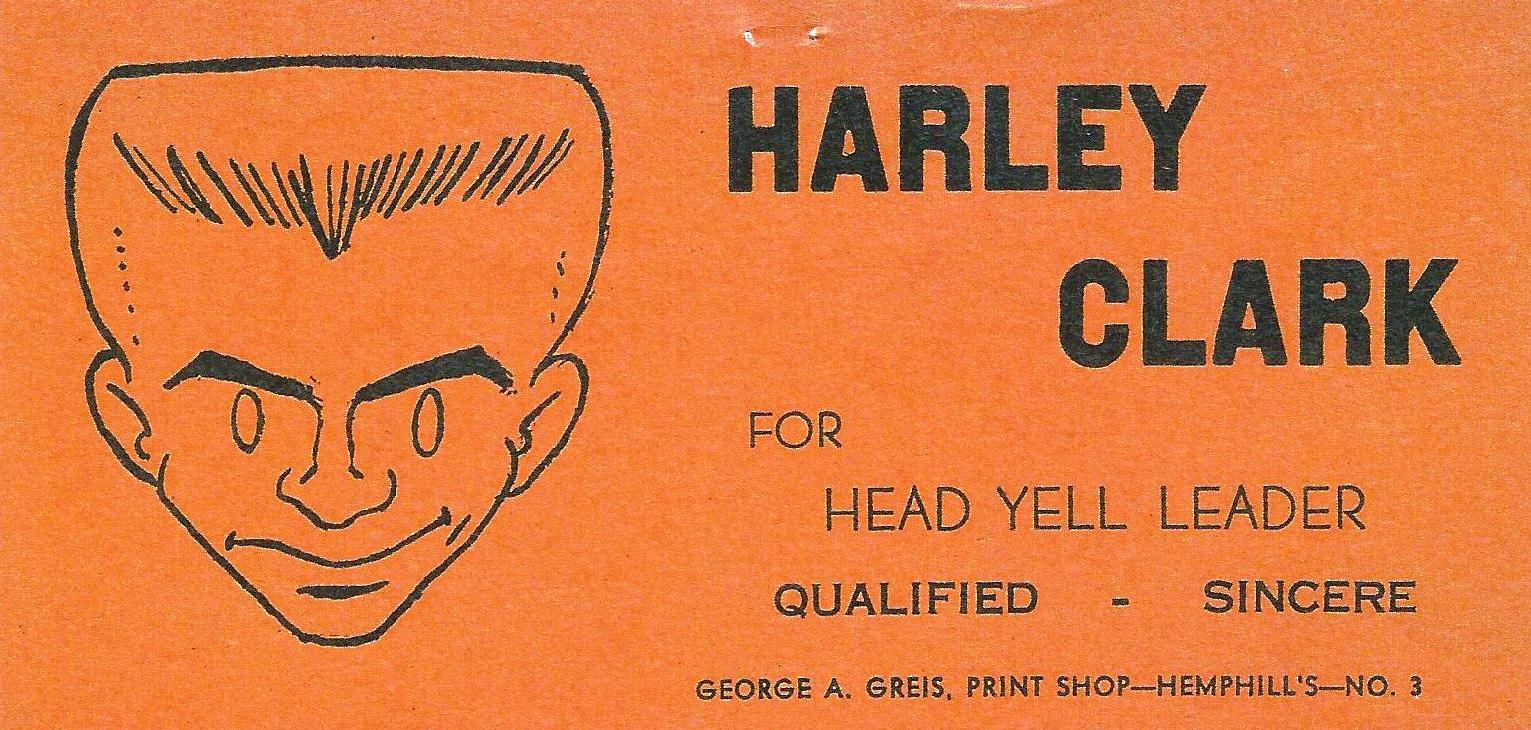
Above: To campaign for the Head Yell Leader spot, Harley distributed cards that fellow students pinned on their shirts.

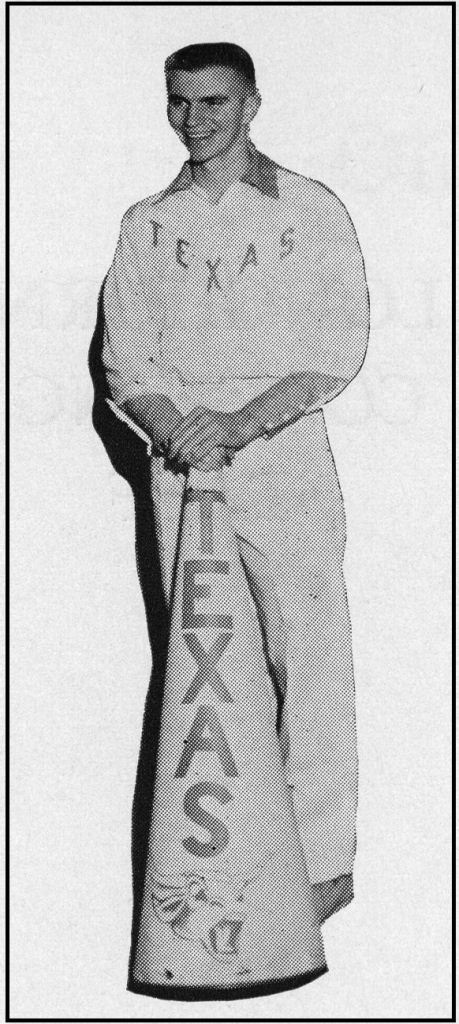
At the center of all this activity was Harley Clark, who’d been elected Head Yell Leader in a campus-wide election the previous April. In the 1950s, the position was highly prized. The Head Yell Leader was responsible for the health and well-being of the Texas Longhorn spirit, and Harley took the assignment seriously.

~~~~~~~~~~

Harley Clark.Head CheerleaderA government major, Harley and his trademark crew cut was an easy figure to spot on the Forty Acres. He seemed to be involved in everything: gymnastics team, Texas Union committees, freshman orientation, Friar Society, Texas Cowboys, and the Tejas Club, his home base, where he roomed with his close friend (and future Austin mayor) Frank Cooksey. Harley would eventually be elected student body president – the first to serve while enrolled in grad school – and earn three UT degrees, a BA and MA in government, as well as a law degree.

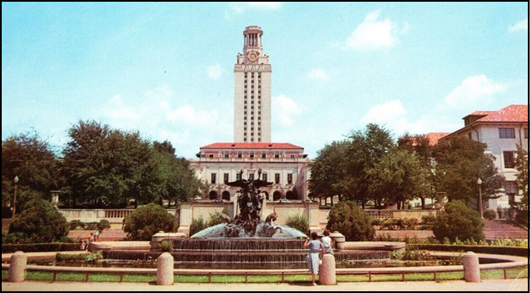
Elected Head Yell Leader at the end of his sophomore year, Harley spent part of the summer of ’55 backpacking through Europe with fellow UT student Speed Carroll. Occasionally, the two would write or phone their whereabouts to family and friends in Austin, and Willie Morris, then editor of The Daily Texan, would report on their adventures in the newspaper. “The Eiffel Tower,” said Harley, “is taller than UT’s and has the added attraction of being quite free of English professors.” Along with taking in the sights of the Old Country, Harley was also hatching plans for the upcoming fall term. The stadium, he thought, was far too quiet during football games, and he wanted to do something to boost the decibel level.

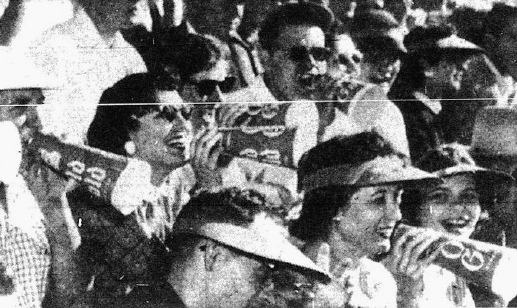
Above: Ten-inch plastic megaphones were distributed at the Texas vs. Baylor game. Fans used them for the rest of the season.

On their way back to Austin, Harley and Speed first stopped in New York, and, not yet recovered from jet lag and without making any appointments, spent two days pestering every advertising company they could find along Madison Avenue. They were looking for a company to sponsor ten-inch plastic megaphones to be distributed at a football game. If the fans had their own megaphones, Harley reasoned, the stadium would certainly be a little louder. Just before they had to push on to Austin, Old Gold Cigarettes (It was the 1950s, remember.) agreed to provide 10,000 orange and white personal megaphones with the company logo printed on the front. The order didn’t arrive until the Baylor game in early November, but they were a big hit with the students and were used for the rest of the season.

~~~~~~~~~~

The official Texas vs. TCU football rally was set for Friday evening, November 11, 1955 in Gregory Gym. As was the tradition, a parade of several thousand students, led by a Dixieland Band on a flat-bed truck, set out from the northwest corner of campus, marched south on Guadalupe, then east on 21st Street to the gym. There was rousing music by the Longhorn Band (with its newly acquired “world’s largest bass drum,” dubbed Big Bertha), yells by the cheerleaders, and spirited talks by Dean of Students Arno Nowotny, Head Coach Ed Price and Team Captains Herb Gray, Johnny Tatum, and Menan Schriewer. Then, at the end of program, Harley decided to introduce something new.

A few days earlier, while in the Texas Union, Harley was talking with classmate Henry “HK” Pitts, who suggested that the hand sign with the index and little fingers extended, looked a bit like a longhorn, and might be fun to do at rallies and football games. The Texas Aggies had their “Gig ‘em” thumbs-up sign, inspired while playing the TCU Horned Frogs. With the TCU game coming up on Saturday, why can’t Texas fans have their own hand signal?

 Above: The “Hook ’em Horns” hand sign is shown – front and back – for the first time in Gregory Gym. At the lower left, someone is trying out the new signal for themselves. The head at the lower right belongs to Longhorn Band Director Vince DiNino. 

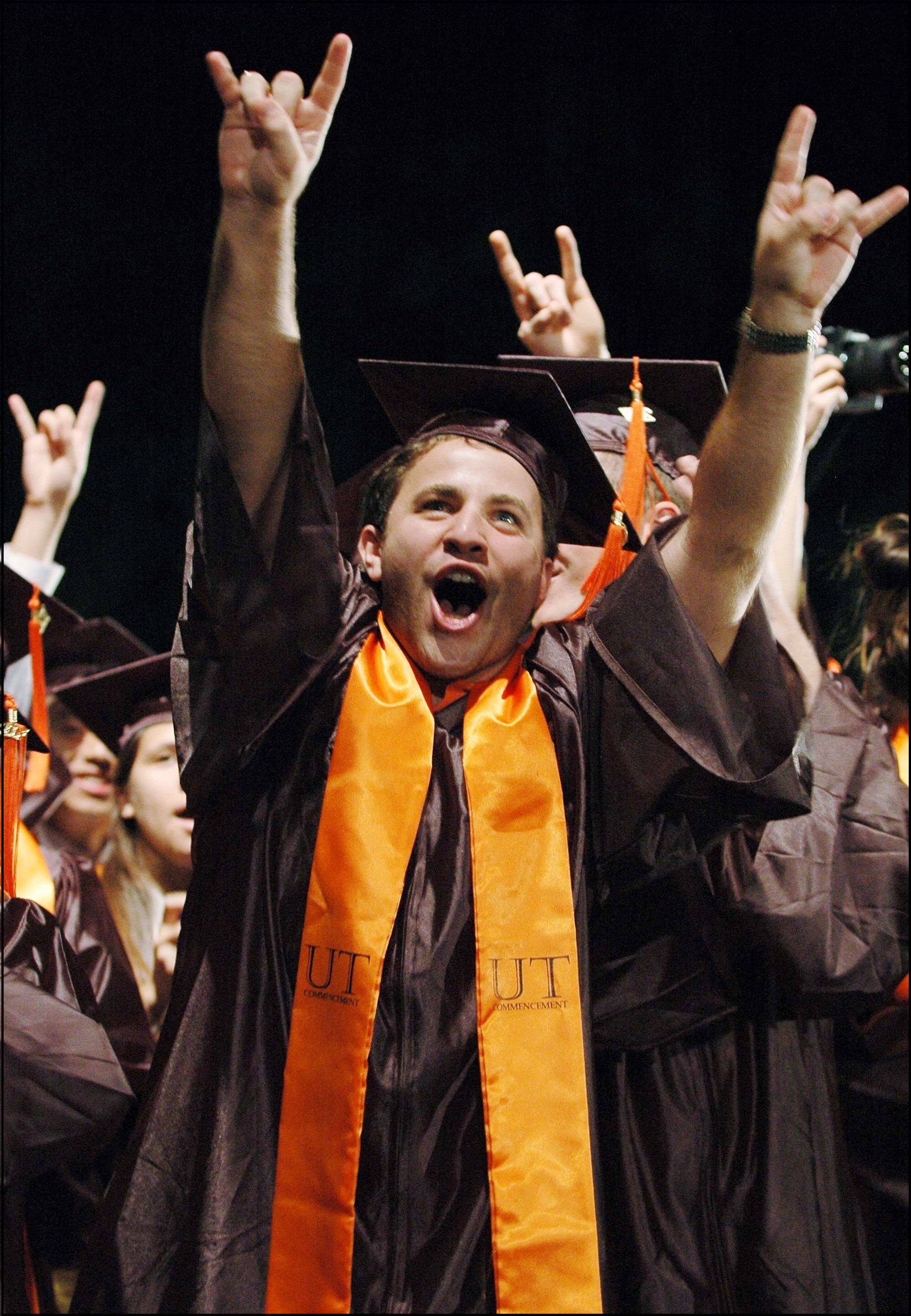
Harley liked the idea, and decided to introduce it at the Gregory Gym rally. He demonstrated the sign to the crowd, and promptly declared, “This is the official hand sign of the University of Texas, to be used whenever and wherever Longhorns gather.” The students and cheerleaders tried it out, and Harley led a simple yell, “Hook ‘em Horns!” with hands raised.

Immediately after the rally, Harley was confronted by a furious Dean Nowotny. “How could you say the hand sign was official?” the dean wanted to know. “Has this been approved by the University administration?” Harley admitted that the idea hadn’t been approved first, but the cat was already out of the bag – or the longhorn was already loose in the pasture.

~~~~~~~~~~

Sometimes, when recounting the story, Harley said that Dean Nowotny also demanded, “Do you know what this means in Sicily?!!” Or Italy. Or anywhere in Europe, where the hand sign is generally considered rude. I asked Harley if it were true, if Nowotny really said that, and Harley admitted that it was the only embellishment he added, mostly just to get a laugh from his audience. For accuracy’s sake, while Nowonty was unhappy that Harley hadn’t first cleared the idea of an “official” hand sign with the administration, the reference to Sicily didn’t actually happen.

~~~~~~~~~~~

The next day at the football game, the student section practiced what they had learned the night before, and the alumni were quick to follow. By the end of the game, the stadium was full of “Hook ‘em Horns” hand signs. And while TCU won the day (47-20) the University of Texas had a new tradition it would cherish for decades to come.

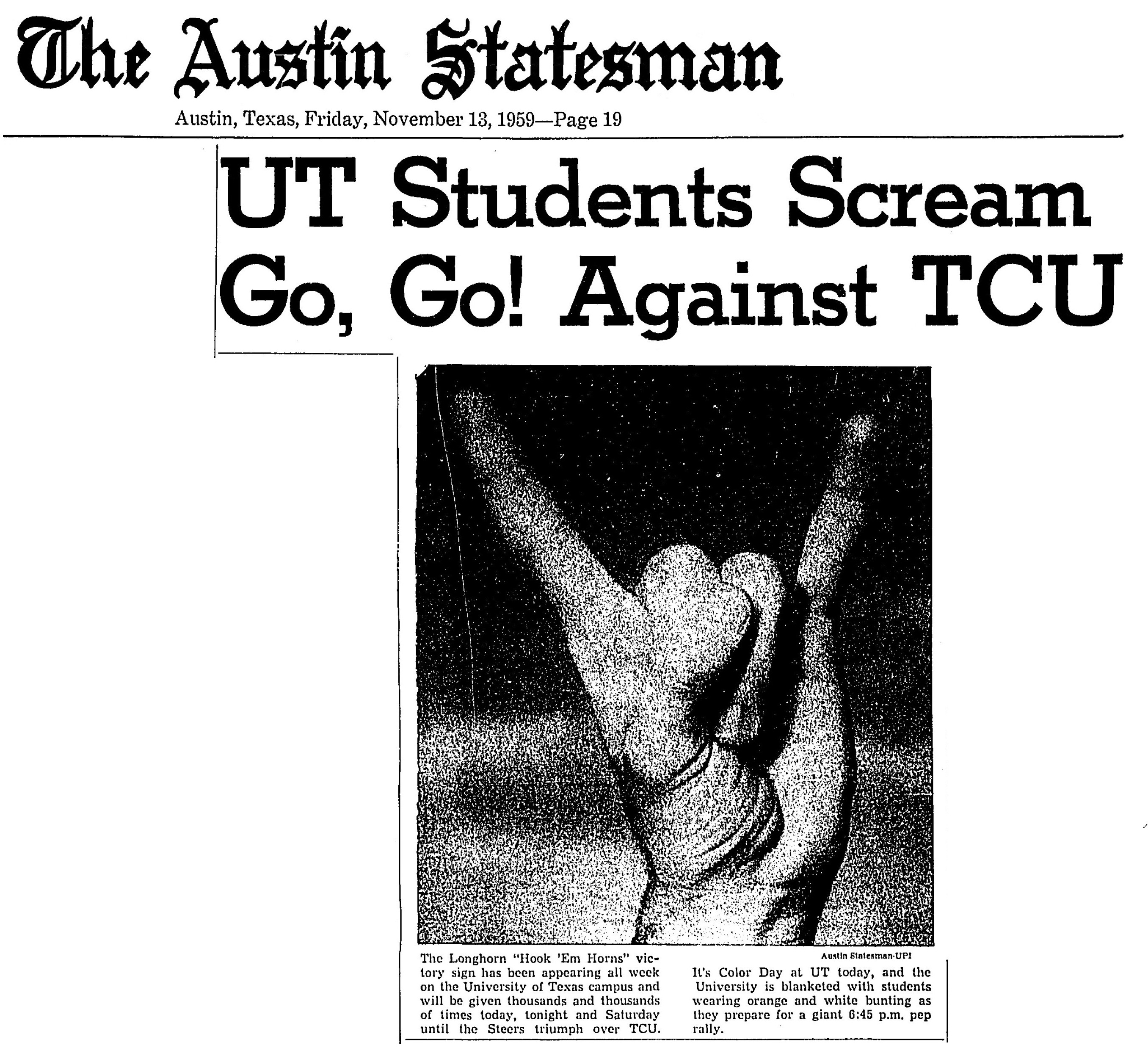
Above: A 1959 issue of the Austin Statesman. The “Hook ’em Horns” hand sign hand already become a well-established UT tradition.

One Hundred Forty-Two

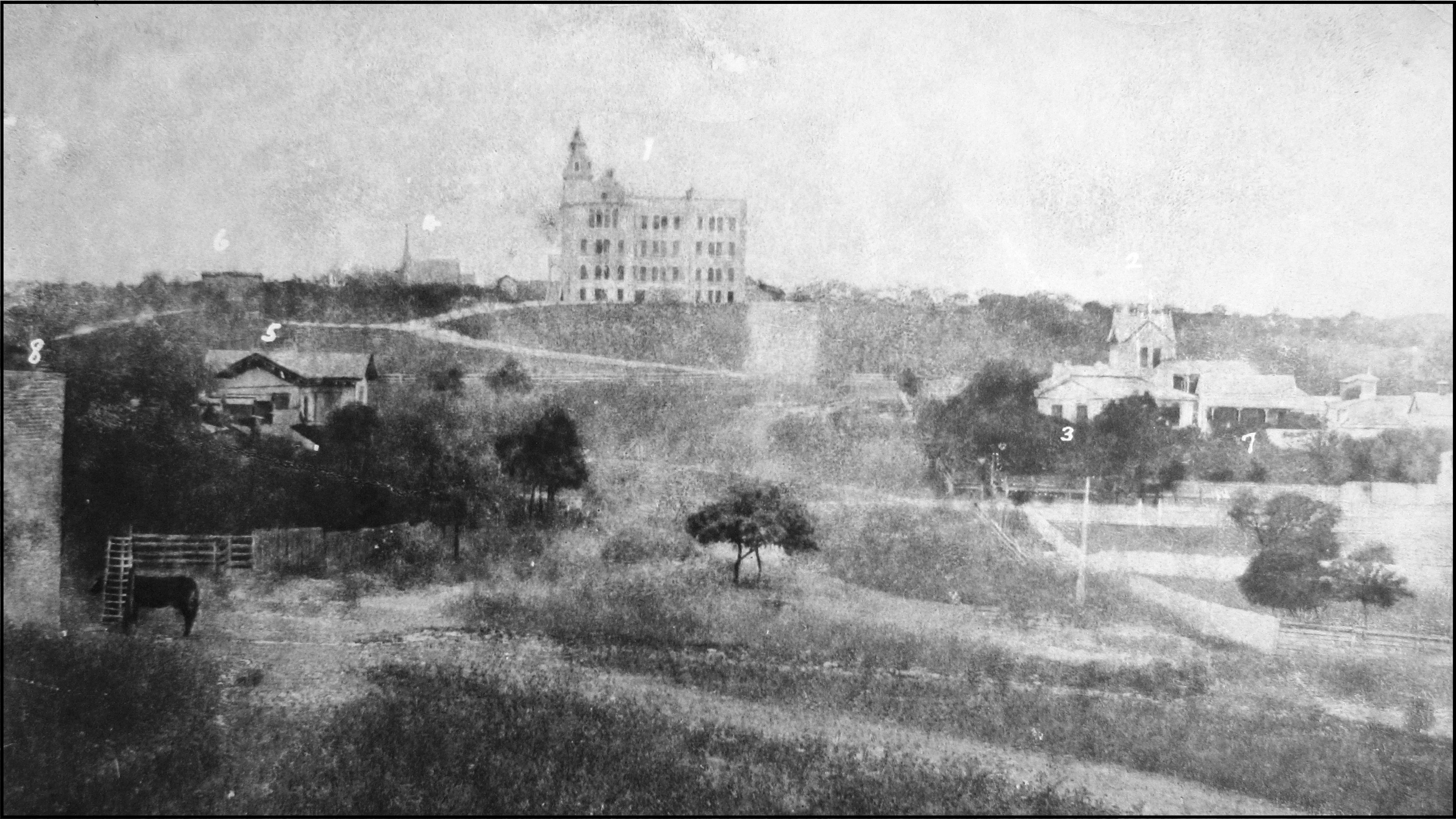
Above: The earliest known image of the UT campus, taken in 1883 at the present intersection of University Avenue and Martin Luther King, Jr. Boulevard. The west wing of the old Main Building – where the Tower stands today – is the only structure.

One hundred and forty-two years ago, the University of Texas opened not to the blare of trumpets and fanfare, but to the chatter of neighs and whinnies.

It was a sunny, sticky, Saturday morning, September 15, 1883, when nearly 300 persons gathered at 10 a.m. for the opening ceremonies of the new University. The men dressed in dark three-piece suits and popular bowler or derby hats, while the women donned colorful bustle dresses with matching, fashionable headwear.

The group assembled in what was the unfinished west wing of the old Main Building and sat on chairs arranged on a makeshift floor of undressed lumber, surrounded by unpainted walls. The incomplete windows were open to the elements, which required the day’s speakers to compete with the brays and snorts – and odors – of the many horses hitched outside.

The west wing sat near the center of a square, uneven, 40-acre campus, initially dubbed “College Hill.” It was almost devoid of flora, save for a thicket of mesquite trees and a handful of live oaks, some festooned with Spanish moss. A great gully extended from the top of the hill to the southeast, dry most of the time but a muddy torrent in wet weather. According to Halbert Randolph, who earned his law degree in 1885, the ornamental shrubbery consisted of a “cactus sporting its full-grown fruit, looking like the ripe nose of a drunkard.” For a few weeks in the spring, the campus was aglow with a blanket of Texas bluebonnets, and the pitiable state of the grounds was temporarily forgotten.

Above: The west wing of the old Main Building, about 1885. Victorian Gothic in style, it was made from yellow pressed brick with limestone trim, and had a grey slate-tiled mansard roof. Plumbing for the building was incomplete. Almost out of sight and behind the hill to the right is the roof of a temporary lavatory.

To the east, beyond the University grounds, lay vast tracts of pasture land and open prairie. Just to the west, along a dusty and unpaved Guadalupe Street, stood two grocery stores, a dry goods shop, and a saloon.

The sprawling town of Austin filled the view to the south, its 11,000 inhabitants still abuzz over the local telephone service that was installed two years earlier. Austin won the privilege to host the main campus of the University after a hotly contested state election, and as it was already the seat of Texas government, civic leaders predicted Austin would soon be the “Athens of the Southwest.”

Fortunately, there were no proposals to change the city’s name accordingly. Harvard University, opened in 1638 in the village of New Town, Massachusetts, was founded by a group of University of Cambridge alumni with high hopes for the college, and New Town was promptly renamed Cambridge. The trend continued into the 19th century, as the United States expanded westward. Colleges and universities were desired assets of newly-started, up-and-coming towns with lofty ambitions, and communities sometimes renamed themselves to reflect their goals. It’s no accident that two of Ohio’s state universities reside in towns named Oxford and Athens, that students enrolled at the University of Mississippi travel to Oxford, or that the University of Georgia is located in Athens.

~~~~~~~~~~~~~~~~~~~~~

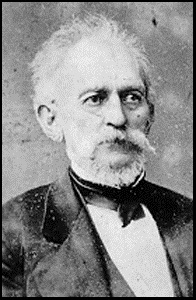
Ashbel Smith, a 76-year-old physician from Galveston (photo at left), was selected to chair the University’s inaugural Board of Regents, and was entrusted with the Herculean task of creating the new university. A graduate of Yale, Smith was a secretary of state for the Republic of Texas and served multiple terms in the state legislature.

In the final years of his life, Smith’s passion was the University of Texas, and his top priority was to recruit the best faculty possible. Smith traveled extensively, visited colleges throughout the country, and spent many late nights devoted to University-related correspondence. His letters, scribbled by candlelight, are now carefully preserved in the University archives.

After nearly two years of effort, Smith and the Board of Regents selected eight professors. Six of them formed the Academic Department, and most were assigned to teach multiple disciplines: English, literature, and history; chemistry and physics; mathematics; metaphysics, logic, and ethics; ancient Greek and Latin; and Spanish, French and German. The remaining two faculty members composed the Law Department. Salaries averaged $2,500 per year, a generous sum in the 1880s.

Most of the professors hailed from Virginia, Tennessee, and Kentucky. To save on travel expenses, Smith convened the first faculty meeting in May 1883 not in Austin, but at Vanderbilt University in Nashville.

Above: The University’s first faculty. From left: John Mallet, professor of physics and chemistry; Leslie Waggener, professor of English language, history, and literature; Robert Dabney, professor of mental and moral philosophy and political science; Robert Gould, professor of law; Oran Roberts, professor of law; Henri Tallichet, professor of modern languages; Milton Humphreys, professor of ancient languages; and William LeRoy Broun, professor of mathematics.

The initial entrance requirements were determined by the faculty. Candidates for the Academic Department were expected to know elementary Greek and Latin, though French and German could be substituted for those planning to pursue science or literature. Competency in algebra and plane geometry, English composition, history, and political geography were also required. Admission to the law department did not yet require a bachelor’s degree, though candidates were urged to have a strong background in reading and writing English, and a “familiarity of the history of the United States and England.”

In the weeks before the University was scheduled to open, college-aged youth made their way to Austin to present their credentials and be interviewed by the faculty for admission. In a state where 90 percent of the population was classified as rural, many of the candidates were from farms and ranches, the children of pioneers, raised in log cabins with few luxuries. They were practical and self-motivated, but their preparatory education was incomplete. Many did not possess high school diplomas, and the standards for admission were too high. One prospective student who hoped to study mathematics, when asked how much math he had taken, proudly responded that he’d completed a class in “discount and bankruptcy.” Though hindered by a lack of formal education, the young Texans managed to impress the faculty. According to chemistry professor John Mallet, “Boys whose spelling and arithmetic were much behind their years, talked and thought like grown men of house building on the prairie, of cattle driving, even of social and political movements.” At the end of the first day of entrance examinations, the faculty met, discussed the situation, and with a collective shrug decided not to rigidly enforce the “grade of scholarship” established for admission, due to the “limited advantages for education in this state.”

From the beginning, the University was open to women, a progressive statement at a time when opportunities for women in higher education were rare. That UT would be co-educational was the result of a compromise in the state legislature as it debated the bill to create the University. Some members of the House who were opposed to female students were also political opponents of Governor Oran Roberts, and they feared that Roberts, whose term in office was coming to a close, would be named UT’s first president. In order to support the inclusion of women, the legislators demanded that the University be modeled after the University of Virginia, which was then led by a faculty chairman instead of a chief executive. An agreement was reached. Women were admitted as students, but for its first decade, University affairs were the responsibility of the elected head of the faculty. Roberts was denied the possibility of serving as UT’s president, but he was appointed one of the two initial law professors.

While the 1876 Texas constitution mandated the creation of the University, it also required the legislature to “establish and provide for the maintenance of a College or Branch University for the instruction of the colored youths of the state,” which denied the Austin campus to African Americans. It would take another 70 years, starting with the 1950 enrollment of Heman Sweatt in the School of Law, for the University to truly become of and for all Texans.

~~~~~~~~~~

Among the speakers for the opening ceremonies was Dr. John Mallet (photo at left). Hired away from the University of  Virginia to teach chemistry and physics, Mallet was elected by his fellow UT professors to be the first Chair of the Faculty.

Mallet cautioned those present not to expect too much too soon, and prophetically compared the progress of a university to the growth of a tree. “It must have a fruitful field . . . but you will be disappointed if you expect it to grow from the seedling to the proportions of a stately tree in a single night. And more will you be disappointed if, in your efforts to hasten its growth, you pluck it up by the roots to see how much the roots have grown.” Mallet also spoke of the students, “to whom the faculty look with peculiar interest and hopes,” and then, directly to the students in the audience.

To the students: “We ask you to be fellow workers with us. You should try to understand your true relations to the University. You frequently hear the phrase used, ‘coming to the university,’ not remembering that you are the university. More than the faculty – more than the Board of Regents – more than all else – it is the students that make the university. It is not the crumbling stones of Oxford, nor the memories of its hundreds of able teachers that make it the great university of England, but it is the never dying intellectual and moral life of the five and twenty generations of men who have gathered there as students. The students are, in the highest and truest sense, the university themselves.

“If Texas is to have a university of the first class, worthy of the name, the work of the faculty can form but a small part in its success. Its development must be the result of the united efforts of the people of Texas, of the State government, of the Board of Regents, of the faculty, and above all, of the students of the university.”

With an incomplete building, sitting on a mostly barren campus, boasting an inaugural faculty of eight professors, and joined by 221 students, the University took its first, tentative steps upon the stage of Academe.

An Alumni Quadridecacentennial

The Texas Exes marks its 140th year.

Bright blue skies and uncomfortably warm temperatures greeted the second annual University of Texas Commencement in June 1885. “Rain is falling in different portions of the state,” reported The Austin Daily Statesman. “It is asked to put in its presence here without delay.” Held over three days, commencement was a lively affair, crammed with receptions, banquets, a grand Commencement Ball, and more than its fair share of oratory. Among the speech-makers was new law graduate Thomas Watt Gregory (a future U.S. Attorney General and Gregory Gym’s namesake), whose eloquence thoroughly impressed his audience. “At times he rose to fine oratorical heights,” lauded the Statesman, “and prudently eschewed from his discourse the tinseled vaporings which generally characterize commencement efforts.” To beat the summer heat, the formal graduation ceremony was held Wednesday morning at 11 a.m., June 17, at Millet’s Opera House downtown. Ashbel Smith, chair of the Board of Regents, conferred 20 law degrees and presented the University’s first Bachelor of Arts degree to Samuel Clark Red.

After lunch, the 1885 graduating class re-convened in the history lecture hall of the west wing of the old Main Building. (Image above left.) Made of pale-yellow pressed Austin brick, limestone trim, and a grey slate roof, the collegiate Gothic west wing was the only structure on the young 40-acre campus. With the academic year ended, the building was nearly empty.  Only a row of horses and horse-drawn carts parked at the west entrance betrayed the activity inside. As it was still many decades before modern air conditioning, windows were opened to encourage a cross-breeze and make the hot afternoon a little more tolerable.

The 1885 class was joined by their counterparts of the year before, the 13-member inaugural class of 1884. Once assembled, the group worked through the afternoon to create the University of Texas Alumni Association. A constitution was debated and adopted, which limited membership UT graduates. John Stone was elected the first president, with Gregory chosen as vice president. Robert Walker, the group’s new secretary, dutifully took minutes and began to collect alumni records on index cards. Future annual meetings were scheduled to coincide with June commencement, and John Cobb was asked to be the alumni speaker for the 1886 graduation. Among the founding members of the Association, the oldest was 24.

One hundred and forty years later, the Texas Exes boasts more than 116,000 members globally, open to all ex-students and friends of the University. While the Association’s rich and colorful history is too long to be posted here, below is a smattering of lesser-known pieces of the Texas Exes story.

The Alumni Association couldn’t fund its first scholarship. 

At its June 1899 meeting, the Association voted to award a $100 scholarship to the incoming freshman with the highest overall score of UT’s entrance exams in English, history, and math, and appointed a committee to oversee the funding and selection. As in-state tuition was free until the 1920s, the scholarship would help pay for textbooks and living expenses.

The scholarship was to be financed through membership dues to the Association and was widely advertised in newspapers across the state. By the end of the summer, however, only about 60 alumni had paid their $1.00 annual dues, not enough to fulfill the scholarship. Since the Association had committed to it, the scholarship was awarded anyway to Conrad Shuddenmagen of Gonzalez. The committee made up the deficit among themselves, and then began to solicit scholarship funds for future years, both through handwritten letters and personal visits to fellow alumni.

Above right: A handwritten letter on Alumni Association stationery discussing how to raise funds for the first alumni scholarship.

Today, the Texas Exes annually awards $2.6 million in scholarships to about 800 UT students, with over $750,000 contributed by volunteers in local chapters and networks, much as they did 140 years ago.

Above: The Fountain of Energy at the 1915 San Francisco World’s Fair.

The Alcalde alumni magazine was featured in the World’s Fair.

The Alcalde alumni magazine made its debut in 1913 (see Birth of the Alcalde Magazine) and its high typographical quality and use of monotype for its cover and other graphics quickly garnered national attention. In 1915, it was a showcase publication in the printing exhibit at the San Francisco World’s Fair, as well as the San Diego Panama-Pacific Exhibition in 1916.

Alumni missed meals to build the Texas Union.

In 1928, the Texas Exes launched the Union Project, an ambitious $500,000 fundraising effort to build today’s Texas Union (photo above), Hogg Auditorium, and Gregory and Anna Hiss Gymnasiums. After the stock market crashed the following year, much the project had to be completed during the years of the Great Depression. When the economy worsened, some alumni were forced to default on their pledges. “My children come first now, and it is hard for me to do what is necessary for them – at times impossible. I am very sorry,” wrote Zulieka Adams from Mexia. Other alumni skipped meals in order to save up for their annual pledge payments.

When the Union opened in 1933, the Association moved in to the space just above what today is the Cactus Café. It’s currently a study area, but visitors can still see the fireplace at the north end that was part of the small alumni lounge. Go out into the lobby – named the Presidential Lobby for the wood-carved portraits of University presidents on display – and find the names of Association presidents hand painted on the ceiling beams directly in front of the ballroom, as well as above the hallway that leads to the north. (At last check, the names had been kept up-to-date.)

The Texas Exes created UT’s first academic recruitment program.

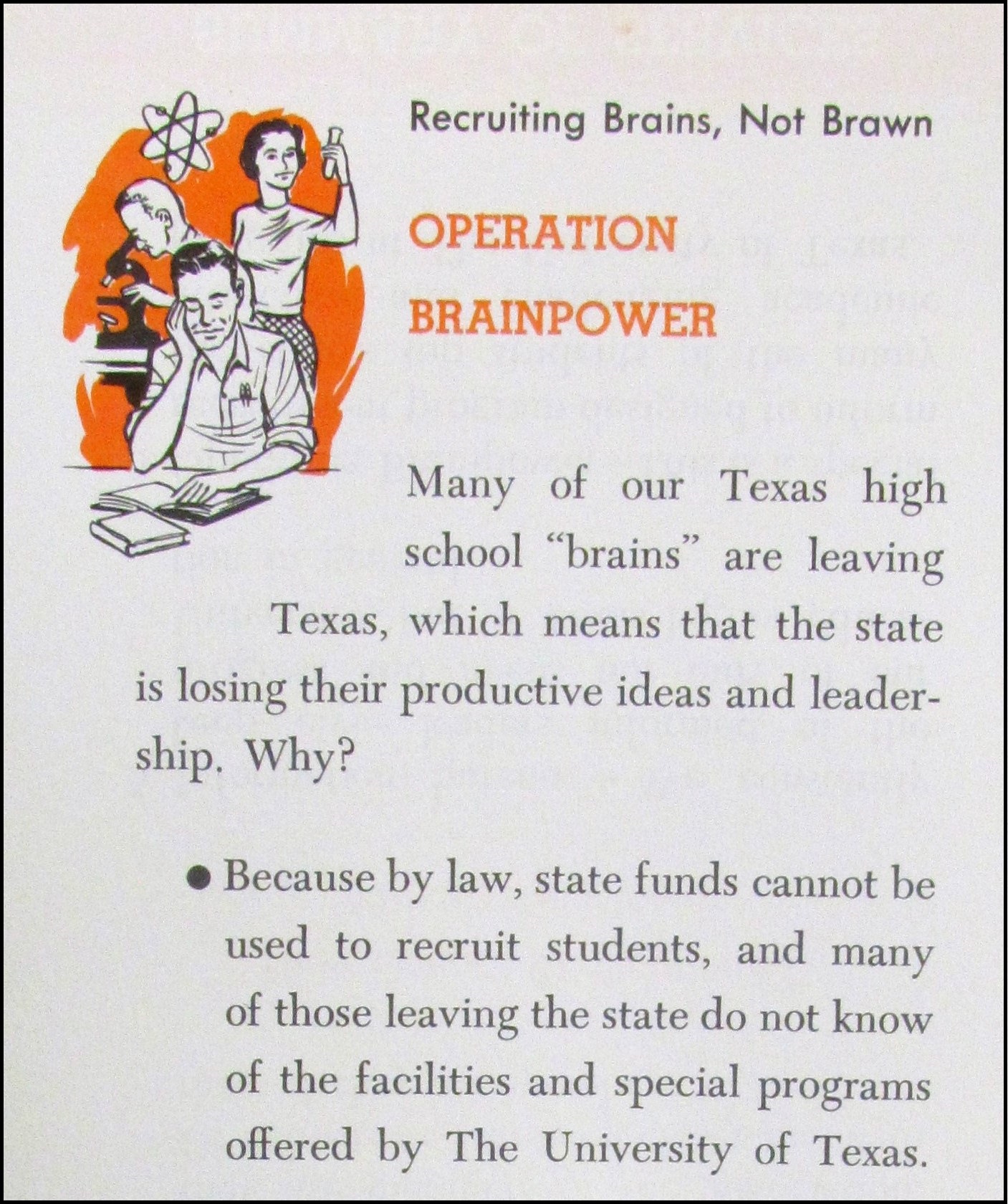
In the 1950s, it was common practice for Ivy League and other private universities to visit Texas for what was called a yearly “talent search” and recruit many of the best high school students away from the state. Ed Schutze, a 1948 UT graduate and president of the Texas Exes Dallas Chapter, grew concerned and discovered that nearly 10% of the top Dallas area high students were going “back East” to college. Texas laws prohibited the University from using state monies for a counter program, so Schutze decided to create one of his own. In 1957, he convinced several UT administrators and student leaders to visit Dallas and spend time with a specially invited group of high school students. Along with discussions about academic opportunities in Austin, the group saw a short film – “This is Your University” – which had been funded, in part, by the Texas Exes. (See “This is Your University” on YouTube, with scenes of the campus filmed in the 1950s.)

Above: Part of an explanation of “Operation Brainpower” in a 1960s Texas Exes membership solicitation.

Schutze’s idea was a hit, and the following year, as the University celebrated its 75th anniversary, the Texas Exes provided financial support for what became “Operation Brainpower” and added programs across the state. In 1959, an Alcalde magazine article on this new idea of “recruiting brains, not brawn” drew the eye of then U.S. Senator Lyndon Johnson. He thought the effort set an example that many state universities could follow, and had the article placed in the Congressional Record.

“Operation Brainpower” was a great success, and continued through the 1960s.

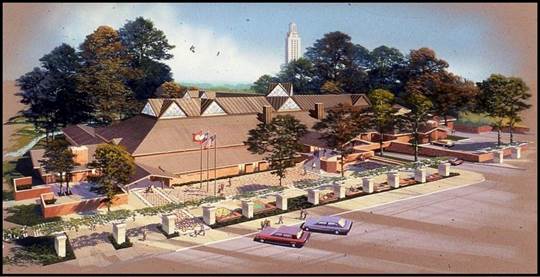
Above: The 1988 architectural rendering of the Alumni Center expansion.

The Alumni Center was inspired by geodes.

As the Association’s first permanent home, the Alumni Center opened in 1965 (see “On Building an Alumni House”), but within 20 years was deemed too cramped for the ever-growing alumni programs. Discussions on a major expansion to the building culminated in the 1990 opening of the Vernon F. “Doc” and Gertrude Neuhaus addition. The $7 million renovation more than tripled the available space in the building, provided for an in-house caterer, and added underground parking.

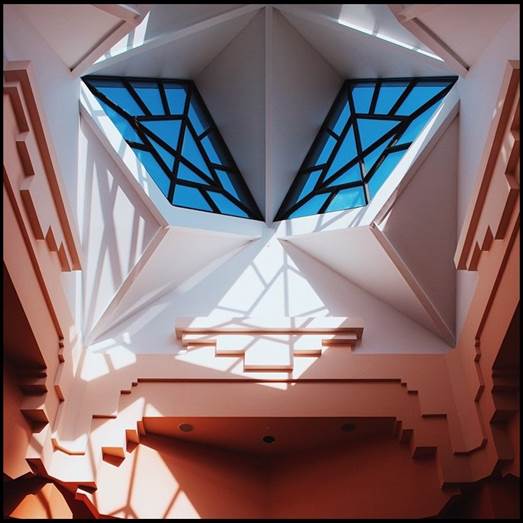
In the 1960s, architect Fred Day designed the Alumni Center as a sprawling, single-story ranch house with comfortable rooms and a pleasant, simple courtyard. Charles Moore, the architect of the 1990 expansion, wanted to keep the theme. “It’s a building that has to do with people’s memories,” said Moore. “What we’ve tried to do is stay with the mood of the existing building but add a set of dramatic spaces.” Moore, though, was famous for his sense of whimsy, and his design, especially for the main rotunda and concourse, was inspired by geodes.

Popular in natural history stores or geology fairs, geodes are best known as hollow rocks filled with quartz or amethyst crystals. Moore imagined a geode cut in half with the flat side down. If it were large enough, a person could walk through it with the crystals overhead. For the expanded Alumni Center, Moore’s musings resulted in the sharp-angled windows, tiered concourse ceilings, and hints, especially in the rotunda, of images of longhorns. According to Moore, it was meant to be “a colorful, multifaceted surprise, reflecting light from every angle, and embedded with the symbolism of the University of Texas.”

Above: A view of the Alumni Center rotunda in its original orange shades. The sharply angled windows, inspired by crystals found in a geode, cast a variety of light and shadows. You’ll also see the familiar shapes of longhorns in the center and the corners.

On Building an Alumni House

The Alumni Center turns 60!

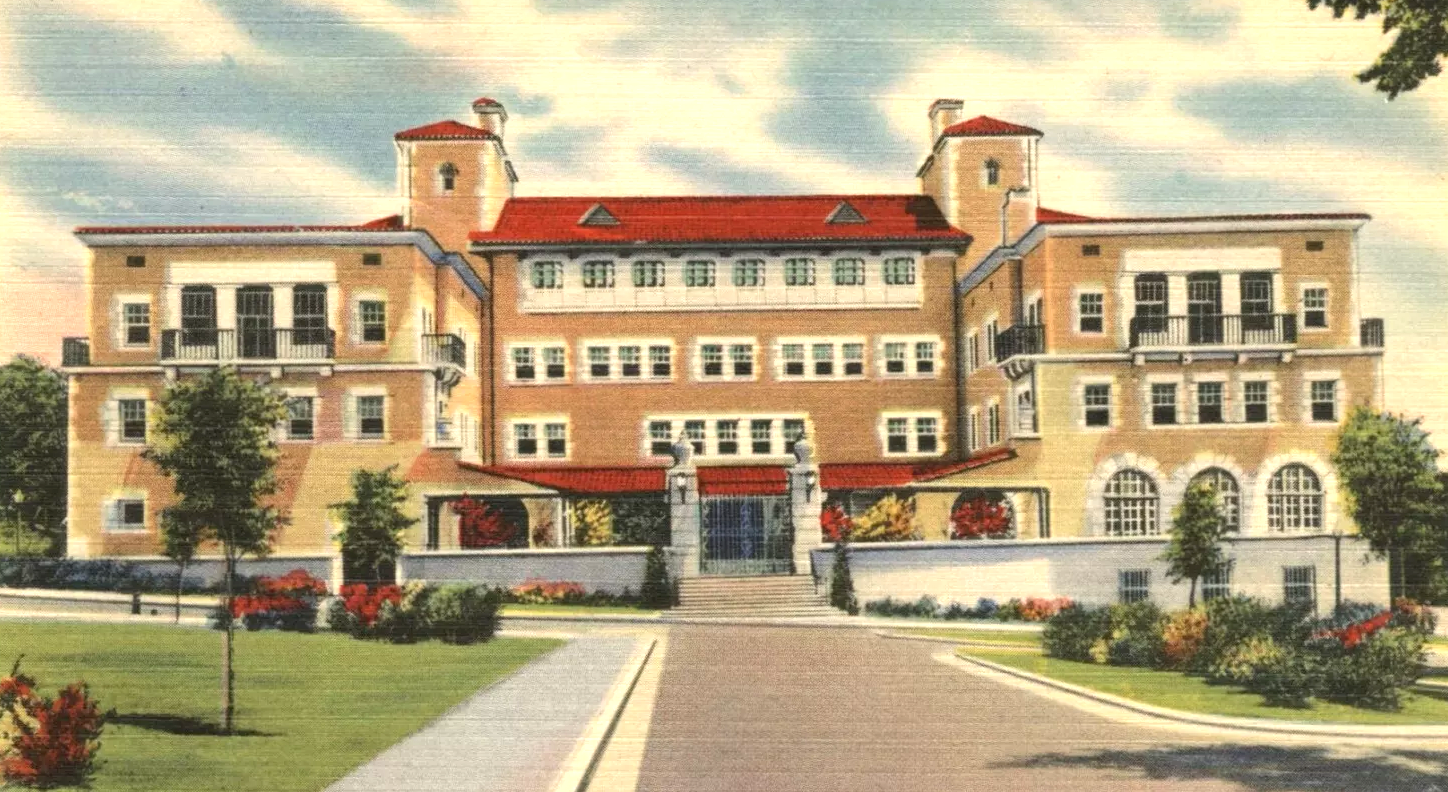
 Above: A color rendering of the UT Alumni Center.

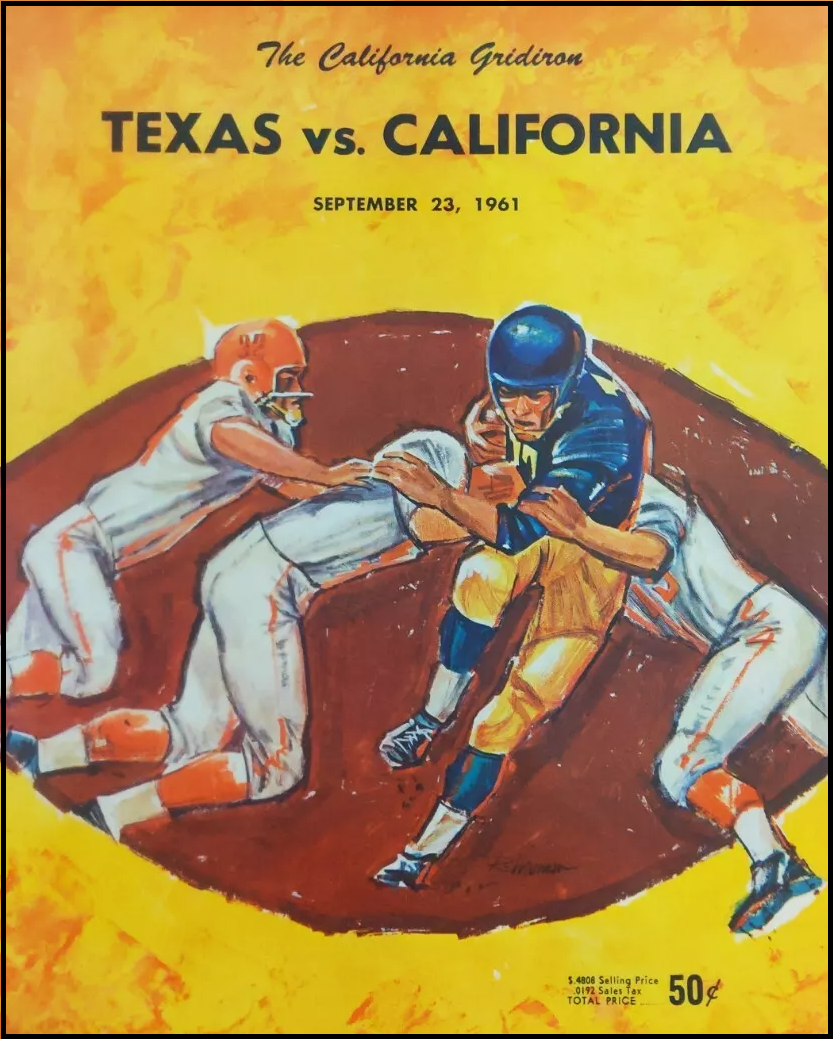
“California, here we come!” The fourth-ranked University of Texas football team opened its 1961 season against the Golden Bears of the University of California. Played at Cal’s Memorial Stadium in Berkeley, UT’s Ex-Students’ Association – the Texas Exes – wanted more orange-minded fans in the seats and chartered its first-ever football weekend excursion. For just under $200, the package included round trip airfare from Austin to San Francisco, a two-night stay in the new Jack Tar Hotel (then billed as the most modern hotel in the world – a television in every room!), ground transportation to Berkeley, and a ticket to the game.  The 80 available spots sold quickly. John Holmes, a Houston lawyer and the Association’s president, was one of the first to register.

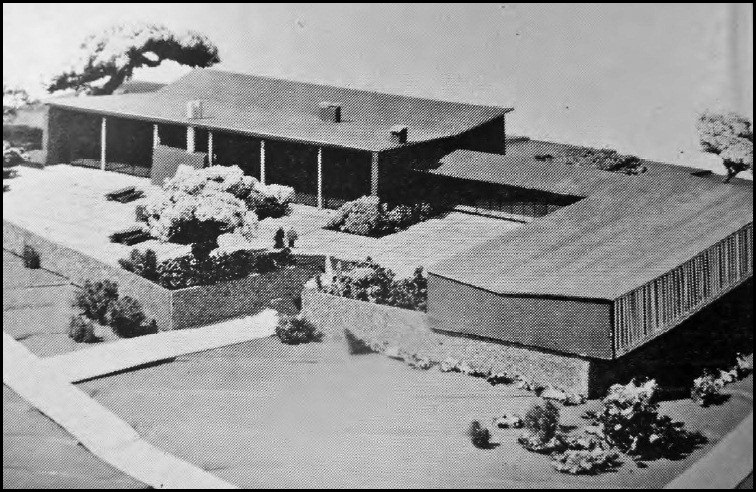
The trip also included a pre-game welcome luncheon at Cal’s Alumni House. (Photo at right is of the architectural model.) Opened seven years before, in 1954, the building was called a “house” as it was deemed a place where “alumni throughout the world can come and feel at home – at home because they are in a spot on the campus that belongs to them, was created for them, and in tribute to their accomplishments however large or small.”  Outfitted with alumni association staff offices, conference rooms, a lounge, and a kitchen, the Alumni House had become a busy and important gathering place on the campus. It also left a strong and lasting impression on John Holmes. While Texas football easily won the day 28 – 3 (though the talk of the game was about the dancing girls hired as substitute UT cheerleaders, (see The Longhorns’ Secret Weapon), Holmes was excited about the possibility of creating an alumni house in Austin, and spent the return flight conferring on the subject with Association Executive Director Jack Maguire.

~~~~~~~~~~~~~~~~~~~~

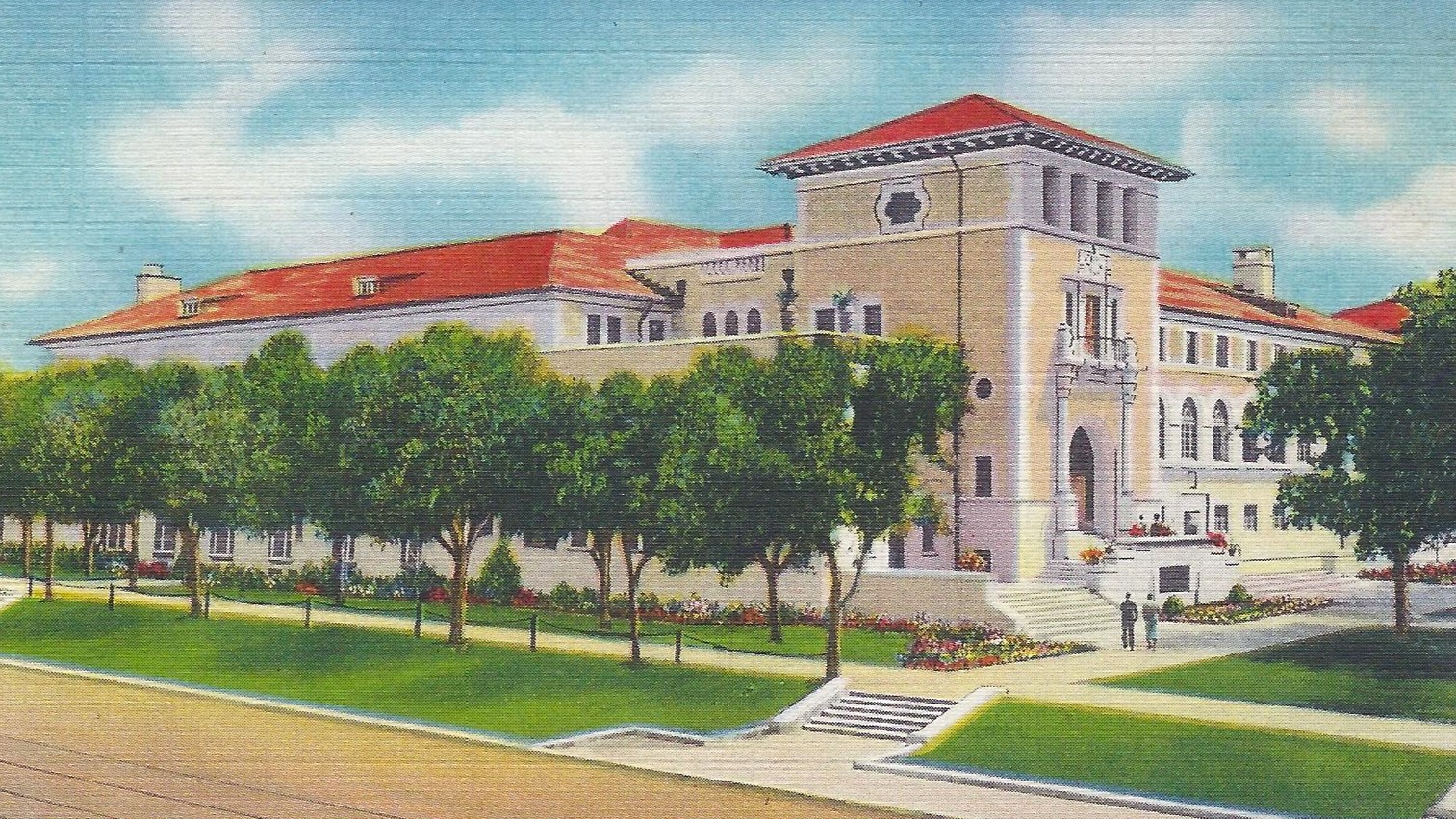
The idea of an alumni house was the solution to a nearly 80-year issue: where to place a wandering alumni association. Founded in June 1885, the Association was homeless for its first 28 years until October 1913, when the University designated room 119 in the old Main Building (photo at left) as the “Alumni Room.” The former office of UT President Sidney Mezes, it measured 25 x 15 feet, was equipped with tables, chairs, bookshelves, and its own candlestick telephone (a luxury in 1913). The walls were crammed with pennants and banners, and photos of Association presidents, University faculty, class portraits, and athletic teams.

The room, though, was only used for four years. When Governor James Ferguson threatened to shut down the University over a controversy in 1917, the alumni rallied to protect their alma mater and set up temporary headquarters off campus in the Littlefield Building downtown. Two years later, after Ferguson had been impeached and World War I ended, the Association moved to the YMCA Building at the corner of 22nd and Guadalupe Streets.

In the 1920s, it ventured a little farther into West Campus, where it purchased the quaint, Victorian-styled Waggener Home (above right), once owned by UT’s first president Leslie Waggener, at the corner of 23rd and San Antonio. It was here that the Association launched the Union Project, an ambitious, and at times, heroic, fundraising campaign through part of the Great Depression that built Gregory and Anna Hiss gymnasiums, Hogg Auditorium, and the Texas Union.

When the Union building opened in 1933, the Association returned to campus with office space on the building’s second floor, now used as a student study room next to the Union ballroom. (You’ll still find the names of Association presidents painted on the beams above the ballroom entrance.) But after World War II, when a flood of returning veterans on the G. I. Bill created a boom in college enrollment (see Life in Cliff Courts) – and thereafter swelling the ranks of alumni – the Association soon discovered it needed more space.

Talks with University officials in the late 1950s led to the idea of the Association taking over the Littlefield Home at 24th and Whitis Streets. It was easily accessible near the edge of campus and already had a small parking lot, but extensive renovations would be required before the building was ready. In 1958, as a temporary measure, the staff was moved to the west-side basement of Mary Gearing Hall, then used by the Department of Home Economics and is today the headquarters for the School of Human Ecology. The place was a little roomier, but the “mole hole,” as it informally came to be known, was difficult to find, and was certainly not suitable for the activities of a growing alumni association. After three years in its so-called “temporary” quarters and with no progress toward the use of the Littlefield Home, a permanent solution was desperately needed.

~~~~~~~~~~~~~~~~~~~~

Following his trip to California, Holmes wasted no time on the Alumni House idea. The day after his return to Texas, he conferred with other Association leaders, named a committee to investigate possibilities, and initiated a conversation with UT administrators. The point of contact from the University fell to UT System Vice Chancellor Larry Haskew, who moved the process along quickly.

Five weeks later, at the end of October, Haskew had prepared a draft report for the Board of Regents, which declared that “an Alumni House of distinctive character and outstanding convenience is of great importance to The University and that one should be provided as soon as possible.” The alumni committee and administration had investigated several options. The Littlefield Home was still a possibility, but serious design and financial obstacles existed. The group also looked at existing homes in the area, including the Delta Tau Delta fraternity house still located just north of campus, but the consensus was that a new facility, designed specifically for the needs of the alumni, was the best solution.

The desired location was the mostly-vacant lot on San Jacinto Boulevard, across the street from the football stadium. The area was still occupied by a pair of temporary men’s dormitories, former World War II Bachelor Officers’ Quarters that had been relocated to campus to accommodate the post-war growth in enrollment (see Life in Cliff Courts), but the dorms were scheduled for demolition. The space had been informally earmarked for a second student union building, but Haskew wrote, “This latter use would be enhanced, actually, by location there of Alumni House,” which implied that the alumni association and the Texas Union might join forces again in the future.

To help financially, the administration proposed using $110,000 from the Lila B. Etter trust fund, a bequest from the daughter (left) of former UT president Leslie Waggener. The alumni could add any amount desired, and the building would be known as the Etter Alumni House. Once completed and occupied, the Association would pay back the $110,000, without interest, at $5,000 per year.

The Board of Regents gave an initial green light to the project at its November meeting, and then formally approved use of the Etter fund and the San Jacinto location on February 3, 1962, a day after the Alumni Council had officially voted its consent. The local firm Jessen, Jessen, Milhouse and Greeven was brought aboard as the consulting architect, and Fred Day, a 1950 graduate of UT’s School of Architecture, was hired to design the building.

~~~~~~~~~~~~~~~~~~~~

By June 1962, initial ideas had been discussed and approved, but the proposed sketch was unlike anything yet seen on the campus. “I’d feel safer,” Haskew wrote to Chancellor Harry Ransom and UT President Joe Smiley, “if both of you would look at the plot design and building schematics for the Alumni House . . . My reaction is highly favorable, but the conception . . . is unusual enough to warrant advance cognizance of top administration before architects proceed with preliminary plans.”

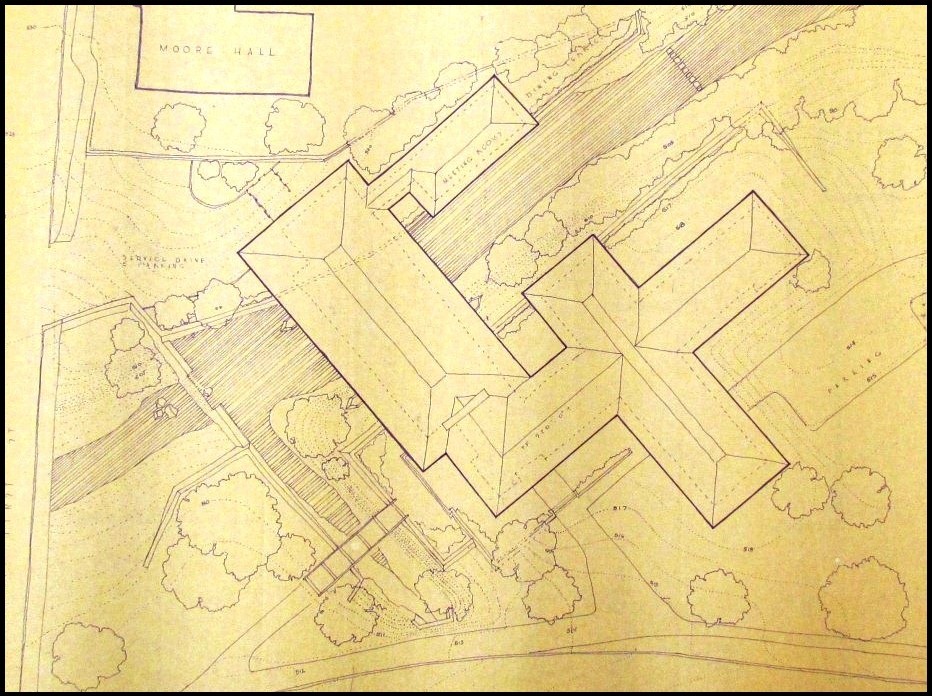
Above: Fred Day’s initial plans for the Texas Alumni House. In this image, 21st Street runs along the left border with part of the Moore-Hill Residence Hall at top left, while San Jacinto Boulevard – with the stadium across the street – is at the bottom. Click on the image for an expanded view. Source: University of Texas Buildings Collection, Alexander Architecture Archives, University of Texas Libraries.

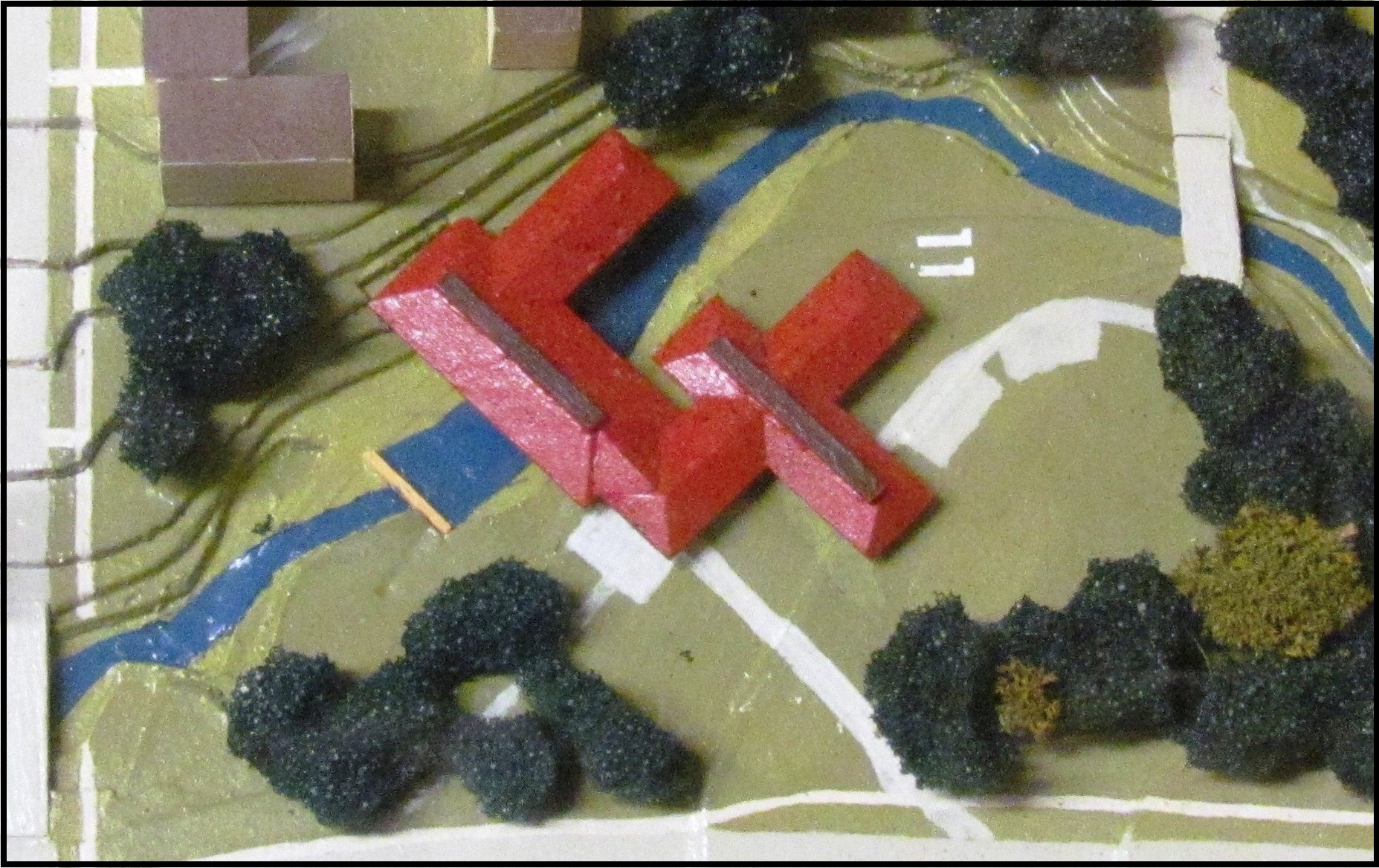
Haskew was prudent to call for “advance cognizance,” as Fred Day’s design was a bold one. The building didn’t simply nestle alongside the dappled and meandering waters of Waller Creek; the creek was the centerpiece of the plan. Day’s Alumni House resembled a squared “C” shape, with the central portion spanning the water. The entrance, lobby, and Association staff offices were in the east wing, nearest to San Jacinto Boulevard. On the far bank, the west wing housed a series of conference rooms with Creekside views, along with an extended outdoor dining terrace shaded by live oaks. Connecting the two wings was a grand main lounge and dining room, equipped with a catering kitchen. Visitors to the lounge would gaze out of full-length windows on either side to see Waller Creek pass underneath the building.

Above: View of the Alumni House footprint with the Main Lounge spanning Waller Creek. Photo from a portion of a 1962 campus master plan model.

To ensure enough water was present, a small dam was planned just downstream from the building that would both back up the creek and add a waterfall. A second partial barrier, installed upstream in the form of a stepping stone bridge, provided foot access across the creek and created an artificial rapids.

Day purposely located the building near the south edge of the property, where the slope of hill on the west side of the creek was a little less steep. The remaining land was reserved for parking and future expansion.

A first birds-eye rendition of the Alumni House was ready in August and a formal announcement made to the press. The reported cost varied from $250,000 – $300,000. The actual estimate was near $260,000, which required the alumni to raise $150,000 and add it to the $110,000 from the Etter fund.

Top: A detailed view of the proposed Alumni Center, with some color added by the author to better distinguish the location of Waller Creek and the outline of the building. The east wing, in the shape of a “+,” housed offices for staff and a vault to safeguard the original alumni records, then kept on index cards. Above: A cutaway view of the main lounge, which used about 2/3 of the central wing. Beyond the doors was a smaller dining/meeting room, with a kitchen behind the wall on the far side. Click on an image for a larger view.

~~~~~~~~~~~~~~~~~~~~

With the 1962 fall semester underway and Fred Day at work on formal building plans, attention turned on fundraising. Holmes appointed a fundraising committee with former Association President Sterling Holloway as chair, while former Texas Governor Allan Shivers oversaw the acquisition of special gifts. Popular Dean of Student Life Arno Nowotny was named vice chairman.

There were discussions with university officials on whether to concentrate on a few large donations or make a general appeal to all alumni. In the end, both strategies were used. In October and November, luncheons for prospective donors were held in cities throughout the state, including: Dallas, Houston, Austin, San Antonio, Corpus Christi, El Paso, Tyler, Midland, and others. On the agenda were talks by Harry Ransom, Allan Shivers, Arno Nowotny, Sterling Holloway, and Jack Maguire.

In concert with the fundraising luncheons, the November issue of the Alcalde alumni magazine featured a second, more detailed rendition of the building, which was now formally styled the “Lila B. Etter Alumni Center.” Included in the magazine was a general appeal for donations. Members of the Association also received letters which asked if they “could spare 144 bricks?” as a minimum $10 contribution would purchase those materials, a square yard of carpet, or two gallons of paint.

Above: Part of the 1962 Alumni Center fundraising solicitation mailed to Association members. Click on an image for a larger view.

Along with alumni donations, additional contributions came from some unusual sources. In January 1963, Allan Shivers, American Airlines president C. R. Smith, and actor Rip Torn, all UT graduates, represented the University on “Alumni Fun,” a popular weekly quiz show broadcast on ABC. The team won $4,700, which was donated to the building fund. Along with quiz show winnings, the Canteen Company of America, one of the largest providers of vending machines in the United States, donated a week’s proceeds from three of its most popular coffee machines on the UT campus, and presented the alumni with $410 in dimes.

Above: Allan Shivers, C R Smith, and Rip Torn compete for the University of Texas in ABC’s Alumni Fun quiz show in January 1963.

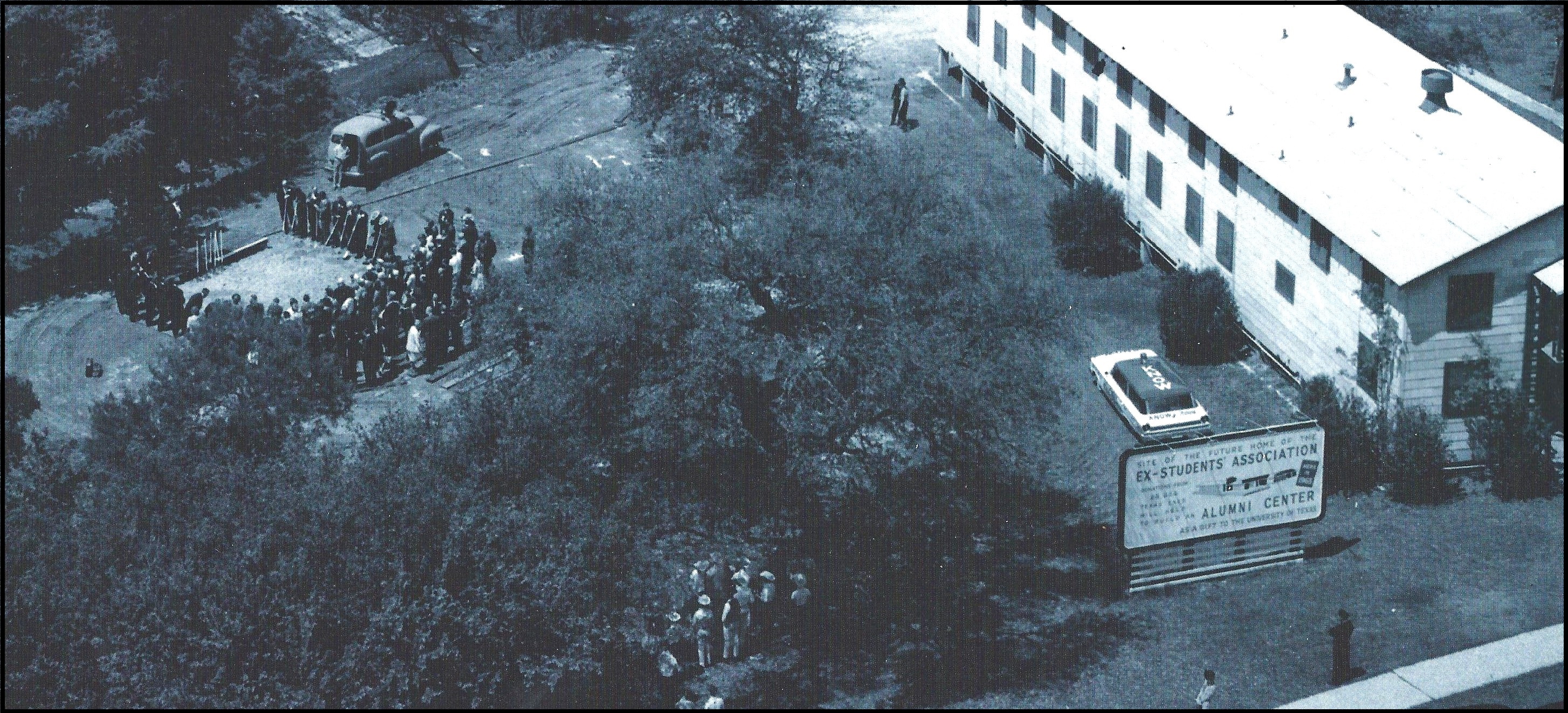
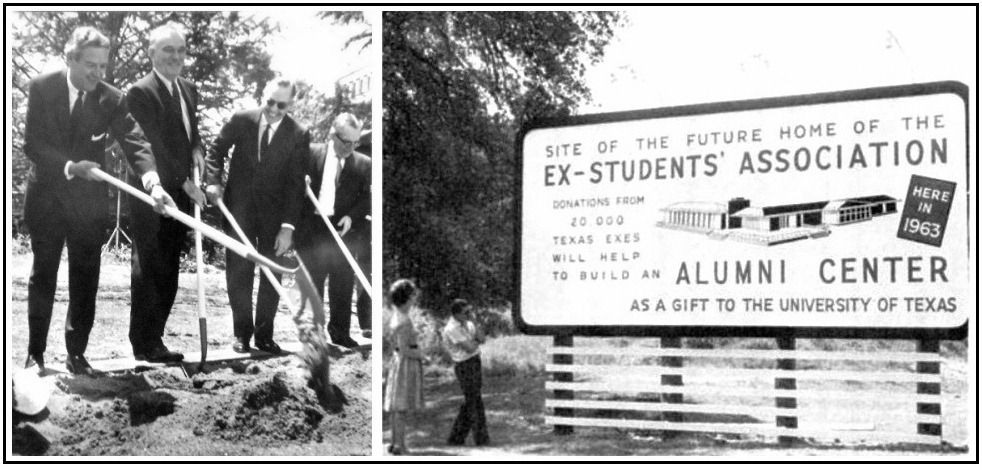
By mid-spring 1963, the campaign was a success. More than 3,000 alumni had sent contributions from $1 and greater, including three $10,000 donors, six $5,000 donors, and 25 alumni who gave $1,000 each. The new Alumni Center seemed assured, and a groundbreaking ceremony was promptly scheduled for 11:30 a.m. on Saturday, April 6th, on the banks of Waller Creek. A large sign on the property announced the future home of the Ex-Students’ Association and told passersby to expect to see the Alumni Center within the year.

Top: A groundbreaking ceremony was held on the Waller Creek site on April 6, 1963. On the right is one of two post-WW II temporary dorms that were scheduled for removal. Groundbreaking participants included UT alumnus and Texas Governor John Connally, Board of Regents chair W. W. Heath, UT President Joe Smiley, and Dean Arno Nowotny.

~~~~~~~~~~~~~~~~~~~~

The great setback came a few weeks late. After contractor bids were opened, the cost of the Alumni Center as designed was far greater than anyone anticipated, specifically the transformation of the western bank of Waller Creek to make room for the west wing and dining terrace, the extensive use of retaining walls, and a redirected tributary to the creek so that it would remain behind the proposed dam. Through the summer of 1963, architect Fred Day attempted to rescue his design. He shortened the west wing and reversed its direction, and then removed it outright while still preserving the main lounge over the creek. Neither brought the costs down to acceptable levels. Unwilling to reopen the fundraising drive, the Alumni Center committee reluctantly abandoned the initial plans and sent Day back to the drawing board.

Through the fall, Day worked on new plans for the building, placed it alongside Waller Creek instead of over it, and preserved the elements used in the initial designs. The single main lounge and dining area was divided into two connected rooms at right angles, and then joined to a larger structure around a simple square courtyard with a fountain. The plan afforded ample light throughout and office windows that faced either the courtyard or outside, while the main lounge and the dining room were nudged close to the edge of Waller Creek for the best views. A walled patio adjoined the main lounge to make room for larger alumni events.

Above: With construction underway at last, a new sign replaced the original.

Construction finally began on April 27, 1964, just over a year after the groundbreaking. The Association staff moved into its new quarters the following February, and it was officially opened Saturday, April 3, 1965, as part of the annual Round-Up Weekend. In the morning, the graduating classes of 1940 and 1915 used the building to begin their 25 and 50-year reunions, and then joined a larger crowd outside in front for the dedication ceremony, which included performances by the Longhorn Singers and the Longhorn Band.

Above: The Alumni Center dedication program cover.

Executive Director Jack Maguire addressed those assembled: “Many years ago, Edgar Guest wrote a poem which began, ‘It takes a heap of livin’ to make a house a home.’ Today we are dedicating a very beautiful house . . . It’s a heap of a house, and we invite you to do a heap of living in it. The best invitation I can extend to you is a line which was used to introduce the 1915 Cactus. ‘The gate is down – ride through.’ Today the gate to the Lila B. Etter Alumni Center is down. Ride through it – any and every time you are here.”

~~~~~~~~~~~~~~~~~~~~

A Tour of the Lila B. Etter Alumni Center

When completed, the new Alumni Center was a 14,400 square-foot beige brick building with brown concrete roof tiles that best resembled a ranch house nestled in a grove of mesquite, live oak, and pecan trees along Waller Creek. With its use of natural materials, textured brick, and local stone, along with its residential-like impression, one visitor simply described it as “Southwest ease.” It was meant to be both a casual, welcoming place for visiting alumni, as well as a functional facility for the Association staff. Inside was a large main lounge, a dining room with a catering kitchen, two conference rooms, 11 private offices, a vault to store the all-important alumni files, a printing and mailing room, three patios (including a central courtyard), and a 25-car parking lot on the north side.

It was also unabashedly the University of Texas Alumni Center, full of what some called “Longhornisms.” The breaks along the edge of the roof, for example, weren’t for style, but held orange floodlights (image above). Just as the UT Tower had its victory lights, the Alumni Center glowed orange – including the central courtyard – after nighttime football victories and for other special occasions.

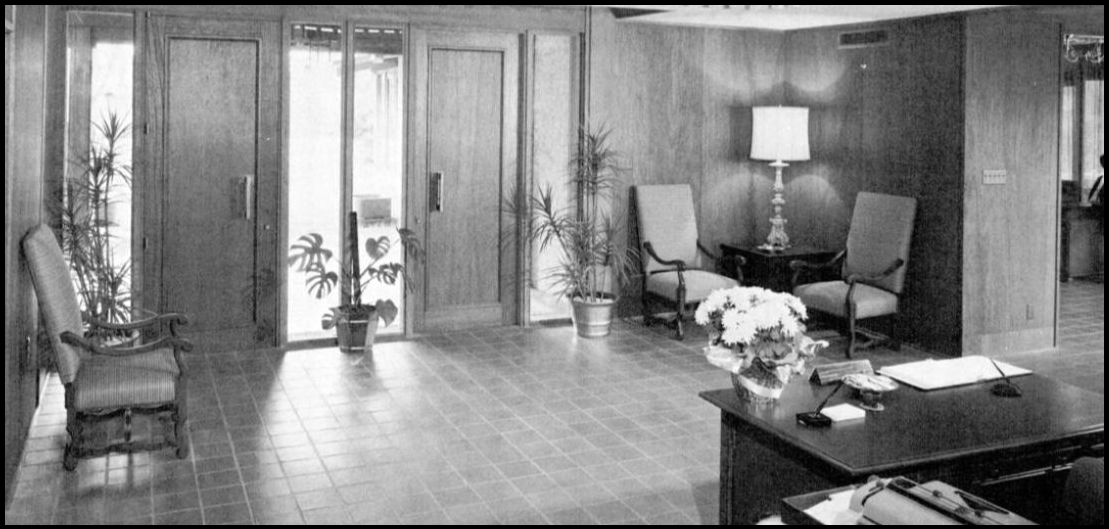
Most visitors entered the building from San Jacinto Boulevard through a pair of massive oak doors with Texas-size brass handles. On the door itself was a “T” plate to which a perpendicular “U” was attached and used as the handle. Once inside, the entry foyer (image below), with its terra-cotta floor tiles, lamps, and chairs, was meant to evoke a home rather than a more formal University building.

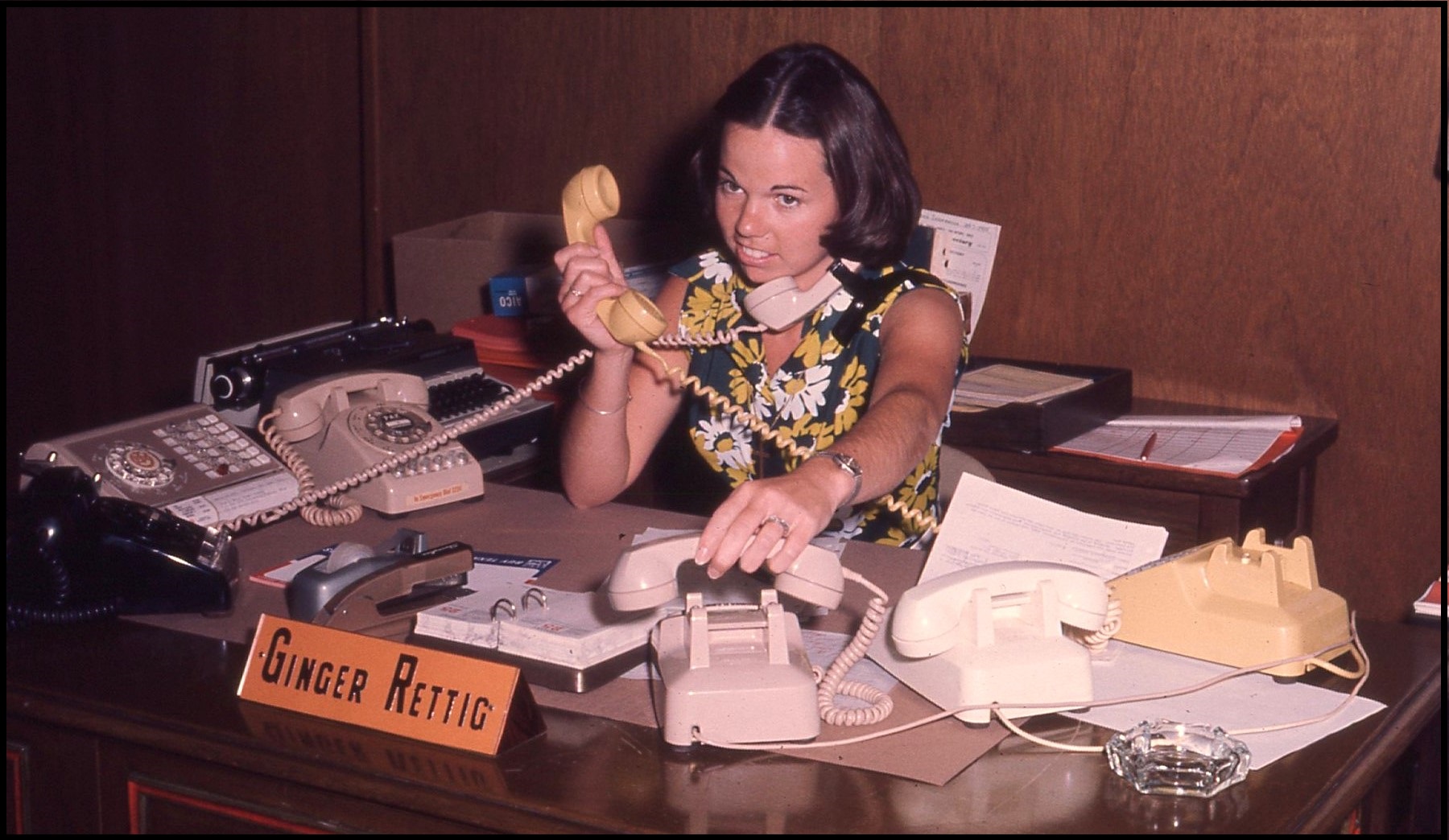
Above, Ginger Rettig in charge at the foyer receptionist desk. “Ancient technology” abounds here, including rotary dial phones and typewriters. And notice the ash tray on the desk at lower right. At a time when smoking was more accepted and common, visitors could smoke indoors, and ash trays were a normal and functional part of the furniture. After the 1990 expansion of the Alumni Center, the wall behind the receptionist desk was replaced with the stairwell that leads to the second floor.

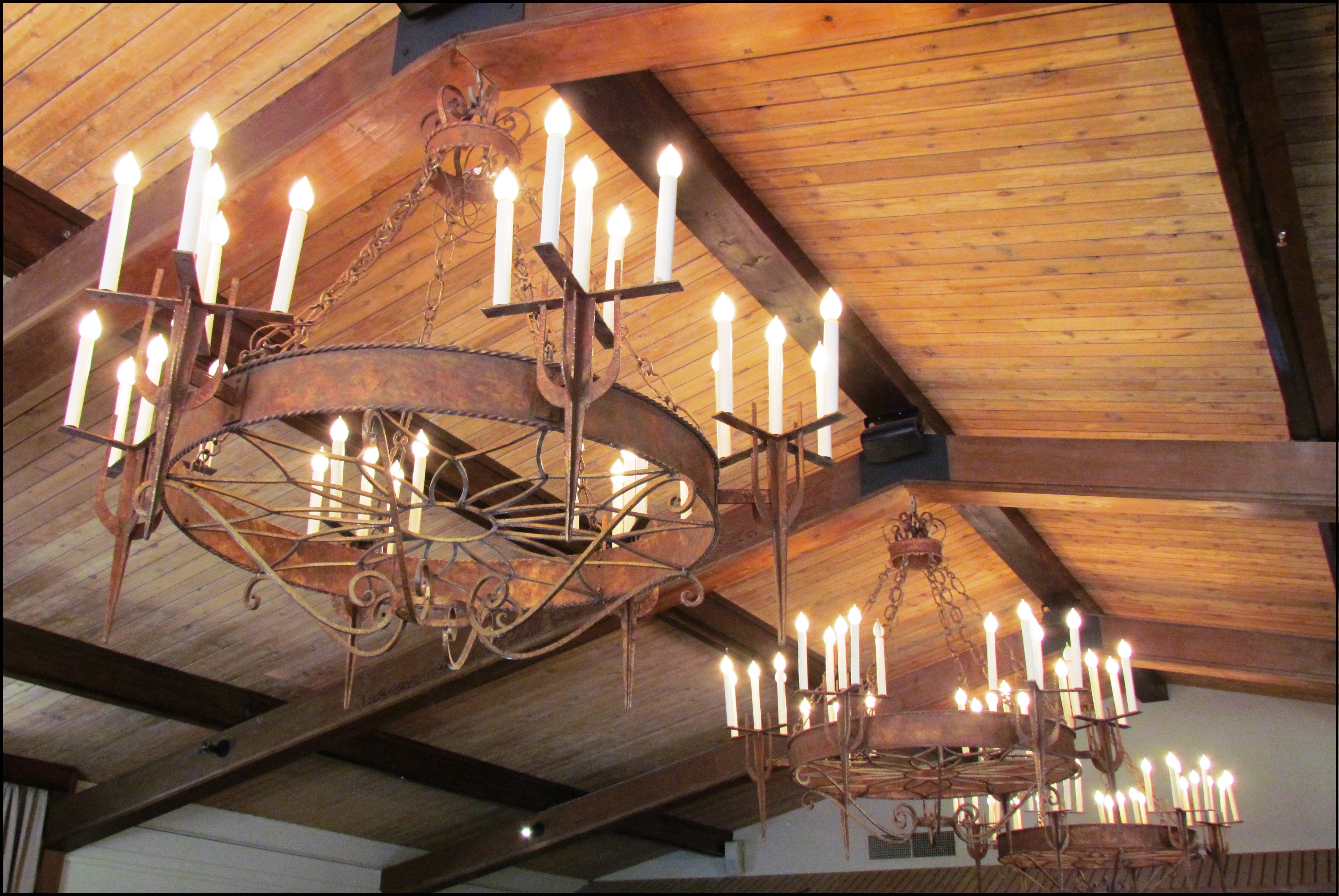
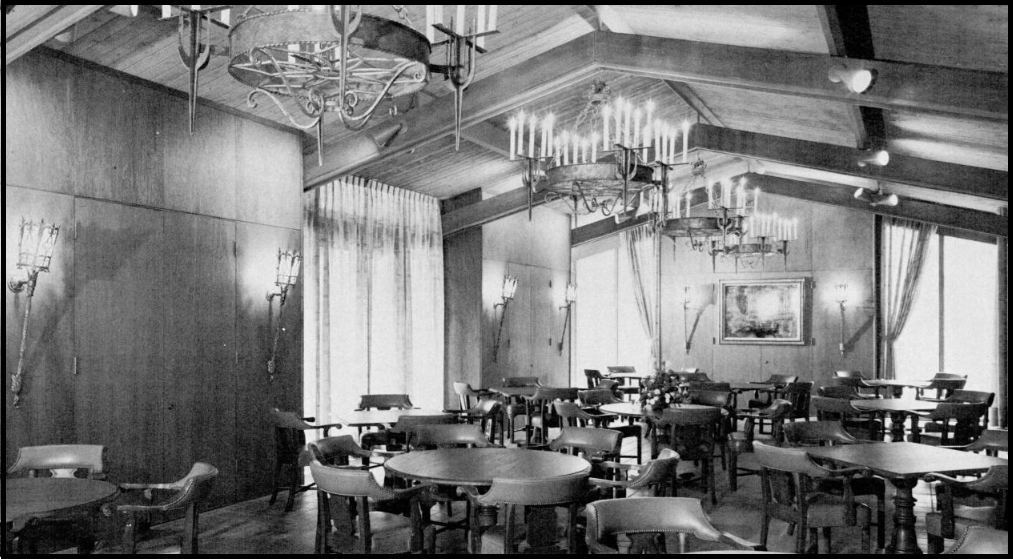
Once past the foyer, the spacious main lounge was the showpiece of the Alumni Center. With a 15-foot vaulted and beamed ceiling, tall windows provided plenty of light and invited visitors to gaze out on Waller Creek. A six-foot fireplace with a Texas granite hearth commanded the east side of the lounge, and mahogany-paneled walls completed the room. Interior designer Arthur Watson, Jr. decided on the furnishings and called it “Early Texas” style, a blend of American West and Spanish Colonial. Along the walls were eight antique brass sconces from Spain, and suspended from the ceiling by heavy chains were wrought-iron chandeliers with gold and copper leaf finish, custom-made in Mexico. Looking closely, a visitor would likely notice the interlocking UTs that supported the candle light fixtures (image above left).

Next to the Main Lounge was the Dining Room, with matching mahogany walls, sconces, and chandeliers. Equipped with a catering kitchen on the north side, the original furniture was purchased from the Texas Pavillion of the 1964 New York City World’s Fair. For years, the Dining Room was used for lunches, served from 11:30am – 1:00pm, at first catered the Driskill Hotel, then the Victorian Hotel in downtown Austin, and finally by University Housing and Food. The meals were especially popular with faculty on the east side of the campus. Today, the room is still popular and used by the Texas Expresso Café.

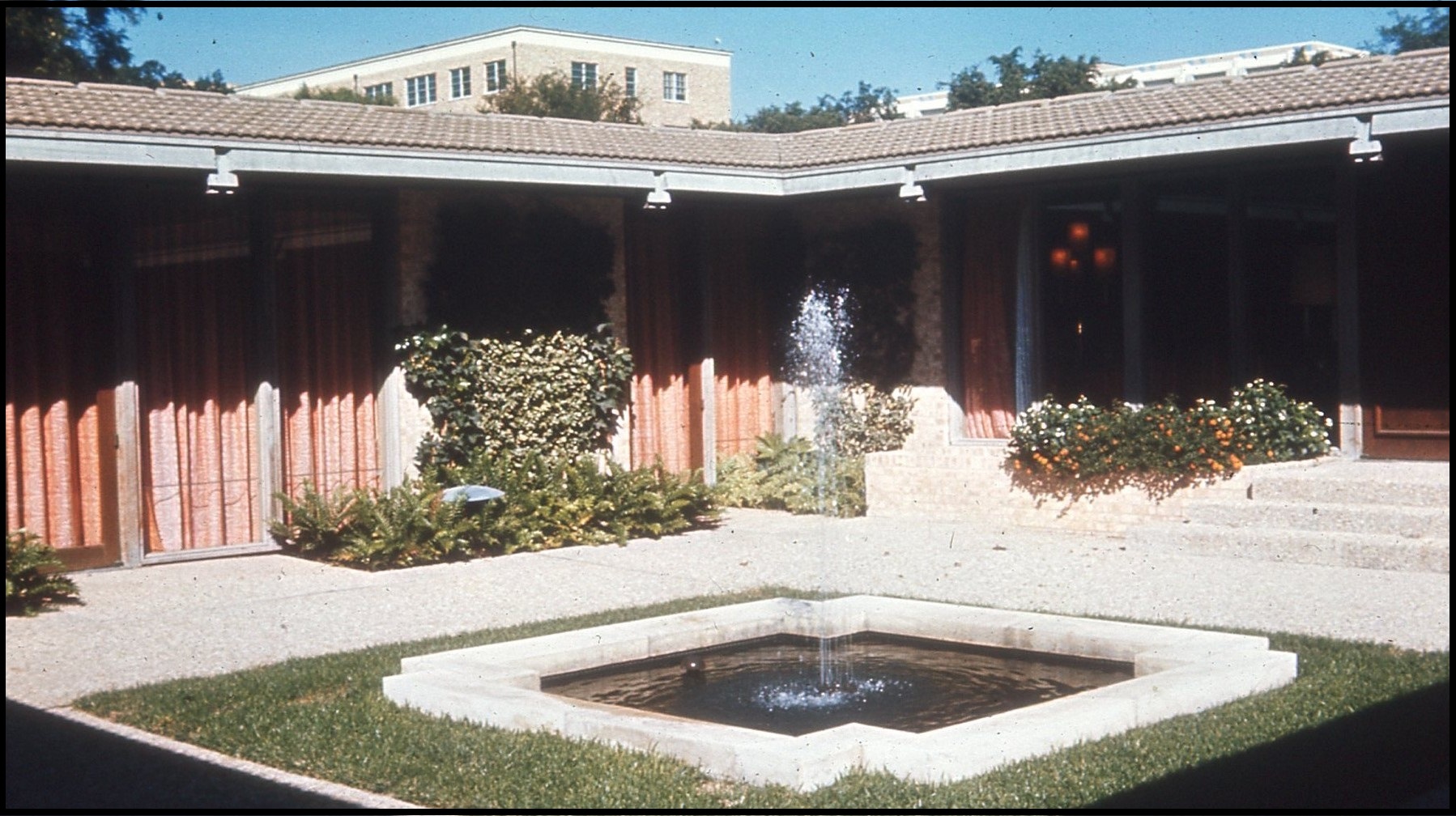
Just north of the lounge is the central courtyard with a simple fountain. Here, too, the breaks along the edge of the roof housed orange floodlights. The courtyard provided an outdoor extension to the lounge for large events, created easy access to other parts of the center, and provided sunlight to the conference rooms and offices that bordered it. Today, the courtyard has been enclosed by the Frank Denius Concourse.

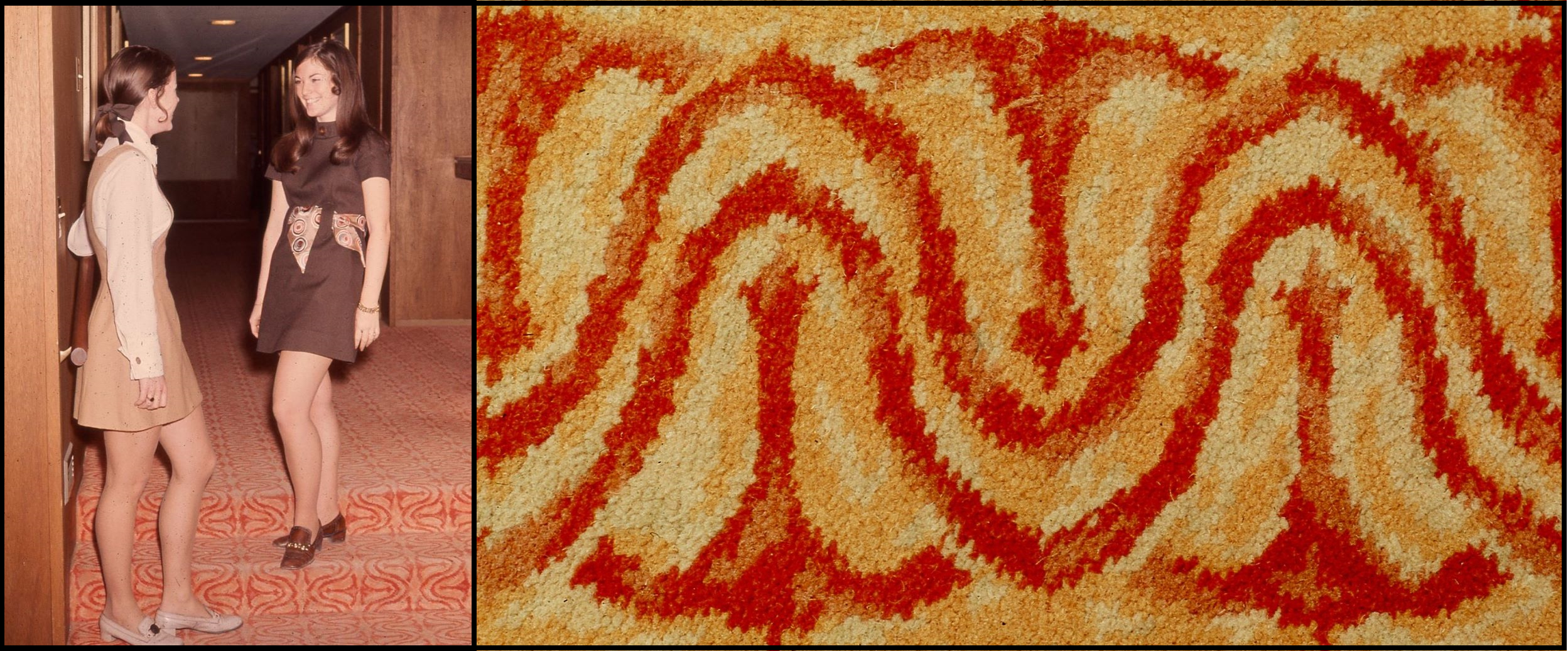
The carpeting in the Alumni Center was one-of-a-kind and woven in Scotland. Designed by Arthur Watson, it, too, was a “Longhornism” with a series of wavy U’s interspersed with Ts. The same design was used for most of the window drapes and some wall coverings.

Inside the office of the Executive Director, where orange was the rule. Eight-foot longhorns were mounted above the double doors that led out to the courtyard, and the carpeting and drapes matched those in most of the rest of the building. Seated is Director Jack Maguire (second from right, smoking a pipe) and future executive director Roy Vaughan (with the cigar).

At left: A different drapery design was used for the Main Lounge, which featured a repeating pattern of orange and white U’s and T’s (which look a bit like longhorns), surrounded by football shapes.

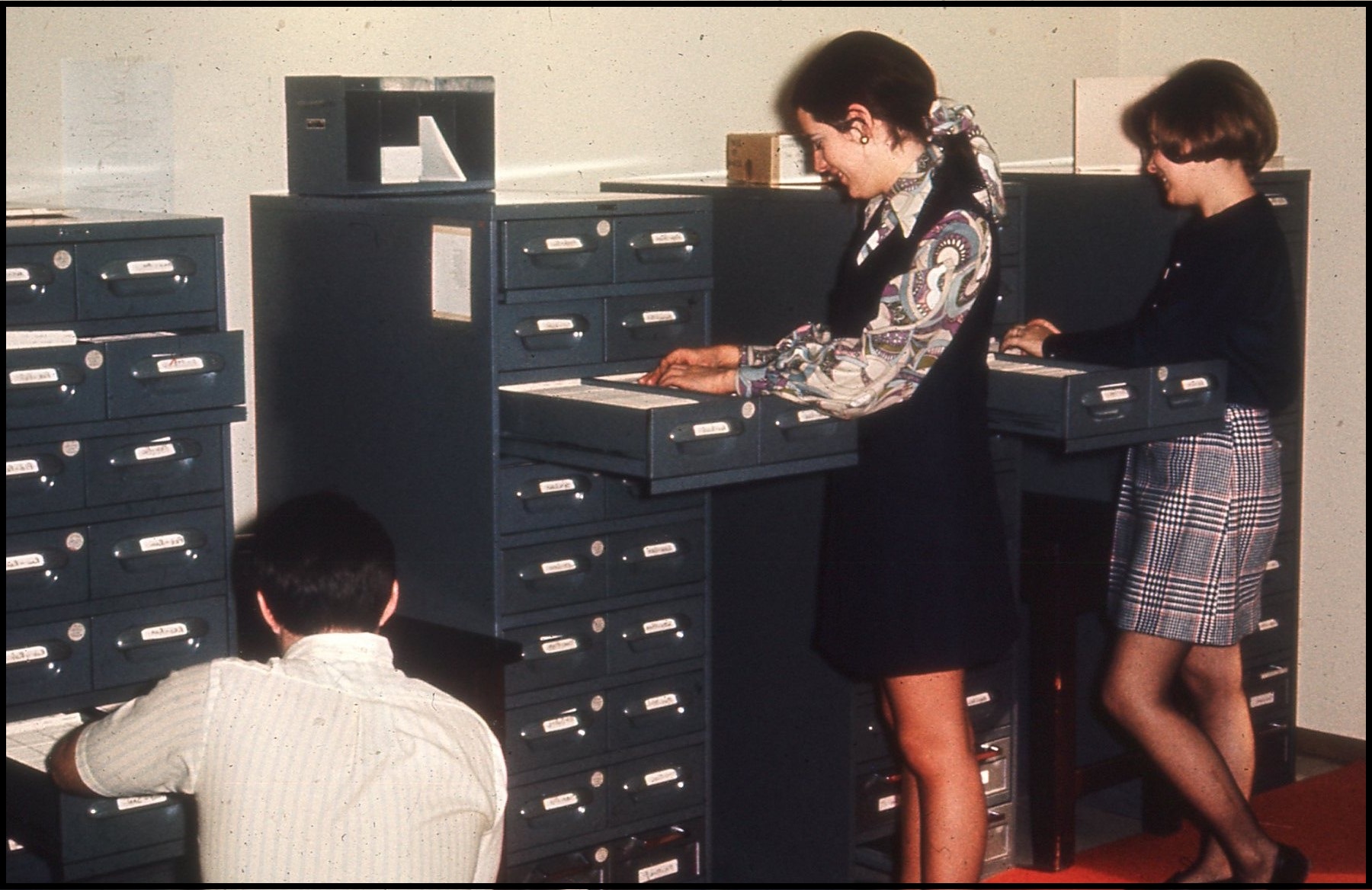
A fireproof vault in the building safeguarded the original alumni records, which had been preserved and updated on index cards for decades. By the early 1960s, more than 175,000 records were being digitally stored on room-size IBM computers.

The alumni records office and printing room in the rear of the building was always a hectic place. While the Alcalde magazine was published off-site, most of the membership solicitations and newsletters were printed and mailed in-house, along with publications for other University schools and colleges. (For many years, the Association printed the very first alumni newsletter for the business school, known as The Ex-Citer.) This area is now the Myers Library and Executive Director’s office. At left, Association staff member Phil Cornejo ran the main printer while wearing an orange apron bearing the new Texas Exes brand (see How to Brand the Alumni).

Sources include: The UT Presidents’ Office Records and Ex-Students’ Association Records, part of the University Archives preserved at the Briscoe Center for American History; architect Fred Day’s drawings for the Alumni Center in the UT Buildings Collection at the Alexander Architectural Archives; California Alumni Association, 2011 Alumni House Historic Structure Report; the Alcalde magazine; and the Austin American-Statesman and The Daily Texan newspapers.

Maroon Madness

When UT’s Athletes Proudly Wore Maroon

It was a great day for the second-ever football game between the University of Texas and Texas A&M. Partly cloudy skies and temperatures in the low 70s greeted fans who gathered at the University’s athletic field – unofficially dubbed “Athletic Park” by the newspapers – on Saturday afternoon, October 22, 1898. The teams hadn’t met in four years since their initial match in 1894, and a large crowd was expected. A few bleachers on the west side accommodated around 200 spectators, but most of the fans stood along the sidelines several persons deep. It would be another decade before UT students built their first stadium. (See The One Week Stadium)

University supporters arrived in suits, ties, and bowler hats for the men, and colorful Victorian dresses and fashionable hats for the women. As was the custom of the time, fans showed their team loyalty by wearing orange and white ribbons on their lapels, though enterprising male students wore longer ribbons so they could “snip and share” with any coeds who had none.

Above left: A UT football player in his orange and maroon uniform. This is actually a sketch found in the 1897 Cactus yearbook and (poorly) colored by the author. Look closely – there is no helmet. In the 1890s, most football players had long, bushy hair and believed it would be sufficient to protect the head.

About 75 members of A&M’s Corps of Cadets rode a chartered train from College Station, accompanied by a similar number of rooters. The cadets were armed with a variety of noise makers, from cow bells to dinner bells to tin horns, and everyone sported bright red and white ribbons, which were then the colors of the A&M College.

Kick-off was set for 3 o’clock, and it wasn’t long before the audience realized the game would be a lopsided one for a UT win. The reporter covering the game for the Austin Daily Statesman had an apparent fondness for simile. He wrote, “The ‘Varsity boys played like champions, and went through the visitors like a temperance resolution at a prohibition convention,” which was followed immediately by, “Touch-downs were as numerous as pretty new bonnets on a well-developed Easter morning.” The final score was 48–0.

The talk of the game, though, wasn’t the tally on the scoreboard, but the UT uniforms. While University fans dutifully showed up with their traditional orange and white, the team ran onto the field in orange and maroon.

The reaction, though, may not have been what you expected.

~~~~~~~~~~~~~~~~~~~~

Above: The 40-acre University of Texas campus in 1895 consisted of the old Main Building (center) only two-thirds complete, the Chemistry Labs building to the left, and B. Hall, the first men’s residence hall, to the right.

By any measure, John Otis Phillips was a BMOC, a Big Man on Campus. Tall with dirty blonde hair, his parents hailed from the northeast United States (Rhode Island and New York), though Phillips was born and partly raised in Calcutta, India, then sent with his brother William to the Oberlin Preparatory Academy, a private boarder school managed by Oberlin College, Ohio, about 30 miles west of Cleveland. Phillips continued on to the College for two years before he transferred to the University of Texas as a 21-year old junior in 1895. Once in Austin, he settled into a room at a boarding house just west of campus, at 2002 San Antonio Street, and then promptly dived deep into University life

Engineering Dean Thomas Taylor described Phillips as, “the smoothest and easiest political boss that ever hit the campus. He readily earned the title of ‘Old Smooth and Easy.’” Phillips graduated in 1897 with a BA in English, studied history and political science for two years (he essentially had a bachelor’s degree with a triple major), and then entered law school in 1899. But along the way, Phillips was vice-president of his junior class and president of his senior class, president of the Tennis Club, ran on the UT track and field team, was treasurer of the University YMCA, the first vice-president of the newly-organized University Co-op, president of the University Athletic Association, a member of the Athletic Field Club (which worked to purchase the land University students were already using for football, baseball, and track), a member of the Bicycle Club, business manager for the student-published University of Texas Magazine, business manager of the Cactus yearbook, twice business manager of The Ranger student newspaper (which preceded The Texan), and twice, in 1897 and 1898, manager of the football team. His status as BMOC might better be described as “Business Manager on Campus.”

Above: The 1897 UT football team sits for a group photo on the front steps of the old Main Building, most wearing their letterman sweaters – white pullovers with orange “T’s.” As was tradition, team captain Dan Parker sat in the middle with the football, young mascot Billie Batts, son of law professor Robert Batts (Batts Hall’s namesake) seated just below, Coach Mike Kelly to the left of Parker wearing his green and white Dartmouth “D” letter sweater of his alma mater, and John Phillips, team manager, to the right wearing a coat.

In the 1890s, before a professional athletic director and staff managed intercollegiate sports on a university campus, the responsibility was taken up by volunteers. On the Forty Acres, an Athletic Council of three professors, three alumni, and three students oversaw UT’s needs for intercollegiate men’s football, baseball, track and field, and later, tennis. (Women’s sports, including basketball, tennis, and field hockey, were added for a time in the 1900s before women’s physical training director Anna Hiss pulled back from intercollegiate competition.)

Assisting the Athletic Council were student team mangers for each sport. As the football team manager, Phillips had to: correspond with team managers at other universities to arrange a schedule and agree upon a share of gate receipts or guarantees (a monetary guarantee was crucial for the visiting team to afford its travel costs), purchase train tickets and make hotel/meal reservations for all out-of-town games, hire a coach (with the Council’s approval), order and maintain uniforms and equipment, secure a place for a “training table” – usually a restaurant or boarding house where the team ate the kinds of meals prescribed by the coach (think athletes’ cafeteria), and oversee publicity, game receipts, and the team budget.

~~~~~~~~~~~~~~~~~~~~

On Tuesday morning, September 20, 1898, the Athletic Council met in the old Main Building. The fall term was to begin the following Monday, September 26, and football practice for anyone interested in trying out for the team was to start the same day. At the top of the agenda, though, was the need for a coach. Mike Kelly, the previous year’s coach, had been hired by the University to oversee the new gymnasium in Old Main’s north wing (see UT’s First Gymnasium) and teach physical training classes.

The Council took a chance and hired David Edwards, an 1896 Princeton University graduate. At the time, Princeton was one of the “Big Four” – along with Harvard, Yale, and Chicago – as college football powerhouses. While Edwards had been a football standout, his coaching debut was less than stellar. In 1897, he guided Ohio State to a dismal 1-7-1 record (which is still the Buckeye’s worst season) and fired. However, Edwards had strong recommendations from Princeton and had spent the summer learning more about coaching at his alma mater. Mike Kelly was retained as assistant coach and would run practices until Edwards arrived by train the first week of October.

Ten days later, on Saturday evening, October 1, the Council gathered again in Old Main. Coach Edwards was due in Austin on Wednesday the 5th and would take over the team the following day. The first football game of the season was set for October 15 at Add-Ran College (later Texas Christian University) in Waco. The team, though, had a uniform problem.

Phillips, who was starting his second season as football manager and was one of the three students on the Athletic Council, explained that the orange and white jerseys were difficult to maintain. When they were washed, the orange stripes sometimes bled over to the white, while the white itself was easily soiled and difficult to clean. There was also a contingent on campus – which included some of the team – that thought the color white too weak, that it represented “surrender” and ought to be replaced with another, stronger hue.

After an extended discussion, and without notifying the University president or anyone else, the Council authorized Phillips to replace white with a darker color of his choosing, one that would better conceal dirt stains. Black was out, as orange and black were Princeton’s colors. So was blue, as blue and orange had been used by the University of Virginia for a decade. Instead, Phillips selected maroon. This was the University of Chicago’s color, but not in combination with orange. “After discussing at length the question of uniforms for the team,” reported the San Antonio Light, “the Council instructed Mr. J. O. Phillips, the manager of the football team, to order at once 18 jerseys, 12 pairs of football shoes, 12 pairs of trousers, 6 nose guards, 1 dozen footballs and 12 pairs of stockings.” (Many accounts wrongly claim that it was Coach Edwards who tried to change UT’s colors, but the colors were chosen and the uniforms ordered before Edwards arrived in Austin.)

Orange and maroon striped jerseys arrived about two weeks later, too late for the first game on October 15, a 16-0 win over Add-Ran College, where the team wore their usual orange and white. Instead, the jerseys were introduced at the first home game a week later against the A&M College of Texas.

~~~~~~~~~~~~~~~~~~~~

Above: The 1898 UT football team with most wearing their letter sweaters – maroon with orange “T’s.”

The day after the A&M game, the Austin Daily Statesman remarked, “The football colors are now maroon and orange, which makes a pretty combination,” and most of UT’s 504 students agreed. The new colors were a hit. There was a sudden rush for maroon and orange ribbons at the general stores downtown before the next home game the following Saturday, October 29, when Galveston’s football club came to Austin.  The Statesman predicted the “game will be replete with an abundance of snap and vim on the part of the maroon and orange.” The University won 17-0, remained undefeated, and had its third straight shutout. (The 1898 team finished with a respectable 5-1 record, though Edwards decided against coaching for a career and returned to New Jersey to become a lawyer. His brother, Edward, served as the state’s governor in the 1920s.)

By early November, maroon mania had swept the campus, while the city’s merchants rushed to respond. The University Co-op, then located underneath the central staircase of Old Main, sold maroon and orange badges to be worn at football games. Maroon hats with orange bands were available for $1.25 in shops along Congress Avenue. Phillip Hatzfeld’s store, which specialized in women’s fashions, advertised “Orange and maroon ribbon in correct shades. ‘Varsity colors.” (At the time, ‘varsity was a nationally used contraction of the word university.)

The University’s sophomore and junior classes of 1900 and 1901 went a step further and voted to have “class hats.” Similar to jockey caps or rounded baseball caps, they were made from henrietta – a woolen fabric – and lined with gray satin. “A group of wearers presents a pretty picture, for the maroon is quite showy,” remarked the Statesman. “For the juniors, the figures ’00, and for the sophomores, the figures ’01, have been worked in orange silk just above the [bill]. The example set is good, and it is hoped other classes will follow it.” Not to be outdone, the 1899 senior law class opted for collapsible maroon top hats with orange bands.

Above: The 1899 baseball team on the front steps of Old Main, with maroon socks and hats, and orange “T’s” on their jerseys.

The following spring, the baseball team found itself in new attire. “The caps are of maroon material, with an orange ‘T.’ The shirts are gray with an orange ‘T’ on the breast,” said the University Calendar. “The pants are likewise gray. Maroon stockings, with orange stripes, and substantial shoes complete the outfit.” The 1899 football team followed their predecessors and kept the popular colors, which had clearly become more than a fad. Even the 1899 Cactus yearbook had a maroon cover.

Above: The 1899 UT football team poses for a group photo in back of Old Main. Players are in their striped jerseys or letter sweaters. Assistant manager Allen Barton, on the left end in a suit, wears a maroon cap with an orange circle and maroon “T” above the bill that was available in the shops downtown. On the right end, team manager Rich Franklin wears his 1900 maroon class cap, with an ’00 in orange on the front.

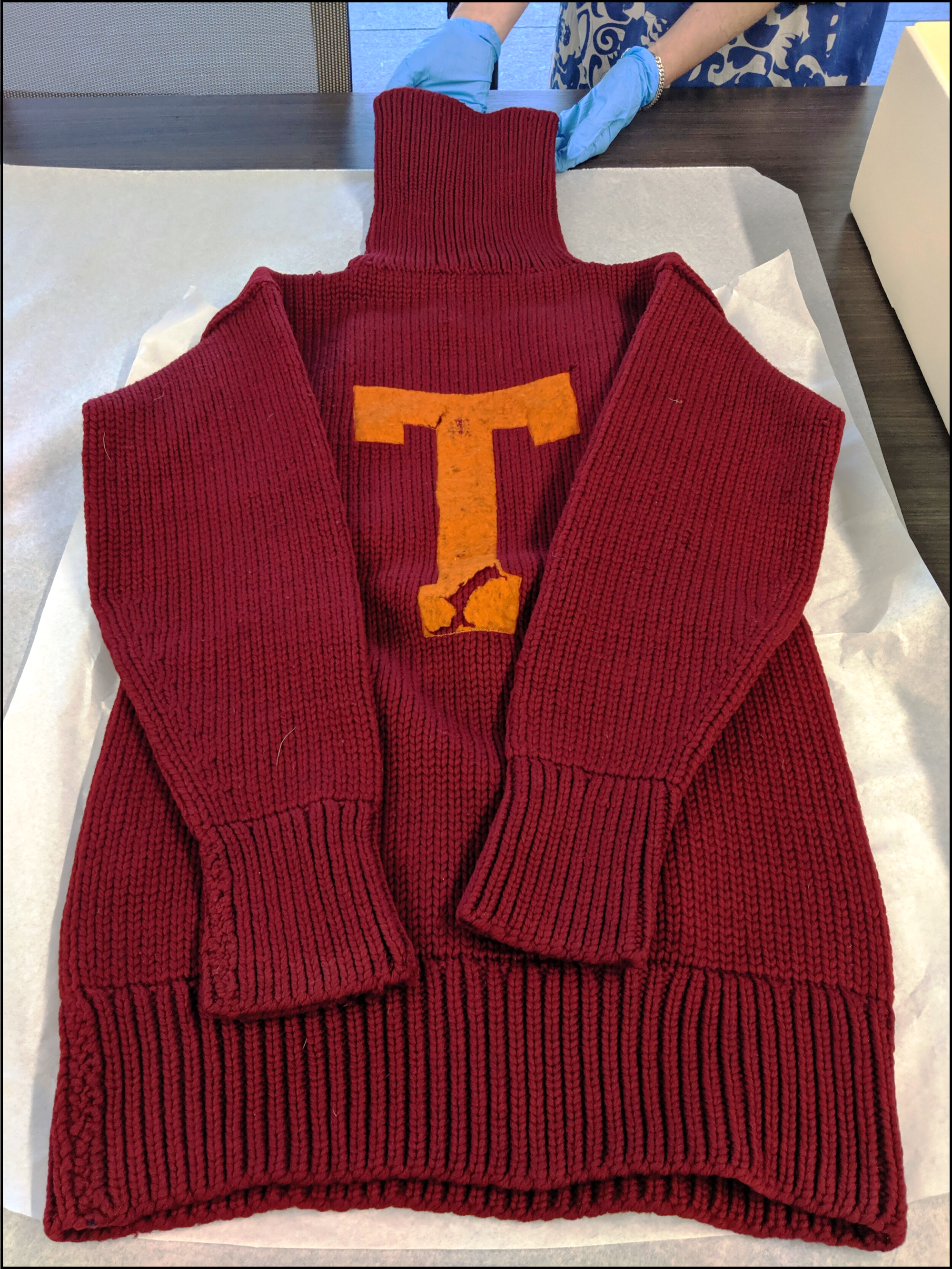
Above: The 1899 football letter sweater earned by halfback Raymond Keller and now preserved in the UT archives, part of the Dolph Briscoe Center for American History. Photo courtesy of Billy Dale.

~~~~~~~~~~~~~~~~~~~~

While the uniforms might have been easier to manage, any perception of a common set of University colors was quickly tumbling into chaos. Most (though not all) students were fans the maroon and orange combination, but the alumni were not, and continued to sport orange and white ribbons on their lapels. After all, the colors first made their appearance in 1885, and orange and white ribbons were still used to tie the rolled-up degrees presented at commencement. A few fans were still loyal to old gold and white, colors used by the first football team in 1893 because the campus buildings were uniformly constructed of pale-yellow pressed brick and limestone trim. (The Gebauer Building, just to the east of the Tower, is the last survivor from that era.) To make matters worse, the UT Medical Branch in Galveston was almost unanimous behind a single color: royal blue. (See The Choice of Orange and White)

The issue had ripened to a point where it could no longer be ignored. After much on-campus discussion and a petition by the alumni association to be included in the process, the UT Board of Regents met February 27, 1900 and called for general vote of students, faculty, and alumni. Ballots were to be accepted until April 1.

Among those advocating for maroon and orange was senior law student Ed Overshiner. Known on the campus as “Ovey”, he was also the 5-foot 10-inch, 170 pound center for the football team.  In a letter to the University Calendar (along with the Ranger, a student newspaper that pre-dated the Texan), Overshiner wrote, “I think the matter of colors ought to be settled once and for all and with as little change as possible.” Orange and white had been found unsuitable, as white was easily stained and was more an “emblem of capitulation than one of victory.” As for blue, Overshiner claimed he would feel “blue enough to see a crowd of our athletes decked in gaudy blue.” Orange and maroon fit the bill and were colors “already dear to the heart of many a contestant on many a hard fought field. . . I believe that we should all unite, oust the white, and stand for the orange and maroon.”

But the alumni were determined to be heard. Voicing his opinion in the Calendar, geology alumnus Robert Brooks argued that orange and white were “so entwined with the history of the Institution that any attempt to change them would do violence to the associations which they recall.” By replacing white with maroon, Brooks claimed the action of the Athletic Council was “more a thoughtless violation of propriety than deliberate disrespect to the colors of the Institution, and those in charge of the purchase of uniforms for coming athletic teams should not weigh a slight preference for colors supposed to be more serviceable against their loyalty to their University.”

April 1 arrived, the ballot box was secured and the votes counted. Exactly 1,111 votes had been cast, 554 from the Austin main campus, 148 from the medical school, and 409 from the alumni. Orange and white received 562 votes, and won the majority by seven ballots. Most of the Austin students had predictably supported orange and maroon, which garnered 310 votes, and Galveston was loyal to blue, which received 203 overall. Crimson came in with 10 ballots, crimson and blue 11, and 15 votes were cast for various other colors (including two votes for Irish green and one for “old gold, maroon, and peacock blue.”)

The Board of Regents ratified the decision at their meeting on May 10, 1900, and maroon mania disappeared almost as suddenly as it arrived. Almost 20 years later, in 1917, Texas A&M replaced its traditional red with maroon.

Above: A 1910, 30-inch University of Texas pennant in orange and white.

Why it’s called “Commencement”

If graduation marks the completion of a degree, what is commencing?

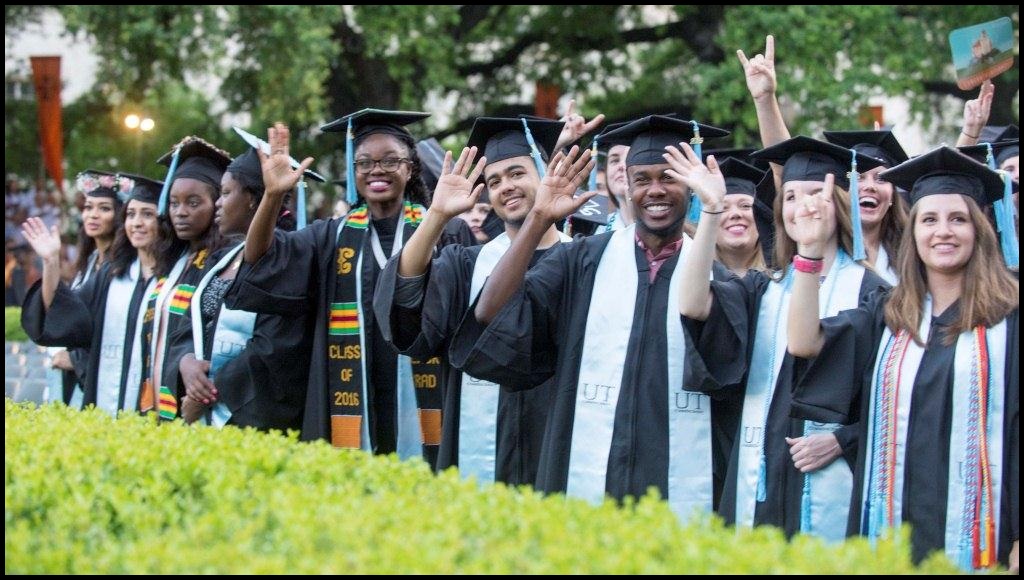
For the University of Texas, Spring Commencement is the most important event of the year, the signature public affirmation of the University’s academic enterprise. For the graduates, it’s the great finale after years of surmounting challenges, making discoveries, and life-changing adventures. The commencement ceremony officially validates their hard-won degrees.

Commencement is also, as is so often said about Texas, a state of mind. For a few days in May, it fills the waking hours of many, both those involved with preparations as well as the participants and audience. It possesses an almost chameleon-like character, changing its outward appearance to suit the expectations of different groups of people, from graduates to faculty to parents. And because it’s rarely experienced or appreciated in the same way by its many constituents, Spring Commencement seems to belong to and have a mysterious hold on everyone.

Above right: Steven Hardt, a 2007 Moody School of Communication graduate, arrives with an orange Tower perched on his mortar board.

~~~~~~~~~~~~~~~~~~~~

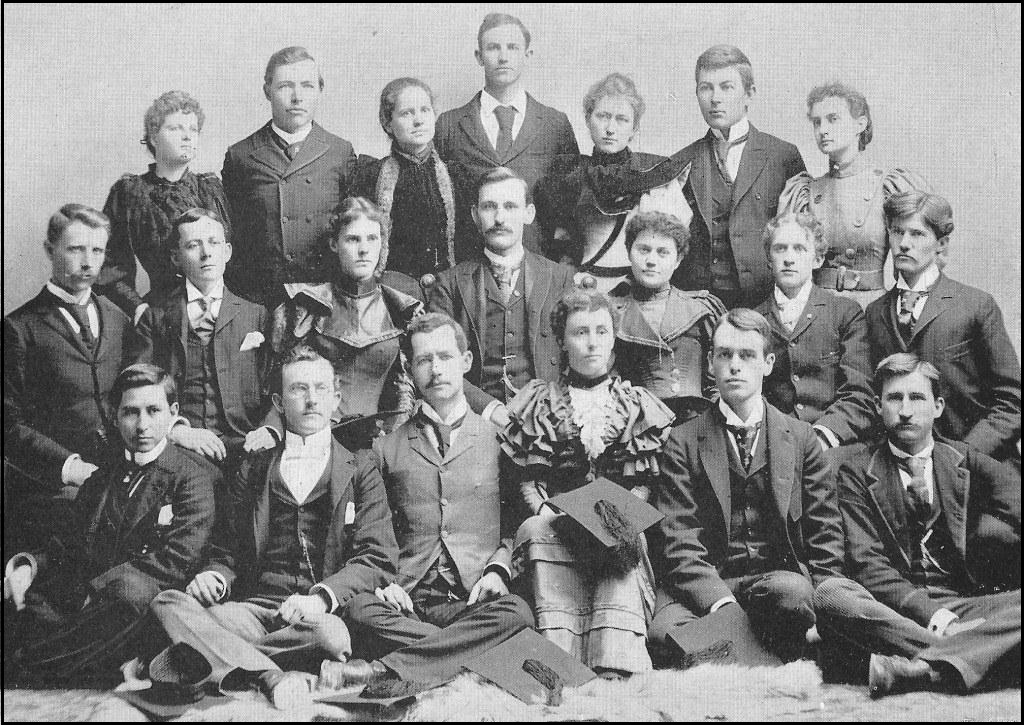
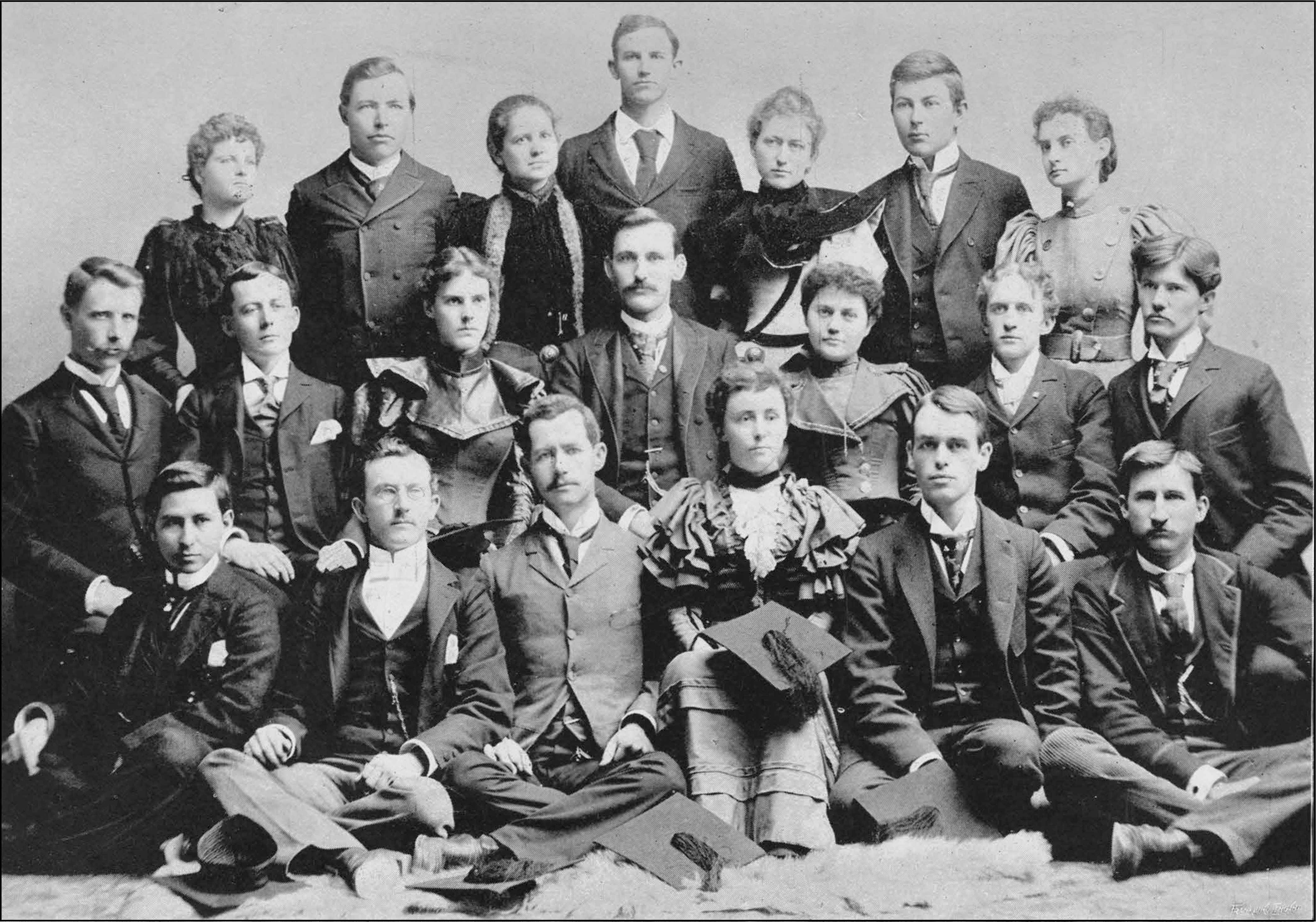
Above: The Academic Department (Arts and Sciences) class of 1894.

First held in June, 1884, the University’s earliest graduation ceremonies were modest affairs, staged in the un-air conditioned Millett Opera House downtown. They were scheduled either in the morning or later in the evening to avoid the early summer heat. Gentlemen arrived in three-piece suits, Ascot ties, and bowlers, while the ladies sported colorful bustle dresses and fashionable bonnets. Graduates were identified by the black-tasseled mortar boards on their heads.

Along with the presentation of diplomas, the ceremony was augmented by a pair of speeches delivered by members of UT’s two literary societies: the Rusk and Athenaeum. In 1885, Thomas Watt Gregory (photo at left, namesake of Gregory Gym) gave a half hour address that made quite an impression, as he optimistically described the march of social and scientific progress through the 19th century. “His speech from the beginning to the close was a grand and masterly one,” reported the Austin Statesman, “eschewing from his discourse the tinseled vaporings which generally characterize commencement efforts.”

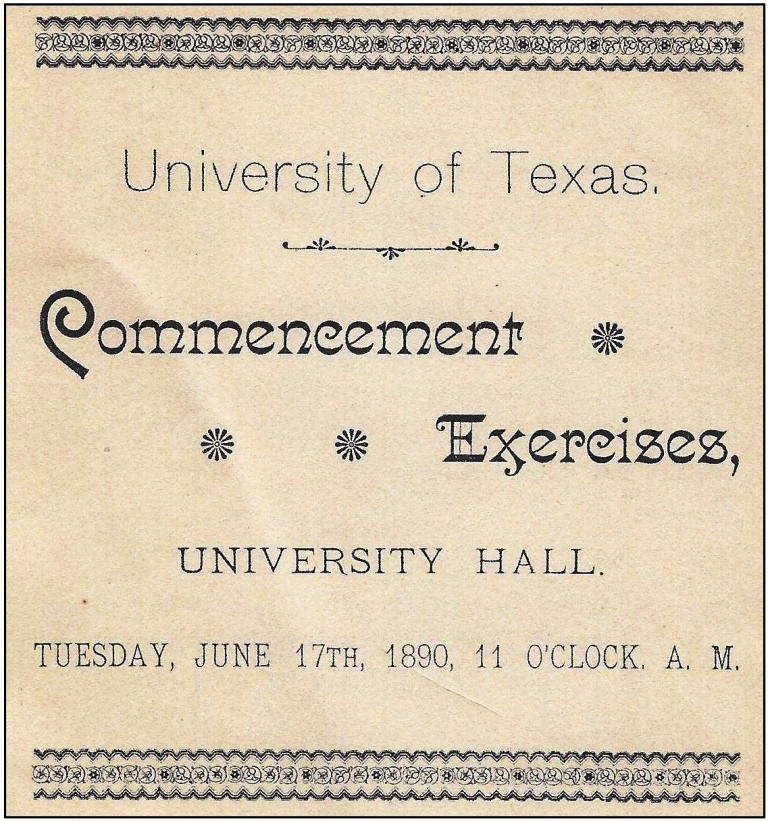
When the auditorium in the old Main Building was completed in 1890, commencement moved to campus, and over the next decade grew into a week long celebration. Parties, dances, picnics, luncheons, and, occasionally, a symbolic textbook burning in front of Old Main all preceded the diploma ceremony. The alumni association held its annual meeting at the same time, elected officers for the next year, and organized class reunions.

In 1901, the senior Academic students – what today might be considered arts and sciences – voted to wear traditional caps and gowns to commencement for the first time. The law students, though, had been left out of the discussion, and, unhappy that they weren’t consulted, refused to conform to the new dress code.  After UT President William Prather insisted that the law graduates wear some type of distinctive insignia, they opted to don light-colored suits with wild Texas sunflowers pinned to their lapels. Plentiful in the open fields around Austin, the sunflowers were at their peak in mid-June. A Daily Texan editor added some meaning to the choice: “As the sunflower always keeps its face to the sun, the lawyer turns to the light of justice.” A tradition was born. Today, UT law graduates still wear sunflowers.

Commencement moved outdoors in 1917. The state’s fire codes had recently been upgraded, and the auditorium was unexpectedly forced to close because of too few proper exits. Held on the warm and humid Tuesday morning of June 12th, just over 350 degree recipients – UT’s largest graduating class to date – gathered on the northwest side of the ivy-draped, Victorian Gothic old Main Building, in the shaded and cool corner between the north and west wings. The ceremony started bright and early at 8:30 a.m., before the Texas heat became unbearable.

Above: 1937 Spring Commencement in Gregory Gym.

Over the next few decades, commencement roamed about the Forty Acres. It was held in the Texas Memorial Stadium from 1925 – 1929, moved to Gregory Gym when that facility opened in 1930, and then returned to the front of the new Main Building and Tower in 1938.

In 1995, UT President Bob Berdahl asked that the University-wide commencement ceremony be re-invented. While participation was still strong for the college and school events, attendance for the Main Mall observance had suffered. The emphasis on hooding the Ph.D. candidates filled most of the time, and the undergraduates felt left out. A separate ceremony was created for the Graduate School, and the University-wide event was refashioned to better include everyone, with more pomp, pageantry, and the notable addition of fireworks. Within a few years, more than 20,000 graduates and spectators annually converged on the South Mall. By the 2010s, the crowd extended past Littlefield Fountain and used much of University Avenue. President Berdahl’s ideas were, perhaps, too successful.

In 2020, because of the Covid-19 pandemic, Spring Commencement was a virtual ceremony. When it returned the following year, the decision was made to move it to the roomier Darrell K Royal – Texas Memorial Stadium. While graduation in front of the Tower was a unique and special setting, it had simply become overwhelmed. As a consolation, the “Gone to Texas” program, meant to welcome new students on the night before fall classes begin and with its own pageantry, is still held on the Main Mall.

~~~~~~~~~~~~~~~~~~~

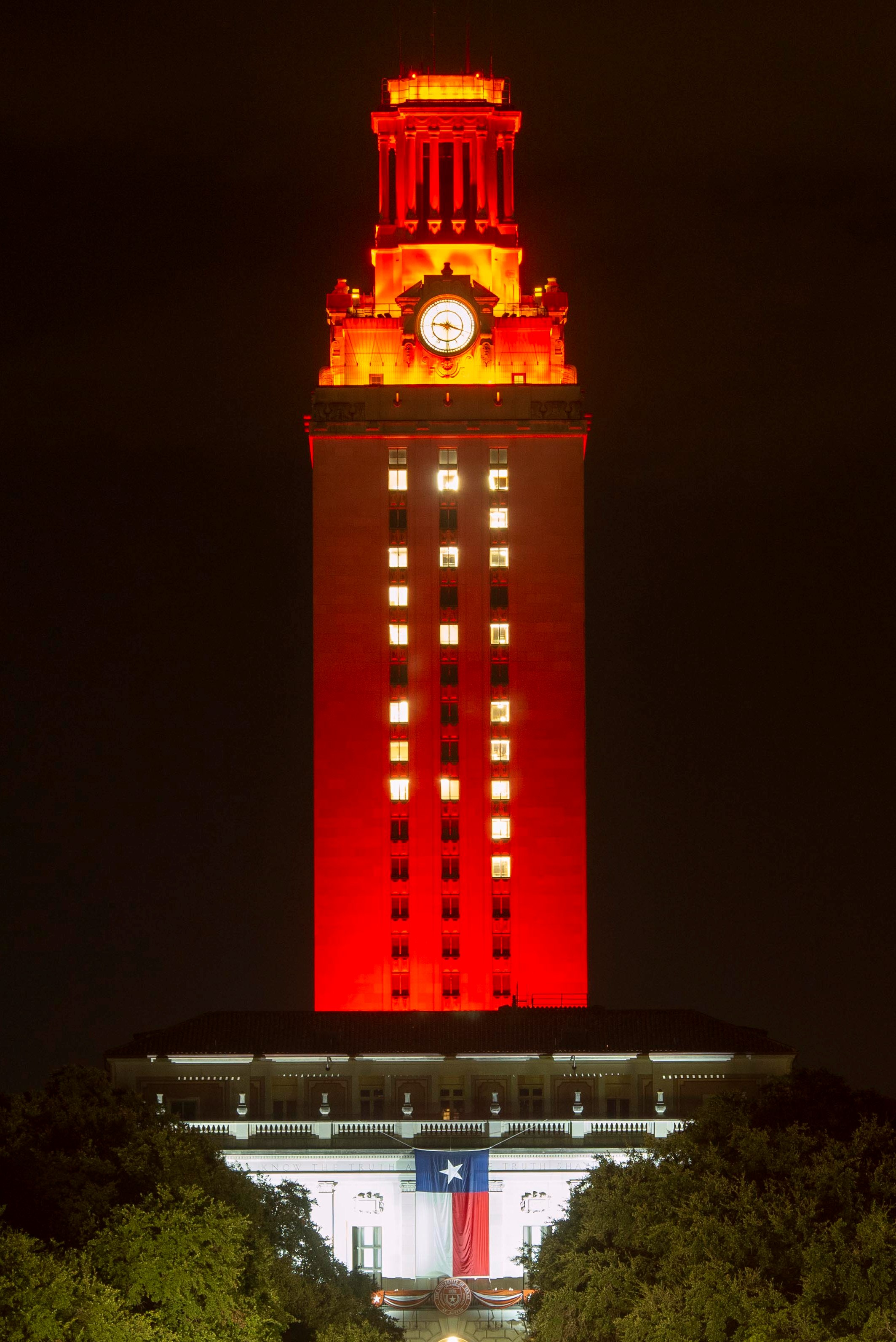
To the undergraduates, for whom their own commencement is often the first one to be witnessed, the modern ritual can pass as a blur of color, music, oratory, and pyrotechnics. The tops of mortar boards are decorated with UT icons, messages of future aspirations, and heartfelt thanks to parents. Deans brag with abandon about their schools and colleges. “If you have to go to a hospital,” chides the Dean of the School of Nursing, “you should hope that you’re being treated by a UT nurse!” The business school dean boasts, “Our degree programs are ranked in the top ten in the country!” All of it is loudly approved by the graduates. Throughout the night, the Main Building and Tower is bathed in a variety of special lighting effects until it bursts with color in the long-anticipated fireworks finale.

Much of the ceremony will seem deliberately out of touch with the 21st century, a purposeful nod to the medieval European ancestry of the modern university. Today’s caps and gowns are holdovers from the cappa clausa, the required academic dress centuries ago at Bologna, Paris, Oxford, and Cambridge. The tassels hanging from mortar boards and stoles draped over gowns are different colors, set by an agreed-upon international standard, to designate various fields of study. White is used by liberal arts, scarlet for communication, green for geosciences, citron for social work. Faculty members, most of whom earned their Ph.D. degrees from other universities, don the academic garb of their alma maters.

College maces, symbols of authority first seen in the 13th century graduation processions of Oxford and Cambridge, are carried at UT’s commencement. For each school and college, a pair of faculty marshals with maces conveys a single-file line of graduates into the stadium at the start of the ceremony. Made from oak and brass, most of the University’s maces were created in the 1960s, and each bears images and emblems connected with a particular college. A mortar and pestle sits atop the College of Pharmacy mace, teaching certificates adorn the one used by the College of Education, and Alec, the mascot or “patron saint” of the Texas Engineers, proudly stands on the mace for the Cockrell School of Engineering.

Prominently hanging above the entrance to the Main Building is a large color rendition of the University of Texas Seal, itself a longstanding tradition, when medieval universities needed official seals in order to conduct legal affairs. (The seals of a dozen other universities are permanently displayed on the Main Building.) Its Latin motto, Disciplina Praesidium Civitatis, comes from an 1838 speech by Mirabeau Lamar, a president of the Republic of Texas, who declared that a “cultivated mind is the guardian genius of democracy.” The use of Latin is a reminder of when the language was studied and spoken by university students in the Middle Ages.

Why is graduation called “Commencement?” It is, after all, a ceremony to mark the completion of something. The word reflects the meaning of the Latin inceptio – a “beginning” – and was the name given to the initiation ceremony for new graduates in medieval Europe. The original college degree was something like a teaching certificate; it certified that the bearer was qualified to instruct others in a given academic discipline. As part of the graduation ritual, which usually included a feast given by the graduate as a thank you to his professors and friends, the newly-minted scholar delivered his first lecture as a legitimate teacher. Commencement, then, means “commencing to teach.”

~~~~~~~~~~~~~~~~~~~~

It’s a relatively straightforward task to describe the tangible features of the day: the colorful procession, the advice dispensed, and the cheers that accompany the fireworks launched from a bright orange Tower. But as mentioned before, commencement also casts a less definable spell. For the graduates, there is the excitement of a goal well-achieved, balanced with nostalgia as they become alumni. For the parents, it’s a joyous time with an undercurrent of relief. For the faculty and staff, the satisfaction of a job well-done, seen in the confident eyes of their former students who are about to go out into the world. All at once, it seems, youthful exuberance meets the sentiment of age.

And for everyone, surrounded by the symbols and traditions of ages past, there is a sense, if only fleeting, of sharing in the timeless succession of learning. From the ancient schools in China, India, and the Middle East, to the famed Library of Alexandria along the northern coast of Africa, to Plato’s Academy in Ancient Athens, and then on to the more modern progression of universities in Bologna, Paris, Oxford, and Cambridge, across the Atlantic to Harvard, and finally, on to  Austin.

Perhaps the true meaning of commencement, so deeply rooted in history, is that it still carries with it an eternal promise of new beginnings.

Note: Some of the images from recent UT commencement ceremonies are courtesy of UT Austin and photographed by Marsha Miller.

“Better Hid than Dead”

UT’s Cold War Fallout Shelters

A surprise awaits those who wander into Waggener Hall.  Opened in 1932 for the business school, Waggener’s outside walls are decorated with colorful terra-cotta panels that represent the exports of Texas. Cattle, oil, maize, pecans, oranges, and even a turkey, are here. Indoors, at the north end of the ground floor hallway, just above the door that leads out to the Speedway Mall, is an unusual yellow and black sign. It’s easy to miss, but 60 years ago, the campus was filled with them. This rare survivor, with its distinctive yellow triangles, is a reminder of a time when Waggener Hall was deemed a fallout shelter in case of a nuclear attack.

~~~~~~~~~~~~~~~~~~~~

For several years just after World War II, the University of Texas was focused on coping with its burgeoning enrollment. In 1946, returning veterans on the G. I. Bill more than doubled the student population in just three months, from 7,900 to 17,100 students. (See: Life in Cliff Courts) Finding additional faculty, classrooms, and dorms were the top priorities, though the University community was also aware of the increasingly tense relationship between the United States and the Soviet Union.

The U.S. monopoly on the atomic bomb, which ended the Second World War, was a short one. The Soviet Union exploded its own atomic bomb in 1949. A few years later, in 1952, the United States conducted its first test of the larger and more destructive hydrogen bomb. The Soviets followed in 1953, and in 1958 announced its deployment of Intercontinental Ballistic Missiles – “ICBMs” – which made the delivery of a nuclear bomb far more efficient and harder to detect.

As the U.S. raced to defend the new threat, discussions over how to best protect the civilian population shifted away from surviving a direct hit (thought by most to be nearly impossible) to avoiding “fallout,” the radioactive dust thrown into the air by a nuclear explosion. Riding on the prevailing winds before dropping back to Earth, fallout could extend several hundred miles from the blast point, and exposure to the radiation could be fatal.

The Eisenhower administration urged building home fallout shelters, either in basements or back yards, where a family could hide from the fallout for at least two weeks. It was presumed that much of the radiation danger would have then passed, and that additional government help would be available.

As it was entirely too expensive for the government to build shelters for the entire population (a 1957 estimate in the now famous Gaither Report placed the cost at $25 billion), the Office of Civil Defense provided printed materials for families to construct and supply their own. In 1959, a 27-minute film was made available: Walt builds a Family Fallout Shelter.

~~~~~~~~~~~~~~~~~~~~

Above: The Texas Capitol, UT Tower, and downtown Austin in 1960.

In Austin, efforts to educate the public on the dangers of fallout and promote shelters began in earnest in 1960.The city was considered a prime target in a nuclear exchange with the Soviet Union, as it was both the seat of Texas government and hosted Bergstrom Air Force Base just to the southeast. (Today, it’s the site of the Austin-Bergstrom International Airport.) In April, a model fallout shelter was ceremonially opened in Zilker Park. (It still exists, but is not open to the public.) With Austin Mayor Tom Miller and Governor Price Daniel on hand for the ribbon-cutting, it was the first publicly-funded shelter in Texas and part of a Civil Defense program to build a model shelter in every state. The shelter’s layout was based on one of the several do-it-yourself blueprints found in the free, 32-page Civil Defense publication The Family Fallout Shelter.

The Zilker shelter inspired UT alumnus Cactus Pryor, then working for Austin’s KTBC-TV station, to write and narrate a 20-minute film that dramatized what might happen if an atomic bomb exploded in the Hill Country just west of the city. Titled “Target . . . Austin, Texas,” it was filmed in June – with scenes in a family shelter taken at the Zilker Park model – and made its television debut on September 4. “The nature of the film is such that should a viewer tune in late he might become alarmed that the film is real,” warned the listing in the newspaper. (Watch: Target . . . Austin, Texas)

Above: The “Target . . . Austin, Texas” film included a shot of an all-grass West Mall.

The Zilker facility also motivated the University’s Delta Zeta sorority, which built a new house over the summer just west of campus, near the corner of 24th and Nueces Streets. Ready by September, the “Modern Monterrey” style home was designed by the local architecture firm Page, Southerland, and Page, and featured a reinforced 1,500 square foot basement outfitted as a fallout shelter. Nationally, it was the first such shelter in college sorority house. (Delta Zeta went inactive in the 1970s and the home was purchased and is still occupied by the Delta Kappa sorority.)

In the fall of 1960, the City of Austin acquired a new director for its Civil Defense program. Colonel Bill Kengla (photo at left) first came to Austin in 1958 for a three-year post as commander of the University of Texas Naval ROTC program. A graduate of the U.S. Naval Academy, a Marine, and a veteran of World War II, Kengla was well-received on campus, but decided to resign a year early in order to take the director position.

Kengla was quite passionate about his new responsibilities and was determined to thoroughly educate and prepare the Austin area for a nuclear attack. He spoke to students at school assemblies and parents at PTA meetings. He installed 17 Civil Defense sirens across the city, including one on the top of the UT Tower, and ordered monthly siren tests. In April, 1961, Kengla convinced the organizers of Austin’s annual Flower Show to include a walk-through display of a family shelter. A month later, encouraged by Kengla, a trio of UT architecture professors conducted seminars on planning and constructing shelters in Austin, Dallas, Houston, and New Orleans.

However, despite all of the activity, the response was less than enthusiastic. Too many Austinites didn’t take the nuclear threat seriously and had no plans to ready themselves accordingly. The attitude paralleled much of the nation.

~~~~~~~~~~~~~~~~~~~

In the summer of 1961, the Berlin Crisis between the United States and the Soviet Union came to a head. Soviet Premiere Nikita Kruschev gave the U.S. six months to vacate isolated West Berlin. President John Kennedy’s response was to activate 150,000 armed forces reserves and increase defense expenses. On July 25, in a speech to the nation, Kennedy said, “I am requesting of the Congress new funds for the following immediate objectives: to identify and mark space in existing structures–public and private–that could be used for fall-out shelters in case of attack; to stock those shelters with food, water, first-aid kits and other minimum essentials for survival . . .” (Read and listen to Kennedy’s speech here.) The following month, the Berlin wall was erected, and soon afterward, the Soviet Union – very publicly – resumed its nuclear testing program.

The events sent a chill through the American populace, while Kennedy’s talk marked a shift in policy to promote both personal shelters as well as community shelters partly financed by government. At Kennedy’s request, Congress augmented the Civil Defense budget to about $207 million.

~~~~~~~~~~~~~~~~~~~~

Above: A Civil Defense poster advertised “The Family Fallout Shelter” booklet.

Through the rest of 1961 and into 1962, interest in personal fallout shelters soared. Some called it the “great awakening,” others dubbed it a “revival for survival,” but newspaper reports claimed Americans everywhere were stocking up on canned goods, reinforcing basements or digging up back yards, and speaking knowledgeably about radioactive isotopes. The Family Fallout Shelter publication, which had gone largely ignored, was suddenly, insatiably popular. “We printed 20 million of those booklets in 1959,” explained Civil Defense Information Officer Joseph Quinn, “and for two years they gathered dust in local CD offices. In July, we had to print three million more just to take care of known demand.”

The surging awareness of shelters, along with Congress’ increase in Civil Defense spending, brought with it a boon for business. “The subject of fallout shelters rates as the number one conversational topic in the nation since the nuclear test explosions conducted by Russia in the past few months,” announced the Texas Business Review, published by the University of Texas College of Business Administration (today’s McCombs School). An “immediate result of this public concern has been the recognition by the construction industry that the fall-out shelter could be very good business indeed.”

Texas newspapers were filled with shelter-related ads that marketed everything from construction materials to air filters to radiation detection kits to portable toilets. The Kinney Company touted its pre-fab shelters, showcased at the Texas State Fair, which could be delivered to a back yard and installed in a day.  The Zenith Company pushed specially-designed fallout shelter clock radios, while General Mills advertised its Multi-Purpose Food, or “MPF.” Invented in the 1940s to help feed post-World War II Europe, MPF was made from fried soy grits and could be used as a high-protein additive to other foods. “One 4 ½ pound can will feed an average person for two weeks,” General Mills claimed, “and can be stored for an indefinite period.”

The spotlight on fallout shelters kindled debate as to whether the shelters were worth the effort and expense. Life magazine optimistically predicted that, with proper preparation, 97 percent of Americans could endure the fallout from a nuclear attack. “Your chances of surviving fallout in a big city would be good. If you are in a large apartment house or office building you could either go to the basement or an inner corridor.” In a rebuke of Life’s claims, well-known biophysicist Eugene Rabinowitz stated that a 50-percent survival rate may be “reasonable,” but only for “systematically protected populations with well-organized construction of large, deep and heavily protected stocked shelters in areas not likely to be the target for direct attack.”
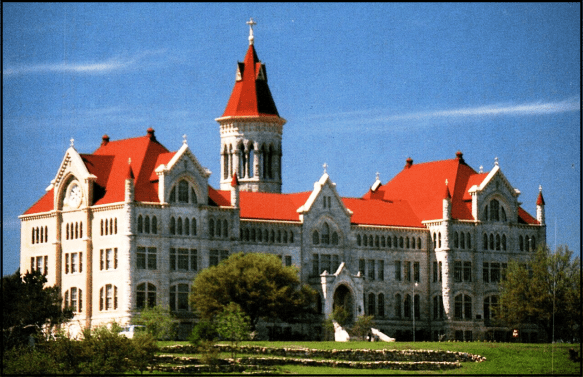
In Austin, Saint Edward’s University equipped its newest building – Saint Joseph Hall for resident faculty – with a $10,000 basement shelter, while the Hilltopper student newspaper posed the ethical question: “Is the Christian required to give up his family fallout shelter to an unprepared neighbor or passing stranger?” It cited Roman Catholic Reverend H. C. McHugh, of the Jesuit monthly America magazine, who wrote, “It is the height of nonsense to say that the Christian ethic demands, or even permits, a man to thrust his family into the rain of fall-out when unsheltered neighbors plead for entrance,” then added that he doubted any Catholic moralist would condemn a homeowner who used violence to “repel panicky neighbors who applied crowbars to the shelter door.”

Despite all of the media attention and promotion, a Gallup Poll taken in late 1961 found that only 12 percent of Americans planned to make changes to their homes or add shelters to prepare for a nuclear attack. This was almost double the number before the Berlin Crisis, but still well below the number wanted by Civil Defense authorities. Certainly, the U.S. population was concerned about nuclear war with the Soviet Union, but were not convinced the family shelter was the best answer or worth the personal investment.

~~~~~~~~~~~~~~~~~~~~

In the meantime, the U.S. government plans for community fallout shelters began to take shape. “Civil Defense is now being permanently woven into the fabric of American life,” Colonel Kengla told the Austin American-Statesman, who described a year-long national effort to identify, equip, and stock fallout shelters for 34 million persons in existing buildings. Kengla hoped to establish 350 community shelters in Austin, including 90 on the University of Texas campus.

In late October, 1961, UT President Joseph Smiley announced a University Committee on Civil Defense, to “establish continuing contact with Civil Defense officials and other appropriate agencies.” Smiley continued, “We have a substantial responsibility to our large academic community for careful planning of precautions and procedures related to civil defense and general disaster measures.”

The seven-person committee included two members of the ROTC faculty, the campus directors of the Physical Plant (UT Facilities), Student Heath Center, Housing and Food Services, the Balcones Research Center (today’s Pickle Research Center) and an engineering professor who specialized in sanitary systems.

~~~~~~~~~~~~~~~~~~~~

On December 1, 1961, a Civil Defense press conference formally introduced the new community fallout shelter sign. Designed by Rob Blakeley, a graphic artist with the Army Corps of Engineers, the sign was reflective yellow and black, highly contrasting colors that could be easily seen and understood in low light. Three triangles pointed downward to indicate fallout material dropping from the sky.

Early versions of the sign included the radiation hazard symbol, with its three blades emanating from a central atom, but the notion was rejected in favor of a sign that indicated safety rather than a warning.

Above: Radiation warning and fallout symbols.

Civil Defense Director Steuart Pittman later explained that the six outer points of the triangles signified: shielding from radiation, food and water, trained leadership, medical supplies and aid, communication with the outside world, and radiological monitoring to determine safe areas and time to return home. “It is an image we should leave with the public at every opportunity,” Pittman added, “for in it there is hope rather than despair.”

~~~~~~~~~~~~~~~~~~~~

Early in 1962, UT sociology professor Harry Moore released the findings of a local survey and claimed Austinites were still largely indifferent to the idea of civil defense, shelters, and warning sirens. Colonel Kengla responded, “I do not contest the survey. But I am not satisfied with community education.” Kengla believed Austin was two years behind other cities on the east and west coasts, but thought the city had a “good hard-core nucleus around which community-wide interest can be built.”

At the same time, the University Committee on Civil Defense began to work with Kengla and his staff. The group’s first project was to test the “Big Voice.”

On Saturday afternoon, April 15, a public address system installed on the 10th floor if the UT Tower shouted emergency instructions from all four sides. Kengla had seen a similar system used in Salina, Kansas and wanted to try it out on the Forty Acres. From 1 p.m. until sundown, the booming “Big Voice” issued its directives to passersby while the committee checked the effectiveness of the system’s range and acoustics. Ultimately, there were too many echoes and reverberations from other University buildings, and the “Big Voice” was abandoned.

Into the summer, the Committee continued to meet and identify potential locations for campus fallout shelters, as well as to compile and publish an 8-page booklet on emergency instructions in case of a nuclear attack or a tornado. While it listed what to do in case of attack (tune in to emergency radio broadcasts, stay indoors, etc.), it had as yet no information on public shelters. The guide was published in September for the start of the new academic year and distributed to all students, faculty, and staff.

~~~~~~~~~~~~~~~~~~~~

In October, the Cuban Missile Crisis once again elevated concerns over an all-out nuclear war with the Soviet Union. In Austin and throughout the nation, there was a run on stores for supplies. “Housewives by the thousands crowded into neighborhood grocery stores and shopping centers searching for $2 cans of Multi-Purpose Food,” reported the Statesman. “Grocers were caught by surprise at the MPF shelves, which had remained untouched for months, suddenly emptied.” The Statesman continued, “Their husbands headed for the hardware stores, buying plastic water cans, flashlights, tools, radiological monitoring equipment, and tear gas pens.” The last item, a hand-held, writing pen-size “weapon,” would presumably be used to repel someone trying to beak in to a shelter.

~~~~~~~~~~~~~~~~~~~~

Above: The view of the South Mall and downtown Austin in 1962 from the Tower Observation Deck.

On November 4, 1962, less than a week after the Cuban Missile Crisis ended, the University announced it had signed a contract with the Office of Civil Defense to provide 84 community fallout shelters in 30 campus buildings that would accommodate 24,099 persons. In fact, UT’s Civil Defense Committee had been working on the project for months, but the timing of the announcement was a little early, in part, to allay the fears of parents who had contacted the president’s office.

The shelters were well-distributed across the campus. Residence halls, the Main Building (which held both the central library and UT’s administrative offices), and the almost-finished Undergraduate Library and Academic Center (today’s Flawn Center) were obvious choices, along with the Texas Union, Student Health Center, and Gregory and Anna Hiss Gyms. Classroom buildings were also selected, including Garrison, Mary Gearing, Welch, Painter, and Waggener Halls, the buildings on the South Mall, and the just-completed Business-Economics Building. On the east side of campus, the Band Hall, Art Building, Drama Building, and the Law School were all deemed fallout shelters.

Above: A Civil Defense poster reminded the public that the fallout shelter sign was a “sign of protection.”
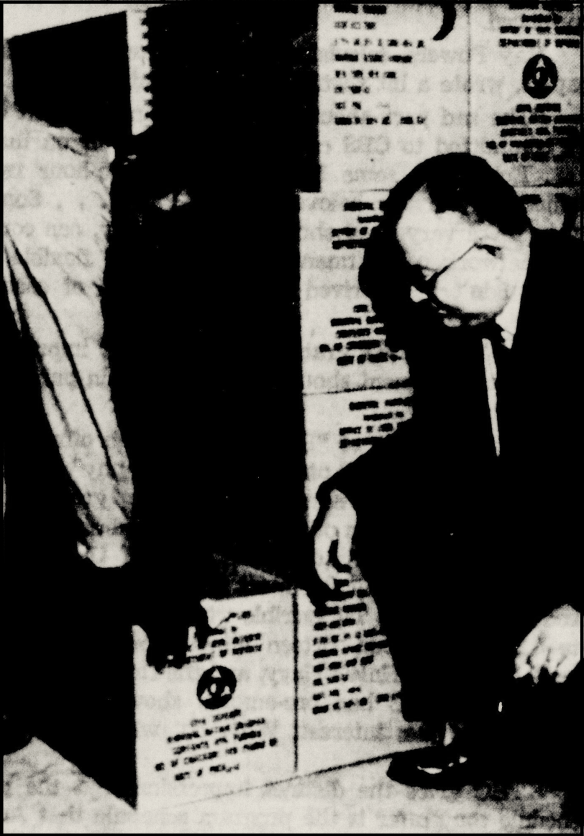
Starting in February, 1963, the designated shelters were stocked with supplies. Food, water, medical kits, radios, flashlights, batteries, soap, basic tools, portable toilets, radiation detection equipment, and walkie-talkies – which would allow for communication with emergency officials and other shelters on the campus – were all included. As with family shelters, the plan was to keep people protected and alive for two weeks.

Photo at left: Boxed shelter supplies are loaded into the basement of the business building.

Food consisted of crackers, biscuits, or wafers, made from wheat and corn flour. The rations allowed for 10,000 calories per person staying in the shelter for two weeks, and presumed the person would be sitting or sleeping much of the time. Additional “carbohydrate supplements” were also available.

About 100 University faculty and staff volunteered to be shelter managers, one each assigned to shelters that could house 50 – 200 persons (a “space” for an individual was defined as a 10 square-foot area), and more to larger shelters. Managers completed an extensive Civil Defense-prepared training program. Basic first aid, use of the radiation and communication equipment, and how to distribute the food rations were all included, but the volunteers also learned to be crisis managers, organize the shelter population, create sleeping and medical areas, prevent radioactive contamination from outside, how to assist parents with small children, accommodate religious services, use of isometric exercises to maintain strength, and a host of other issues and situations.

On campus, the arrival of shelters received mixed reviews. The Daily Texan editorial staff published a column under the title “Better Hid than Dead” and seemed pleased that the shelters were in place. Student letters to the editor, though, expressed contrary opinions. “The specter of nuclear annihilation pales at the thought of being locked in the Union with 1,310 [the Union’s shelter capacity] Union people and surrogates,” wrote Hayden Freeman. “I’ve seen them fight for their daily bread and dread to see them fighting for their lives – I’m sure their manners won’t improve. Not only would I rather be dead than Red, I’d rather be dead than hid.” Nell Hendricks wrote, “What puzzles me about all this tomfoolery is that people seem to be taking it seriously . . . Given the ideal conditions usually postulated in CD folklore, a bomb explodes 25 miles away (the magical distance), and you simply hole up in your shelter for two weeks (the magical period). You emerge to an idyllic, pastoral existence, to rebuild a better world, facing the future free and unafraid. So runs the fairy tale. Isn’t it a pretty one? Like, who said the ostrich is a stupid bird?”

By mid-spring, fallout shelter signs had been placed at the entrances and inside designated buildings, and the yellow and black logos became part the campus landscape.

Above: While business students prepare for the annual BBA Week, a fallout shelter sign (at far left) hangs at the entrance to the business school.
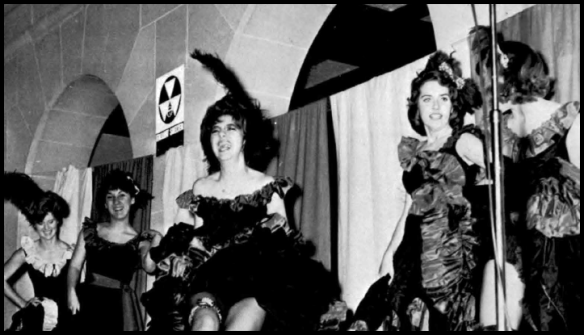
Above: A fallout shelter sign becomes part of the backdrop to a student Can-Can dance performance in front of the arched entrance to Garrison Hall.

Above: Not wanting to drill into the ornately carved limestone entrance of Welch Hall, the fallout shelter sign was posted on the brick to the upper right of the door.

Despite all of the planning, however, one glaring omission remained: there were no instructions as to which persons should go to which shelters in order to best accommodate everyone. If the Tower siren warned of a nuclear attack, should students living on campus report to their residence halls? Or, was everyone expected to simply go to the nearest shelter? What if a shelter had filled? There was no central coordination to track which shelters were still open. There could be a case where students, studying on the South Mall when the siren blew, had to frantically dash from building to building to find an available space. What if an attack came at night? Who would unlock the University buildings? Certainly, shelter managers weren’t expected to leave their families and try to make their way to campus. In addition, as UT’s shelters were public, they weren’t limited to the University community. In an emergency, a visitor on campus was expected to make use of them.

~~~~~~~~~~~~~~~~~~~~

Above: The Business-Economics Building.

It wasn’t until late in the year that a simulation run of a fallout shelter was planned. On Thursday afternoon at 1 p.m., December 5, 1963, 40 volunteer shelter managers descended into the basement of the Business-Economics Building, or “BEB.”  Opened the previous year, it was the largest classroom facility on Forty Acres. The basement level was reserved for student activities, with space for lounges, recreation, student organization meeting rooms, and the largest assembly of vending machines on the campus, including a newfangled dollar bill changer. (See The Big Enormous Building).

The volunteers were part of the latest shelter manager training group and had just completed nine weeks of classes.  They limited themselves to the south portion of the basement so as not to disrupt too much of the usual student activity. In a real emergency, the BEB basement was the University’s largest shelter, with a capacity of 4,400 persons.

For the eight-hour simulation, it was presumed that Bergstrom Air Force Base had just been hit in a nuclear attack and that fallout was drifting northwest over Austin. John Gaulding, on staff at the University’s Personnel Office, was elected shelter manager for the exercise.

“Radiation in Austin increasing, keep shelter closed tightly,” said bulletin number 3 from Austin’s Civil Defense headquarters, which was in radio contact with the group. Professor John Scanlan, who directed the nuclear reactor laboratory in the Engineering Science Building, served as radiation monitoring captain for the day. He unpacked the radiation detection kit from the shelter’s supplies and determined that there were no radiation leaks. As the simulation continued, Civil Defense regularly updated the outdoor conditions.

A volunteer patient was brought in to the shelter, checked for radiation and treated for broken bones. The group spread cardboard boxes on the floor as hospital beds and improvised with strips of cardboard as splints. Large sheets of paper became blankets.

Above left: The standard Civil Defense provisions for a 50-person fallout shelter included 10 drums of water and boxes of food, medical, sanitation, and radiation detection supplies that could be stacked in a space 40 inches square. The BEB basement shelter was equipped to handle 4,400 persons. Image courtesy of the Cold War Museum online.

Gladys Hudnall, the Food Services Supervisor at Kinsolving residence hall, acted as food and water captain and distributed paper cups filled with water from the supplies. Each person saved their cup for future use and was allotted a quart of water a day. The evening mealtime was served at 4:45 p.m., when the volunteers received eight crackers apiece as their caloric ration.

After dinner, there were isometric and other muscle exercises, and discussion on sleeping preparations. The sleeping arrangement captain, Neil Taylor, who was the manager of the Chuck Wagon diner in the Texas Union (what today is the Cactus café), selected the best ventilated area for sleeping. In a real situation, single men and women would have been placed at opposite ends, with married couples and children in the middle. Whatever bedding that was available would have been shared.

The following day, Mattie Treadwell, the chief field officer from the Washington, DC headquarters of Civil Defense, told the Texan that UT’s simulation was the first conducted by a large university. “I hope that other schools will be inspired to try similar exercises.”

~~~~~~~~~~~~~~~~~~~~

And then, nothing. After the 1963 simulation, there were no more records of training sessions for shelter manager volunteers. No one was designated to check the status of the food and medical supplies. Nationally, interest in fallout shelters dropped dramatically and Congress cut the Civil Defense budget accordingly. By 1975, twelve years after the fallout shelter signs were first hung, the Texan reported that the University was clearing out the shelter supplies to create more storage space. The medical provisions only had a four-year shelf life and had long since expired. Some of the food containers were opened, but the crackers and wafers were declared “rancid” and discarded. What could be salvaged was returned to Civil Defense.

In the late 1990s and early 2000s, most of the outdoor fallout shelter signs, by then either rusted or bleached by the Texas sun, were removed from University buildings.


Sources:

Briscoe Center for American History (UT Archives): UT President’s Office Papers, Civil Defense files

Blanchard, Boyce Wayne. American Civil Defense 1945: The evolution of Programs and Policies (Dissertation, University of Virginia, 1980)

Marten, James. Coping with the cold War: Civil Defense in Austin, Texas 1961-62 (East Texas Historical Journal, March 1988)

The Texas Business Review, January 1962, pg. 9-10 (University of Texas College of Business Administration)

University of Texas Emergency Instructions in event of Atomic Attack or Tornado (1962) Special thanks to Avrel Seale who found a copy in the University Communications office and photographed the contents.

Office of Civil Defense publications: Ten for Survival: Survive a Nuclear Attack (1959), The Family Fallout Shelter (1959), Federal Civil Defense Guide – Fallout Shelter Food Requirements (1962), Shelter Manager Instructor Guide (1963), Guide for Community Fallout Shelter Management (1963)

Civil Defense Museum online: http://www.civildefensemuseum.com/

Life magazine, September 15, 1961, pg. 95-108

Newspapers: The Daily Texan, Austin American-Statesman, St. Edward’s University The Hilltopper, Fort Worth Star Telegram, Fresno Bee,  Provo Daily Herald, San Angelo Standard Times, Sioux City Journal, Wichita Falls Times
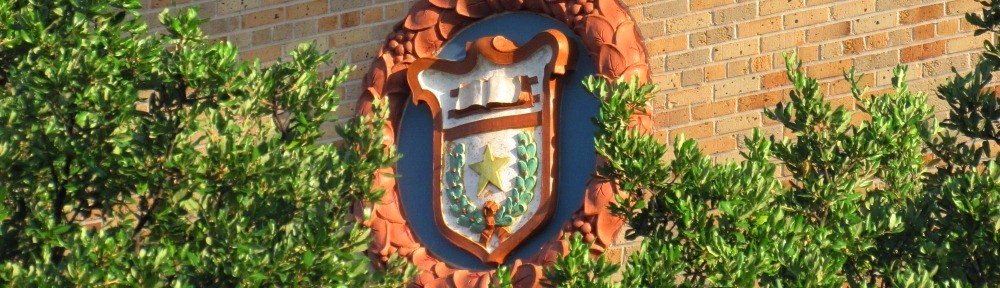
Why are we Longhorns?

Why are University of Texas athletic teams known as Longhorns?

Mascots for American colleges and universities are usually connected to the rise of intercollegiate sports, particularly football, in the late 19th and early 20th centuries. Some nicknames are simply a university’s colors: the Harvard Crimson, the Syracuse Orange, or Cornell University’s Big Red. The stories behind others, though, are as diverse as the mascots themselves. Michigan has often been called the “Wolverine State,” as wolverine pelts were popular in trade between Native Americans and European settlers of the 18th century. When the University of Michigan fielded its first football team in 1879, the Wolverine nickname was an obvious and appropriate fit. In the early 1880s, football players from Princeton University donned orange and black striped jerseys and stockings as part of their uniforms, which prompted local sportswriters to refer to the team as the Tigers. A dozen track athletes from the University of California competed in their first out-of-state competition in 1895, and brought along a blue banner that featured a gold grizzly bear – the symbol of California found on its state flag. Thereafter, Cal teams would forever be known as the Golden Bears. In 1908, Phillips Miller, a vendor in Gainesville, Florida, wanted to sell college pennants of the two-year old University of Florida, but realized it didn’t yet have a mascot. Miller’s son, Austin, suggested the alligator, as it was native to the state and likely hadn’t been claimed by anyone else. The pennants were ordered, sold, and UF teams became known as the Gators.

Above: An early University of Florida pennant with an alligator mascot.

When the University of Texas first played football in 1893, the team was referred to as “‘Varsity.” The term – with an apostrophe in the front – was a nationally used abbreviation of the word “university.” (Think: university -> ‘versity -> ‘varsity.) Browse through early editions of the Cactus yearbook, and the label can be found everywhere – ‘Varsity Band (photo at left), ‘Varsity Glee Club, ‘Varsity Debate Team – as a generic expression for a University organization. (It wasn’t until after World War II that the word “varsity” referred to the “A” team in high school sports.) In Texas, from the 1880s to the 1920s, a person studying at ‘Varsity was understood to be enrolled at the University in Austin, while someone going to the College was a student at the A&M College of Texas, or “AMC,” in College Station.

In the early 1900s, newspapers began to set aside extra room for stories about athletic events and scores, which evolved into today’s sports sections. But journalists who covered football games, for example, couldn’t simply refer to a team as ‘varsity, as that could be applied to either school, and always writing out the full name – the University of Texas football team – was too cumbersome. Instead, the use of mascots as team names became popular, and if a university didn’t yet have a nickname, sportswriters (as was the case with Princeton) might try to invent one.
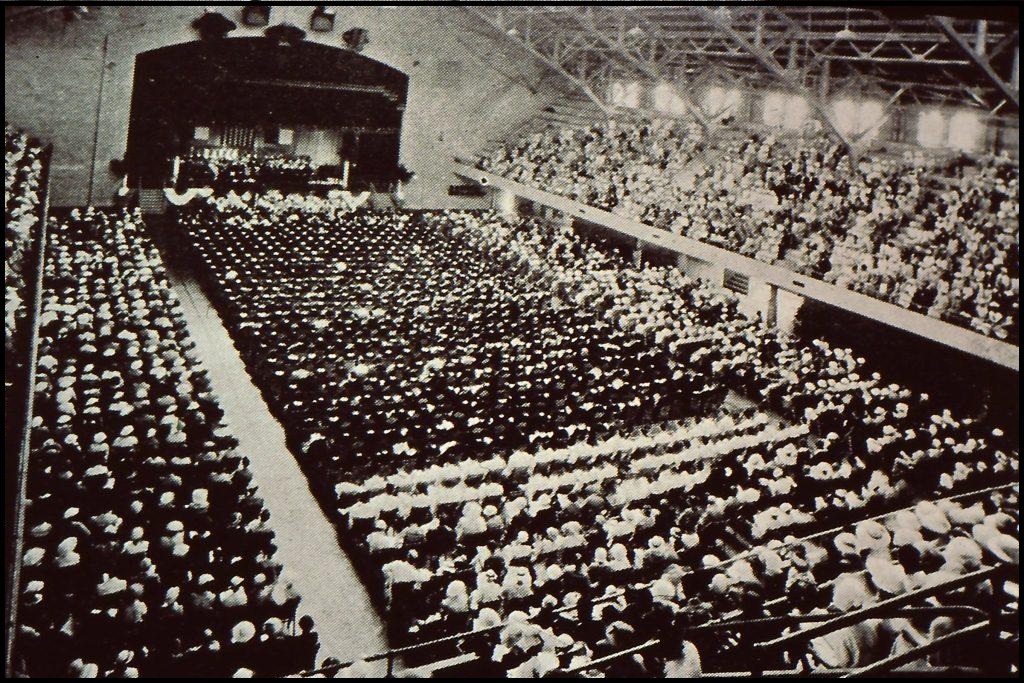
A month into the 1903 fall term, Alex Weisberg, then editor-in-chief of the weekly Texan student newspaper, asked David Frank, then the sports reporter, to refer to UT athletic teams as Longhorns in every article, “and we’ll soon have a name.” The Texas longhorn was a descendent of cattle imported by Spanish settlers in the late 1600s, and its impressive size and strength had made it a favorite symbol associated with the Lone Star State. Frank agreed, and starting in November, the name “Longhorns” (and sometimes “Long Horns”) appeared in stories about the football team.

On November 13, UT traveled north to what was then the Oklahoma Territory to play the University of Oklahoma and left with an 11 – 5 win, though The Daily Oklahoman newspaper out of Oklahoma City published the headline “Rangers Won It” in an attempt to name the team from Austin. “The Texas Rangers won a very exciting game from the Norman University yesterday afternoon,” reported the Oklahoman. The Texan, though, would have none of it, and promptly corrected the Oklahoman on its error.

The Texan kept it up into the spring of 1904, and expanded to the baseball and track teams, as well as the University’s debate team. With a debate scheduled in Austin against the University of Missouri, the paper explained, “The debate will be the first time the Tigers and Longhorns have met on the intellectual gridiron.”

Frank became the Texan’s editor-in-chief in 1905 and continued the campaign. By 1907, the nickname was in use by the entire University community, and the Athletic Council officially recognized the Longhorn as the University of Texas mascot.

Above: The first Longhorn “swag” appeared in 1913 when recent graduate (and future Board of Regents chair) Lutcher Stark donated orange blankets to the football team that read “Texas Longhorns.” One of the blankets is on display in the Stark Center, headquartered at the north side of the stadium.

Birth of the Alcalde Magazine

And the near demise of Texas A&M

The University of Texas alumni magazine Alcalde arrived only after a Herculean overhaul of the Alumni Association, an unprecedented public relations campaign to promote higher education, a sumptuous turkey dinner, a near-fatal bout of appendicitis, and a legislative debate over merging Texas A&M with the University in Austin.

~~~~~~~~~~~~~~~~~~~~

It wasn’t the usual holiday greeting. Less than a week before Christmas, on December 20, 1910, University of Texas Alumni Association President Ed Parker (right) wrote a bluntly candid letter to his fellow graduates. “The Association has at this time,” he explained, “no complete records, no fixed habitation, no funds, no really effective organization.” Alumni dues were a dollar a year, but no one bothered to pay them. The treasury had been empty since 1905 and the office of treasurer left vacant. “That such a condition should not be permitted to continue does not admit of argument.”

Founded on Wednesday, June 17, 1885 by the 34 members of UT’s first two graduating classes – 1884 and 1885 – the University’s alumni group was full of potential. In its first years it provided several gifts and scholarships, and the group raised $1,000 as one-third of the cost of UT’s first athletic field. By 1910, though, the 25-year old Association had languished.

What activity remained was centered on a sparsely-attended “Alumni Day,” an annual meeting in June held in conjunction with the University’s Commencement Week. The meeting highpoints included a formal “alumni address” speech, a debate and selection of next year’s speaker, and then officer elections before the group adjourned to a barbecue lunch.

Parker, an 1889 graduate and Houston lawyer, was elected president at the June 1910 meeting, but didn’t fully realize the somber state of alumni affairs until his predecessor, Will Crawford, cordially stopped by Parker’s office months later. The two had a lengthy conversation and Parker resolved to place the Association on a more prosperous course.

After further discussions and a meeting with his fellow officers in the Executive Council, Parker crafted five ambitious goals intended to resuscitate the Alumni Association:

  • Acquire a permanent alumni secretary “charged with the execution of such plans as the association may adopt.”
  • “Furnish and equip” a room on campus as an alumni headquarters.
  • Add class reunions to the annual June meeting to increase interest and attendance.
  • Enforce the rule requiring $1 annual dues. With approval of the Executive Council, a $50 life membership was created, payable all at once or in $10 installments over five years.
  • Establish an alumni magazine.

University President Sidney Mezes was quick to support Parker’s objectives, and offered to fulfill two items on the list:

  • First, Mezes found an alumni secretary. John Avery Lomax earned his Bachelor of Arts degree at UT in 1897, and then spent six years as the University’s registrar before he was hired as an English instructor at the A&M College of Texas (now Texas A&M University). In 1906, Lomax took a sabbatical, went to Harvard on a scholarship, earned his master’s degree, and fulfilled a childhood ambition to collect and preserve western cowboy and folk songs. Encouraged by his Harvard professors, Lomax solicited songs through newspapers and journeyed throughout the west whenever time and funds permitted. In Fort Worth, he met cowhands who knew the words to “The Old Chisolm Trail” and discovered a gypsy woman who sang, “Git Along Little Doggies.” In San Antonio, an African American former trail cook who was then managing a saloon performed “Home on the Range.” Back in College Station, Lomax compiled the music into a book titled Cowboy Songs and other Frontier Ballads. It was to appear in November 1910 and would eventually make Lomax internationally famous.

Around the same time, Mezes recruited Lomax back to Austin to serve as Secretary of the University and Assistant Director of the Extension Department, and he was to start with the fall 1910 term. As an opportune coincidence, Lomax had also been elected secretary of the Alumni Association at the same meeting Parker was made president. Normally, the secretary – as with the other officers – served in a volunteer capacity, but Mezes made it a professional one. He added “Alumni Secretary” to Lomax’s job description, which provided the first paid staff position for the Association and tied the group more closely to the University. Lomax earned a $2,200 salary, though it would be raised to $2,700 within two years.

Above: The University Library – today’s Battle Hall – under construction in 1910 .(from UT’s Alexander Architectural Archives)

  • Mezes also offered the Association a home. In 1910, the University’s new Library (today’s Battle Hall) was well under construction. When finished the following year, it was expected to have enough extra room that UT’s administrative offices, including the president’s office, would be moved to the first floor. Mezes was confident that once he relocated to the new building, the Board of Regents would approve the use of his current office, room 119 in Old Main, as the Alumni Room, a new campus headquarters for the Association.

Having already attained two of his goals, Parker’s December letter was mailed to about 2,800 alumni, which laid out the troubling state of the Association and outlined the five objectives.  “There can be no question,” Parker wrote, “but that a state university . . . has need for an active, vigilant, and loyal working body of alumni to look out for its interests.”

~~~~~~~~~~~~~~~~~~~~

Through the spring of 1911, Parker and the Executive Council diligently pursued the final three objectives. The June meeting and class reunions for UT’s first 10 graduating classes (1884 to 1893) were advertised in newspapers statewide. Parker sent personal letters to each member of the reunion classes and President Mezes did the same a few weeks later. “In case it is possible for you to attend,” wrote Mezes, “kindly notify me by wire, so that proper provision can be made for your reception and entertainment.”

Above: The Engineering Building, now the Gebauer Building. Opened in 1904, it’s the oldest surviving building on the Forty Acres. Above the ground floor labs and first floor offices, the alumni met in the second floor lecture hall, on the right side with the arched windows.

At 9:30 a.m. on the sunny and warm Monday morning of June 12, 1911, nearly 250 graduates gathered for the annual meeting, held in the second floor lecture hall of the Engineering Building (today’s Gebauer Building). With the entire nation experiencing an early summer heat wave, the windows were opened to catch any southeastern breezes that ventured up from the Gulf of Mexico.

The news was encouraging. Just over 600 alumni had paid their $1 dues and pledged to continue their payments in the future. Three alumni were $50 life members, and 36 more were on the installment plan. John Lomax was formally introduced as the group’s Alumni Secretary, and the Board of Regents had officially approved repurposing room 119 in Old Main as the new Alumni Room. The Association’s first class reunions were to be held later that evening at the Austin Country Club.

In the course of the meeting, the group approved the creation of 31 volunteer “district secretaries,” one in each state senatorial district, to organize social gatherings on March 2, Texas Independence Day. Meant to celebrate both the state and the University, the annual event quickly became a catalyst for the creation of local alumni chapters. (See Why Texas Exes Celebrate March 2nd).

Above right: The Austin chapter of the Alumni Association organized in 1913 with a luncheon at the Driskill Hotel.

Also approved was a resolution to give the Executive Council authority “to establish and provide for a University of Texas periodical,” though it was felt that a magazine should be put on hold for a year. Instead, Lomax was to complete an updated alumni directory.

~~~~~~~~~~~~~~~~~~~~

Above: The University’s Old Main, with the newly opened Library on the left.

The surprise of the day came from Will Hogg, namesake for the W. C. Hogg Building on campus. The son of former Governor James Stephen Hogg, an 1897 law school graduate, and, like Parker, a Houston lawyer, Will Hogg fully supported Parker’s efforts to transform the alumni group “from a wishing organization to a working organization.”

At a time when a majority of the U.S. population remained unconvinced about the value of a college education, the 36-year old Hogg was believed that the only way for state-funded colleges and universities in Texas to be adequately financed and supported was for more Texans to truly understand what was happening on campus. While he had mulled over the idea for years, the momentum Parker was building with the alumni presented a ripe opportunity to put thoughts into action. Hogg proposed an ambitious and unprecedented five-year program to promote higher education to the people of Texas.

He originally called it “The Organization for the Enlargement and Extension by the State of the University Plan of Higher Education in Texas.” What a mouthful. It was quickly shortened to “The Hogg Organization.”

According to its proposed by-laws, the Hogg Organization was to be overseen by the President of the Alumni Association, President of the University, and Chair of the Board of Regents. Committees of volunteers would be organized to handle specific tasks, and Hogg explained that Arthur Lefevre, an 1895 UT civil engineering graduate, was to be hired as secretary.

While it would rest under the umbrella of the Alumni Association, Hogg planned to take on the funding himself and promised to find enough contributors to be able to spend $30,000 for five years, or $150,000 total, equivalent to more than $4.5 million today. The alumni enthusiastically supported the idea, many became contributors, and Hogg was as good as his word. In four months, he obtained enough pledges to finance the entire project. (No subscription larger than $250 per year was accepted.)

Over the next five years, the Hogg Organization made an enormous impact on the state promoting a single idea: that higher education was vital to the future prosperity of Texas. Articles regularly appeared in newspapers statewide, and it received coverage from as far away as Boston. Informational posters and charts espousing the benefits of a university education were placed in courthouses, libraries, and chambers of commerce. “Higher Education Day” programs were held in thousands of Texas public schools – most of them one-teacher schoolhouses in rural communities – to inform and encourage students to consider going on to college. (At the time, in-state tuition to UT and other state-supported colleges was free, paid through a legislative appropriation.) A series of pamphlets, published by the Hogg Organization and mailed to thousands across Texas, promoted the “cultural value” of education and detailed the economic impact of higher education on the state. Elaborate exhibits were placed at county fairs, where University alumni volunteers were there to explain and answer questions.

Perhaps its best publicity effort was in hiring about 30 recent graduates who represented every college and university in Texas, both publicly and privately funded. As something akin to higher education missionaries, they canvased the state, especially small towns, where they spoke about their own collegiate experiences. As John Lomax later remarked, “These men were carefully selected, and the hope of what they could accomplish lay in the fact that they themselves were Texas people who could talk pretty well and could show the people of the state what a college education had done for them. A great deal of good was done by these men.”

Of course, as the Hogg Organization was considered a project of the Alumni Association, the public profile of the latter was raised considerably.

~~~~~~~~~~~~~~~~~~~~

By June 1912, a year-and-a-half after Parker’s dire letter, the transformation of the Alumni Association was nothing short of remarkable. Attendance for the June 10 annual meeting had doubled to 500 and was moved to the newly-opened YMCA Building at the corner of 22nd and Guadalupe Streets. Dues-paid memberships had topped 1,000 persons. Reunions were organized for the second ten graduating classes (1894 to 1903), and the first ever Alumni vs. ‘Varsity Baseball Game was held, pitting former UT baseball stars against Coach Billy Disch and his current team.

The signature event of the evening was a torchlight and colored lantern procession. Alumni assembled on the West Walk (the future West Mall) and with the University Band leading the way, paraded on the streets around the perimeter of the Forty Acres. Colorful floats built by academic departments and student organizations joined the “devoted foot-cavalry,” as Lomax described it, “plugging along amid dust and hilarity.” Student and Austin spectators crowded the route.

To prepare the campus, “the Senior Engineers have strung thousands of electric globes along the main walks,” reported the Austin Statesman. Additional strings of alternating orange and white lights were hung under the eaves of the new Library (above right) and the front of the old Main Building was brightly floodlit. The parade wound up at a wooden stage just west of Old Main, where the participants were entertained by skits and songs performed by UT students.

“Everybody was tired, but everybody was happy,” reported Lomax. “Alumni Day, 1912, was at an end – a day filled with much pleasure for many people, and a day marking probably the largest and most successful home-coming of old students the University has ever known.”

The most important and far-reaching events, though, were during the morning business meeting. In an effort to recruit still more participation (and, it was argued, missing friends who hadn’t completed their degrees), the alumni approved a constitutional amendment to expand membership from graduates-only to anyone who had attended the University. Hereafter, the UT Alumni Association was renamed the Ex-Students’ Association of the University of Texas.

The group also gave the go-ahead for an alumni magazine and set a target date of January 1, 1913 for the first issue. A committee was appointed to get the ball rolling and meet with President Mezes about potential financial assistance.

Left: Ribbon from the 1912 alumni meeting. In lighthearted fashion, the alumni were divided into three 10-year sets and given special designations. The oldest group was dubbed the “Ancients,” the middle group called the “Medievals,” and the most recent graduates were the “Old Timers.”

~~~~~~~~~~~~~~~~~~~~

Of course, deciding to launch a periodical wasn’t the same as putting all of the pieces together. The magazine needed a name. There wasn’t yet an editor, editorial board, final decisions about content, completed articles, photos and illustrations, a cover design, advertisements to help defray printing costs, and a host of other details. Given all of the work that needed to be done, the New Year’s publication date wasn’t all that distant.

Lomax didn’t waste any time, and used the summer to solicit possible article contributors for the first issue. “The Alumni Association of the University of Texas has voted to begin an Alumni Magazine,” Lomax wrote to Alexander Macfarlane, who led the physics department from 1885 to 1894 and had since retired to Canada. “One purpose of the publication is to obtain a record of the early days of the institution from the men who were the chief actors in making this history.” McFarlane declined, but Lomax had better luck with John Mallet. A longtime chemistry professor at the University of Virginia, Mallet was among the eight-member inaugural UT faculty in 1883 and served as the faculty chair. He obliged with a three-page “Recollections of the First Year.” Lomax’s request was a timely one, as Mallet passed away only a few months later, in November.

In the meantime, an alumni committee approached President Mezes about financial support. Mezes offered to help, but wanted the alumni publication to replace The University of Texas Record. A UT-sponsored journal first published in 1899, it provided a wealth of information about academics and student life on the Forty Acres, but as many of the topics would overlap with an alumni magazine, it didn’t make sense to fund both. About 5,000 copies were printed for each issue of the Record, and Mezes hoped the new magazine would have the same circulation.

~~~~~~~~~~~~~~~~~~~~

Progress on the magazine continued through autumn. On Friday morning, October 18, 1912, the Ex-Students’ Association Executive Council assembled in the brand-new and majestic Adolphus Hotel (left), opened less than two weeks beforehand in downtown Dallas. President Mezes attended as well. The group officially endorsed the alumni magazine and appointed an eight-person editorial board, which included Lomax. Among its members: Dr. Harry Benedict, Dean of the College of Arts and Sciences, Eugene Barker, chair of the UT history department, and Fritz Lanham, a 1900 graduate who had served as the first editor-in-chief of The Texan student newspaper. In addition to the board, an ad hoc committee of Association Vice President John Philip, Will Hogg, and John Lomax was organized to look after the business affairs for the first issue.

Just over a month later, on Wednesday, November 27 (Thanksgiving Eve) the editorial board gathered in Austin for its organizational meeting. Five additional members had been selected, including Richard Fleming and Mary Batts as student editors, who would contribute news about campus life and Longhorn sports.

The group met at the Lomax family home in west campus at 910 West 26th Street, a one-year old, two-story, yellow-brick bungalow with a hillside view of what today is North Lamar Boulevard and Shoal Creek, and where a pre-Thanksgiving turkey feast awaited everyone. “Carefully cooked by Mrs. Lomax,” Harry Benedict recounted years later, “in strict accord with all the finer principles of gastronomy, it was set, not before a king, but before certain unroyal personages who were met to destroy the turkey and to found a Texas alumni magazine.”

After dinner, the first order of business was to select an editor-in-chief, at the time an entirely volunteer position. Fritz Lanham (at right) received the nod. A lawyer from Weatherford (just west of Fort Worth), he was best-known on the Forty Acres as the founder and first editor of the Texan newspaper. The group hoped Lanham would bring that experience to the new alumni magazine.

Like Will Hogg, Fritz Lanham was also the son of a former Texas governor. Samuel Lanham held the office from 1903 to 1907, after having served 18 years in the U.S. Congress. Though Fritz never ran for governor, he did follow in his father’s footsteps to Washington, where he represented Texas’ 12th congressional district from 1919 until his retirement in 1946.

Following the choice of Lanham as editor, the board held an animated conversation well into the evening, debating the purpose and content of the magazine. Benedict quipped, “This enthusiasm was, it must be admitted, in part due to the fact that Charles K. Lee, Will Hogg, Dr. David H. Lawrence, and John Philip had agreed to back the proposed magazine to the extent of a couple of thousand in case a deficit should unfortunately arise.” Its pages were to be filled with reminiscences from faculty and alumni, news of current campus events, discussions over University problems, and literary efforts, including poetry.

The publication date was pushed back to March 1, 1913, just before Texas Independence Day on March 2 and the planned alumni events across the state. What better time to distribute the first copy of an alumni magazine than on the day ex-students came together to celebrate Texas and their alma mater?

Perhaps the most anticipated question was the magazine’s title. Professor Barker was chosen to lead a sub-committee to select a name, and the nominations included: The Orange and White, The Bronco, The Lone Star, The Alamo, The Ex-Students’ Record – a nod to the retiring University of Texas Record – and The Alcalde.

~~~~~~~~~~~~~~~~~~~~

The word “alcalde” (al-CAL-day) originated as the 7th century Arabic term “al-qadi,” or, “the judge.” Early Muslim kings, known as caliphs, appointed qadis to administer justice in local civil and criminal cases.  When the caliphs expanded the Arabian Empire west across northern Africa, and then north into the Iberian Peninsula in 718, they brought the al-qadi custom with them. Local Spaniards later modified the term to “alcalde,” though it retained much of its original meaning. Eight centuries later, after the Spanish regained control of the peninsula, the conquistadors sailed across the Atlantic to invade what is modern day Mexico, and the alcalde tradition arrived in the New World.

Starting in the 1500s, Spanish military and missionary explorers often designated the chiefs of Native American villages as alcaldes, and the term expanded to mean not only a local magistrate, but the town spokesman. By the time Texas won independence from Mexico in 1836, alcaldes were an integral part of the political and legal landscape north of the Rio Grande. With the founding of the Texas Republic, the system was outdated and replaced.

The term, however, endured. Texas Governor Oran Roberts, who shepherded and then signed the 1881 legislation that created the University and later served as one of UT’s first two law professors, was widely known as the “Old Alcalde.” In his honor, the first campus newspaper, a weekly launched in 1895, was named The Alcalde (above). The publication lasted only two years, but John Lomax had been one of its editors. He thought the title appropriate for a UT alumni magazine, both with its connection to the University’s past and in its purpose as the “town voice” for the alumni. Professor Barker’s subcommittee agreed.

~~~~~~~~~~~~~~~~~~~~

With the coming of the New Year, the 33rd regular session of the Texas Legislature convened on a sunny and mild January 14, 1913. Higher education was to take a prominent part, and the Hogg Organization had been busy. Secretary Arthur Lefevre authored an extensive survey on the state-funded colleges. Titled, “The State Institutions of Higher Education in Texas: Their Past Services, Future Possibilities, and Present Financial Condition,” it was published in time for the beginning of the session and consulted regularly by lawmakers.

One of the pressing issues was the relationship between UT and A&M. The 1876 Texas Constitution designated the A&M College a “branch” of the University, but UT’s Board of Regents and A&M’s Board of Directors met a week before the session began and agreed to ask the Legislature to formally separate them. The Legislature would need to pass a constitutional amendment that would then be ratified by a statewide vote.

Some lawmakers, though, urged just the opposite, and called for A&M to be merged with the University in Austin, while the College Station campus would be renovated into a “state hospital for the insane.” Arguments for consolidation focused on the costs for maintaining the remote A&M College, with duplicate libraries, labs, and faculty. Lefevre’s study seemed to support a merger. While A&M’s enrollment was less than half of the University (1000 to 2300 UT students), the survey listed the cost per student as more than double ($700 vs. $300 at UT).

On February 5, Texas Governor Oscar Colquitt presented a special message on education. Officially, he was in favor of separating UT and A&M and discussed the constitutional amendment, but he also described his idea of a “Greater University” at length. Colquitt imagined a single campus of “ample acreage” as a place for A&M, a law school, a medical school, the state normal colleges, and arts and industry. “In the center of the campus I would build a magnificent main building of Texas granite,” the governor continued, “and I would call the whole the ‘University of Texas.” To some, it seemed as if Colquitt wanted consolidation on the grandest scale.

The case for a merger was strengthened by headlines from College Station. In January, 27 members of A&M’s Corps of Cadets were dismissed for repeatedly violating hazing rules. On February 1, a petition signed by 466 A&M cadets – nearly half of the student body – was presented to the faculty, insisting their fellow cadets be reinstated. If not, “none of the undersigned men will attend any academic duties from now until such time as our demands are acceded to.” The faculty convened and promptly voted to expel all of the cadets who signed the petition. Eventually, the crisis was solved and the 466 petition signers reinstated (though not the original 27 cadets), but not before the governor became personally involved and the Legislature took time to pass an anti-hazing bill.

Above: The A&M College’s old Main Building. (Cushing Memorial Library, Texas A&M)

Controversy was no stranger to the A&M College. In 1879, when the College was in its third year, bitter disagreements between professors led to the dismissal of the entire faculty and the president, and two-thirds of the students withdrew. Through the spring of 1908, a series of incidents between President Henry Harrington and the students, investigated twice by the Board of Directors, led to a well-publicized mass exodus of students and ultimately Harrington’s resignation. An early morning kitchen fire destroyed the student mess hall in November, 1911, and just over six months later, in May, 1912, A&M’s original Main Building burned. Only the brick walls were left standing, and most of the College’s records, along with the entire library, were destroyed. The Legislature had to approve additional funds to replace the facilities.

The latest incident, taking place during a Legislative session, only served to increase the volume of the voices who thought A&M should be relocated, and more lawmakers were listening.

~~~~~~~~~~~~~~~~~~~

Above: The Southland Hotel in Dallas.

While the Texas Capitol was full of activity, work proceeded on the alumni magazine. On January 30, 1913, the Executive Council met in the Southland Hotel in Dallas. The group officially approved the name Alcalde, set the subscription price at $1 per year (in addition to the $1 Association dues), and created the Alcalde Founders, a designation for alumni who donated $5 a year for five years to support the publication and would then be entitled to a lifetime subscription. The Council also recruited University Registrar Ed Matthews as the magazine’s business manager.

By February, most of the first issue’s content was ready, as Lomax and Lanham had been working for months to secure both authors and articles. Since the magazine was supposed to debut on Texas Independence Day, an image of the Alamo was the choice for the cover. The publication date, though, had to be pushed back yet again to April after Lanham’s wife, Beulah, suffered a near-fatal attack of appendicitis. “My wife was stricken with appendicitis and has been quite sick since,” Lanham wrote to Hogg on February 17. A few days later, Lanham described a “midnight auto trip to Fort Worth for a nurse . . . the doctors concur in the belief that an operation will be necessary as soon as she is able to stand it.”

While his wife convalesced, Lanham created a list of about 300 University friends and sent an appeal for support from his home in Weatherford on March 15. “This is a personal letter, not a waste-basket letter, “Lanham began. “You have likely read about the Alcalde . . . I can imagine nothing which will bind us closer together in our esteem for each other and the University than this publication.” Lanham made his pitch for a $5 annual contribution. “I’m willing to pay my fiver and work hard on the job . . . Don’t pass the ice water; it won’t quench this burning desire we have to do something for the University and each other.” The same day, Lanham took the train to Austin to complete the first issue with Lomax and Matthews.

~~~~~~~~~~~~~~~~~~~~

When Lanham arrived in the capital city, the Legislative debate over whether to separate or merge the University and A&M was at full throttle. The hazing problems in College Station only bolstered the arguments that the A&M campus was too remote. A consolidation bill had been introduced in the House and much of the Legislature supported it.

On March 22, less than two weeks before the session ended on April 1, a pamphlet appeared signed by 12 members of the House. It outlined several reasons for consolidation, including:

  • “The recent strike is but the last of a series of similar troubles of the College . . .”
  • “These periodic upheavals are not due to the inefficiency of the Faculty and the unruly character of the students, but rather to the location of the College and the conditions under which the students are forced to live.”
  • “The State is wasting a large sum of money in maintaining rival engineering schools and in duplication of libraries, laboratories and the teaching staff.”
  • “The agricultural and other interests of the State would be better cared for by one strong unified institution like the University of Wisconsin or Illinois . . .”

The pamphlet reprinted editorials from the Houston Chronicle, Dallas Morning News, San Antonio Express, Austin Daily Statesman, Fort Worth Record, and Farm and Ranch. All endorsed a merger. There were recent testimonials from university presidents across the country: Wisconsin, Ohio State, Arkansas, and Minnesota, among them. “I regard the separation of the Agricultural and Mechanical College from the State University as illogical in conception, inefficient in practice, and always wasteful,” wrote Sam Avery, an agriculture professor and Chancellor of the University of Nebraska. “The best scheme I can think of to waste the State’s money is to maintain the college of agriculture and mechanical arts separate from the State University,” stated Ross Hill, President of the University of Missouri. Ben Wheeler, President of the University of California, was direct. “The place for your Agricultural and Mechanical College,” wrote Wheeler,” is undoubtedly at Austin in connection with the State University.” The Texas Cattle Raisers’ Association added its voice, and thought that merging A&M with UT “would be wise and prudent from every point of view.”

Most important was the view of David Houston, who was appointed President of A&M (1902 – 1905), then was UT’s President (1905 – 1908) and was currently serving as the U.S. Secretary of Agriculture under Woodrow Wilson. “The present location of A. and M. is exceedingly unfortunate, agriculturally and educationally,” wrote Houston. “The Faculty and students both suffer . . . Consolidation would result in a great strength for both institutions, and the A. and M. College interests would be the chief gainers . . . In my judgement, the friends of the A. and M. College should be the strongest advocates for the proposal.”

When asked about space for a College farm in Austin, supporters quickly pointed to the 500-acre tract of land along the Colorado River, recently donated to the University in 1910 by San Antonio Regent George Brackenridge (and known today as the Brackenridge Tract). Will Hogg was initially for separation, but gradually changed course, thought it financially prudent to headquarter A&M in Austin, but also wanted it to direct four or five sub-campuses of the College in various parts of the state, with “practical training adapted to the agricultural resources of that section.” When asked about consolidation, Baylor University President Sam Brooks approved of the idea, “properly safeguarding the rights of both institutions and the alumni of both.”

~~~~~~~~~~~~~~~~~~~~

The discussion in the Legislature injected eleventh-hour uncertainty with plans for the Alcalde. If the lawmakers passed a constitutional amendment to merge A&M with the University, there were calls to have some kind of article in the magazine about the legislation and the issues. And if the amendment were approved in a statewide vote, it would mean that the A&M alumni organization would merge with the Ex-Students Association, and the magazine would need to reflect the interests and historical memories of A&M alumni as well.

As it was necessary to know the final outcome of the consolidation debate, it was agreed not to send the Alcalde to press until after the session ended April 1.

~~~~~~~~~~~~~~~~~~~~

As March came to a close, A&M alumni and other supporters rushed to the College’s defense, including six members of the Corps of Cadets who remained at the Capitol for days to personally speak with every lawmaker. Perhaps the most prominent was Clarence Ousley, Chairman of the UT Board of Regents, who wanted to adhere to the January agreement between the regents and A&M Board of Directors and was firmly in favor of separation.

The 33rd Legislative session was set to adjourn at noon on April 1, but the clocks in the Capitol were turned back several times to accommodate the usual last-minute flurry of bills. The final gavel was heard closer to 4:30 in the afternoon.

The House unanimously passed a constitutional amendment to separate the University and A&M, but the Senate favored consolidation, leaving the issue at an impasse and the relationship between UT and A&M unchanged.

~~~~~~~~~~~~~~~~~~~~

Printed, bound, and ready at last, the inaugural issue of the Alcalde was delivered from the publishing house April 15. At just over 100 pages, square bound, and 7 by 10 ½ inches, it better resembled an academic journal than a magazine. The next day, Lomax mailed Hogg the very first printed copy, along with a handwritten note.  “I am sending you . . . the first copy of The Alcalde, the real first copy of all copies received from the press . . . to you is due the credit of its appearance . . . For your activity, brain, and generosity is giving life to the whole Alumni movement.”  The note was a gracious acknowledgement of Hogg’s support and financial backing, but everyone knew that it was Lomax’s diligent labors which deserved the most praise.

The cover was yellow (officially “old gold”), with its masthead – “The Alcalde” – and a version of the University’s Seal at the top in orange, and with a large, shaded image of the Alamo in the center, a reminder that the issue was six weeks late. The color choice wasn’t arbitrary; it had deep roots in the University’s history and resonated with the alumni at the time. While orange and white had been formally recognized as UT’s colors in 1900, all of the buildings on campus, except for the new Library, were made from Austin pressed yellow brick and cream limestone trim, still seen today in the Gebauer Building. The use of similar construction materials not only provided a unifying visual element to the Forty Acres, it influenced how students and alumni identified with the University. In 1893, UT’s first football team listed its colors as “old gold and white” and wore yellow beanie caps with black and white jerseys. Gold and white were also contenders in the final color selection in 1900.

Above: The yellow-bricked Gebauer Building.

The Alamo cover design was the product of Ed Connor, a 1905 graduate who earned both engineering and liberal arts degrees. As a student, Connor’s artistic talents were always in demand, especially in the Cactus yearbook. He even spent a summer in Europe to study drawing in Paris.

Connor married into the Lanham family on January 1, 1907, when he wed Governor Lanham’s daughter, Grace, at the first marriage ceremony held in the Governor’s Mansion. As brothers-in-law, Fritz and Ed were close. The Connors named their first child Fritz Lanham Connor after the boy’s uncle. While Connor pursued engineering as a career, he was happy to help when Fritz asked about a cover for the Alcalde.

Just inside the cover, the front matter included a subscription form, the Table of Contents, a full-page ad by the University Co-op, the names of the Executive Council and district secretaries, lists of the Association’s life and endowment members, and names of 58 Alcalde Founders, which would grow to 170 by the end of the year. There was also an Alumni Law Directory for those who paid a small fee to be listed. In future issues, it would expand into a full Professional Alumni Directory, connecting ex-students by their occupations.

President Mezes penned the Foreword. “I rejoice from my heart at the inauguration of The Alcalde,” he wrote. “It should be a bond of ever-growing power tying former students to each other and to Alma Mater. Through it they will learn how fare the others over the broad back of the Earth. Through it they will revive fond memories of their college days . . . Through it they will learn of the progress of the institution to the goal of its ideal and have an orderly record of its life and work.”

Readers were treated to memories of UT’s earliest years written by the late John Mallet and Milton Humphries, the last surviving member of the original faculty. George Carter’s article, “Who Spiked the Canon?” relayed details about UT’s first Texas Independence Day celebration in 1897, when students borrowed a canon from the Capitol and fired it in front of the old Main Building. Another article in the second issue, “The Choosing of the Colors” by Venable Proctor, explained how orange and white was introduced to the University. Without these important contributions, the stories behind some of UT’s popular traditions might have been forever lost.

Here, too, was news from the campus, the latest in Longhorn sports, a lighthearted anecdotal column authored by Dean Harry Benedict, and occasional poetry composed by alumni. Personal updates by class year were listed under the heading, “Texas Exes,” the first time the now-familiar term was published.

Five thousand copies of the first issue were published by the Von-Boechmann-Jones Company in Austin and sent to alumni (subscribers and potential subscribers) as well as those who used to receive the University of Texas Record. Some copies were for sale in Old Main and the University Co-op. Mary Batts, one of the Alcalde’s two student editors, set up a table at the second floor entrance to the Library’s reading room (what today is the Battle Hall library) and did not let a student pass until they subscribed. “Truly the greatest present problem of THE ALCALDE is financial,” wrote Lanham in his editorial column. “This first issue of five thousand copies is put forth on faith.”

The magazine received glowing reviews from the local press. “The contents of the periodical require no apologies on any ground. The articles are timely, interesting, and well written,” declared the Texan. “The Alcalde should find a ready acceptance, not only with the alumni of the University, but with the student body as well.” The Austin Statesman gushed, “In point of print and paper, the Alcalde can lay more claim to art – spelled with a capital A – than any other magazine published in the Southwest.”

Just a few days after the release of the first issue, on April 19, Jessie Andrews, the first woman graduate of the University and its first female instructor, penned a five-stanza poem to welcome the new alumni magazine. It was published in the May 1913 issue:

~~~~~~~~~~~~~~~~~~~~

Epilogue

The Alcalde magazine enjoyed a very adventurous first few years. Among the highlights:

  • The third issue of the magazine, ready in time for the June 1913 commencement and the University’s 30th anniversary celebration, featured a special cover (right) in tribute to engineering Dean Thomas Taylor and his 25 years on the UT faculty. A popular and respected figure across the campus – known affectionately by the students as the “Old Man” – a color rendering of the rusty-haired Taylor was drawn by Ed Connor, but was published in the usual gold tint. The original version, though, with its weathered and battered frame, still resides in the Alcalde offices in the Alumni Center as one of the few surviving artifacts of the magazine’s first year.
  • A photo of UT’s football coaches, labeled “Greatest Coaching Staff in the South,” appeared in the November 1913 issue (at right). The image included Assistant Coach Burton Rix, a Dartmouth graduate, Assistant Coach Lt. Joseph Weir from West Point (Army), and Head Coach David Allerdice, who played for the University of Michigan. All three wore their college letter sweaters, which appeared in the photo as “D A M” and sparked a complaint letter to The Daily Texan. “I think that the editors and staff of the Alcalde should at least have a say so as to what goes and leave the ‘cuss’ words out . . . The grouping is excellent, considered from the ‘cussing’ standpoint . . . Now honestly, don’t you think that these figures should have been reversed or changed in some way?” The note was anonymously signed, “J. B.”
  • On Saturday, March 21, 1914, the University of Texas Ladies Club held its organizational luncheon at the Driskill Hotel in downtown Austin. Along with electing officers and making plans for future activities, Bess Lomax, wife of alumni secretary John Lomax, voiced her disappointment that there were almost no women authors in the Alcalde. She came prepared with copies of a pre-written letter for members to pass along to their friends. “The fact will always remain,” Bess wrote, “for the first twelve months of its existence, the men have written practically all of the Alcalde.” She continued, “I am writing to you as a representative University woman . . . Whatever happens, we must not let the Alcalde become merely a man’s magazine, any more than we would allow Varsity to become only a man’s college.” It wasn’t long before more female bylines appeared in the pages of the magazine.

  • With interest in the Alcalde growing, the August 1914 issue was an impressive 200 pages long and included its first color image (above). A photo of the University Library (above), the front balustrade was carefully drawn as it would appear. The decorative railing was part of the building’s original design, but never constructed. As was so often the case during Austin’s warmer months, the windows were open to catch any cooling breezes.

  • In 1915, the Alcalde’s high typographical quality and the use of monotype for its cover and other graphics made it a featured publication in the printing exhibit at the San Francisco World’s Fair, as well as the San Diego Panama-Pacific Exhibition in 1916.

~~~~~~~~~~~~~~~~~~~~

Sources:

Alcalde magazine

University of Texas Record

Briscoe Center for American History (UT Archives): Robert Batts Papers, William J. Battle Papers, Harry Y. Benedict Papers, Will C. Hogg Papers, John A. Lomax Papers, UT Ex-Students Association Records, UT President’s Office Records

Alexander Architectural Archives

UT Board of Regents minutes

House and Senate Journals, 33rd Regular Session of the Texas Legislature

Report of the National Conference of Alumni Secretaries 1913 – 1916

Benedict, Harry. A Sourcebook of University of Texas History (UT Bulletin, 1916)

Dethloff, Henry. A Centennial History of Texas A&M, 1876 – 1976 (Texas A&M, 1976)

Porterfield, Nolan. The Last Cavalier: The Life and Times of John A. Lomax (University of Illinois, 1996)

Newspapers: Austin American-Statesman, The Daily Texan, Galveston Daily News, Fort Worth Telegram, Fort Worth Record and Register, San Antonio Daily Light, Houston Post