One Two Oh – It’s Football!

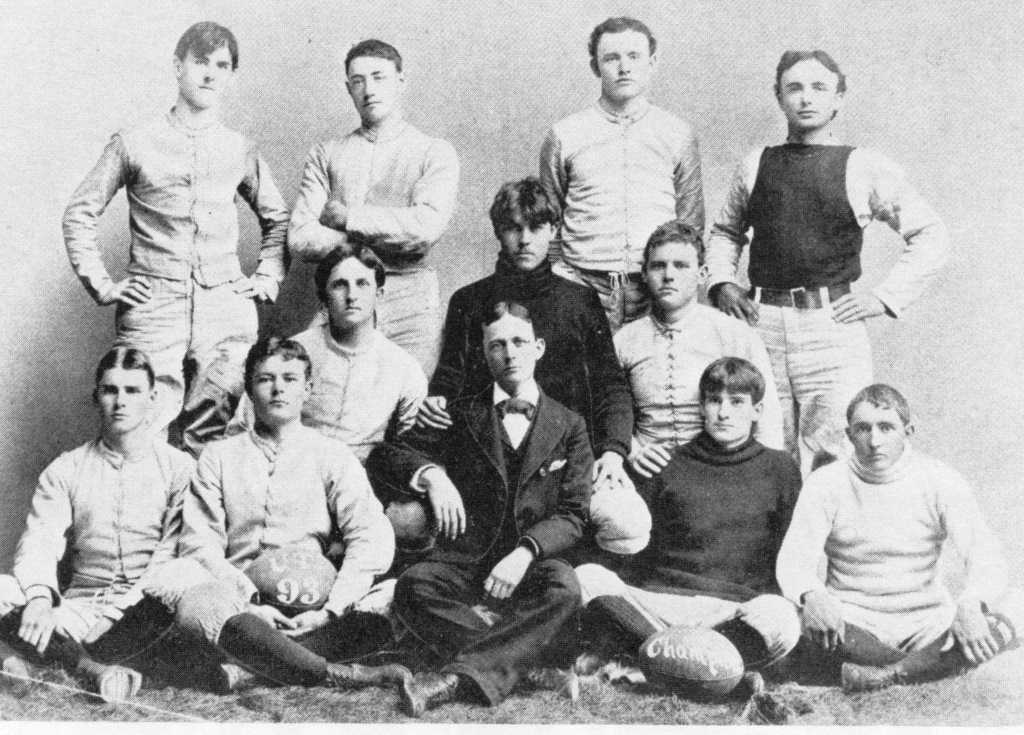
The 1893 UT Football Team

This fall, the University of Texas fields its 120th “official” football team. In the 1880s and 1890s, the new sport of football – an Americanized version of English rugby – was already immensely popular along the East Coast. At the time, the “Big Three” college teams: Harvard, Princeton, and Yale, were closely followed by newspapers and magazines, and the annual Princeton vs. Yale game on Thanksgiving Day was so well-attended, it had to be played on neutral turf in New York City before 40,000 – 50,000 fans.

In Texas, football had a rougher beginning. When the University first opened in the fall of 1883, students in Austin were aware of the sport. In early December of that year, perhaps inspired by the news reports of the Princeton – Yale game, a few UT students put together a makeshift team, but there weren’t any opponents available for a game. Fortunately, a member of the UT squad was working as a part-time tutor for students at the Bickler School, a private high school which held its classes in a building just west of the Capitol. A game between the two schools was proposed and accepted, and about a week later the University of Texas played the Bickler School on a field near the present day Blanton Museum of Art. While neither team could brag about its football prowess, the Bickler team fared better, and outscored UT two goals to none. The game was immortalized in a poem printed in the inaugural edition of the Cactus Yearbook in 1894.

But after the defeat, football at the University of Texas was decidedly unpopular. For the next decade, students would sporadically play intramural football one year, and ignore it the next. It wasn’t until the fall of 1893, as the sport continued to become more well-known in the state, that the University finally fielded its first “official” squad.

The opening game was against the undefeated and favored Dallas Football Club on their field on Thanksgiving Day, 1893. In front of 1,500 fans, and dressed in black and white uniforms with gold caps, the UT squad pulled off the upset. “Our name is pants and our glory has departed,” moaned The Dallas Morning News. There still weren’t too many opponents available, so the team only played four games: the Dallas Football Club and the San Antonio Football Club in the fall . . . and, well, the San Antonio Football Club and the Dallas Football Club the following spring. But the UT team won all four games and staked its claim as the best in Texas.

Photo: The 1893 UT football team.

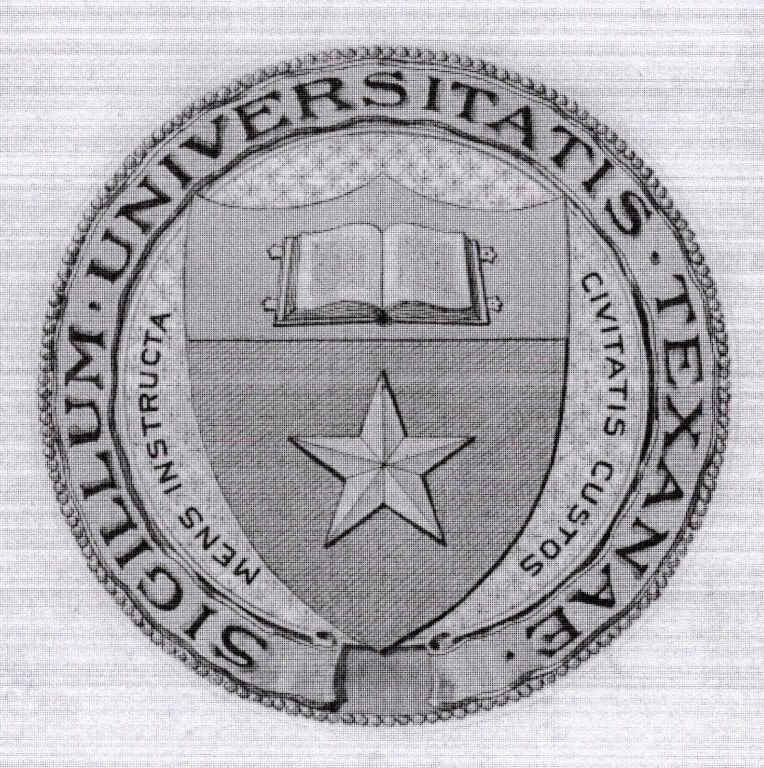
The University of Texas Seal

University of Texas Seal

Go to any UT library, pull a book off the shelf, open the front cover, and you’ll find it. Run afoul of the University police (well, hopefully not!), and you’ll see it on the shoulder patches of their uniforms. Stroll into the Gregory Gym annex and you can see it inlaid on the floor. It’s printed on every UT degree, carved in limestone on campus buildings, and displayed prominently on the Main Building for commencement. It’s the official seal of the University of Texas.

What we think of as the modern university made its first appearance in 12th century Europe as a well-organized union of teachers and students. It was an “academic guild,” similar in many ways to the trade guilds that were an important part of medieval towns. An aspiring tradesman would learn his craft first as an apprentice, and progress to a journeyman. When he had fully developed his skills, his final test was to produce a “masterpiece,” usually an object that showed his best skills and all that he had learned. If it passed inspection, he was declared a master tradesman by his peers and allowed to teach others. Academic degrees grew out of this same process. But instead of a masterpiece, a modern-day Ph.D. candidate writes a doctoral dissertation and defends their thesis in front of a faculty committee.

From the beginning, academic insignia and dress were an integral part of university culture. Congregations, lectures, examinations, and graduations all included ritual words, objects, music, and required forms of dress. A scepter or mace carried by the rector identified him as the leader of a university, graduating doctors often received gold rings with their degrees, and hooded capes, which evolved into the modern cap and gown, were worn to identify university members to the public, with special colors and designs for both students and teachers.

The most prized symbol of a university was its seal. Only granted by a pope or monarch, the seal officially recognized a university as a corporation that could conduct legal affairs, and whose members had special rights and privileges different from ordinary townsfolk. The seal was so valuable, often the original carving was kept in a special chest with a triple lock, and several university authorities were required to be present to open it.

Early university seals were usually intricate, elaborate designs: a student at a desk reading a book, the rector in academic garb holding a mace, or an image of a saint special to the university. A Latin inscription, the “motto,” was almost always included, and was sometimes considered the most important part of the design. Later, as knights were permitted to have seals that resembled their personal shields, university seals began to sport coats of arms of their own.

In November 1881, the newly-appointed Board of Regents of the University of Texas convened in Austin for its inaugural meeting. Among the many items on the agenda, a sub-committee of the Board was asked to create a seal for the university. They completed their task in a single afternoon.

The original UT seal borrowed liberally from the seal of the State of Texas, with a five pointed star framed on the left by an oak branch, representing strength, and on the right by an olive branch, signifying peace. Placed within a circle, Universitas Texana labeled the seal as belonging to the University, with the motto Non Sine Pulvera Palma. A well-known Latin phrase, the motto may be translated as, “The prize cannot be won without effort,” or in more modern terms, “Do your best.”

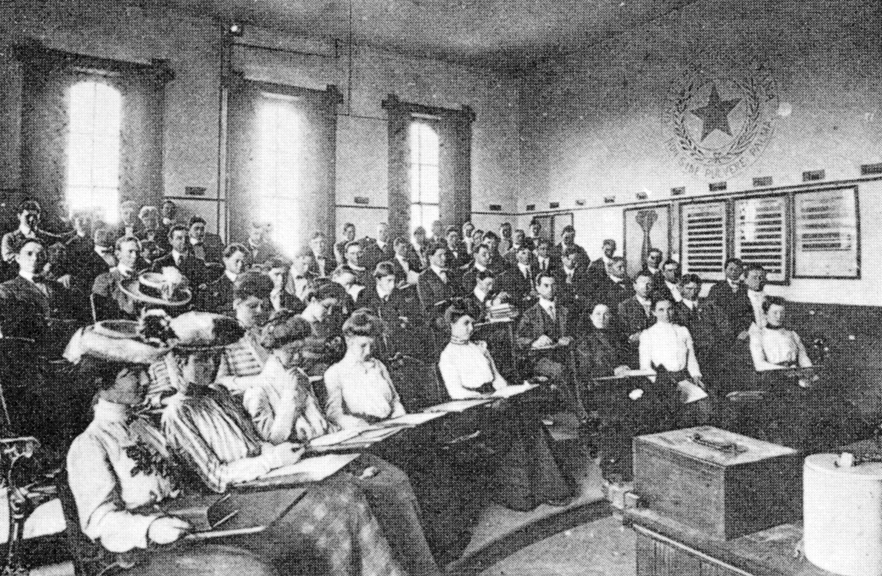
Money was set aside to purchase an embossing stamp, but the University seal wasn’t very popular. Its use limited to decorating degrees and a few other official documents, though a mural of the seal was painted on the wall of the history lecture room in the old Main Building. (See photo above, on the wall to the right. Click on the image for a larger version, and did you notice that all of the co-eds sit toward the front?).

In 1901, Dr. William Battle, a well-known and popular professor of Greek on the Forty Acres, took it upon himself to design a new, more distinctive seal for the University. He may have been prompted by the 1900 vote by students and alumni to recognize orange and white as UT’s official colors, and thought the time was right. Of the original seal, Battle declared, “Except for the word Universitas, it might just as well have been the emblem of the State Penitentiary.”

Battle was thorough. He purchased books on heraldry, and requested copies of seals from universities across the U.S. as well as from Oxford and Cambridge in England. At his own expense,Battle hired a leading firm in heraldic design – the Bailey, Banks and Biddle Company of Philadelphia– as consultants and to sketch prototypes according to his directions.

The process went through several versions, all of which are still preserved in the UT archives at the Dolph Briscoe Center for American History. Battle himself changed the motto to Republic of Texas President Mirabeau B. Lamar’s famous quote, “A cultivated mind is the guardian genius of democracy,” which at the time regularly appeared on the inside covers of most University publications. Battle’s Latin translation of Lamar was Mens Instructa Civitatis Custos, but this sounded a bit clunky. Instead, Battle conferred with friend and colleague Dr. Edwin Fay, head of UT’s Latin Department, who suggested, Disciplina Praesidium Civitatis.

In its final version,Battle described the University seal:

“In conformity with general usage, the design adopts as its central feature the shield form that shows the origin of its heraldic arms. The shield is divided into two fields, the upper white, the lower orange, the University colors. In the lower and larger field are the historic wreath and star of the Great Seal of the State of Texas; in the upper field is an open book, fit symbol of an institution of learning. The shield rests within a circle of blue, the color of sincerity, containing the motto, Disciplina Praesidium Civitatis. This is Professor Edwin W. Fay’s rendering of the apothegm of President Mirabeau B. Lamar, “Cultivated mind is the guardian genius of democracy. Around the disk of blue is a larger disc of red, color of strength, bearing the words, Sigillum Universitatis Texanae.

Battle presented his seal to UT President William Prather in 1903. Two years later, on October 31, 1905, the Board of Regents officially approved Battle’s proposal, though the words, Sigillum Universitatis Texanae, were changed to the English, “Seal of the University of Texas.” Within a year, the new seal appeared on library bookplates, invitations and programs of University events, and, of course, diplomas.

Images: The Seal of The University of Texas at Austin; Seal of the University of Bologna, Italy, among the earliest of European universities; the history lecture room in the old Main Building, from the 1900 Cactus yearbook; an early version of the UT seal, found in the William J. Battle Papers, Dolph Briscoe Center for American History.

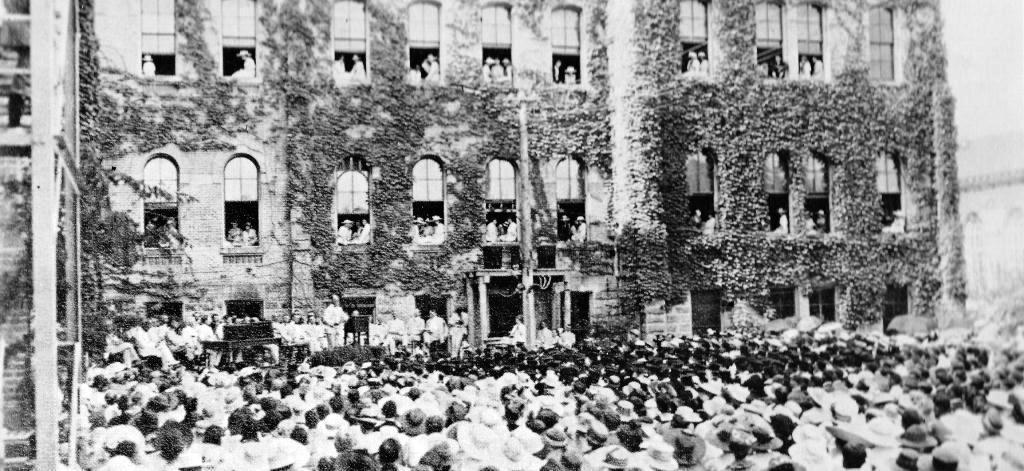
Commencement 1912: No Style for a Texas Sundial

Above: A century ago, Spring Commencement was held on a June morning, on the northwest side of the old Main Building and protected from the early summer sun.

The University’s annual Spring Commencement draws tens of thousands to the Forty Acres. It’s a two-day extravaganza of school, college, and departmental ceremonies all over campus, culminating in a University-wide spectacle Saturday evening in front of the Tower. The deans brag about their schools and colleges, the University President congratulates both graduates and parents on their achievements, and fireworks are launched from the Tower to the delight of everyone.

Though not as grand in scale, the graduation schedule of 1912 was just as packed, and extended over four days in mid-June, starting with a Saturday all-University dance that began early, at 7:30 a.m, to take advantage of the relatively cool temperatures in the morning. A baccalaureate service was held Sunday, followed by Class Day ceremonies Monday morning, which featured the passing of gavels and other symbols of leadership on to next year’s senior class. The alumni association held their annual meeting and luncheon immediately afterward, and divided their ranks into three groups: the “Ancients” were those who had graduated among the University’s first 10 classes, 1884 – 1893; “Mediaevals” finished their degrees between 1894 and 1903; and “Old Timers” designated the rest. Each group had a special ribbon to wear for the week.

The alumni luncheon finished in time for attendees to stroll over to old Clark Field to watch the first-ever baseball game between the current Longhorn team and the alumni. UT grad Will Hogg, son of former Texas governor Jim Hogg (and for whom the Will C. Hogg Building is named), served as celebrity umpire. Coach Billy Disch arranged to borrow “baseball suits” from the local Austin Senators team so the alumni would have a uniform to wear. It didn’t help. Despite the stand-outs on the alumni roster, the Longhorns won the day.

But the day wasn’t yet finished. At 7:30 that evening, a crowd gathered on the campus for the popular student-alumni parade through downtown. Many in the group carried torches or vari-colored Chinese lanterns, and the parade included two brass bands and several floats. “After a thousand torch lights of red and green,” reported the Austin Daily Statesman, “the student body and the old time grads who are visiting, frisked around the campus and back again.” The procession ended on the northwest side of the old Main Building in front of a temporary wooden platform. There, graduating seniors put on vaudville acts, other students offered skits, and held yell leader Teddy Reese lead the group in some UT cheers and songs before the party ended late in the evening.

The official commencement ceremony, Tuesday morning at 10 a.m., was conducted at the same spot as the previous night’s gathering, in the shade behind Old Main. An elegant Final Ball that night at the Driskill Hotel concluded the week’s events.

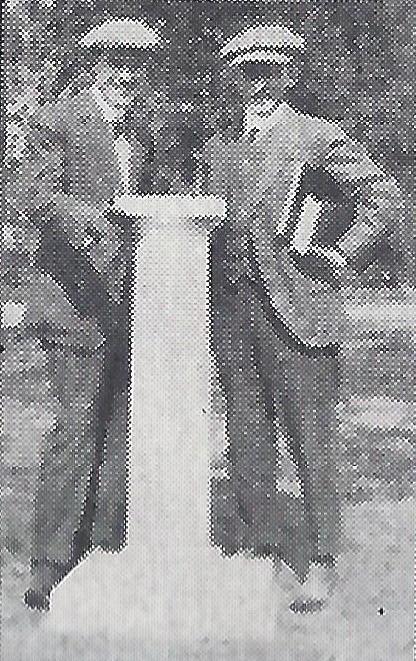
Sprinkled in between the cracks of a hectic schedule were plenty of receptions and other parties, and the formal dedication of a gift to the University from the Academic Class of 1912: a sundial (photo at left). With a marble pillar and a brass plate, it was placed about 100 feet south of the Woman’s Building – the first co-ed residence hall – so that it would have been seen along today’s West Mall.

Unfortunately, the sundial’s style, usually a triangular piece that casts a shadow on to the plate, wasn’t made for Austin’s latitude. “The time of day could not be determined to the nearest hour,” moaned Harry Benedict, then Dean of the Academic Department, “and the time of night could not be determined at all.” This made the sundial’s inscription, “Ye Know Not The Hour,” both redundant and superfluous.

Even worse, within a year, the style was broken off and taken outright, an act that reduced the inscription to being downright hilarious, and prompted accusations from College Station that “Texas has no style.” Despite the heartfelt intentions from the Class of 1912, the poor sundial was quietly removed, and has long since been lost.

Rules for Freshmen . . . in 1908!

A steamy summer has arrived in Austin, and with it comes another orientation season on the UT campus. Starting in June and continuing into mid-July, seven, three-day sessions will attempt to acquaint new students with the inner workings of the University. It’s a daunting task, but UT now provides a wealth of programs to help Greenhorns adapt to life on the Forty Acres. The Gone to Texas convocation held on the night before classes begin in the fall, Freshman Interest Groups (FIGs), Freshman Seminar classes, the Freshman Leadership Organization (FLO), Camp Texas, and more, are intended to support and help new students integrate into the University community.

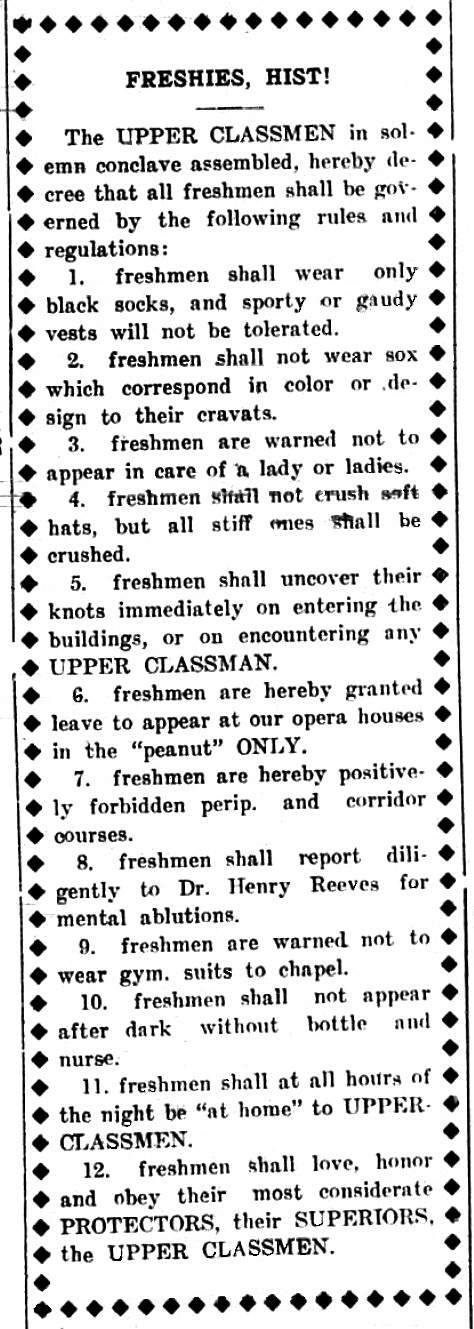
But such was not always the case. The freshman class of 1908 would have perused the Texan student newspaper and discovered a less-than-cheerful set of guidelines penned by some of the upperclassmen. Published in the October 3rd edition, near the start of the fall quarter, were a dozen rules for the male freshmen. (Click on the photo to see a larger version.)

All are silly, and the word “freshmen” is always printed with a small “f”: “freshmen are warned not to wear gym suits to chapel,” or, “freshmen are hereby granted leave to appear in our opera houses in the ‘peanut’ [peanut gallery = back seats] ONLY.”

Most of the guidelines are self-explanatory, but a few might need some explanation.

Rule five: “freshmen shall uncover their knots immediately on entering the buildings, or on encountering any UPPER CLASSMEN.” A knot, in this case, is a head. Freshmen were asked to doff their hats as they went inside, or whenever they met a “higher ranking” upperclassman.

Rule seven: “freshmen are hereby positively forbidden perip. and corridor courses,” refers to the Peripatos, or “Perip” for short, the sidewalk that encircled the Forty Acres. It was a popular activity to stroll the Perip with a date, or follow the Varsity Band on one of its promenade concerts, with stops along the way for dancing and sing-alongs. And the corridors of the old Main Building were the places to meet friends between classes. In short, the rule stated that freshmen shouldn’t be seen at the popular hangouts around campus.

Rule eight: “freshmen shall report dilligently to Dr. Henry Reeves for mental ablutions.” Neither a Ph.D. nor a medical doctor, Henry Reeves was hired on as a custodian for the gymnasium in 1897, and for more than two decades became a popular and valuable assistant to the football team as a self-taught physical trainier. “Doc” Henry patched up injured UT athletes at home and on the road, and was quick to lend a sympathetic ear and offer encouragement and advice to everyone.

After reading the other rules, some freshmen might have been anxious to make an appointment with the friendlier “Dr. Reeves.”

Image from the October 13, 1908 issue of the Texan student newspaper.

Of Regents and Women

Combing through the minutes of the UT Board of Regents can be a tedious process. They’re a great resource for University history, though all too often, what had to be some lively and animated debates are either boiled down to a few dry sentences, or only the final decision was recorded. But sometimes, there’s a peek into the manner and attitudes of the regents, and of their times.

On July 12, 1917, the regents met in Austin to, among other things, meticulously review the University’s budget. The United States had entered World War I the previous April, and the Board was looking to financially trim what it could to help with the war effort. Most salary raises were placed on hold for the duration. Before the war was over, UT would partner with the War Department to host three military schools. The School for Military Aeronautics (SMA) was stationed at the Little Campus. Hargis Hall and the Nowotny Building just north of the Erwin Center are all that’s left of a larger complex. The SMA was called the “West Point of the Air,” and was a prototype for the Air Force Academy. The School of Automobile Mechanics was stationed at Camp Mabry, where instructors included members of the UT faculty. And the School of Radio Operators was located on campus and set up shop in rows of canvas army tents that lined what is today the South Mall.

While meeting in the old Main Building – in an Austin summer and without air conditioning – the regents’ review came to the Department of Home Economics, today’s School of Human Ecology. The department’s proposed budget for the 1917-18 school year was $13,800, most of which went to faculty salaries. (Department chair Mary Gearing was to be paid $3,000.) Two of the regents, John Mathis and William Love, moved to eliminate the department outright. Regent George Littlefield spoke up to defend it, but thought “the salaries were too high for women.” His fellow regents must have agreed. As a compromise, the Board decided to reduce all of the teaching slaries by 20 per cent.

Four years later, Governor Pat Neff appointed Mary McLellan O’Hair as the first woman regent. A vocal supporter of women’s suffrage, and an active member of both the Daughters of the American Revolution and the Daughters of the Republic of Texas, Mrs. O’Hair would likely have had her own opinion on how much women should be paid.

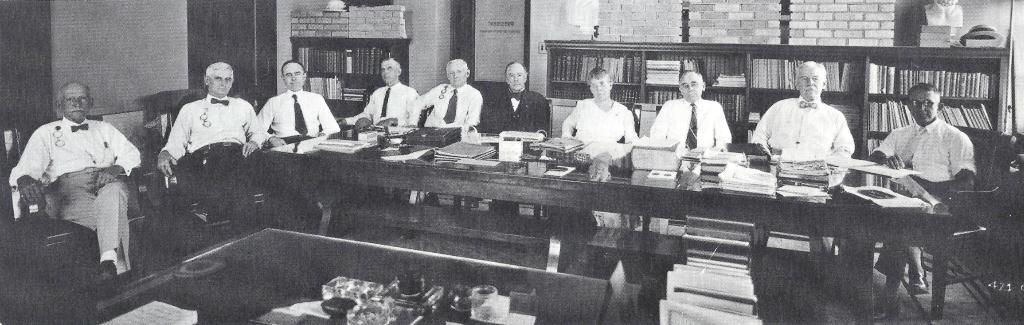
Photo above: The 1923 Board of Regents meets on campus. Mary McLellan O’Hair, the first woman on the Board, is fourth from left. UT President William Sutton is seated on the far left.

UT’s First Gymnasium

The idea of a campus gym is almost as old as the University “We need a gymnasium,” moaned a student editorial in an 1886 issue of the Texas University Magazine. “We want no weak-eyed, stoop-shouldered youths to go forward as a result of University of Texas training. We want to send out no soured cynics, vilely compounded of dyspepsia, acetic acid and classic lore.” When the north wing of the old Main Building was completed in 1889, most of the basement was reserved for storage. Students and faculty alike thought the space might be put to better use.

At their meeting in June 1896, the Board of Regents heard a proposal from law professor Robert Batts to convert the basement into a gymnasium. Given the University’s meager finances, the regents were unsure they could cover the cost of outfitting the basement with locker rooms, showers, and weight training equipment. They also wanted some assurance that if the money were found, the students would indeed utilize the room. In a bargain with the regents arranged by Batts, three students agreed to sign a guarantee for the estimated $500 cost of the weight training “gymnasium apparatus” on behalf of the student body, though whether they had the authority to do so was never actually determined.

But the task of remodeling the basement itself remained an issue, as enough funds simply weren’t available. “The suspense was terrible,” recorded a witness at the meeting, “until a friend of the University volunteered to pay for these preparations.” The unnamed friend was George Brackenridge, a wealthy banker fromSan Antonio who had served on the Board of Regents since 1885. Brackenridge wanted to remain anonymous “because he prefers to give quietly and unostentatiously,” but his identity didn’t remain a secret for long.

Brackenridge contributed $600 to the cause, and the renovation began almost immediately. The ground in the basement was excavated to deepen the floor and create an eleven-foot ceiling, and locker rooms with showers were installed at the north end. The students ordered exercise equipment from the Narragansett Machine Company in Providence, Rhode Island, one of the most popular suppliers of “gymnasium apparatus” in the country at the time.

By November, the gymnasium was ready, and had cost almost $1500 to construct. Completing, and exceeding, their part of the bargain, the students were able to raise $900 to add to Brackenridge’s donation and finish the project. The gym was open to students who joined the newly formed Athletic Association, but as there was only one locker room, men and women were to use the facility at separate times. Part of the dues to the Association, along with a locker fee of one dollar per year, was set aside to pay for new equipment, general maintenance, and a gymnasium superintendent.

Once the gym was opened, however, the regents’ fears were soon realized, as few students took advantage of the facility. The chief reason cited was the lack of a formal gym instructor. By February 1897, the treasury of the Athletic Association was empty, and the gym temporarily closed.

The University took over the facility the next fall term, hired Homer Curtiss as the men’s instructor, reopened the gym, and required male freshmen to enroll in “physical culture” courses. Classes were held twice a week for an hour, either from11am to noon or from 3 to 4pm. Regulation gym clothes consisted of an orange and white striped sleeveless jersey, black tights or shorts, and “tennis slippers.” Sessions usually began with thirty minutes of pulley-weight work or “dumb-bell drill,” some practice on a gymnastics apparatus, a half mile run outside, and finished with a series of deep breathing exercises.

The basement, though, was never an ideal place for a gymnasium, “A large part of the space is taken up by twelve large brick pillars,” grumbled Curtiss. “The presence of these pillars prevents any marching or playing of games and greatly inconveniences the working of the classes.” While the locker facilities and office had a concrete floor, the main room had “a rather damp dirt floor covered with a layer of sand.” There were constant complaints about the air quality, in part because of poor ventilation, and “from the fact that sand is kicked up by the running and jumping.”

A separate gymnasium building was proposed in 1901 (pictured above). With an estimated cost of $25,000, it was to be placed at the southwest corner of 24th Street and Speedway, where the older part of Welch Hall stands today. It would have been just across the street from the University’s new athletic field, and was to contain a larger gym for basketball and seating for fans, an elevated running track, swimming pool, separate locker facilities for students in classes and UT athletic teams, and a trophy room.

While there was interest in the new gym, the Board of Regents had to place academic needs ahead of athletics. An engineering building (built in 1904 and now called the Gebauer Building) and a new home for the law school (completed in 1908, but razed in the 1970s to build the Graduate School of Business building) were higher priorities. A full-fledged gymnasium had to wait almost three decades until Thomas Watt Gregory, an 1885 UT grad who had served as U.S. Attorney General under Woodrow Wilson, chaired a fundraising drive with the Texas Exes to construct  the Texas Union, Hogg Auditorium, and Gregory and Anna Hiss gyms in the 1930s.

Why is UT in Austin?

A statewide election placed UT in Austin. Or was it in Tyler? You decide.

1908 Postcard.Old Main with bluebonnets

On the final day of March, 1881, Governor Oran Roberts signed the bill that formally established the University of Texas. Among its provisions, the campus was to be placed “at such locality as may be determined by a vote of the people.” though it allowed, if the voters chose, to separate the medical department from the main university. Roberts called for a special election on September 6 and declared the city of Austin a candidate. But while the capital city was an acknowledged favorite, history had taught its citizens to be wary of competition.

Above: Austin in 1881. The view up Congress Avenue to the old Capitol building.

Austin was founded in 1839 to serve as the capital of the Republic of Texas, but when Texas joined the Union in 1845, its status as a state capital had been provisional. It wasn’t until 1872, when the city defeated Houston and Waco in a statewide election, that it formally became host to state’s government. In order to win the University, Austinites knew they would have to campaign.

Alexander Penn Wooldridge (known as “A.P.” to friends) was the young and energetic lawyer chosen to lead the Austin effort. Born in New Orleans, educated at Yale and the University of Virginia, Wooldridge arrived in Austin in the 1870s and quickly established himself in social and legal circles. He was the driving force to organize the city’s public education system, chaired the first Austin School Board, and would later serve as Austin’s Mayor. A 14-person committee assisted Wooldridge in the effort.

In early May, the group published an open letter to all Texans in the state’s newspapers and argued that the capital was an ideal place for a University. It was central, granite and limestone quarries existed nearby for university buildings, and students could observe the state’s government in action while acquiring their own education. Even the “healthfulness” of Austin was promoted as “its mortuary report showing the smallest death rate of any city in the South or Southwest.”
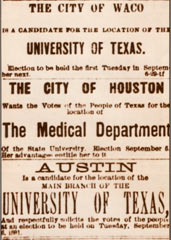
Along with ads in newspapers, Austin promoted itself on bills hung on the walls of county courthouses and post offices, an effective medium at the time. Supporters state-wide sent lists of friends and acquaintances to committee members in order to compile an enormous mailing list.

By June, as the summer sun warmed the state, the temperature of the location debate also began to rise. Along the heavily populated Gulf Coast, Galveston and Houston worked together to convince voters to divide the campus, then competed against each other for the prized medical department. Galveston’s campaign was more aggressive, and it published a letter to voters similar to Austin’s address. As the largest city in Texas at the time, Galveston bragged about its two hospitals where medical students could receive practical experience and “closely watch the progress and treatment of different diseases.” The city already had a small medical school, the Texas Medical College, and its facilities were to be turned over to University. Because Galveston was a port city, it also “boasted” of having a greater variety of illnesses to observe.

Houston’s chief spokesman, State Senator Charles Stewart, countered by pointing out that his city was a major railroad depot, and was therefore subject to a greater number of visitors. “I can safely say,” Stewart crowed, “that there are ten, nay perhaps a hundred railroad travelers to one by ship.” The senator also mentioned the frequency of injuries suffered by railroad workers, and declared it would be “God-giving charity for Texas to locate her University where these men could receive proper care and treatment.” Fortunately for Texas, tourism wasn’t yet a major industry. The contest between Galveston and Houston as to which was the most disease ridden and injury prone wouldn’t have fared well in a vacation brochure.

Among the rivals to Austin, Waco was the most vocal. It also touted a central location and easy access by railroad, along with “cheap and abundant fuel, excellent water,” and its “highest degree of healthfulness.” Waco wasn’t afraid to fire a shot at Austin: “While exempt from the noise, bustle and confusion of a commercial metropolis, Waco is free from the distracting scenes, corrupting influences and fevered excitements of a political capital with its multitudinous temptations to allure the young into paths of vice.” The chair of Waco’s campaign committee was a popular lawyer and former city attorney named William Prather, who would later serve on the Board of Regents, and then was appointed by his colleagues to be the University’s president. President Prather was well-known for ending many of his speeches to students with the phrase, “and always remember, the eyes of Texas are upon you.”

The town of Tyler, about 200 miles northeast of Austin, was another candidate for the main campus. It was ready to contribute the unused ten acres of the defunct Charnwood Institute, and offered its own opinion of the capital city. The Tyler Courier warned not only of the “din of drunken legislators” in Austin, but declared the city’s white limestone buildings were “so blinding to the sight that green goggles are peddled like peanuts upon the streets, and that sore eyes and blindness are the frequent result.” Tyler’s citizens were understandably upset. One of their favorite residents, Governor Roberts, was publicly supporting rival Austin.

Not to be outdone by the larger cities, several small towns also submitted bids to host the University. The Cleburne Chronicle advocated placing the campus at Caddo Peak in north central Johnson County, because it was a “moral place” and far away from the “busy haunts of man – and woman.” Thorp’s Springs, just south of Fort Worth, declared that “no intoxicating liquor will be allowed within four miles of the University,” as soon as it got it.

As its final task, the Austin campaign committee was charged with designing, printing, and distributing the ballots for the election. The committee was aware that most voters in the state favored a separate medical branch, but many of those who supported Austin also wanted the entire University. To complicate matters, Governor Roberts’ proclamation had announced the capital only as a candidate for an undivided campus. This posed a serious problem. Voters who favored a separate medical school might choose a town other than Austin for the main site. If Austin was to receive enough votes for all or part of the University, the ballot had to be skillfully worded.

Wooldridge devised a ballot that presented to the voter all of the possible choices, but was decidedly biased for Austin. Approved by the committee, the ticket read, “For” or “Against” separation of the departments and, “For Austin for the Main Branch.” Blanks were included to write-in a choice for the location of the entire campus, and, if needed, the preferred city for a separate medical department. But to vote for another city for the main branch, the word “Austin” had to be physically marked out and another written in its place. The committee suspected the ballot might upset Houston and Galveston, as it allowed for the possibility of an undivided campus, but hoped Austin’s supporters would be content with the design. Instead, Austinites thought the committee had cleared the way for the separation of the University. No one was satisfied.

As expected, Houston and Galveston cried foul, and charged Austin with selfishness for wanting the entire campus. By early August, rumors reached the capital that an alliance had formed between the gulf cities and Tyler to deny Austin any part of the University if it should, directly or indirectly, oppose a detached medical branch. If the Austin committee’s ballot was used in the election, Houston and Galveston threatened to vote for Tyler for the main campus. Despite the high visibility of the campaign, voter turnout for the special election was expected to be small. The danger of a coalition against Austin was real.

The Austin committee sought a legal interpretation as to the form of the ballot and tabulating procedures, and addressed an inquiry to the State Canvassing Board. The Board consisted of Governor Roberts, Attorney General James McLeary, and Secretary of State Thomas Bowman.

On August 19th, the Board released its opinion, which was a lengthy and divided one. Roberts and Bowman concurred, while McLeary dissented. McLeary argued that if separation won, votes for an undivided campus should be ignored. Roberts and Bowman declared that if the voters opted to separate the medical branch, the votes cast for both the main branch and the entire university would be counted, and the city with the largest combined total would win the main branch.

Turnout for the election on September 6th was indeed sparse. Less than eighteen percent of eligible voters cast ballots. When the results were announced, Austin was declared the winner of the main branch and Galveston the seat of the medical school. Out of 56,480 votes, 38,117 were in favor of division to 18,363 against. Austin received 16,306 votes for the main branch and 14,607 for the entire university, for a combined total of 30,913. Tyler was second with 18,420 votes for the main branch, but acquired only 554 for the entire campus, for a sum of 18,974. Galveston and Houston had remained true to their word. If the canvassing board had dismissed the ballots for an undivided campus, the University’s main branch would have been located in Tyler.
Happy Birthday to the Eyes of Texas

Yesterday was the 109th anniversary of the first performance of The Eyes of Texas. Written by John Lang Sinclair and Lewis Johnson, the song poked fun at UT President William Prather, who frequently ended his speeches to students with the phrase, “and always remember, the eyes of Texas are upon you.” It was also a two-year project for Johnson, who wanted a song that University of Texas students could call their own. A more complete history of the origins of the Eyes is here.

Photo above: The scribbled original version of The Eyes of Texas (not the one sung today) written by Sinclair on a piece of brown laundry paper. It is currently on display in the Alumni Center.

Welcome!

Welcome to the UT History Blog, a place to explore the history and traditions of the University of Texas. This has been a longstanding interest of mine – “a hobby that got out of control” – and I enjoy sharing what I’ve discovered. As this site develops, you’ll find links to other articles about the University’s history, and what I hope will be a helpful guide for those who want to do some research of their own. Questions, comments and suggestions are all welcome.

As a disclaimer, please note that this is not an “official” publication of the University of Texas. The writings and opinions are my own.

Jim

Photo above: “Old Main” in spring. The Victorian Gothic old Main Building was the first on the campus, and stood where the current Main Building and Tower are today. And yes, the campus was a sea of bluebonnets in the spring.