1954: The Cactus in Sound

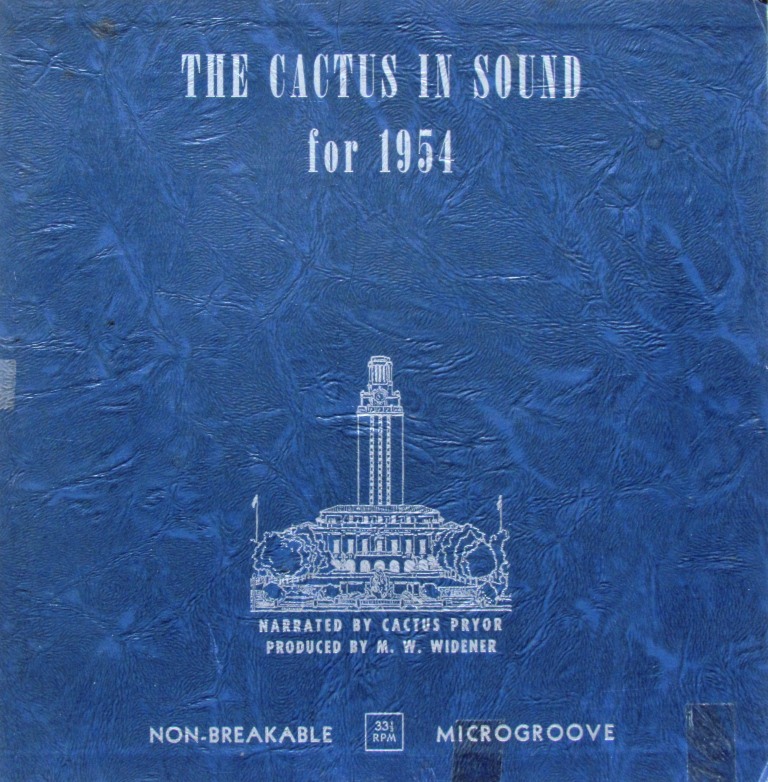
the-cactus-in-sound-album-cover

Above: The Cactus in Sound for 1953 – 1954. Listen here.

In 1953, the Cactus yearbook staff decided to try an experiment. Instead of documenting the academic year only through photographs, what if the Cactus created a sound archive as well? The staff recruited Richard “Cactus” Pryor, then a UT alumnus and well-known humorist and radio personality, to serve as narrator, and promptly set out to record some of the highlights of the school year.

A formal album – an “audio yearbook” –  was produced and sold for $6.00, but the recording wasn’t as popular as the staff had hoped. The 1954 edition was the only one. Today, though, it provides us with a few precious glimpses of campus life at UT over sixty years ago.

1953-rally-at-kumback-burger

Above: An unofficial football rally staged at Martin’s “Kumback” burger restaurant.

Included on the recording:

  • The first football rally of the 1953-54 school year, held in Gregory Gym. Some of the yells here are no longer heard on the campus.
  • The inauguration speech of Logan Wilson, installed as President of the University of Texas on October 29, 1953.
  • Selections from “Time Staggers On,” an annual musical spoof on campus life that was a popular 25-year UT tradition.
  • Highlights from the annual Round Up weekend, originally a spring homecoming with parties, dances, performances, an elaborate parade through downtown Austin, and the announcement of the UT Sweetheart.
  • The UT Tower chimes play “Home on the Range” and “The Eyes of Texas” before marking the hour at 1 p.m.

Listen to the 1954 Cactus in Sound here!

You can also find it under the “Audio” menu on the UT History Corner.

Happy listening!

Jim

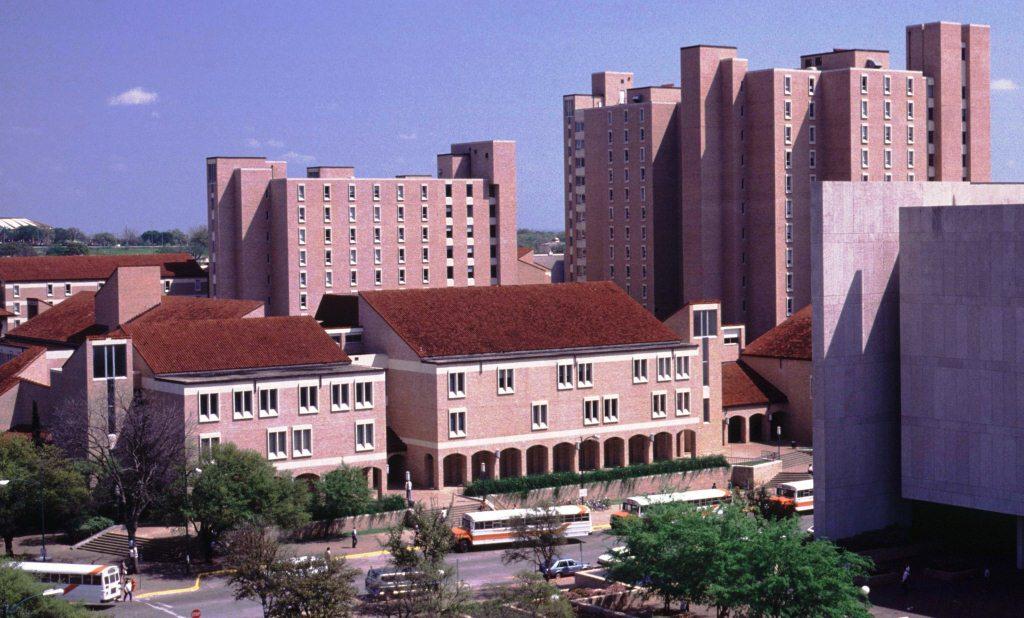
1954-ut-tower-from-mary-gearing-hall

Above: The Main Building and Tower in 1954 as viewed from Mary Gearing Hall. 

Race for the Turkey

duck-turkey-chicken

For Berry Whitaker, the new Director of Intramural Sports for Men, it was to be the start of a new University tradition. A century ago, November 28, 1916, the Tuesday before Thanksgiving, Whitaker organized a special cross-country style two-mile race that started at the men’s gymnasium, went north of campus for a mile along Speedway Street, then doubled back to the finish. The race was open to any boarding house or fraternity that could muster a four-man team, though only the top three finishers would be counted in the overall results.

Instead of medals or trophies, though, the prizes awarded were appropriate for the upcoming holiday. The first place team would receive a Thanksgiving turkey, second place finishers given a chicken, and the third place team was to be awarded a duck. And just to clarify, the prizes weren’t coupons to be redeemed at the local grocery store for pre-processed, smartly packaged frozen fowl. The winning teams would receive live animals to take home and do with as they wished.

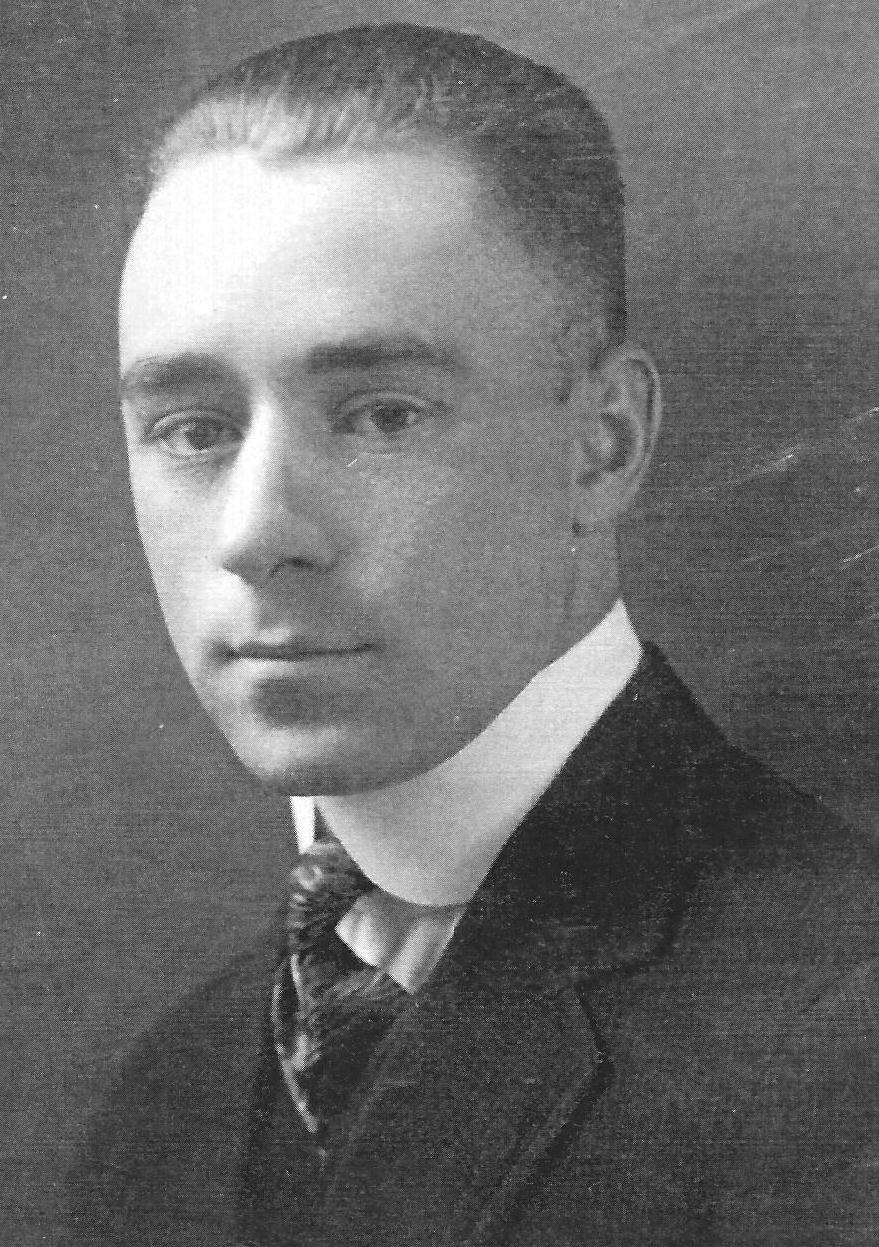
berry-whitakerWhitaker was hired the previous June to be an Instructor of Physical Training and to launch an Intramural Sports program, the third – behind Ohio State and Michigan – on a university campus. For a starting salary of $1,500, he was charged with providing a formal organization and direction to the recreation activities that were mushrooming on the Forty Acres. The inaugural meeting of the student-led Intramural Council on October 6, 1916 is considered the birth of the program, and this year, the Division of Recreational Sports celebrates the centennial.

Above right; Berry Whitaker, the founder of UT’s Intramural Sports program for men. The Whitaker Sports Complex – the intramural fields and tennis courts about 2 1/2 miles north of campus – is named for him.

While the fledgling intramural program included the traditional sports of football, basketball, tennis, and baseball, Whitaker looked for opportunities to involve more students. A turkey race just before Thanksgiving provided something novel, and he hoped it would become an annual event.

dt-1916-11-28-turkeyrace-headlineThe race was announced in The Daily Texan and entries were taken through the Saturday beforehand. In all, eight teams vied for the prized gobbler, including the boarding houses of Mrs. Smith, Mrs. Walker, and Mrs. Hopkins, along with the Phi Kappa Psi, Sigma Chi, Acacia, and Delta Tau Delta fraternities.

On Tuesday afternoon, under partly cloudy skies and with light northern breezes, Whitaker started the race with a starters pistol. University student Roy Henderson volunteered to drive his Model T Ford in front of the runners to clear any traffic. In less than 15 minutes, the heavily favored Mrs. Walker’s boarding house claimed first place, as half of its runners were also on the UT Track Team. Who won the duck and the chicken wasn’t mentioned in the Texan, which by Wednesday was full of stories about the Thanksgiving Homecoming celebrations, the football game against the A&M College, and the upcoming presentation of a steer that would later be named Bevo.

As for the turkey race, the 1916 version was the only one. The United States entered the First World War the following April, and most campus activities were directed toward the war effort. Whitaker, along with UT Athletic Director Theo Bellmont, enlisted in the U. S. Army. When peace was achieved in November 1918, Whitaker returned to Austin only to be drafted as an assistant football coach in 1919, and then promoted to UT head football coach the following year, all while still managing the Intramural Sports program. Whitaker retired from coaching in 1922 (with an admirable three-year 22-3-1 record), but never tried to revive the Thanksgiving turkey race.

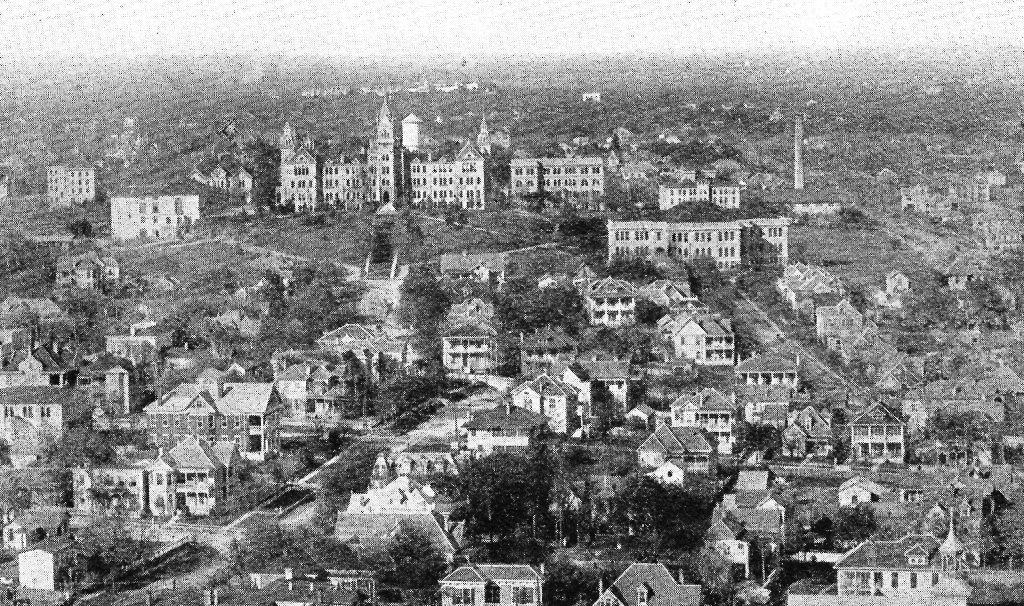
1916ut-campus-from-capitol-dome

Above: The UT campus in 1916, with the old Main Building, as seen from the Texas Capitol dome. 

Garrison Hall is 90!

garrison-hall-1926

Above: Garrison Hall, just before it was opened in 1926.

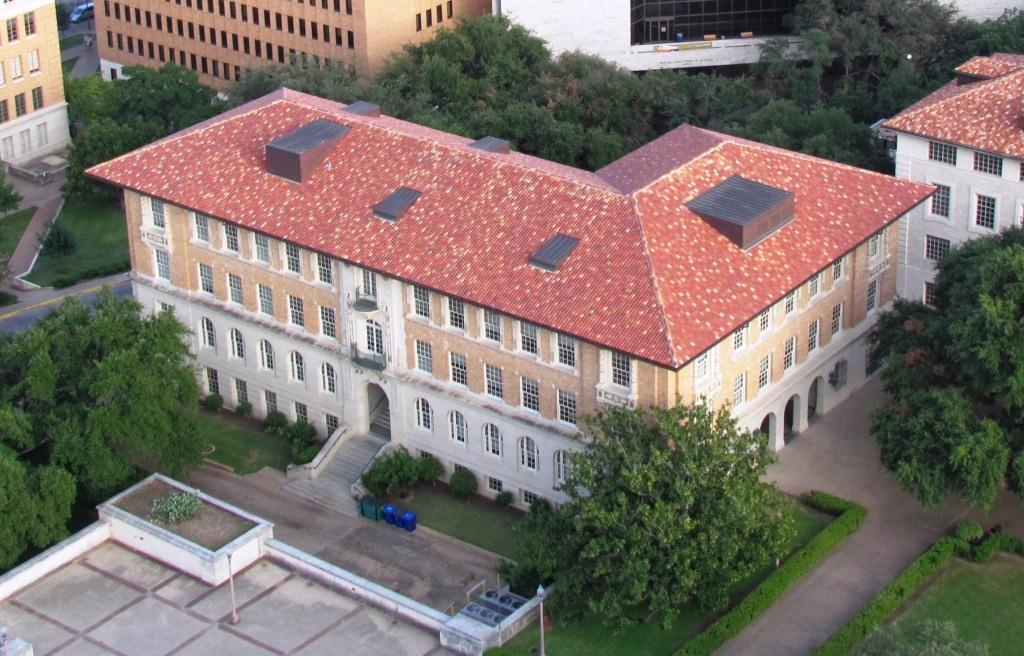
This year, Garrison Hall is 90 years old. Nestled in the southeast corner of the Main Mall, peeking out from behind a canopy of live oaks, the building is often overlooked in favor of its better-known neighbors, Battle Hall and the UT Tower. But Garrison Hall is an architectural gem with a distinctive history, a treasure on the campus for those who take the time to explore it.

~~~~~~~~~~

ut-campus-1920

Above: The University of Texas campus from University Avenue, circa 1920. 

In 1921, a crowded and growing University of Texas first acquired land beyond its original forty acres. A bill passed by the Texas Legislature and signed by Governor Pat Neff purchased property to the east and southeast. The campus tripled in size, and extended past Waller Creek.

The following year, the Board of Regents appointed Herbert Greene of Dallas as the University Architect. Greene succeeded Cass Gilbert, who had designed Battle and Sutton Halls, but because he was based in New York City, was a victim of mounting political pressure to have an in-state architect for the University. Greene was highly respected as a building designer, but his experience in campus planning was limited. In 1923, the regents recruited James White, an architecture professor at the University of Illinois, as the consulting architect who would provide an overall campus master plan.

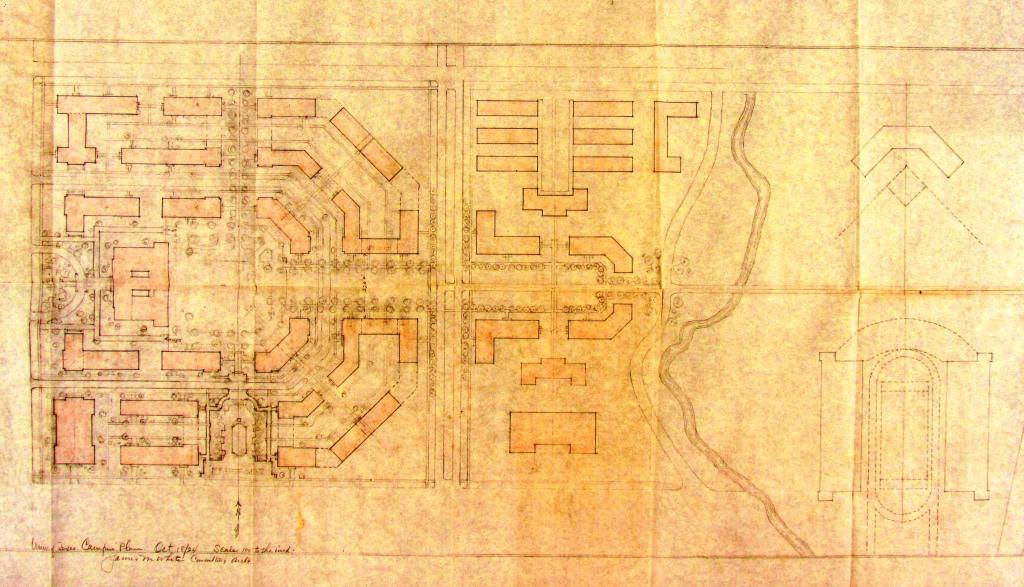
White submitted his first campus scheme in fall of 1924. Eager to take advantage of the long, gently sloping hill that extended east into the new portion of the campus, White proposed a significant re-orientation of the campus, to face east instead of south toward downtown Austin, and designed a single mall, 175 feet wide, that connected the crest of the hill at the center of the Forty Acres – where the old Main Building stood and where the Tower is today – with Waller Creek at the bottom of the slope. Campus structures were arranged in a series of concentric rings that spread outward from the hilltop.

1924-10-18-john-white-ut-campus-master-plan

Above: John White’s 1924 campus master plan, which would have emphasized an east-west orientation. On the left, Battle Hall would have been enlarged and become the focus of a large square, while a broad East Mall would have continued down the hill to the right toward Waller Creek. The football stadium is at the bottom right. Below: The future position of Garrison Hall is circled. It was changed to an L-shaped building to help define the edge of the central square and the East Mall. Click on an image for a larger version.

1924-white-campus-plan-garrison-hall-placementWhite envisioned the University Library (today’s Battle Hall) as the focus of the campus, removed the Old Main Building entirely, and replaced it with a large square plaza, 450 feet long on each side. The library was to be enlarged so that its façade was roughly three times the length of the original building, and would be centered on the plaza’s west side. Across the plaza on the east end, two buildings were planted as part of the first concentric ring and also intended to visually define the width of the mall.

Surprisingly, the Faculty Building Committee, the University President and the Board of Regents all approved this radical new design, with a few important alterations. The two buildings immediately to the east of the central plaza, instead of being part of a circle, were retooled as L-shaped structures. One was to be placed near the southeast corner of the plaza and face the library; its north-south wing would define the limit of the plaza, while it east-west wing would define the boundary of the mall. As its counterpart, another L-shaped building was intended to be near the northeast corner of the plaza.

Once White’s campus plan was ratified, the regents declared a new classroom building (and a new home for the history department) its top priority, and directed the building planned for the southeast corner of the plaza to be constructed first.

garrison-hall-from-ut-tower-deck

Above: Garrison Hall seen from the UT Tower observation deck. 

Almost immediately, though, the administration began to have second thoughts. William Battle, Chair of the Faculty Building Committee, wrote to White, “The University has been facing Austin and the Capitol so long that it would not be easy to abandon this front even if it were thought desirable.” Within a year, the regents concurred, rescinded their decision, and asked White to try again. But the process for the new structure was well underway, and rather than wait for a new scheme, construction was allowed to continue. The building’s odd placement – it doesn’t line up with the entrance to Battle Hall or the flagpoles on the Main Mall – would be an issue for future campus planners.

~~~~~~~~~~

view-from-garrison-hall-1920sOpened in 1926 at a cost of $370,000, Garrison Hall was host to a collage of academic departments; English, government, psychology, sociology, philosophy, economics and history initially shared the facility, though the building was really always intended for history, and the other departments have since found lodgings elsewhere on campus. The building’s namesake, George P. Garrison, joined the University faculty in 1884, served as the first chair of the history department, and was a founding member of the Texas State Historical Association.

Above: The 1920s view of the campus from the north side of Garrison Hall. Old Main is on the right, with the library (Battle Hall) across the mall. Click on image for a larger version.

1925-garrison-hall-cornerstone-ceremonyThe cornerstone, as with the cornerstones of most of the buildings on the Forty Acres, is hollow, something like a permanently sealed time capsule. Among the objects placed inside: a 1925 Cactus yearbook; a catalog, course schedule, and student directory for the 1925-26 academic year; an alumni directory, copies of The Daily Texan; a souvenir “Book of Views” of the University; a source book on the history of Texas; and articles and letters authored by George Garrison.

Right: Images from the cornerstone ceremony in December 1925.

Along with its unusual location, Garrison’s ornamentation also represented a departure from earlier UT buildings. Classical icons adorn architect Cass Gilbert’s Battle and Sutton Halls. Owls, an ancient symbol of Athena, the Goddess of Wisdom, were placed under the eaves of Battle Hall, while Sutton Hall was decorated with scallop shells, emblematic of Venus, the Goddess of Truth and Beauty.

garrison-hall-longhorn-skull

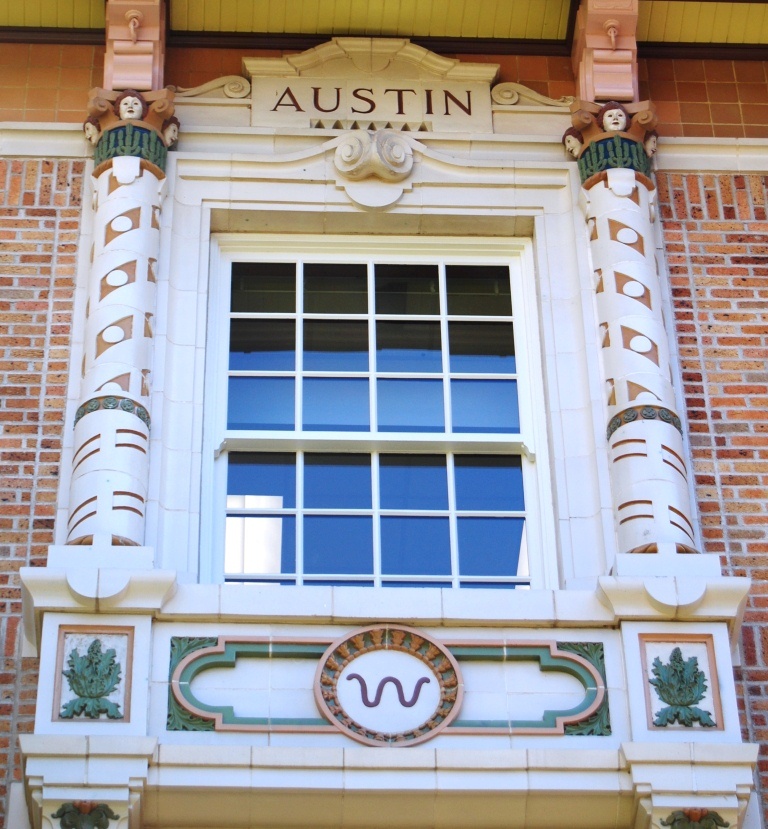
garrison-hall-austin-windowGarrison Hall continued the same Mediterranean motif of Gilbert’s designs, constructed of Lauder limestone quarried from France, multi-colored bricks similar to Sutton Hall, and a red-tile roof imported from Spain. Its ornamentation, though, is unmistakably “Texan.” Limestone carvings of longhorn skulls, along with terra-cotta cacti and bluebonnets decorate the entrances. Imprinted below the eaves and corner windows are the names of founders of the Republic of Texas, among them: Houston, Austin, Burnet, Jones, Travis, and Lamar.

Above: The names of the founders of the Republic of Texas appear on the building, along with 32 cattle brands. Here is the “W” of the King Ranch.

Most striking are the 32 terra-cotta cattle brands, carefully chosen among hundreds of candidates, to represent various periods of the cattle industry in the State of Texas. Garrison Hall is the only college building anywhere to have cattle brands on its outer walls. The unusual choice received national press while the building was under construction.

garrison-hall-cattle-brands-st-louis-times-dispatch

Above: The inclusion of terra-cotta cattle brands on a college building to mark the history of the Texas cattle industry received national press. This is a clipping from the Saint Louis Times-Dispatch.

The idea came from Dr. William Battle, then chair of the Faculty Building Committee. Though he was, ironically, a professor of Greek and Classical Civilization, Battle claimed not to be “stuck on” classical icons for UT buildings, and suggested the use of images that pertained to the academic departments housed inside them.

garrison-hall-linoleum-tileInside, more than 3,500 square feet of linoleum tile was used in the extra-wide hallways. Greene advocated using “battleship green,” but Battle was concerned that the color wouldn’t hide the dirt, scuffing, and general wear as well, and preferred brown. In the end, a compromise was reached, and both colors were used. Rooms were equipped with ceiling fans, and a modern water cooling system was installed for the drinking fountains to make the un-air conditioned building bearable in the warmer months.

~~~~~~~~~~

garrison-hall-1930s

Once opened, the broad arched doorway on the north side of the building soon attracted a population of bats, and the attention of Goldwin Goldsmith, then the head of UT’s Department of Architecture and for whom Goldsmith Hall is named. A brief letter exchange between Goldsmith and Battle, found in the University Archives, reads:

October 28, 1931

To: Dr. William Battle, Chairman, Faculty Building Committee

Dear Dr. Battle:

I noticed that the north entrance to Garrison Hall is a harboring place for bats. It is evident to the senses of both sight and smell.

Goldwin Goldsmith

~~~~~

November 8, 1931

My dear Goldsmith:

Thanks for your letter about bats. I do not see how to protect entrances from these loathsome creatures, but Miss Gearing tells me that the Comptroller’s office has an excellent way of dealing with them. It is apparently by using fire extinguishing apparatus.

Yours very truly,

W.J. Battle

~~~~~~~~~~

Paul CretPaul Cret (photo at right), appointed in 1930 to replace James White as consulting architect, developed his own campus master plan, which included the Main Building and Tower, and attempted to resolve the issue of Garrison Hall’s placement. Born in Lyon, France and trained at the Ecole des Beaux-Arts in Paris, Cret has immigrated to the United States and oversaw the architecture school at the University of Pennsylvania when he was hired by UT. With an emphasis of straight lines and balanced masses, he placed the flagpoles on the Main Mall to line up with the entrance of Battle Hall.

To anticipate future growth, Cret suggested adding wings to existing structures, rather than construct new buildings in open areas that might disturb the layout of the campus. Garrison Hall was included in the idea. Though not implemented (at least, not yet), Cret envisioned a north wing to Garrison Hall that would allow its main entrance to be re-positioned where it would still be in the center of the front façade, and also line up with Battle Hall.

paul-cret-1933-master-plan-1

Above: A bird’s eye view of Paul Cret’s campus plan, with a close-up of the Main Mall. To plan ahead for growth, Cret advocated adding wings to the W.C. Hogg Building and Garrison Hall. This wouldn’t disturb the overall plan – actually, it better defined the start of the East Mall – but the wing to Garrison would also allow the front door to be moved to the north and centered with Battle Hall and the flag poles.

Below: A closer look at the W. C. Hogg Building on the left with a wing extending south, and Garrison Hall on the right with an addition to the north and its front entrance relocated.

cret-campus-plan-garrison-hall

Source: Detail from 1933 University of Texas Perspective of Future Development, The University of Texas Buildings Collection, The Alexander Architectural Archive, The University of Texas Libraries, The University of Texas at Austin

garrison_hall-burnet

Moonlight Prowl on October 14th

moonlight-prowl-oct-14-2016

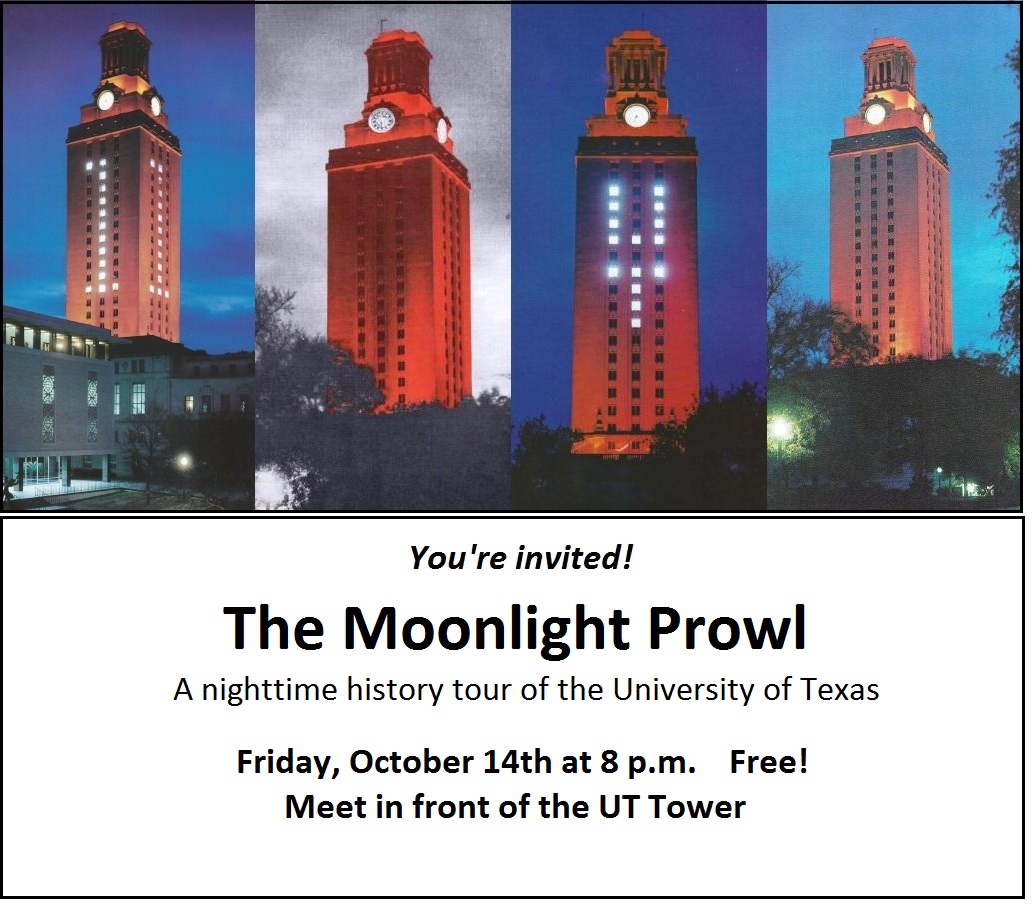
It’s been a busy fall semester for the Moonlight Prowl. Eight tours were held in September, including a group of 130 students and parents who gathered for a Prowl during UT’s Family Weekend. Several more are set for October.

The next “all-comers” Prowl – open to anyone interested – is scheduled for this Friday, October 14th, the night before the Texas vs. Iowa State football game. We’ll gather on the Main Mall in front of the Tower at 8 p.m.

For all the particulars, see the Moonlight Prowl information page.

RSVPs are appreciated, but not required. You can send me a quick note here, or RSVP via a Facebook event.

The weather forecast is for partly cloudy skies, and it’ll only be two days before the full moon. A great night to wander the campus and discuss some UT history!

Hope to see you October 14th,

Jim


Old Main.1910s.Postcard.2.

Above: The University’s old Main Building, where the Tower stands today.

The Inscription

main-building-quote

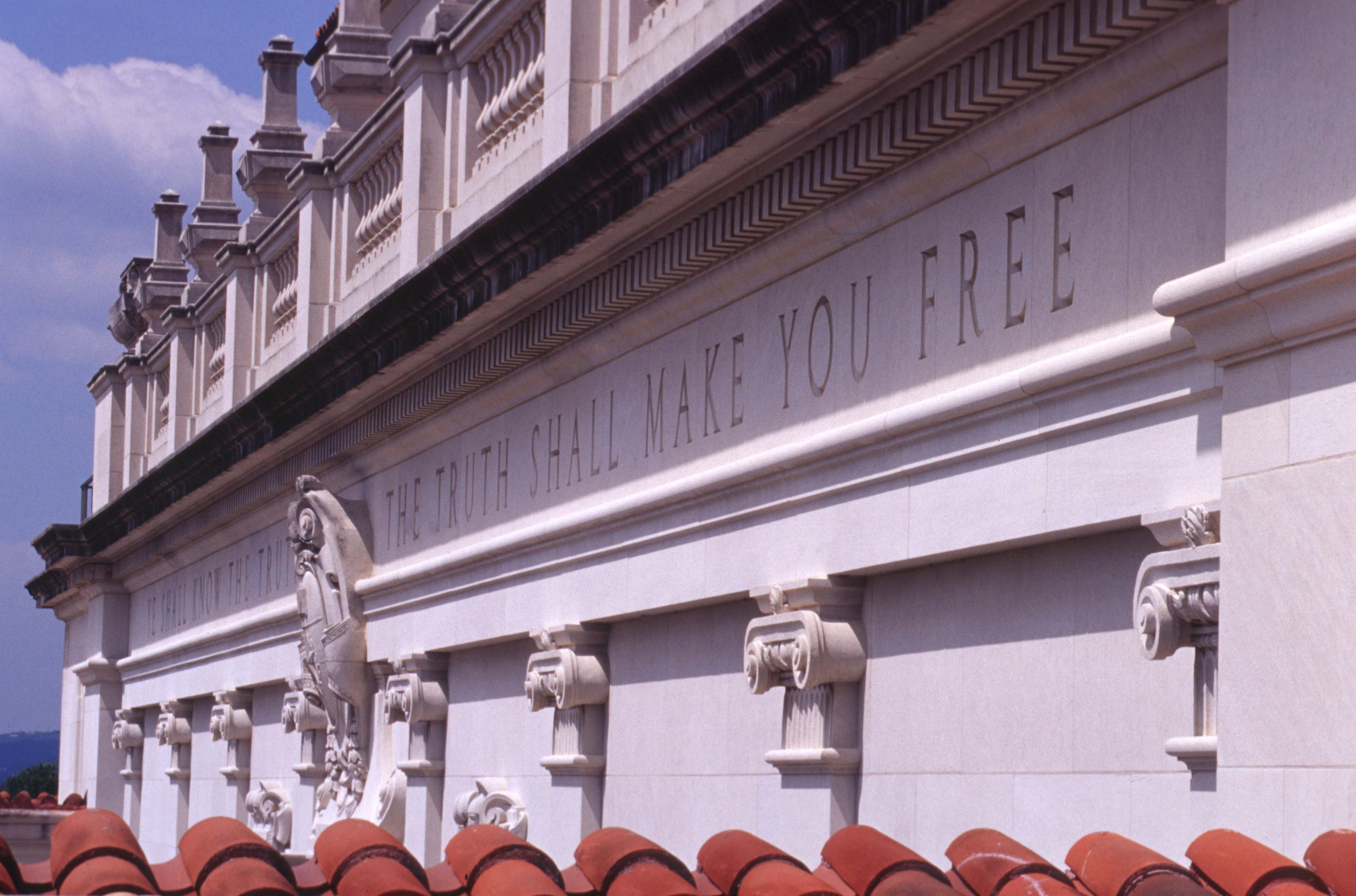
Above: Perhaps the most-read inscription on the University of Texas campus, “Ye shall know the truth and the truth shall make you free,” above the entrance to the Main Building.

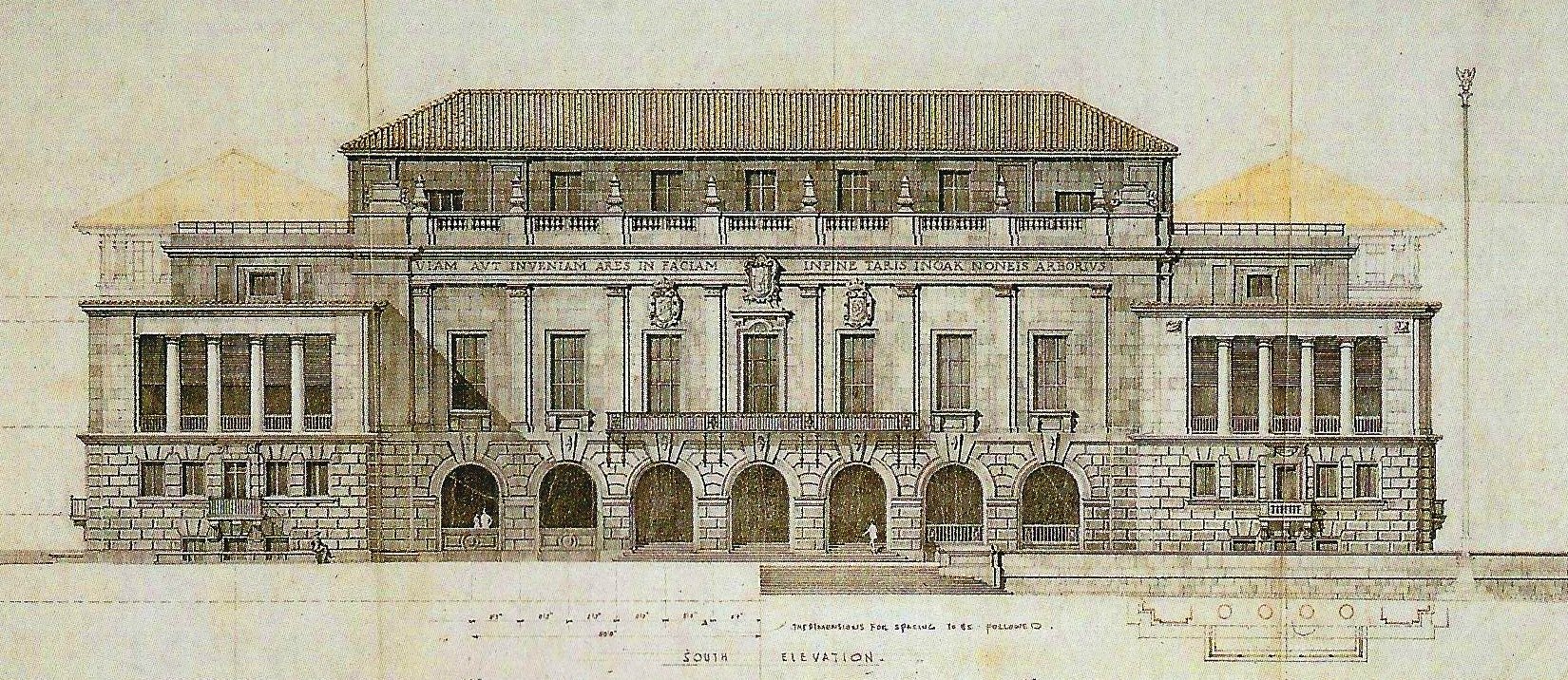
After much rumination,” wrote Dr. William Battle on April 10, 1935, “I suggest the following as an appropriate inscription for the front of New Library.” Battle chaired the Faculty Building Committee, and as the construction of the Main Building and Tower – which would serve as the University Library – was well underway, the committee needed to make decisions about some of the ornamentation. Specifically, the text for the signature engraving that would adorn the south façade of the building.

The choice was overdue. “I wrote you some time ago about the inscriptions for the Administration-Library building,” prodded architect Paul Cret the previous December, “and to determine the size of the letters, joining of the stones, etc., we need the ne varietur text of the frieze inscription of the south elevation.” The ne varietur, or “not to be altered” script could be up to 108 letters and spaces in length, either one sentence or two, though as the design called for the inscription to be divided by a rendering of the University seal in the middle, Cret advised that it would be “difficult to find two suitable sentences of the same length. We feel that a single sentence gives more leeway.”

main-building-facade

Above: The south elevation of the Main Building, designed by architect Paul Cret. Click on the image for a larger version. Source is listed below.

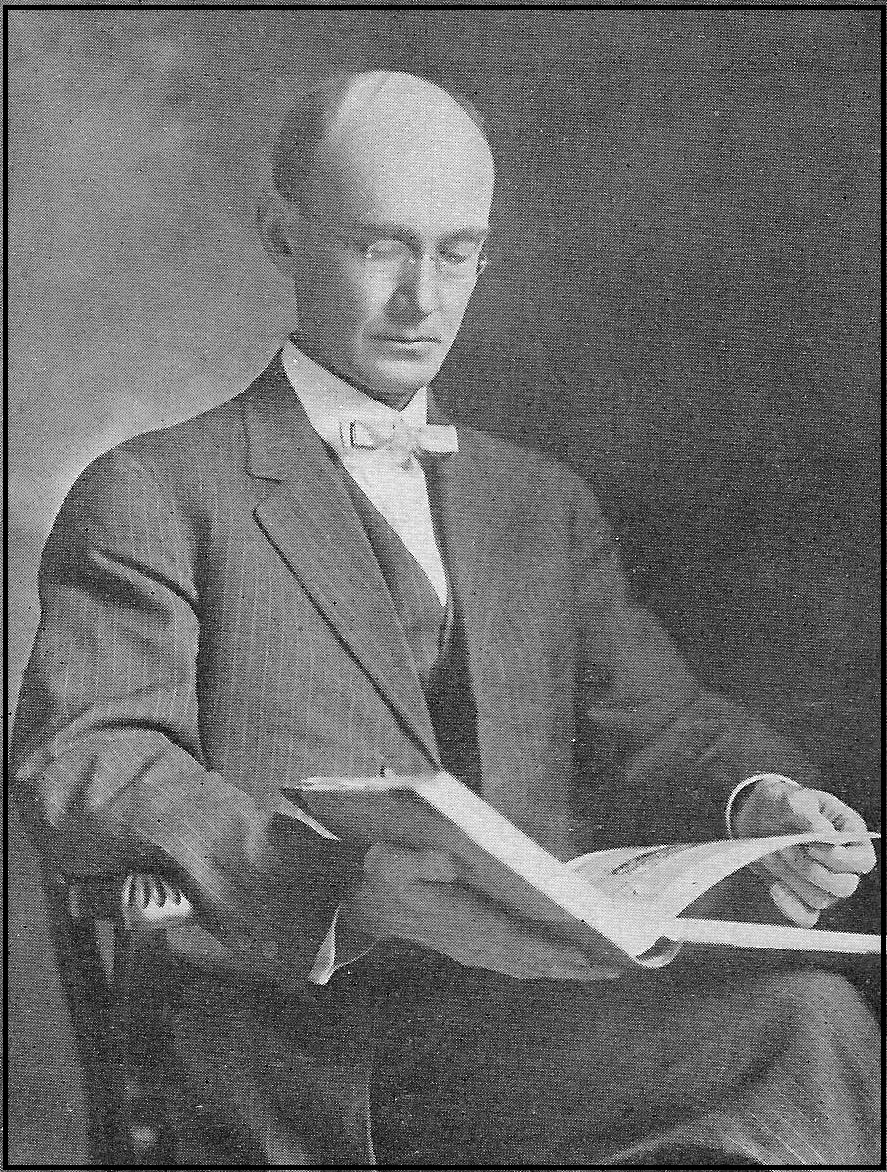
william-battleBattle, who had joined the faculty as a professor of Greek and classical studies in 1893, was highly respected on the Forty Acres. He’d served as Dean of the University (today’s Office of the Provost) and Acting President, created the UT seal, founded the University Co-op, and initiated a campus directory. His greatest contribution, though, was to chair the Faculty Building Committee from 1920 – 1948. Battle’s lifelong interest in architecture was almost as great as his fascination with Ancient Greece and Rome, and he took great care to ensure that the design of the campus and its buildings were both appropriate to their setting in Texas, and reflected the high aspirations of the University. When considering the text of the primary inscription on what was intended to be the iconic building of the University of Texas, Battle was not to be rushed.

His suggestion was:

“The records of the past shall give light and courage to them that come after.”

As Battle explained, “This seems to me to really convey the purpose of the Library and what should be its result. The words carry a formal, rather stately manner suggested obviously in the King James version of the Bible.” The sentence was Battle’s own creation, not a biblical quote, and he hoped it would evoke a similar gravitas. “The locution ‘them that come after’ by its ancient flavor ought to stick in the memory,” Battle explained.

The proposal garnered a less-than-enthusiastic response from the committee, but Battle had such stature and influence on the campus that many on the committee were reluctant to voice their opinions directly. Instead, they asked fellow committee member John Calhoun for help.

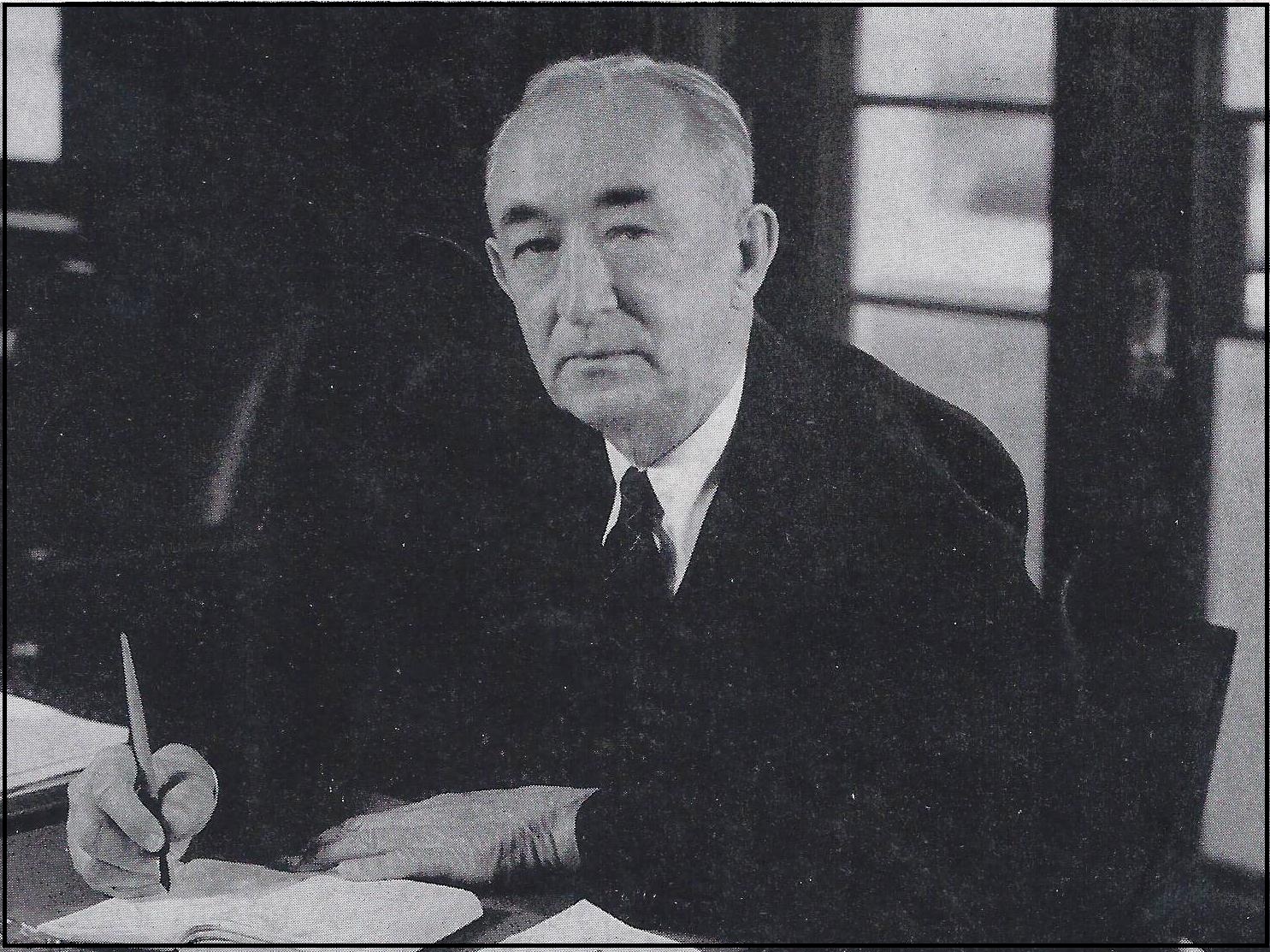
john-calhounA longtime friend and trusted colleague, Calhoun was a UT graduate who joined the mathematics faculty in 1909, was appointed the University’s comptroller in 1925, and later served as president ad interim. With a passion for oak trees, Calhoun was primarily responsible for the planting of live oaks around the perimeter of the Forty Acres, along the South Mall, and elsewhere on the campus. In the 1950s, he created a valuable detailed map of every campus tree and its history, still used by UT’s Office of Landscape Services. Calhoun Hall on the South Mall is named for him.

Calhoun penned a tactful letter to Battle. “After pondering for some little time over your suggested inscription,” he wrote, “I have tried my hand a little to see whether or not there might be some slight change made, keeping the idea, which I think excellent, intact. The reason that I think some change might be considered is the fact that in your inscription you say that ‘records’ shall give ‘light’, and while records are frequently enlightening it seemed to me that the metaphor is a little strained.”

Calhoun offered a few variations:

  • “The light of the past shall guide the feet and strengthen the hearts of them that come after.”
  • “The light from the past shall guide and hearten them that come after.”
  • “The light of experience is the guide and inspiration of the future.”
  • “Light of past ages shall illuminate the paths of the future.”

Battle appreciated the feedback, but was rather attached to his initial idea. He acquiesced a little and changed the phrase “shall give light and courage” to “shall bring light and courage,” but that was as much as he was willing to concede. In an effort to bring Battle around, Calhoun provided an alternative, “Ye shall know the truth and the truth shall set you free,” found in the Book of John in the Bible. The suggestion wasn’t meant to be a religious message; Calhoun simply thought it was an appropriate description of University students engaged with the library.

A month passed before Battle returned to the topic. “Had we not better be reaching some conclusion as to the inscription on the front of the Library?” he wrote the committee on May 14th. “It seems highly appropriate for the inscription to indicate the character of the building as a library.”

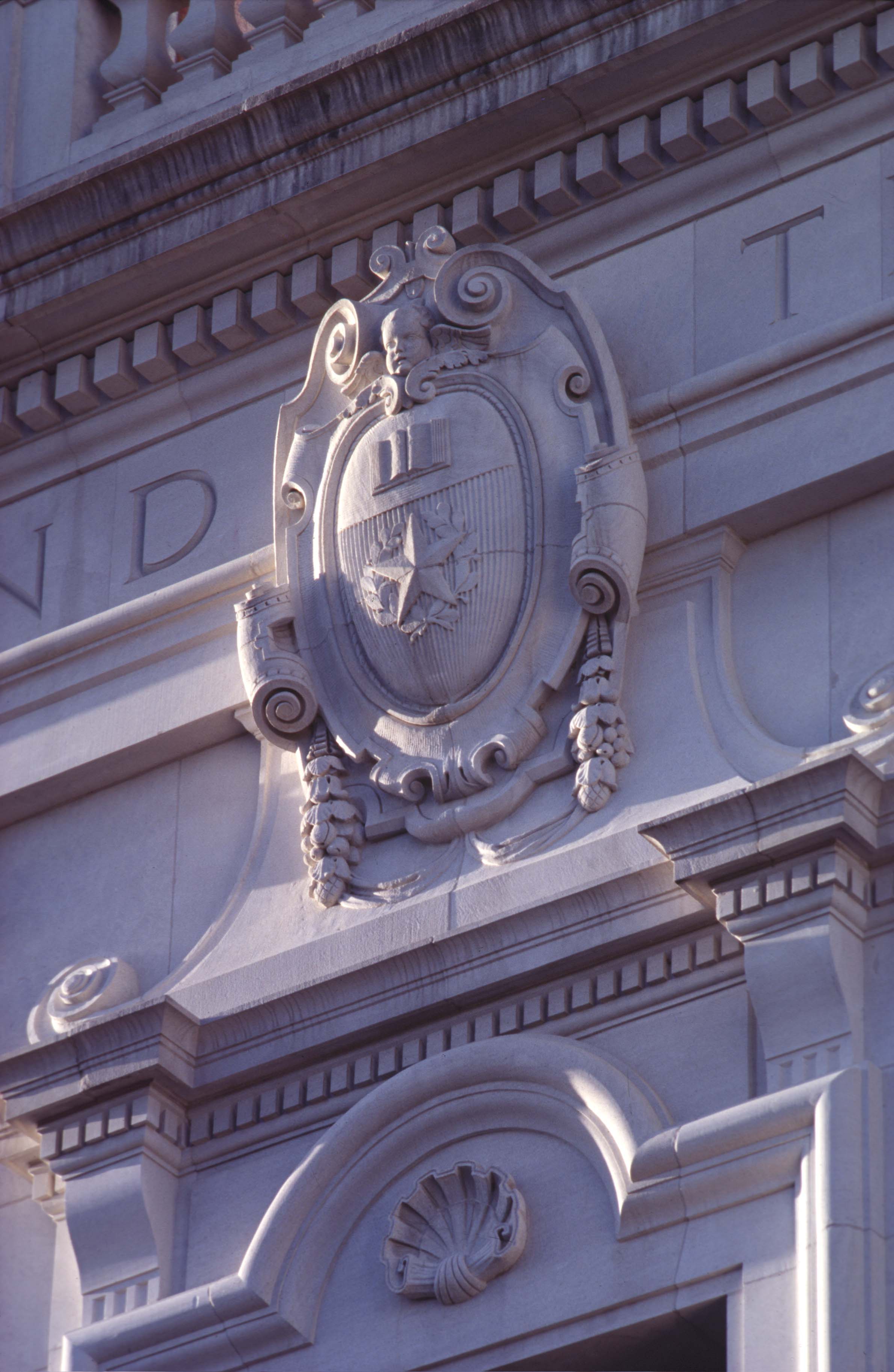
ut-seal-main-building-south-facadeBattle repeated his initial submission, but partially conceded,” I still think my first suggestion good, but I am not sure if the second is not after all preferable: Ye shall know the truth and the truth shall make you free, or, “Cognoscetis Veritatem et veritas liberabit vos.” The last was a Latin translation.

Battle continued, “Truth and freedom are so essentially the foundation of education, character, and progress that the injunction to seek truth as a means to freedom is as splendid a call to youth as we can make. Its form is perfect, its source is not a drawback, and it has the weight of nearly two thousand years acceptation.”

The biblical quote was brief, inspiring, and easily understood. And from a practical angle, it was composed of two clauses and twelve words, which fit well for the elevation design.

The committee met May 20, 1935 to make a decision. Battle handed each member a sheet of paper with three choices, though from the wording he seemed to still be encouraging his initial creation. The page read:

“W. J. Battle’s suggestion for the Library front inscription:

The records of the past shall bring light and courage to them that come after

Another suggestion:

Ye shall know the truth and the truth shall make you free

Or better:

Cognoscetis Veritatem et veritas liberabit vos

In the end, the committee favored the English version from the Book of John. With UT President Harry Benedict’s support, the Board of Regents gave its official approval on September 28th.

main-building-inscription-view-from-east

Source for Paul Cret drawing: Main Building and Library extension, Comm. 282, sk. no. 36, Paul Philippe Cret Drawings – Copyright held by H2L2 Architects/Planners, The Alexander Architectural Archives, The University of Texas Libraries, The University of Texas at Austin.

Shakespeare-palooza!

A century ago, the University went all out to celebrate William Shakespeare.
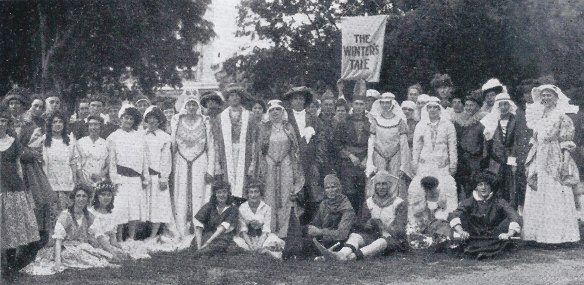
Shakespeare Tercentery.The Winters Tale

Above: UT students portray characters from The Winters Tale for a campus-wide Shakespeare pageant.
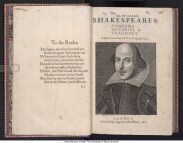
 Shakespeare.1623 Folio.Harry Ransom CenterForsooth! This year marks the 400th anniversary of the death of William Shakespeare. For the occasion, the University’s Harry Ransom Center presented a special exhibit of its extensive Shakespeare collection, including three copies of the 1623 First Folio (left), considered by many to be the most important collection of English literature ever published.

On the anniversary date – Saturday, April 23rd – the UT campus was relatively quiet. There were no ceremonies to honor William Shakespeare. No speeches, parades, songs, dances, revels, or plays performed to remember the Bard from Stratford. That might sound a little over the top, but a century ago, the entire University community turned the 300th anniversary, the Shakespeare Tercentenary, into a five day Shakespeare-palooza.

~~~~~~~~~~

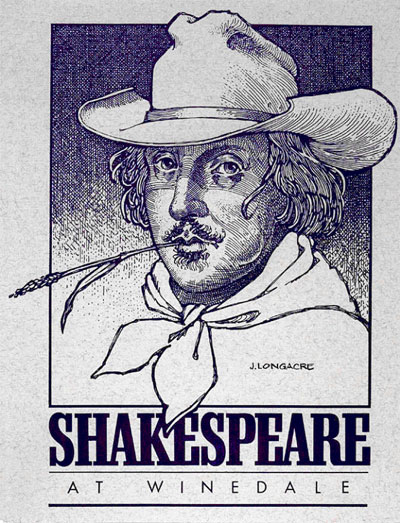
Shakespeare at WinedaleMention Shakespeare and the University of Texas in the same sentence and the conversation inevitably turns to the Shakespeare at Winedale program. Begun in 1970 as a summer class by English professor James Ayers on the premise that the best way to explore Shakespeare’s plays is to perform them, the program has grown into a year-round effort that reaches students from elementary school through college. Most performances still take place in a now iconic nineteenth-century barn at the Winedale Historical Complex east of Austin, in the tiny town of Round Top. Though it’s an unlikely setting, both students and audiences alike swelter through the Texas summer heat to immerse themselves in Shakespeare’s works.
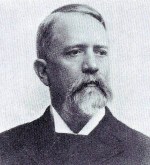
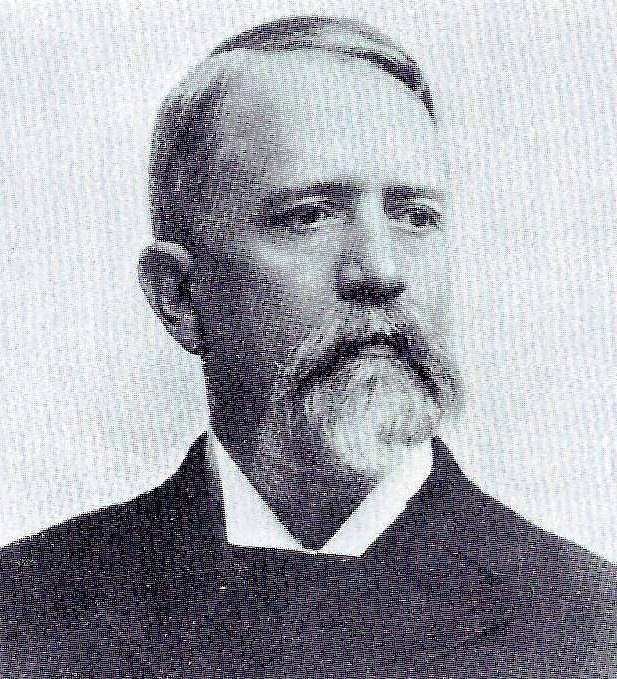
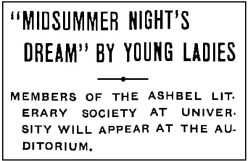
Leslie WaggenerThe Bard, though, has long been a welcome figure on the Forty Acres. Leslie Waggener (photo at left), one of the University’s original eight professors and a longtime Chair of the Faculty, inspired students in his English classes to organize a Shakespearean Club in 1885, during UT’s third academic year. When time allowed, he often presented lectures about Shakespeare to appreciative audiences across the state. “People who went to the opera house last night were entertained far beyond their most sanguine hopes,” gushed the Fort Worth Gazette about a talk Waggener delivered in 1887. AAS.1905 headlineInternationally known Shakespeare scholar Mark Liddell taught at UT in the late 1890s and mesmerized students with his occasional in-class performances. Liddell published an essay titled “Botching Shakespeare” in the October, 1898 Atlantic Monthly that’s still referenced in the current debate over whether to translate Shakespeare’s plays into modern English. In 1905, the Ashbel Literary Society, a ladies-only student organization, surprised everyone with a performance of A Curtain Club Logo.1909Mid-Summer Night’s Dream that featured an all-female cast, a reversal from Shakespeare’s time when women were prevented from appearing on stage and all of the roles were played by men. The show was such a hit, the Ashbel staged As You Like It the following year. In 1909, the Curtain Club was founded as the University’s first formal dramatic association. It was named for the Curtain Theater, one of several commercial stages – along with the Globe – that were operating in London during Shakespeare’s career.
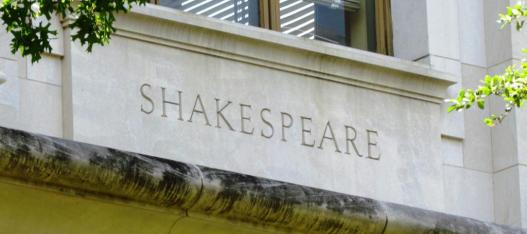
Shakespeare on Main Building

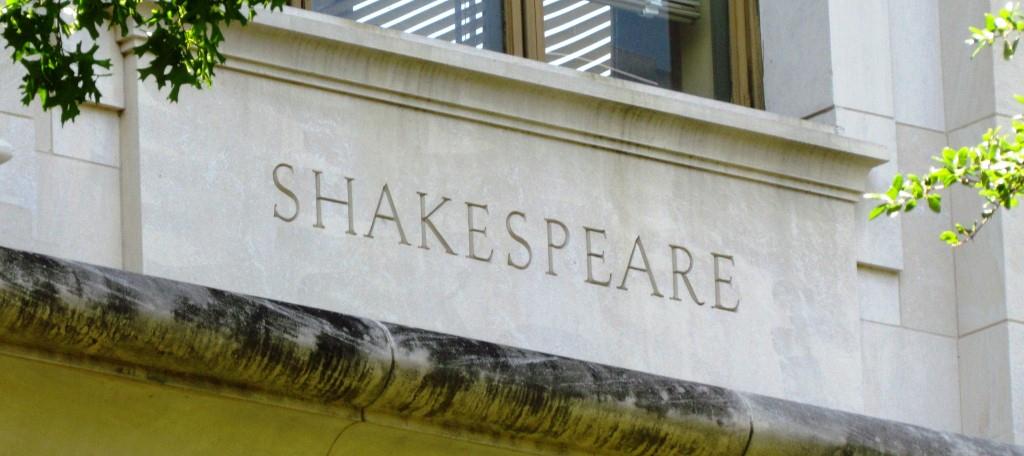
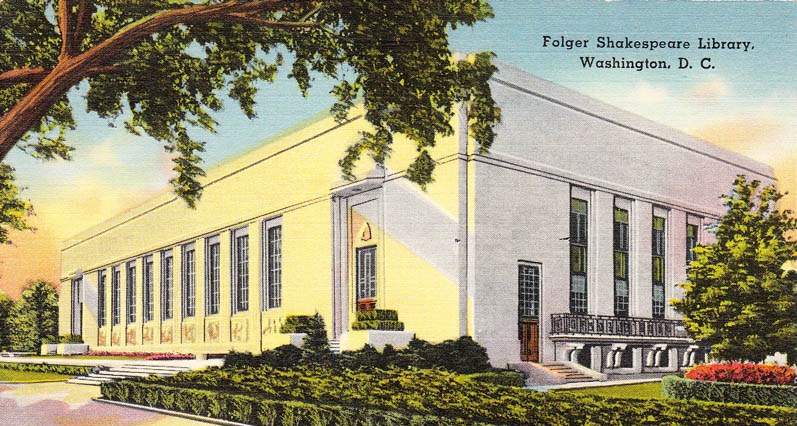
Today, “Shakespeare” adorns the University’s Main Building. Constructed in the 1930s to serve as the central library, the names of fourteen literary giants – Aristotle, Homer, Cervantes, Moliere, and Mark Twain, among them – were symbolically engraved in limestone along the east and west walls. Shakespeare was placed in the northeast corner. And, just in case more UT-Shakespeare connections were needed, Paul Cret, the architect of the Main Building and Tower, was also the designer of the Folger Shakespeare Library in Washington, D.C.  Cret was finishing his plans for the Shakespeare Library just as the University hired him to be its consulting architect.
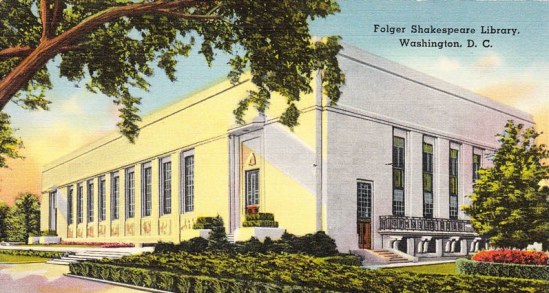
Folger Shakerspeare Library

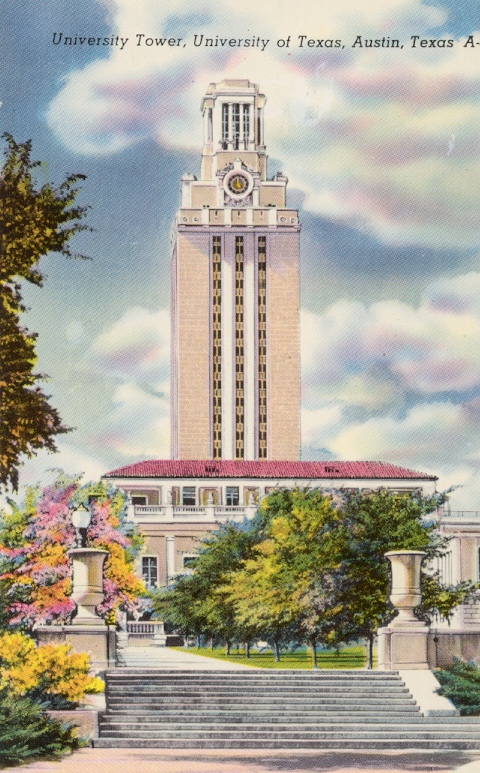
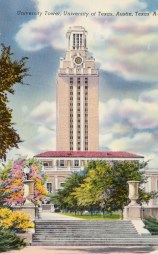
SouthMallColorAbove and left: Two buildings which share the same architect. In 1928, oil magnate Henry Folger hired Paul Cret, then head of the architecture school at the University of Pennsylvania, to design a library and theater in Washington, D.C. to make Folger’s extensive collection of rare Shakespeareana available to the public. Two years later, as Cret was finishing the project and construction was about to begin, the University of Texas appointed him as its consulting architect. Cret completed his campus master plan for UT – which included the Main Building and Tower – in 1933, the same year the Folger Shakespeare Library opened. Click on an image for a larger view.

~~~~~~~~~~
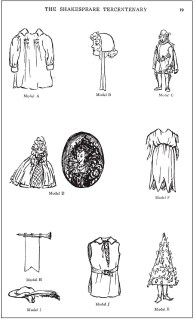
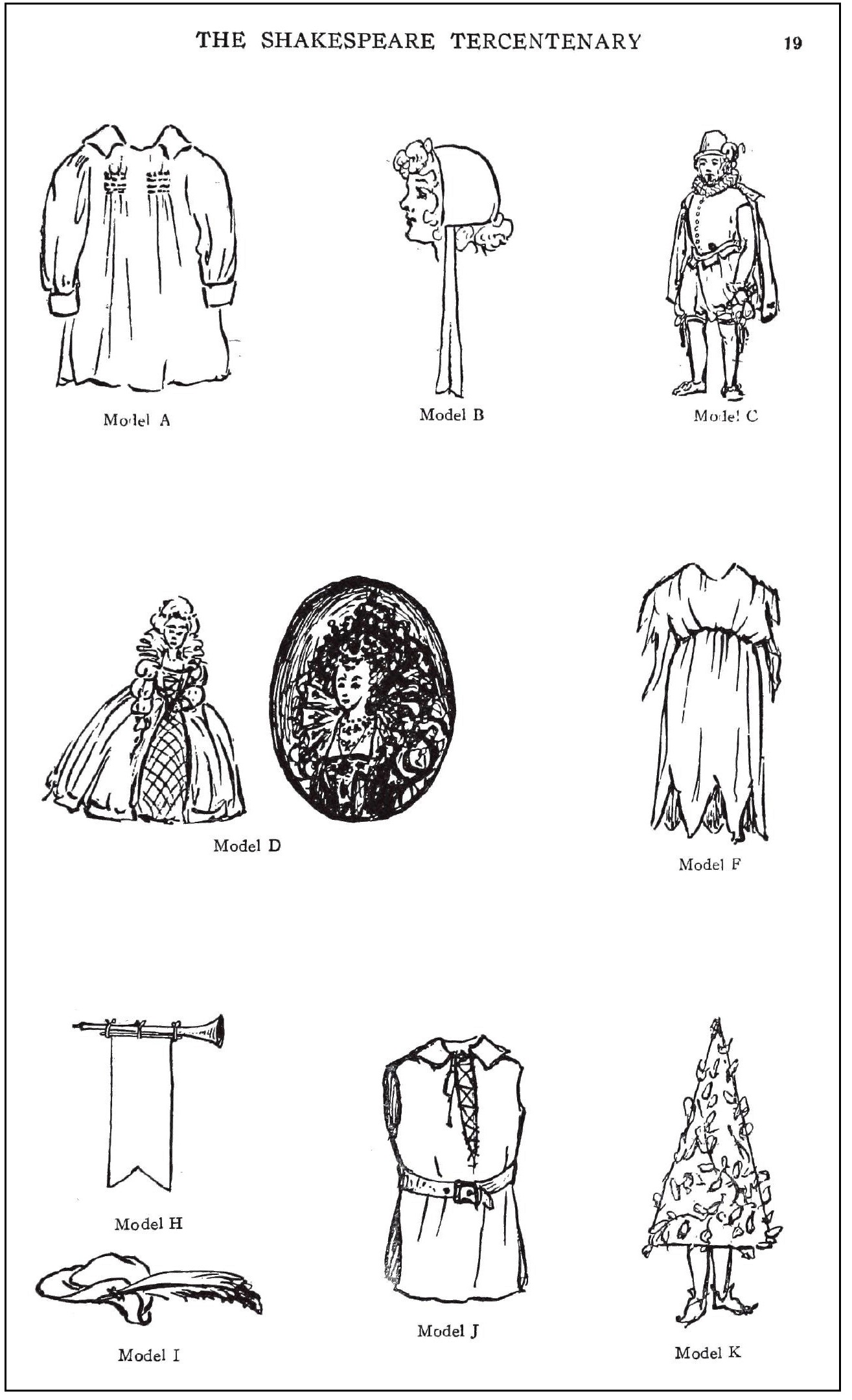
Drama League of America.PamphletIn 1914, at its annual conference in Chicago, the Drama League of America discussed the upcoming 300th anniversary of Shakespeare’s death in 1916 and voted to bring about   “a great national Shakespeare Tercentenary Celebration.” The group didn’t have the resources to coordinate a single, coast-to-coast effort. Instead, it encouraged local events organized by communities, schools, and colleges. It held press conferences, contacted civic organizations, and published pamphlets filled with ideas for parades, day-long Shakespeare festivals, music and steps to old English dances, and ideas for easily-made Elizabethan costumes (image at right).

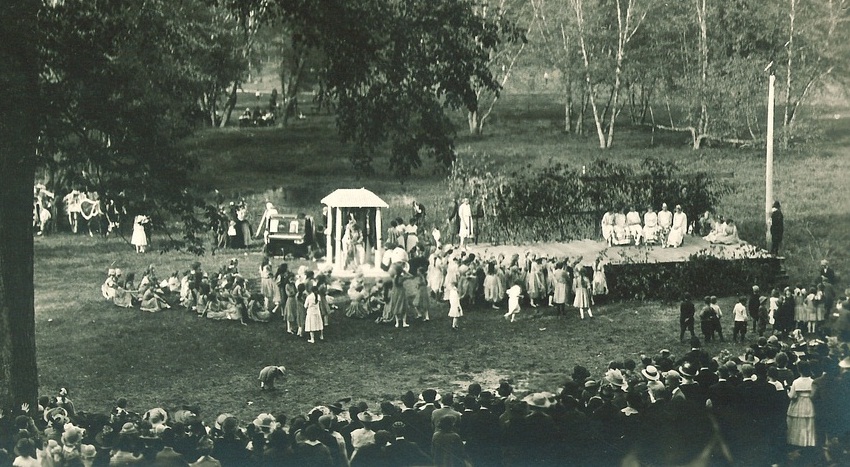
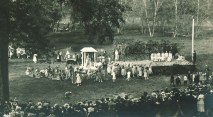
The Drama League’s efforts were incredibly successful. Despite the anxiety of an economic recession and a heated debate over whether the United Sates should enter the war in Europe, much of 1916 was given over to a national veneration of Shakespeare. The New York Times sponsored a weekly supplement devoted to the Bard, the city of Saint Louis Shakes Tercentenary.U Iowaboasted five performances of As You Like It with a cast of 1,000 persons, the University of Iowa organized a well-attended outdoor festival (photo at left). Commemorative parks were dedicated, schoolchildren learned Morris dances, and Shakespeare parties were a national fad.
Most organizers took their cues from the Drama League and sponsored one or two of the published suggestions: a parade and performance of a play, for example, or an academic lecture as part of a library exhibit. But Shakespeare was especially welcome in Austin. The University of Texas did them all, and more.

~~~~~~~~~
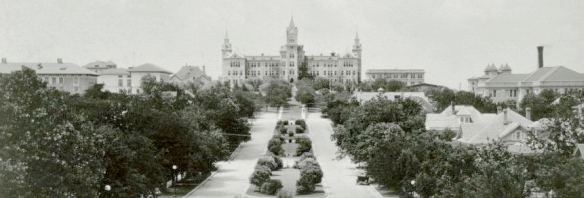
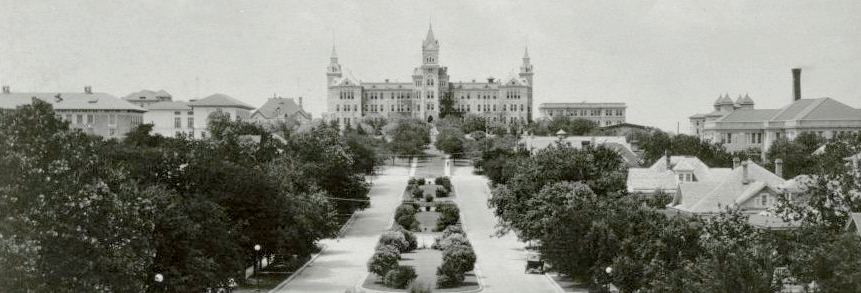
UT Campus.1916

Above: The University campus in 1916. “Old Main” in the center has been replaced by the current Main Building and Tower.

For UT, Shakespeare fever arrived in 1915 at a spring meeting of the faculty, when English professor Reginald Griffith proposed a campus-wide celebration. A PhD graduate of the University of Chicago, Griffith came to Austin in 1902 for what would be a fifty-year career.  Passionate about rich libraries and rare books, he initiated with UT president Robert Vinson – and enabled by a generous $225,000 gift from George Littlefield – the 1917 purchase of the John Wrenn Library in Chicago, the first step in creating a world class literary research center at the University. Just before his retirement, Griffith spearheaded the effort to found the University of Texas Press in 1950.

AAS.1915.07.15.Headline.Program AuthorizedThe faculty approved the idea unanimously. An organizing committee of five, with Griffith as chair, was appointed, including Latin professor Ed Fay, history professor Eugene Barker, Aute Richards from zoology, and faculty secretary (and noted cowboy song collector) John Lomax. By mid-July, the initial plans were announced in the Austin Daily Statesman, but were decidedly tame and traditional. There would be an exhibit in the University Library, distinguished scholars would be invited for guest lectures, and a professional troupe would be hired to present several Shakespeare plays “for the delight and instruction of the students and faculty.”

Griffith, though, wasn’t satisfied. Just as the future Shakespeare at Winedale program was built upon the tenet of understanding Shakespeare through performance, Griffith sought to involve as much of the University community as possible, and not as mere spectators. He prodded the committee for more ideas and sought advice from friends and colleagues. By the end of the 1915 fall term, plans for a far more ambitious Shakespeare Tercentenary had emerged.

~~~~~~~~~~
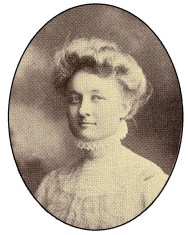
Eunice AdenFor several years, Eunice Aden, as Director of Physical Training for Women (photo at right), had organized an annual spring exhibition of games, exercises, and dances by hundreds of participating co-eds. Held at the University’s athletic field  (old Clark Field, about where the O’Donnell Building and the Gates-Dell Computer Science complex are today), it was meant, in part, to promote the still not-completely-accepted idea of women in sports. Griffith approached Aden about substituting a nighttime Shakespeare commemoration for her usual program, making it instead an evening of old English folk dances, along with an original artistic tribute to the Bard. Aden, who as a UT student had starred as Orlando in the 1906 Ashbel Society production of As You Like It, readily agreed. A dozen sections of the men’s gym classes were recruited to be partners with the girls.

A performance of sixteenth century English dances, though, needed a proper setting. Phi Alpha Tau, a professional fraternity whose membership then drew from the campus literary, debate, and dramatic clubs, volunteered to design and build a replica of an English village that would stretch across the far side of the football field as a backdrop. The idea quickly expanded into a full Bartholomew Fair, what amounted to the first Renaissance Fair in Texas. Spectators would watch the dance performance seated in the stands, and then be invited on to the field to join in the fair afterward.
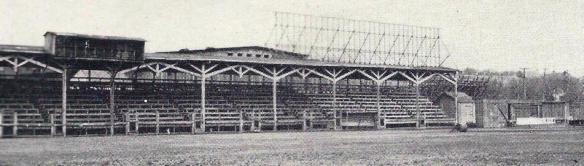
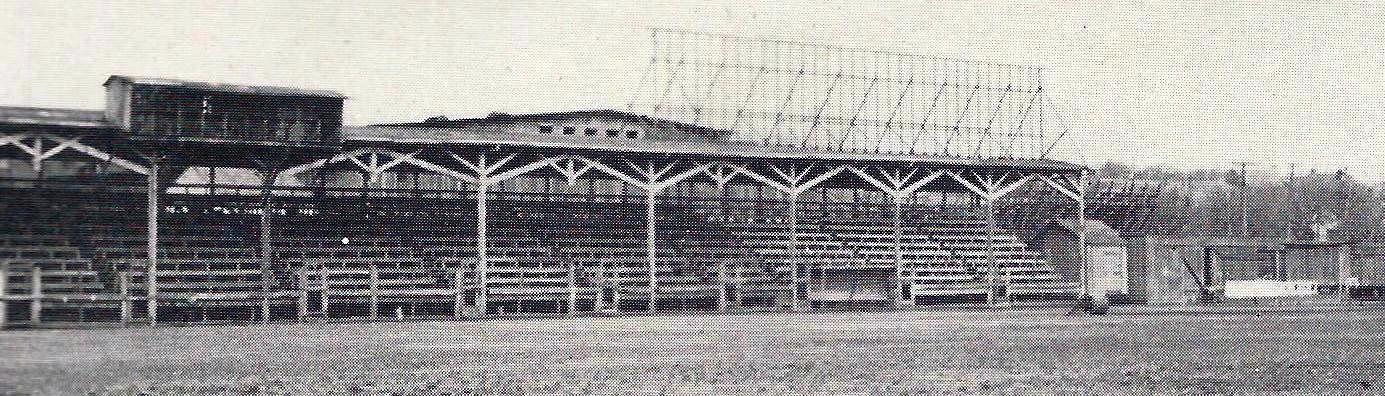
Clark Field.West Stands

Above: Clark Field, looking toward the covered west stands. A Bartholomew Fair was constructed along the east half of the field.

As Clark Field wasn’t lighted, physics professor LeRoy Brown offered to supervise a group of science and engineering students that would install spotlights as temporary illumination, along with special lighting effects for the fair. Music professor Frank Reed took on the responsibility for the live music needs for the evening, found the scores to English folk dances and other appropriate tunes, and recruited the University band and singing groups.

~~~~~~~~~~

Thus far, more than a thousand of the University’s 2,600 enrolled students were involved.  What about the rest? Inspiration came from the home front, as Griffith’s wife, Alice, had been researching previous Shakespeare celebrations, particularly the first Shakespeare Jubilee that took place in Stratford in 1769. Among the many scheduled events was a pageant, a parade of costumed characters from Shakespeare’s plays. Though rainy weather had cancelled the 1769 pageant, it was included in future Shakespeare celebrations and had long been popular. Why not stage a pageant on the campus?

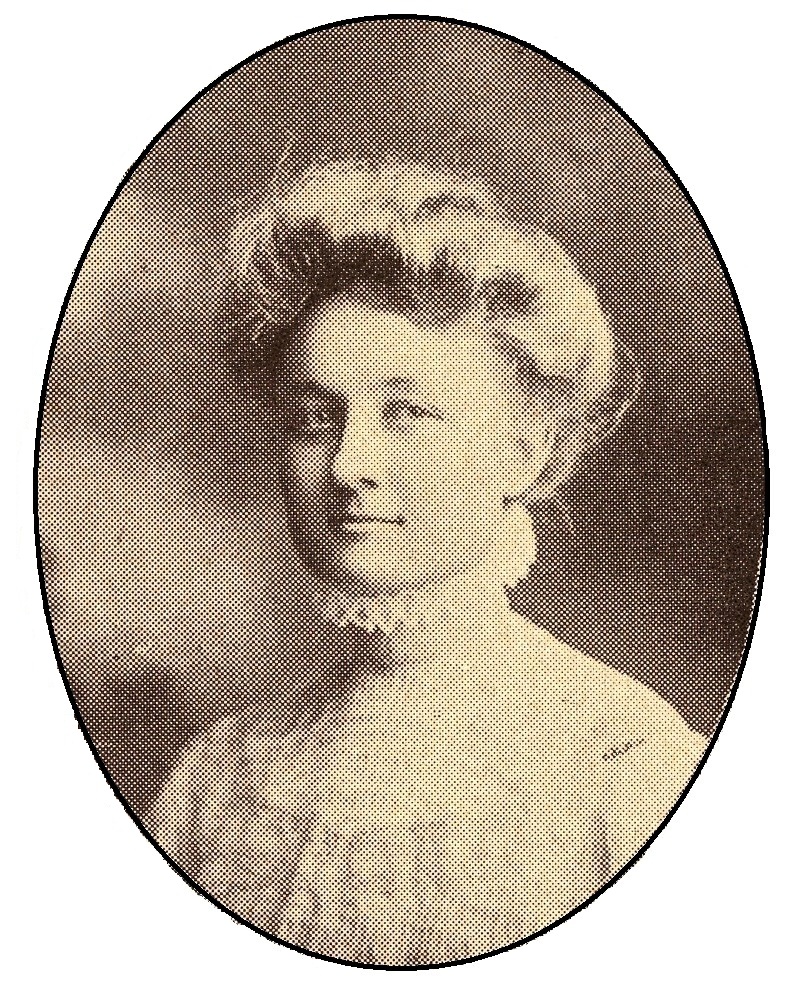
Before long, a pageant committee had organized, chaired by home economics professor Mary Gearing and composed of faculty, wives of professors, and friends of the University. The committee created a dozen parade units, depicting either scenes from plays or snapshots of Shakespeare’s life, and assigned each to an academic department or student organization. To visually distinguish each group, the committee went so far as to select “color schemes” for the costumes.

~~~~~~~~~~

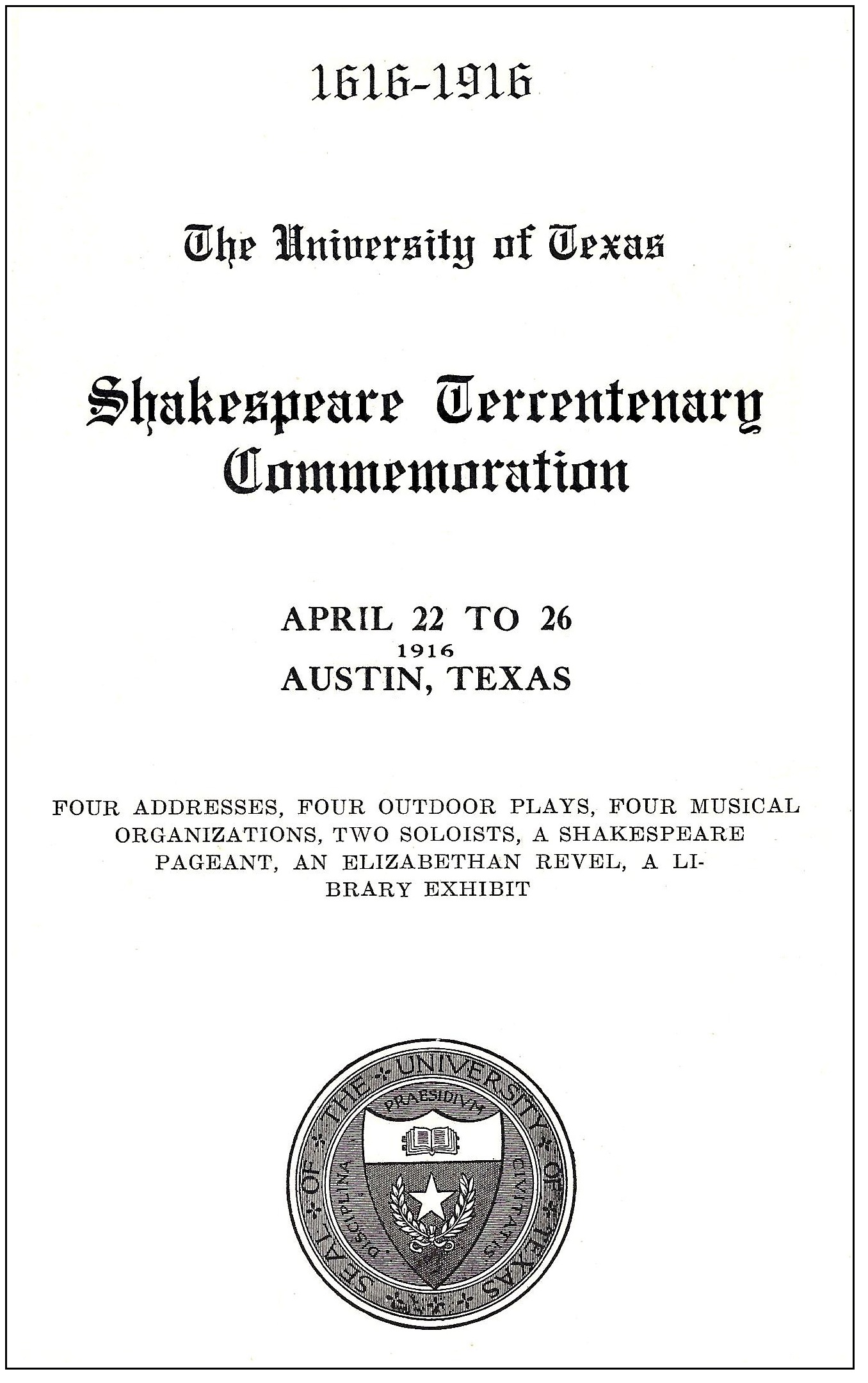
With the inclusion of a procession, plans for the University’s Shakespeare Tercentenary were at last complete. A five-day celebration, from April 22 – 26, would include a library exhibit, lectures by visiting academics, performances of Shakespeare plays by a professional troupe from New York City, an Elizabethan Revel with folk dances, a Bartholomew Fair, and, to start off the festivities, a great Shakespeare Pageant. For UT, it was the most ambitious project yet attempted.
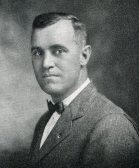
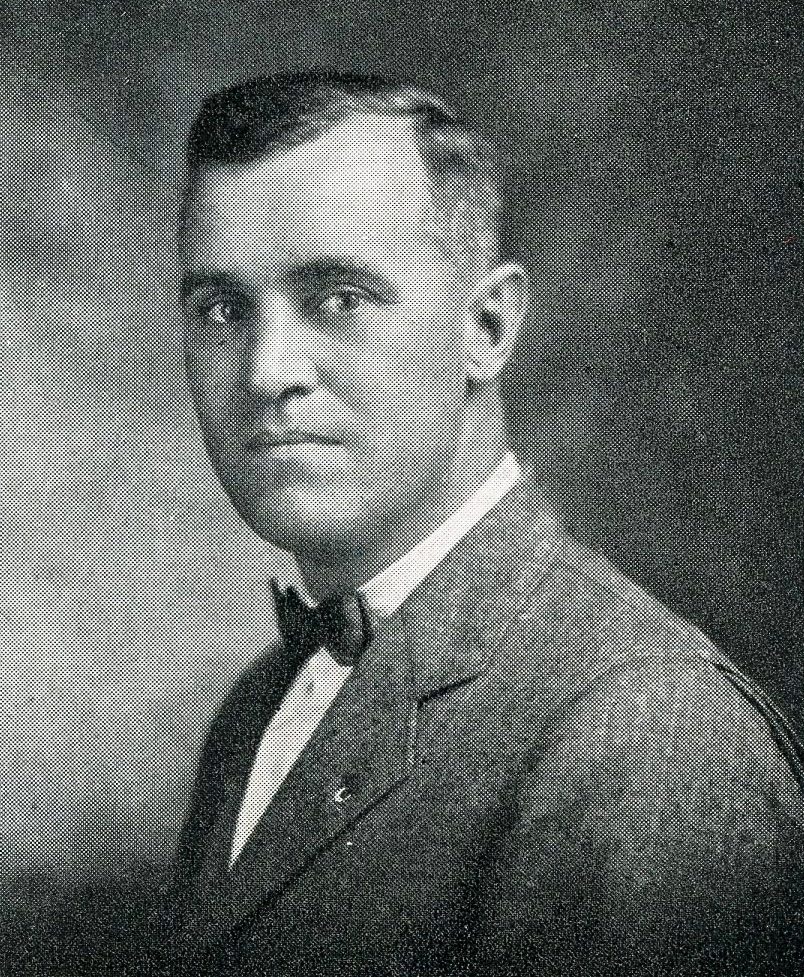
Theo BellmontFunding all of this, of course, quickly became an issue. The University could afford to bring visiting scholars and hire a professional troupe, but had limited resources to provide the lumber, nails, and paint for the Bartholomew Fair, or the materials and labor needed to create thousands of Elizabethan costumes. Concessions were to be sold at the pageant and the fair, and a planned twenty-five cent admission to Clark Field would all help cover the costs, but the money was needed beforehand. To the rescue again came Dr. Griffith, who fronted the needed funds, a sizeable risk for an associate professor earning a $2,200 salary. So that Griffith could concentrate on the tercentenary program, UT athletic director Theo Bellmont (image, above right) volunteered for business manager duties.

~~~~~~~~~~
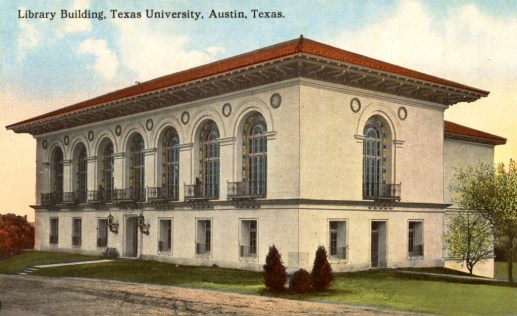
UT Library.Battle Hall

Above: The University of Texas Library, currently the Architecture and Planning Library in Battle Hall, site of the 1916 Shakespeare exhibit.

By February 1916, much of the campus community was actively preparing for the tercentenary. Massive rehearsals for folk dances took place in the women’s gym, then housed in a temporary wooden structure about where the Texas Union stands today. University Librarian John Goodwin assembled an exhibit in a room on the first floor of the library (Battle Hall), with books, maps, photographs, and other materials about Shakespeare and Elizabethan England.

The exhibit, though, quickly became a critical resource, heavily consulted by the members and friends of Phi Alpha Tau as they designed and built their English hamlet for the Bartholomew Fair. Home economics students, under the advice of Professor Mary Gearing, used the exhibit to study Elizabethan textiles and fashion, and sketched dozens of historically accurate costumes that were posted on bulletin boards all over campus.
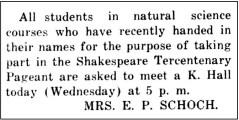
DT.1916.03.22.Note from Mrs Schoch

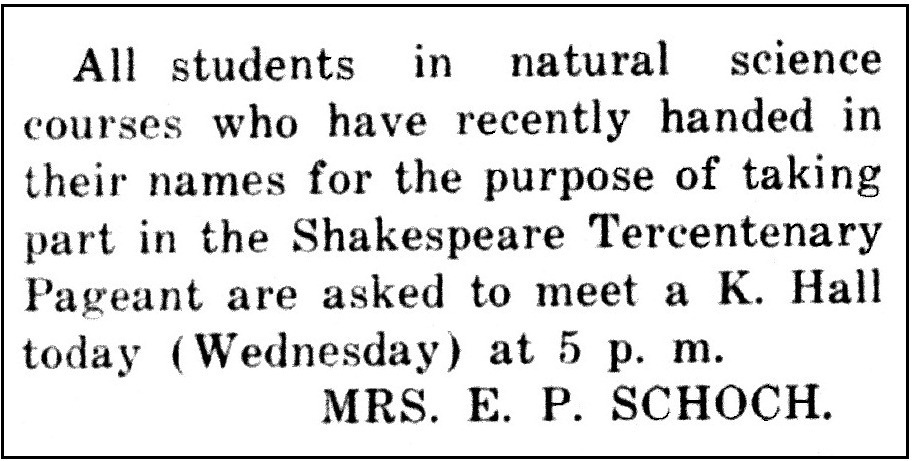
Left: Throughout the spring, notices about meetings and rehearsals for the Shakespeare Tercentenary regularly appeared in The Daily Texan student newspaper.


The costumes were, by far, the most time consuming. Thousands were needed. Materials for hats and suits were purchased at wholesale prices. Along with student volunteers, every tailor and dressmaker in Austin was employed. Even the sinks in the chemistry lab building were commandeered to dye endless pairs of stockings just the right shade.

In the meantime, the University advertised the upcoming celebration in newspapers throughout the state. Many of the hotels in Austin were filled.

~~~~~~~~~~
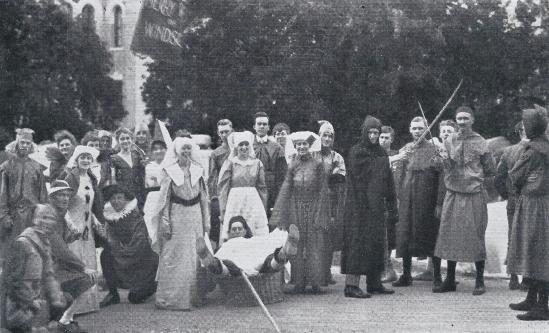
Shakespeare Tercentery.Merry Wives of Windsor

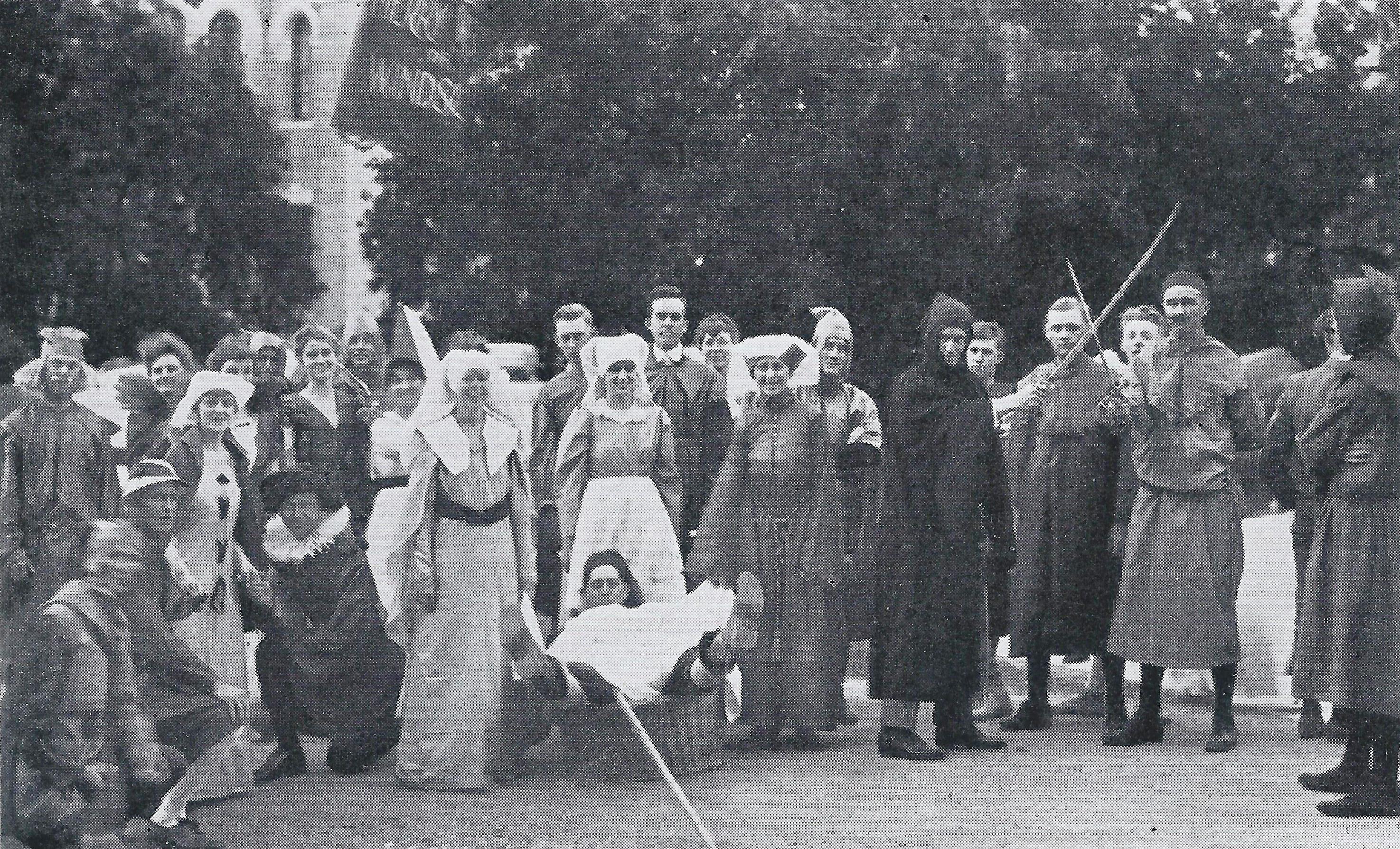
Above: Pat Holmes (in the wheelbarrow) stars as Falstaff as fellow social science students recreate a scene from The Merry Wives of Windsor in the Shakespeare pageant.

At precisely 6 p.m. on Saturday, April 22nd, a trumpet fanfare, played in front of the Victorian-Gothic old Main Building, heralded the start of the Shakespeare Pageant. The mile-long parade route started on the east side and moved counter-clockwise along the walkway that enclosed the square, forty acre campus. Twelve flags were spaced evenly on the course to mark the stops where the pageant groups would perform.

According to the Austin American, “The last rays of a brilliant sunset, reluctant to retire beyond vision of such a resplendent scene, shed multi-colored rays over the rollicking actors in the pageant. On every hand minstrels darted, jesters chided and bantered, and apple-sellers and sandwich peddlers adjured the crowd to purchase their wares. Twelve groups of players composed the main body of the pageant, portraying some dramatic moment of one of Shakespeare’s plays. Minstrels preceded each group, joyously rendering ballads and accompanying themselves with mandolins and guitars.”
Shakespeare Tercentery.As You Like It

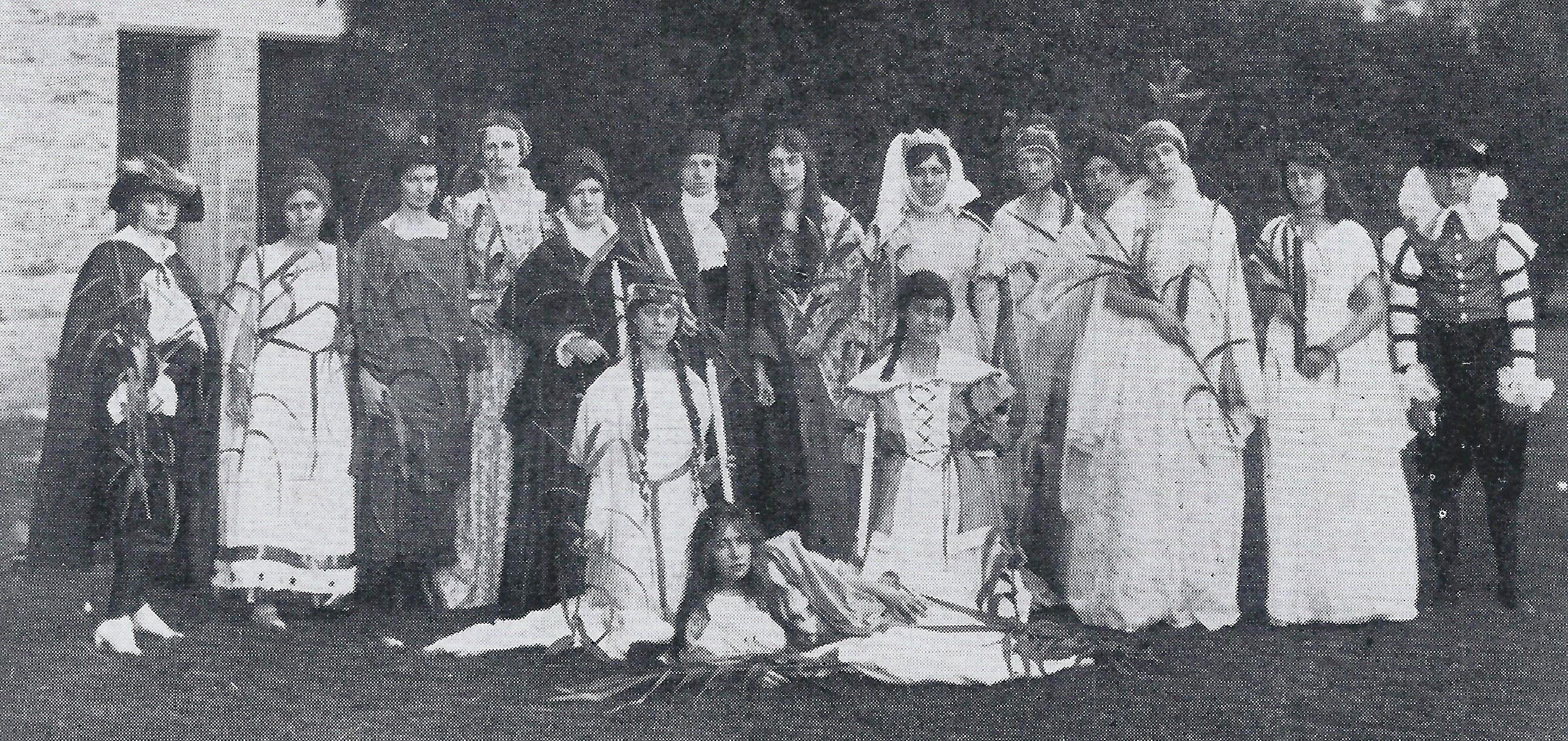
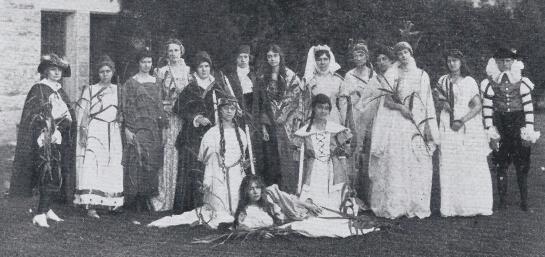
Above: With Grace Denny as Rosalind (far left), natural sciences students portray As You Like It. All are holding young corn stalks, meant to depict the trees in the forest of Arden.

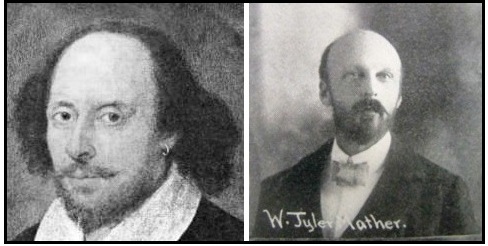
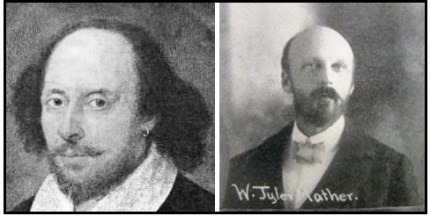
The Department of Social Sciences took on The Merry Wives of Windsor, decked out in “biscuit colored outfits in red trim,” while natural science students chose As You Like It in costumes of “forest green and brown.”  Appropriately, the law department reenacted the trial scene from The Merchant of Venice. Ancient languages claimed Julius Caesar. Modern languages went with Taming of the Shrew, education students opted for King Richard III, home economics selected The Winter’s Tale, and the engineers boldly chose Hamlet.  The remaining groups depicted scenes from Shakespeare’s life. At the end of the procession was the Bard himself, played by Dr. Tyler Mather, chair of the physics department.
Shakespeare and Mather

Above: Good casting? Dr. Tyler Mather (right), chair of the physics department, played Shakespeare in the tercentenary pageant.

An estimated 10,000 spectators gathered to see the parade, more than half of them sporting their own, homemade Elizabethan costumes. They stayed well after sunset and watched the parade by the light of electric lamps only recently installed along the walk.
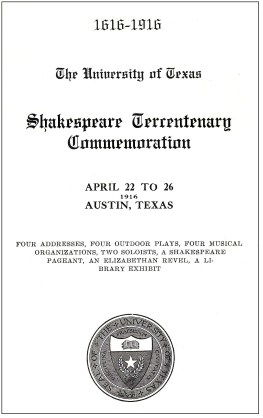
Program Cover.Shakespeare TercentaryThe pageant concluded, the crowd hurried to fill the west stands of Clark Field for the 8 p.m. Elizabethan Revel. Under the gaze of special lighting and accompanied by the twenty-piece University band, hundreds of UT students performed a series of English folk dances: Morris dances, the Sailor’s Hornpipe, and others. Next, the all-girl advanced modern dance class presented an interpretive, original piece which depicted an aging Shakespeare, retired from the stage, returning his literary gifts to each of the Nine Muses. “The various young ladies and their attendants captivated the audience by the gracefulness and beauty with which they danced their respective parts,” reported the Cactus yearbook.

After the dance program, the audience was invited on to the field for the Bartholomew Fair. The Boar’s Head “Tavern” served shepherd’s pie and family-friendly libations. Puppet shows, mock sword fights, wrestling matches, and fortune telling provided entertainment, and fairgoers could try their own hand at archery, lawn bowling, and folk dancing. The Austin Daily Statesman called it a “gorgeous jollification,” and the party continued well into the night.

Sunday, April 23rd, was the anniversary date of Shakespeare’s passing, but also turned out to be Easter Sunday. The University, along with most of Austin, was closed for the day.  No matter. Caught up in the spirit of the weekend, most of the city’s clergy found a way to weave Shakespeare into their Easter sermons.
Dr Wendell LectureThe tercentenary continued through the following Wednesday, as UT president William Battle suspended classes each day at noon so as many students as possible could attend lectures by visiting scholars in the Old Main auditorium.  Addresses were delivered by John Manly of the University of Chicago, Barrett Wendell of Harvard, and former UT law professor and regent Robert Batts. In the evenings, the Cliff Deveraux troupe from New York performed Shakespeare plays outdoors in the southeastern corner of the campus, the audience sitting on the hillside where the Graduate School of Business building now stands. Wednesday afternoon, the campus was given over to the children of the Baker, Winn, and Wooldridge elementary schools who held their own Shakespeare pageant and a Maypole dance.
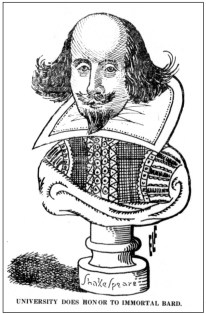
DT.1916.04.22.Shakespeare ArtworkOne last fling was held Thursday evening. An all-University dance in the women’s gym provided an excuse to don those Elizabethan costumes a final time. Class attendance Friday morning was reportedly a bit sparse.

“Never before has a single activity been more enthusiastically participated in by a larger number of our student body than the Shakespeare Tercentenary,” reported The Daily Texan student newspaper. “Its influence educationally was great. The institution was imbued with a new sense of the artistic and cultural. It has done a lasting good.” Professor Griffith, who was fully reimbursed from the earnings of the Bartholomew Fair, was praised from all corners of the campus. “He shouldered the whole responsibility, financial and otherwise,” lauded the Texan. “Such loyal public service cannot be commended too highly.”
 

The Great Jester Center Food Fight

John Belushi.Animal House

Above: “Food Fight!” shouts John Belushi as the irascible John “Bluto” Blutarsky in the film Animal House by Universal Pictures.

It was stress time. For UT students in the spring of 1982 – as it is today – the dreaded last week of classes was about as popular as an Oklahoma Sooner at a Longhorn tailgate. Professors smiled as they distributed yet another round of tests (Don’t forget your blue books!), semester-long projects and research papers were due, and final exams loomed just over the horizon. The harried inmates of Jester Center, the University’s largest and at the time only co-ed residence hall, were up at all hours and bleary-eyed, living off caffeine as they sprinted to the end of the academic year.

That’s when the flyers appeared.

They were everywhere. Posted along the hallways, in the elevators, on the bulletin boards, in the bathroom stalls, no one could miss them. And in those ancient and primitive times before email, the internet, and social media, flyers were one of the best ways to get the word out about something. Students took notice.

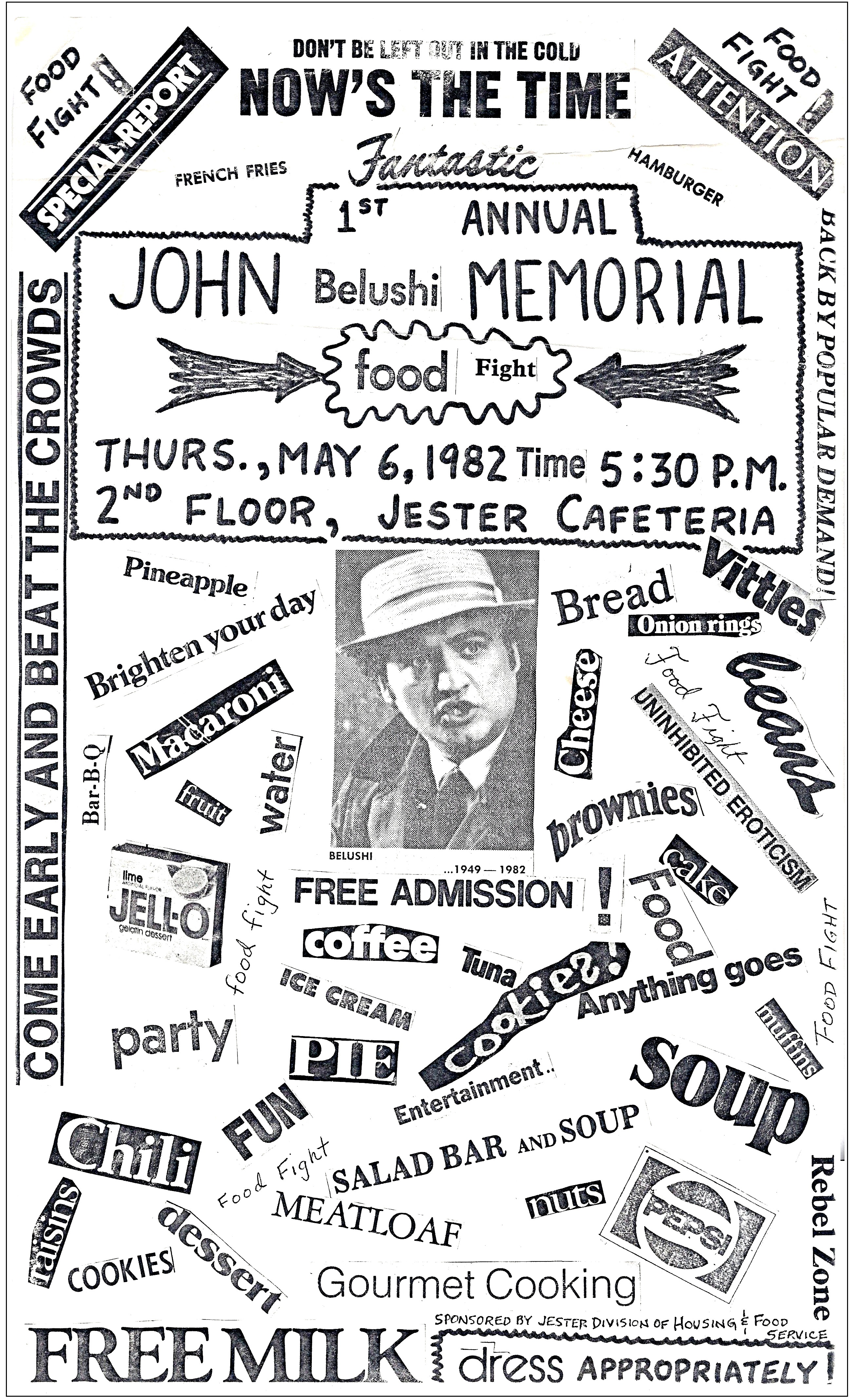
Food Fight Flyer“Don’t be left out in the cold. NOW’S THE TIME.” With great fanfare, the flyers announced the first annual John Belushi Memorial Food Fight, set for Thursday, May 6th on the second level of the Jester Cafeteria. Belushi, famous for his performance as the college degenerate John “Bluto” Blutarsky in the film Animal House, had died two months previously in early March.

A food fight?! In the Jester cafeteria? This didn’t seem like the usual program the dorm’s resident assistants (RAs) would organize. But there it was, plainly printed on the bottom right hand corner of the flyer: “Sponsored by the Jester Division of Housing and Food services.” That sounded official. And how thoughtful for the housing office to provide a way for students to let off a little steam before final exams.

Above: The infamous food fight flyer, created by cutting out words from magazines and newspapers, taping them to a sheet of paper, then running off copies at the nearest Xerox machine. Old school technology. Click on the image for a larger view.

Of course, the housing office had not organized, approved, sanctioned, endorsed, or in any way condoned a food fight in the cafeteria. Most of the flyers were removed post haste. Most, but not all. The RAs did their best to spread the word that food fights were a definite no-no. But college students, especially those cramming for tests, sometimes have selective hearing.

~~~~~~~~~~

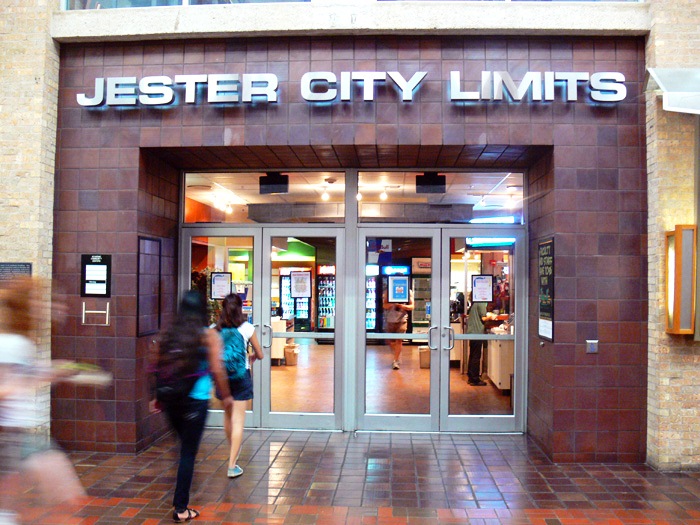
Jester City LimitsToday, the Jester Center eatery is divided into two facilities. Downstairs, the Jester City Limits resembles a food court at a posh shopping mall, and offers a broad selection to satisfy the choosiest of appetites. (Check out today’s menu here.) Upstairs, “J2” is an all-you-can-eat buffet style cafeteria with an expansive salad bar. As college fare goes, today’s Housing and Food Services does an outstanding job.

In the early 1980s, though, Jester’s dining options were decidedly more limited. Students trudged through one of eight cafeteria lines – four on each floor – and chose between two entrees. One line on the second floor served greasy hamburgers as the lone culinary alternative. Around campus, the Jester potato balls were the stuff of legend, and everyone was wary of the unpredictable and mysterious effects of the Jester chili-mac.

~~~~~~~~~~

On the appointed day, a much larger crowd than usual gathered for dinner on the second floor. Some students arrived with umbrellas or in ponchos, even though it was a clear, sunny day. One couple unabashedly showed up in matching garbage bags with holes cut out for heads and arms. Everyone had an appetite, or at least their plates were full. The salad bar could barely keep up with the demand. Spectators loitered along the second floor open hallway outside the cafeteria, trying their best to look nonchalant even though they were three persons deep.

Tink! Tink! Tink! Tink! Tink! At precisely 5:30 p.m., the sound of a lone knife clinking against a glass was heard in the northwest corner, soon joined by others until a cacophony swelled through the dining hall. Heads were on swivels, eyes alert for a surprise attack. Once the first biscuit was launched, the armistice was over, and for one brief, shining moment, the Jester Center cafeteria was a scene from Animal House.

DT.1982.05.07.Jester Food Fight

Above: Headline in the Daily Texan.

Not an all-out battle, it was a quick series of skirmishes. Students dove under tables with their ammunition and then fired when they thought it safe. Chicken wings found flight one last time. A spoonful of corn became scatter shot. Garbonzo beans were surprisingly accurate. The crowd outside the dining hall roared with approval. Amidst the confusion, RAs braved the cross-fire and rushed to confiscate the student IDs of anyone doing more than just ducking for cover.

It was all over in a few minutes. Some of the participants faced stern disciplinary action with the Dean of Students, and at least one of the authors of the flyer was asked to take a semester off from the University and elected not to return. Why be in a food fight? “I couldn’t help it,” was the popular reply. “I was under the influence of Jester chili-mac.”


The First UT Senior Ring

1927 UT Senior Class Ring

Above: The design of the 1927 UT senior ring. The Bachelor of Arts degree is displayed in its Latin form as Artium Baccalaureaus, or “AB.” Click on the image for a larger view.

Rings have been a part of university culture for centuries, dating back to the 1200s when the University of Bologna presented gold rings to students who had completed their doctor’s degrees and earned their licentia docendi, or “licenses to teach.” The practice continues at a few universities in Europe. The idea of a class ring began with the United States Military Academy, when the Senior Cadets of 1835 designed and wore a common ring as a show of class unity and to remind them of their West Point days after graduation.

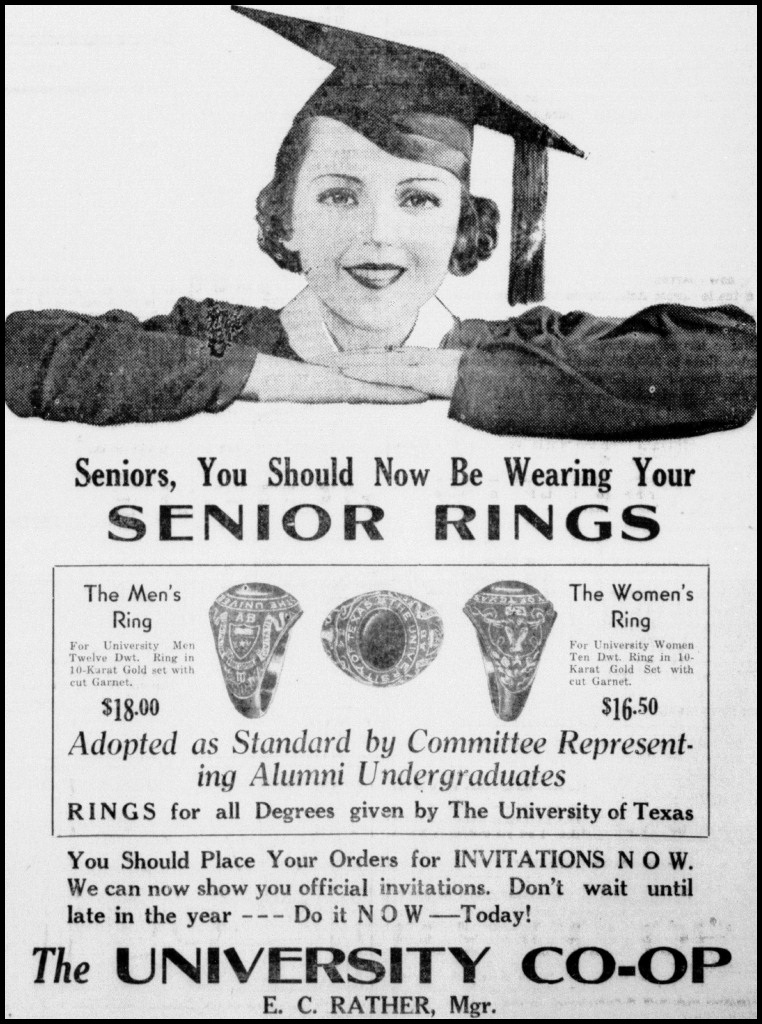
At the University of Texas, the senior ring tradition arrived early in the spring of 1927, when the senior class voted to have one and solicited designs from fellow students. By mid-February, the class had chosen the entry from Amy Jackson, a student who worked part-time as a technician in the zoology department.  Made of 10-carat gold and with a red garnet stone, orders could be placed at the  University Co-op; men’s rings cost $13 each, co-ed rings were $10.50. Sales were sluggish at first. By mid-March, only 26 rings had been purchased. But when the UT Students’ Assembly (today’s Student Government) approved the design as the “official” senior ring of the University for future years, interest grew swiftly. Rings ordered by April 20th were ready in time for spring commencement in early June.

1927 Senior Ring Headline

Teeming with Texas and University symbols, the Daily Texan described it:

“One one shank appears a Longhorn head with a lariat draped from one horn around under the nose and up to the other horn. The number ’27’ is just above the head, and a lone star is just below the nose. In a semi-circled wreath below the star is a group of Texas cacti.

“On the other shank is the degree and crest with a scroll bearing the words Disciplina Praesidium Civitatis. [The Latin motto on the University Seal, translated as ‘Education is the safeguard of democracy.’] Corresponding to the cacti on the first shank is a wreath of bluebonnets.”

Above: A 1936 advertisement in The Daily Texan for senior rings.

The Start of UT Women’s Basketball

1901 Whitis Basketball Team

Above: The victorious Whitis Team, which won the first basketball game played on the Forty Acres. Gym instructor Pearl Norvell is in the center with the basketball.  

Women’s basketball is almost as old as basketball itself.

James NaismithAs most fans of the sport know, basketball was invented in December 1891 by Dr. James Naismith, (photo at left), then an instructor at the YMCA Training School in Springfield, Massachusetts, about 90 miles west of Boston. Newspaper accounts of the new game reached Sendra Berenson, a newly-hired physical training instructor at nearby Smith College for women. Looking for new activities that would interest and engage her students, Berenson introduced basketball the following spring, though she thought the style of play used by the men to be too rough. With Naismith’s help, Berenson adapted the rules for a women’s version of the game, which permitted five to ten players on a side. The court was divided into three equal sections; each player was assigned a section and couldn’t move beyond it. To speed up the pace, girls were limited to three dribbles each and could hold the ball for only three seconds before passing it to a teammate. The game relied more on passing and shooting skills than full court sprints or fast breaks.

1901.Three Court Drawing

Above: Sedra Berenson’s three-court design, which appeared in a 1901 guide for women’s basketball.

Another early advocate for the game was Clara Baer, who taught at Sophie Newcomb College in New Orleans. Baer published a handbook for women’s basketball in 1895 and taught the one-handed shot not used by the men until thirty years later. Baer, though, also devised her own rules. Taking Berenson’s three-court idea to an extreme, Baer divided the court into as many squares as players on a team. Players usually didn’t have to run more than a few steps, which might have been preferable as Baer also kept the girls in long dresses in corsets, while Berenson opted to keep her teams in loose-fitting bloomers.

Both versions were in response to the prevailing attitudes about women and sports at the time, that young ladies who exercised too much might “break something” and risk their futures as mothers. “You can over-exercise, become too much excited over contests in the gymnasium, use up force to such an extent that your womanly functions become weakened,” explained Dr. William Howard, whose cautions in the early twentieth century were widely accepted. “No girl with a nervous temperament should go into any athletic contest. Such a girl should not play basketball; nothing, in fact, which calls for a strain upon the nervous system.”

~~~~~~~~~~

AAS.1899.12.23.Athletic Young Ladies Headline

Pearl Norvell.1901At the University of Texas, basketball arrived in the fall term of 1899 with the hire of Pearl Norvell (left) as the physical training instructor for women. Norvell had attended the highly-regarded Sargent School for Physical Training in Cambridge, Massachusetts (now Sargent College, a part of Boston University), and had learned about basketball directly from Sendra Berenson.

Along with Norvell’s arrival, the University renovated the largest room in the west wing of the old Main Building, initially used as the library, to serve as a new women’s gymnasium. Previously, in 1896, UT’s first gym had been constructed in the basement of the building with student support and a timely donation from UT regent George Brackenridge, but the facility wasn’t considered suitable for young women. The new ladies gym was outfitted with its own locker room and equipped with, among other things: fifty pairs of dumb bells, a vaulting box, a set of parallel bars, two climbing ropes, twenty-five pairs of fencing foils, and “one pair of basket ball goals.” Classes were mandatory for freshmen women, but were soon popular among all of the coeds. “The young ladies gym at the University is being liberally patronized,” reported the Austin Daily Statesman, and Miss Norvell is fast improving the young ladies, physically speaking.” The University Calendar, one of several student newspapers that pre-dated the The Daily Texan, agreed: “There is not a young woman in the ‘Varsity who is not proud of the gym and its charming instructress. We wonder which section will play the best basket ball.”

1900.Girls Gym in Old Main Library

Above: The first women’s gym in the old Main Building. The tall pole in the center is a basketball hoop. Click on an image for a larger version.

Norvell had organized four basketball squads, and taught the game through the fall term using Berensons three-court rules that she’d learned in Massachusetts, with one point awarded for a basket or a free throw. Games would be played starting with the winter term.

On the cloudy and chilly afternoon of Saturday, January 13, 1900, the first basketball game on the University campus was held between the Whitis and Ideson teams, named for their captains: Gertrude Whitis and Margaret Ideson. With seven players on a side, the game was divided into four 10-minute quarters.

A few spectators were allowed to watch – women only! – though it was “with difficulty that they restrained their feelings.” According to The Ranger (another one of those early student newspapers), “As the game was called, each face was earnest and each eye eager.” The match was a spirited but low scoring one. In the third quarter, with the tally 2 – 1 in favor of the Whitis team, a foul was called and the Idesons were given a free throw. Miss Laura Kritser, “took her stand, amid breathless excitement, aimed cooly, and made her goal.” The tie lasted until late in the fourth quarter when Whitis scored again, and despite the “superhuman” efforts in the final minutes, won the game 3-2. Women’s basketball had made its official debut, and was instantly popular.

1902 Cactus.Womens Basketball Team

Above: The 1902 women’s basketball squad, with Pearl Norvell in the center.

Norvell continued to develop the program over the next several years. From the inter-class teams she selected a University squad that played against the “Town Girls” from the Austin Y.W.C.A., and traveled to local high schools, but didn’t engage in intercollegiate competition.

Despite the enthusiasm of the students, numerous concerns about too much exercise were soon raised among members of the faculty. To help allay any fears, Norvell scheduled an open house in March 1901, and invited the professors’ wives so they could witness the activities for themselves and “report back to headquarters.” The gym was decorated with orange and white streamers and flowers, students demonstrated some of the exercises they did in their classes, and the coeds and faculty wives mingled in a reception “with the daintiest refreshments.” Norvell’s efforts helped, but progress was slow.

Womans BuildingIn October 1903, the Woman’s Building (photo at left) opened as the University’s first residence hall for women. Positioned west of Old Main (about where the Flawn Academic Center is today), it, too, was controversial. As the Texas Legislature considered a $50,000 appropriation for the building’s construction, many lawmakers believed college women would be better supervised if they stayed with Austin families rather than in a dorm. A tie vote in the House required the Speaker to cast the deciding ballot and approve funding.

Womans Building Gymnasium

Above: The basement gym in the Woman’s Building. The elevated running track doubled as a gallery for basketball fans, though only women were allowed entry. Click on an image for a larger view.

Outfitted with an elegant dining room, full kitchen, parlor, and an elevator, the basement of the Woman’s Building was reserved for a gym. A step up from the cramped quarters in Old Main, the gym included a small pool for swimming lessons, an open area for exercises, dance classes, or basketball, and an elevated running track that doubled as a gallery to watch basketball games.

DT Headline.Apr 6 1904Along with the new building came a new instructor. Pearl Norvell was succeeded by Louise Wright as Director of Physical Training for Women, and immediately set out to expand the basketball program. In the spring of 1904, the first season in the new facility, UT hosted its first out-of-town squad, the girls from Belton High School, about 60 miles north of Austin. The Texan printed a headline that labeled the game as being between Texas and Baylor, which has led some to think it was the first intercollegiate game. But the article, and other reports in the Austin Daily Statesman, are clear that the opponents were from the high school. What’s going on here?

Baylor was chartered in 1845 by the Congress of the Republic of Texas and first located in the small town of Independence. After a few years, in 1851, the university divided into two campuses for men and women. The men relocated to Waco, the women to Belton, where it became the Baylor Female College (today’s University of Mary Hardin-Baylor). The connection between Belton High School and Baylor isn’t clear, though it’s possible the two coaches for the high school squad were on the  Baylor faculty.

AAS.1904.04.01.Ad for UT vs Belton Game

The game was scheduled for Saturday afternoon, April 2nd, with a 25-cent admission, half of which would go to the Belton team to cover their traveling costs. Texas won the game easily, 12 to 6. “The girls won many new admirers,” reported the Texan, “and it is to be hoped that those who have opposed such sports before will have had their eyes opened to the many admirable and beneficial features of the game.” The Texas team did a “zig-zag march” across campus to mark their victory; today the women’s basketball team probably celebrates in a different way.

Along with hosting an out-of-town team for the first time, Wright helped the coeds to formally organize a Women’s Athletic Association to better coordinate all on campus women’s sports,and successfully petitioned the University’s Athletic Council to award letters in tennis. While none of the female sports  programs were intercollegiate, women’s tennis appeared on the campus first and was better established. Letters, though, were smaller than those given to the men, and were worn on the sleeve of a letter sweater. In 1906, the Athletic Council formally approved a men’s basketball team, and at the same time approved letters for women’s basketball as well.

1906 Womens Tennis.

Above: The 1906 women’s tennis team, The two girls in the center, team captains, are sporting the letter sweaters then approved for women’s sports.

When, then, was the first women’s intercollegiate game? One source has claimed it was 1906, when the renown Clara Baer brought her squad to Austin from Sophie Newcomb College in New Orleans. Similar to the Baylor Female College, Newcomb was the “women’s department” of Tulane University. But while scheduling a game between Texas and Newcomb was suggested, the contest never actually took place. Baer was still using her own rules, different from the three-court game played in Austin, and she was ardently opposed to intercollegiate competition.

1907.Womens Basketball

Above: The 1907 UT women’s basketball team.

Instead, the first recorded intercollegiate game for UT women’s basketball was held the following year, in the spring of 1907, when Texas hosted a squad from Southwestern University on Monday, February 18th. “A better exhibition of the game was never seen in this city,” declared the Austin Daily Statesman, “both teams were well trained and were selected from the best material in the respective schools. The gallery above the court was full, “the visiting girls having numerous supporters mingling with the fair wearers of the orange and white,” and the score was close through all four quarters. But in the end, Southwestern scored the final, and winning, basket, handing UT its first defeat 19-18. A post-game dance was held for both teams in the parlor of the Woman’s Building as “the young ladies from Georgetown were given a good sample of ‘Varsity hospitality.”

AAS.1907.02.19.UT Women Lose to Southwestern

While the initial game was a loss, today’s Longhorn basketball faithful might take comfort in knowing that UT’s first baseball game, played April 21, 1885, was also against Southwestern and was a 22-6 rout, though the colors orange and white made their first appearance.

The University’s experiment with intercollegiate women’s basketball didn’t last long. Bowing to the common belief that competitive sports for college ladies was too stressful (though some universities, such as Ohio State, regularly played local colleges, while high school girls teams were vying for state interscholastic titles), UT limited the game to intramural leagues. Not until 1967, when a group of UT students petitioned the Department of Physical Training for Women, was a squad allowed to participate in newly created college tournaments in Central Texas. The team, though, was still considered a club. Coaches were faculty volunteers, and the players sewed their own uniforms and paid for travel expenses. Not until 1974, after Title IX was enacted and Donna Lopiano hired as the Athletic Director for Women, was intercollegiate women’s basketball formally established on the Forty Acres.