Attack of the Academs!

Academs

All hail the University of Texas professor! Tireless researcher, espouser of knowledge, valiant defender of free inquiry, appointed distributor of homework and grades, and, on occasion, “other duties as assigned.” From time to time, faculty members have been required to perform above and beyond their usual academic roles.

In the early years of the University, the 40-acre campus was a magnet not only for aspiring scholars, but the town cows, which were free to wander and graze about Austin. The campus sported a wealth of wildflowers, newly-planted pecan and oak trees, and lush English ivy that tenaciously clung to the walls of the old Main Building (where the UT Tower stands today), all of which was an irresistible treat for the four-legged visitors. The munching and mooing, though, was a distraction to lectures. Professors had to regularly interrupt their classes, meet in front of Old Main, and as a group, shoo away the boisterous bovines. It was, perhaps, good practice for herding longhorn students through their degree requirements.

By 1915, the University of Texas boasted 2,300 students, most of them divided into three departments: law, engineering, and academic. The Academic Department included the “arts and sciences” curriculum offered today by the Colleges of Liberal Arts and Natural Sciences, and was contained almost exclusively in Old Main. The engineers were housed in what today is the Gebauer Building, and the old Law Building, once nestled into the southeast corner of the campus, was removed in the 1970s and replaced by the Graduate School of Business (GSB).

Two of the departments – law and engineering – have had an ongoing rivalry for more than a century. Most of the time it’s been a good-natured feud, though there have been episodes that would better be described as all out rumbles, and which required faculty intervention. The Academic students, informally called the “Academs,” typically remained neutral, and were either too busy pursuing their degrees or visiting Scholz’ Beer Garden to bother.

Texas Independence Day on March 2nd often provided an excuse for student shenanigans, and professors were always wary as the day neared. It was one of only two spring holidays and had been loudly celebrated by the University since 1897, when a group of law students borrowed a brass cannon from the Capitol, fired it repeatedly on the campus, and nearly broke out the windows of Old Main. (See How to Celebrate Texas Independence Day)

WaterTankFightEarly in the evening of March 1, 1915, UT President William Battle made a harried call to all faculty still on the campus. The engineers and laws were at it again at their usual spot: the old water tank. Placed on the north side of the campus, about where Painter Hall is today, the tank was installed in 1904 as a safety measure against water shortages that plagued Austin at the time. It was never used for its intended purpose, but its 120-foot perch was an instant hit with students, who dared to climb the tank’s legs and paint class initials on its walls. Almost always, the perpetrators were from the law or engineering departments. (See Rumble at the Water Tank)

Professors arrived at the tank to discover a full-blown scuffle in progress. The engineers held the high ground – at the top of the tank – while the laws were determined to dislodge them. The law students were having trouble, though, as the engineers had come prepared with an ample supply of eggs acquired from the University Cafeteria. Dropping the “hen fruit” from the tank’s platform discouraged any would-be climber.

The faculty immediately took control and sent the students home, though not before several professors were splattered with egg yolk, including English professor and future Plan II founder Dr. Hanson Parlin. Determined to prevent any more activity that evening, four members of the faculty remained on the grounds: Harry Benedict, who taught applied mathematics and astronomy, and was Dean of the University (what would be the provost today); Edward Bantel, a civil engineering professor and the Assistant Dean of the Engineering Department; Hyman Ettlinger, an instructor of applied math; and Milton Gutsch, who taught Medieval History. A spotlight owned by the electrical engineering department was hastily installed on the roof of the Engineering Building and pointed north to illuminate the water tank. The foursome settled into the northwest corner room on the first floor, where they kept watch throughout the night. According to all accounts, they found a chess set to help keep them occupied. Card games, such as poker, had been specifically prohibited on the campus by the Board of Regents.

1913 Cactus Yearbook.Engineering Building.

Above: The Engineering Building, today’s Gebauer Building. With a makeshift spotlight installed on the roof, the four faculty members stayed in the room on the first floor (one floor up from the ground floor) seen on the far left corner. From there they could look north to the water tank.

At the first sign of daylight on March 2, and satisfied trouble had been averted, the four bleary-eyed instructors decided it was finally safe to return to their homes. Three of them –  Benedict, Ettlinger, and Bantel – elected to make a final pass in front of Old Main before they wandered off to the west and north campus neighborhoods where most of the faculty lived.

The Victorian-Gothic old Main Building featured a tall central tower with two shorter towers at the east and west entrances. Atop each of the towers was a short flag pole. As the three ambled to the west side of the Old Main, which was out of the line-of-sight of the Engineering Building, they discovered, much to their chagrin, a large flag hung on the western pole, with the rope flying loose in the wind. Fluttering in the pre-dawn breeze, the flag read “Academs 1915.” The Academs had struck at last!

Old Main and Water

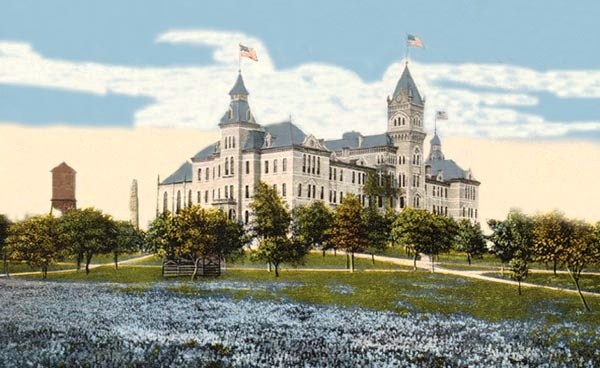
Above: The Old Main Building, where the UT Tower stands today. Flags are flying from each of its three towers, with the west wing on the left. The water tower can be seen to the north, while the Engineering Building is out-of-sight, behind Old Main to the east. And yes, there were lots of bluebonnets on the campus in the spring. (For more on that topic and the bluebonnet chain tradition, go here.)

If the flag remained, there would be a new round of class rushes, and the all-night vigil would have been for nothing. There was but one choice: the flag had to be removed.

Resigned to the task at hand, the three ascended to the top of the central tower of Old Main, climbed out of the window onto the roof, and precariously made their way to the west wing. The flag’s untied halyards were flapping in the wind, four to six feet from the roof’s edge. What to do? The three pondered a moment, and hatched a plan to remove the flag and preserve the campus peace.

Academ

Above: Three UT faculty take a precarious early morning walk on the roof of Old Main. This drawing, along with one of the accounts of the story, was found in the Thomas Taylor papers in the Briscoe Center for American History, which houses the University Archives. Taylor was the first dean of engineering studies, and an avid recorder of UT student life.

There, on top of the west wing of the old Main Building, a little after 6 a.m. on March 2, and after having been awake all night, Benedict (a future UT president), grabbed the coattails of  Ettlinger, who in turn had a firm grip on Bantel’s right ankle. Standing on his left leg, Bantel leaned out over the roof, and after a few tries, successfully grabbed the rope and secured the offending flag from its pole.

And what of the water tank incident? Six students were brought before the Faculty Discipline Committee and were suspended and banished from the campus for two weeks, though one of the offenders was defiantly seen on the Forty Acres almost any time of day. When confronted about his trespass, he argued that there was a U. S. Post Office in the rotunda of Old Main, and as a United States citizen, he had a right to mail letters, check his post office box, and attend to any other postal matters that he desired.

The faculty, perhaps tired of shooing away belligerent cattle from the campus, took no further action.

The Bluebonnets are Blooming!

UT Bluebonnets.Feb 2013

Winter seems to have skipped Austin this year. Except for a few cool days around the start of January, the city has managed to avoid the heavy dousings snow and ice that have created havoc farther north.

Spring usually arrives around Valentine’s Day, when the Texas Ash trees – always the first to bloom – just begin to show new leaves. But this year, the trees have gotten off to a three-week head start. Some trees were sprouting growth by the last week of January, and already have enough foilage so that’s it’s not possible to see through the once bare, wintry branches.

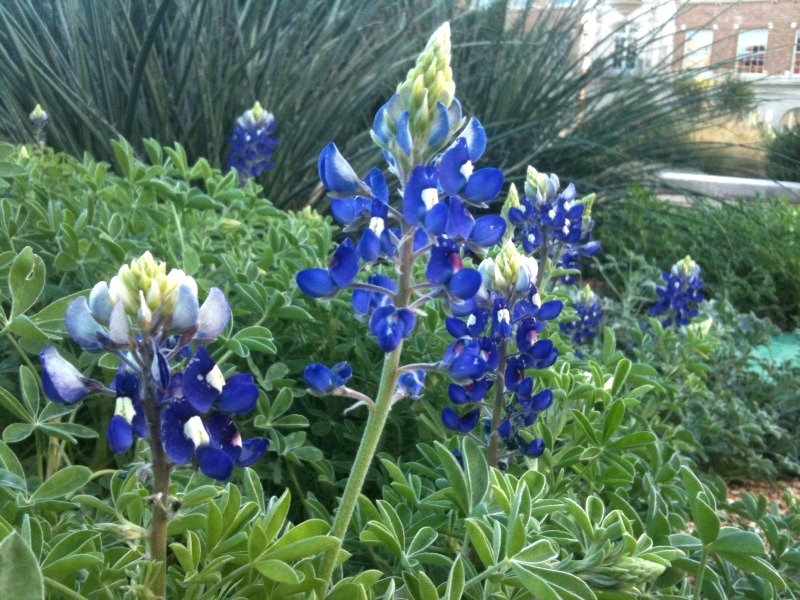
The greatest surprise is on the UT campus, where mature bluebonnets are already in full bloom. The photo above was taken this past week at the head of the East Mall, next to the Main Building. Bluebonnets and other Texas wildflowers traditionally arrive in mid-to-late March, which make these a full six weeks early.

It’s good to see the Texas Bluebonnet on the campus again. For years, the Texas state flower has been scarce on the Forty Acres, but recent efforts by the staff who take care of the grounds have made a special effort to guarantee the bluebonnet’s return.

OldMainBluebonnets

Old Main in the spring, around 1900.

Such efforts weren’t always needed. For the University’s first half century, the campus in springtime was awash with bluebonnets, along with poppies, yellow daisies, and the bright red blossoms of the prickly pear cactus. The old Main Building was a golden island in a blue sea, and the wildflowers were an invitation to campus picnics.

BluebonnettsonCampus

On a campus overflowing with bluebonnets, UT co-eds enjoy a picnic in 1899. The Woman’s Building, the first residence hall for co-eds (where the Flawn Academic Center is today), is in the background.

In the 1910s, the abundance of wildflowers helped create an annual tradition among University co-eds. Inspired by a similar rite at then women-only Vassar College, graduating seniors passed an immense, handmade chain of real bluebonnets, representing tradition and responsibility, onto the shoulders of junior girls who were dressed in white.

By 1922, the ceremony became known as “Swing-Out,” and was organized by Cap and Gown, a women’s student organization. The event was intended to recognize women leaders on campus, and to formally transfer the mantle of responsibility to the junior class. It was a prominent part of the annual Senior Week, which featured activities for all graduating seniors, both men and women.

Originally, a chain several hundred feet in length was made from bluebonnets attached to Spanish moss, but as more buildings appeared on the campus, the supply of both flowers and moss didn’t last. In 1928, a reusable chain of paper bluebonnets was created, and thereafter maintained by the sophomore class.

Swing Out.1920s

The Swing Out ceremony in the 1920s, on what is today the South Mall. Senior girls in caps and gowns have passed the bluebonnet chain, representing the ties of leadership and tradition, on to the shoulders of the junior class, dressed in white.

In 1955, Cap and Gown agreed to expand the ceremony to include both women and men, and Swing-Out evolved into an event to honor current student leaders and announce the leaders for the following year, including the new student body president. But the event grew less popular in the 1960s, and the 1964 edition was the last for several decades.

In the 1990s, a new version, called the Swing-Out Awards, was created to honor outstanding accomplishments and contributions by student organizations on campus. The awards are presented in April, but if the bluebonnets are going to start blooming earlier in the year, the ceremony might need to be rescheduled…

How to Borrow a Bell

or, What the Fulmore School gave to B. Hall, and vice versa.

Fulmore School Bell

The Fulmore bell safely resides in the courtyard of the school.

It was the final day of November 1911, as a chilly, peaceful, lazy Thanksgiving morning dawned on the University of Texas campus. The only holiday of the fall term, most of the residents of Brackenridge Hall – or B. Hall, as the men’s dorm was called – expected to enjoy some extra sleep. An inexpensive residence hall intended for the “poor boys” of Texas, B. Hall’s inhabitants didn’t possess many luxuries, and that included alarm clocks. For years, in order to wake everyone in time for breakfast and class, a designated bell ringer strode through the hall with a cowbell promptly at 6:45 a.m. every morning. But the University faculty took a dim view of the cowbell, thought it an unworthy instrument to rouse young college scholars, and at the start of the 1911 academic year had electronic chimes installed as a “more dignified method.” While this eliminated the need for the crude cowbell, the musical chimes turned out to be less than effective on slumbering students, who constantly had to pass up on breakfast in order to make it to their 9 a.m. lectures.

Bong! Bong! Bong! Bong! The morning quiet was abruptly interrupted at the usual 6:45 a.m., but not by a sound usually heard in the hall. A fire alarm? Startled residents rose from their beds and hustled outside to investigate. The noise came from the top of the building. As they peered up to the roof, they discovered a 30-inch brass bell, installed in a makeshift belfry in front of the community room on the fourth floor. How it arrived and who delivered it was a mystery, but the dorm’s inmates weren’t about to let such a gift go to waste. After a noontime Thanksgiving Day dinner, which was universally praised as the “best ever served in the hall,” the 120 residents gathered upstairs for a proper bell dedication. Junior law student Teddy Reese, who was also UT’s head yell leader, provided the oratory, described the history of the cowbells used in the past, dwelled on the failure of the electric chimes to serve their purpose, and expressed the “heartfelt and sincere thanks that is in the bosoms of all B. Hallers for the modest and benevolent donor of the bell, whomever it may be.” Katherine Smith, only the second woman to serve as the hall’s steward, officially christened the bell. “There not being any champagne at hand,” reported The Austin Statesman, “the ‘Belle’ christened the ‘bell’ with a bottle of good old Adam’s ale.” The bell was immediately put to use.

1911 B Hall Group Portrait

Some of the residents of B. Hall in a 1911 group portrait. Hall steward Katherine Smith is standing on the first floor, center, in the white dress.

In a remarkable coincidence, just as the unexpected bell arrived at B. Hall, a similar bell disappeared from the Fulmore School in South Austin. Opened in 1886, the Fulmore School was initially housed in a whitewashed, wooden, one-room structure just off South Congress Avenue. Austin resident Charles Newning presented the school with a bell in the early 1890s. A prized possession, the bell was rung a half hour before classes began every morning, and again as school ended for the day, so that parents knew their children would soon return home. Its familiar peal had been a part of the neighborhood culture for decades.

Early in 1911, the Austin School Board elected to build a new brick building for the Fulmore School, two blocks south of its original location. It was completed over the summer and formally dedicated on November 17, just two weeks before Thanksgiving. A short wooden bell tower, which looked something like a miniature oil rig, was constructed for the old bell, but it hadn’t yet been installed before the bell disappeared.

Fulmore Middle School.1934.

The Fulmore School in the 1930s. The building was completed in 1911, with a wooden bell tower (and brass bell) to the right.

As news of B. Hall’s good fortune spread to South Austin, the custodian of the Fulmore School began to wonder if the hall’s newly acquired bell, and the school’s missing bell, might just be one and the same. In the middle of the afternoon on Thursday, December 7, while most of the hall’s residents were in class, the custodian ventured to the UT campus and took an unwise risk. He entered B. Hall alone, quietly crept up the stairs to the belfry, and tried to examine the bell, which sported a fresh coat of red paint to disguise its former appearance. But the intruder was soon discovered, the bell rung in alarm, and B. Hallers sprinted from all parts of the campus to defend their home. According to accounts, one resident giving a speech in his law class heard the bell, abruptly stopped talking, and dashed from the classroom with no explanation. An engineering student was in the middle of a calculus problem at the chalkboard when the bell sounded. He muttered an apology to his professor – engineering dean Thomas Taylor – then jumped out of the first floor open window and hurried to the hall. Before the frightened custodian could make his exit, he was surrounded by a vocal mob of B. Hallers and doused repeatedly with so many buckets of cold water that he later remarked he’d had his bath for the week. But while the bell hadn’t been visibly identified, its familiar sound was unmistakable.

A week later, Dr. Harry Benedict, then serving as Dean of the University (what would today be called the “Provost”), received a letter from Arthur McCallum, the Austin school superintendent. “At a meeting of the school board yesterday afternoon,” wrote McCallum, “I was instructed to ask that the Bell which someone took recently from the South Austin school be replaced or put where someone can get the bell without suffering the humiliation of being watered.” McCallum explained that the bell had “summoned the children of that community to school for a long-long time, and I believe that the people of South Austin are more attached to the bell than the boys of B. Hall.” Certainly the custodian missed the bell, as he had been forced to improvise and use a cowbell of his own to call the children to school.

Benedict, himself a UT graduate and a former resident of the dorm, passed the note along to B. Hall steward Katherine Smith.

The fall ended with the bell secure in its B. Hall roost. It continued to be employed through the new year and into a chilly January, which included a rare, mid-month snowstorm. But as time wore on, the novelty of the bell waned, and “some embryonic reformer” began to urge his fellow residents that it was time to return the item to its true owner. As related in the Cactus yearbook, “So well did this Luther preach that ere long he had converted enough to make the project possible.” Since no one was willing to admit to kidnapping the bell, residents had to come up with a creative solution that would preserve B. Hall’s dignity.

On January 31, 1912, a letter was delivered to Superintendent McCallum from the “B Hall Boys.” It read, in part:

“Referring to the deplorable and regrettable loss of a bell from one of your ward schools and feeling deeply, but unresentingly, the insinuating remarks that have been made in regard to, and on account of, a certain melodious and more or less valuable bell which now swings in the B Hall belfry, we, collectively, individually, and separately, have unanimously agreed to heap coals of fire on your august heads (except the bald ones) by presenting free, gratis, and for nothing, and without trouble on your part, the same melodious, magnificent and misappropriated bell above referred to. This bell will be sent at our (or your) earliest convenience to the South Austin school which is suffering from ‘cowbellitis’ as once even B Hall did.”

B Hall Bell.Congress Avenue Bridge Crossing

Crossing the new Congress Avenue Bridge, B. Hallers return the Fulmore School bell atop a horse-drawn flat wagon on February 4, 1912.

Clangity-clang! Clangity-clang! The following Saturday afternoon of February 4, amid brief snow flurries, shoppers along Congress Avenue were amused by the ridiculous sight of a horse-drawn flat wagon loaded with about 20 residents of B. Hall, all dressed in various garb. One incessantly rang a bright red bell, and two others, one with a barrel and wooden pole, and other with a tuba, provided musical accompaniment. The sight and noise attracted nearly a hundred local school children, who followed along on foot or rode bicycles. At each street corner downtown, the wagon stopped and yell leader Teddy Reese led the group in “Fifteen Rahs” for the bell. The wagon continued across the bridge, over the Colorado River, and on to South Austin and the Fulmore School, which was three miles south of the University campus. Upon arrival, and with much fanfare, pomp, and ceremony, the bell was presented to the school’s custodian, who graciously accepted the gift.

A century later, the bell still proudly resides at the Fulmore Middle School, minus its coat of red paint.

1911.Teddy Reese Yell LeaderA few years after the incident (and, perhaps, after a statute of limitations had expired), Teddy Reese confessed to instigating the bell’s capture. In 1910, a new Congress Avenue Bridge was constructed to replace the older, unsteady pontoon bridge that once crossed the Colorado. A year later, the city’s electric trolleys extended a line across the bridge and into South Austin, and UT students began to take their dates on the trolleys to the south side for afternoon walks. The weekend before Thanksgiving, Teddy and his date spied the Fulmore School bell on the ground next to the new building, and Teddy decided that it would make an excellent alternative to the chimes used in the hall. Teddy approached his best friend in the dorm, Walter Hunnicutt (who would later compose “Texas Taps,” better known as the Texas Fight song), and together they recruited a crew of about 10 persons, all sworn to secrecy. In the late night hours before Thanksgiving, the group paid the B. Hall chef to borrow his horse and delivery wagon, went to the Fulmore School, carefully loaded the 300-pound bell so it wouldn’t ring, then returned to campus and quietly hauled the bell upstairs, where it was rung at the break of dawn.

Having returned the brass bell, the trusty cowbell was once again heard in B. Hall.

How to Woo a Legislature

It’s that time of year again. The 88th Texas Legislature convened January 10, 2023, and our University president – just as his predecessors before him – is mindful of UT’s relationship with the current occupants of the Capitol.

Legislative relations can be tricky. Because the University is state-supported, the president, while wanting to adequately convey the needs, priorities, and aspirations of the campus to lawmakers, is prevented from roaming the halls of the Capitol to lobby on the University’s behalf. While alumni and other supporters have since assumed this important role, such was not always the case, especially in UT’s infant years. What’s a University president to do?

An ingenious Sidney Mezes called on all of his resources and devised a creative, novel, and apparently successful, approach just over a century ago.

~~~~~~~~~~~~~~~~~~~~

Old Main Building 1900s

The old Main Building on the UT campus in the early 1900s.

It was a mild and pleasant Saturday, February 18, 1911, when members of the 32nd Texas Legislature gathered at the west entrance to the University of Texas campus. Shuttled from the state capitol in a caravan of electric trolleys, the legislators had been invited by UT President Sidney Mezes to a barbecue lunch, privately financed by a group of Austin citizens, and an opportunity to visit the buildings and grounds. The invitation was a welcome respite from a rather hectic legislative session. But if the lawmakers expected a simple, quiet meal, they would soon discover that on this particular day, the UT campus was anything but tranquil.

The trolleys arrived promptly at 11:30a.m., and as the legislators disembarked and stepped onto Guadalupe Street, they were eagerly met by a cheerful President Mezes, most of the faculty, and the 25-member University Band. The visitors were politely ushered on to the campus, directed to the West Walk – which in future years would become the West Mall – and up the hill toward the Victorian-Gothic old Main Building.

Waiting for the legislators were almost 1,000 male UT students, which stood shoulder-to-shoulder along each side of the walk. As the lawmakers ambled up the hill, the gauntlet of students smiled, cheered, bowed, saluted, and made certain their guests felt two and three times welcome. In 1911, classes were normally held Monday through Saturday, but on this Saturday morning a brief suspension was ordered. The Texan newspaper requested that every student participate “with your yelling apparatus well oiled.”

1911 Legislative Reception.1.

1911 Legislative Reception.2.

Above: Labeled “We Entertain the Legislature,” two small photos tucked away in a corner of the 1911 Cactus yearbook may be the last surviving images of the event. Top: The West Walk (now the West Mall) viewed from an upper floor of Old Main, while male UT students line each side. Most are sitting, waiting for members of the Texas Legislature to arrive from Guadalupe Street in the background. Bottom: Led by the University Band, lawmakers begin their procession up the walk. The wooden fence on the left secured a portion of the construction site for Battle Hall. Click on the images for close-ups.

The procession continued to the crest of the hill, and then around to the south doors of Old Main. Along the way, the group paused to view the progress of the new University Library, then under construction. Today known as Battle Hall, its broad, arched windows, red-tiled roof and colorful decoration would soon lend an air of architectural sophistication to the campus.

As the legislators approached Old Main, they were met by more than 600 University coeds, “clustered like a great bouquet” at the front steps. The girls sported their best Victorian dresses, serenaded the lawmakers with The Eyes of Texas, and pinned flowers on the lapels of their guests as they were escorted inside to the University Auditorium. According to Austin Daily Statesman, the transition was startling, as the legislators had been “greeted by the masculinity and strength of the school, and then suddenly found themselves overwhelmed by femininity, grace, and beauty.”

Old Main Auditorium

The University Auditorium in the Old Main Building.

The auditorium was crammed well beyond its seating capacity. On the main floor, House and Senate members sat in the front center section, surrounded on three sides by the male students and faculty. The upstairs balcony was reserved for the female members of the University community, as cheering, yelling, or anything else above a polite applause was considered “unladylike” and strongly discouraged.

Displayed on the auditorium walls were large charts, painted on canvas, which compared the University of Texas to other state universities (e.g. legislative appropriations given to universities in Illinois, Wisconsin and California, among others, had been awarded more in a single session that the University of Texas had received over its entire history), UT enrollment from each Texas county, and other information that might be of interest to the lawmakers.

Head yell leader and law student Gene Harris bounded upon the stage and conducted a boisterous series of UT yells in honor of the legislators. Among the cheers were the always popular Rattle-de-Thrat Yell and the Nine Rahs.

In response, the lawmakers stood and performed an impromptu oratorical stunt of their own, though the specifics were, unfortunately, not recorded.

President Mezes assumed emcee duties, welcomed everyone to the campus, commented briefly on the state of the University, and flatly told the legislators that UT’s future had been entrusted to them. Mezes then introduced four of the lawmakers – two each from the House and Senate – who addressed their colleagues in turn, emphasizing the needs of the University and expressing the desire to fill those needs.

One of the presenters was to have been Sam Rayburn, a UT Law grad and the newly elected Speaker of the House, but legislative business required Rayburn to remain at the Capitol. In his stead was Austin Kennedy, who led the House in the previous legislative session. Kennedy prefaced his remarks by claiming no gift for oratory, and then promptly launched into a dramatic, heartfelt speech. He’d been denied the prospect for a higher education early in his life, and made an emotional appeal to his fellow lawmakers to ensure that such an opportunity existed for future generations of Texans.

Gebauer Building 1910s

The old Engineering Building, currently the Gebauer Building.

With the program concluded, a hungry crowd of legislators left the auditorium, retraced their steps outside Old Main, and then turned east to the Engineering Building, today known as the Gebauer Building. Waiting for them, sprawled on long tables on the front lawn, was an immense barbecue spread of beef, mutton, and pork, along with bread, pickles, and coffee. The lawmakers took their seats and were served by the best-educated wait staff ever assembled in the state: the University Faculty.

After lunch, legislators took time to informally visit the University’s facilities, inspect classrooms and laboratories, talk with the students, and then took the mile-long stroll back to the Capitol. As the Saturday afternoon session began, the lawmakers discussed the funding of the University.

For the University of Texas, the 1911 legislative appropriation was the most generous it had yet received.

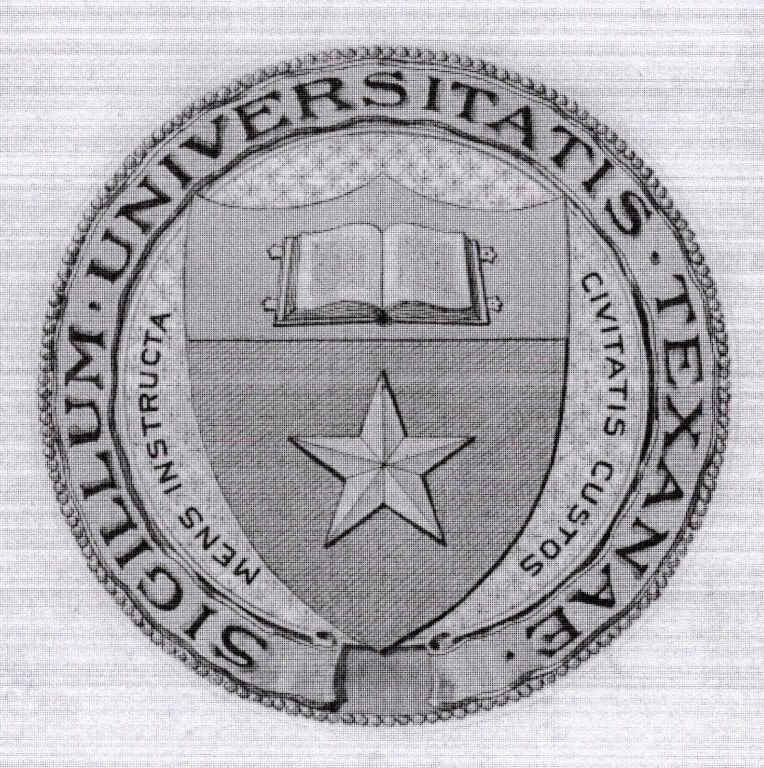
The University of Texas Seal

University of Texas Seal

Go to any UT library, pull a book off the shelf, open the front cover, and you’ll find it. Run afoul of the University police (well, hopefully not!), and you’ll see it on the shoulder patches of their uniforms. Stroll into the Gregory Gym annex and you can see it inlaid on the floor. It’s printed on every UT degree, carved in limestone on campus buildings, and displayed prominently on the Main Building for commencement. It’s the official seal of the University of Texas.

What we think of as the modern university made its first appearance in 12th century Europe as a well-organized union of teachers and students. It was an “academic guild,” similar in many ways to the trade guilds that were an important part of medieval towns. An aspiring tradesman would learn his craft first as an apprentice, and progress to a journeyman. When he had fully developed his skills, his final test was to produce a “masterpiece,” usually an object that showed his best skills and all that he had learned. If it passed inspection, he was declared a master tradesman by his peers and allowed to teach others. Academic degrees grew out of this same process. But instead of a masterpiece, a modern-day Ph.D. candidate writes a doctoral dissertation and defends their thesis in front of a faculty committee.

From the beginning, academic insignia and dress were an integral part of university culture. Congregations, lectures, examinations, and graduations all included ritual words, objects, music, and required forms of dress. A scepter or mace carried by the rector identified him as the leader of a university, graduating doctors often received gold rings with their degrees, and hooded capes, which evolved into the modern cap and gown, were worn to identify university members to the public, with special colors and designs for both students and teachers.

The most prized symbol of a university was its seal. Only granted by a pope or monarch, the seal officially recognized a university as a corporation that could conduct legal affairs, and whose members had special rights and privileges different from ordinary townsfolk. The seal was so valuable, often the original carving was kept in a special chest with a triple lock, and several university authorities were required to be present to open it.

Early university seals were usually intricate, elaborate designs: a student at a desk reading a book, the rector in academic garb holding a mace, or an image of a saint special to the university. A Latin inscription, the “motto,” was almost always included, and was sometimes considered the most important part of the design. Later, as knights were permitted to have seals that resembled their personal shields, university seals began to sport coats of arms of their own.

In November 1881, the newly-appointed Board of Regents of the University of Texas convened in Austin for its inaugural meeting. Among the many items on the agenda, a sub-committee of the Board was asked to create a seal for the university. They completed their task in a single afternoon.

The original UT seal borrowed liberally from the seal of the State of Texas, with a five pointed star framed on the left by an oak branch, representing strength, and on the right by an olive branch, signifying peace. Placed within a circle, Universitas Texana labeled the seal as belonging to the University, with the motto Non Sine Pulvera Palma. A well-known Latin phrase, the motto may be translated as, “The prize cannot be won without effort,” or in more modern terms, “Do your best.”

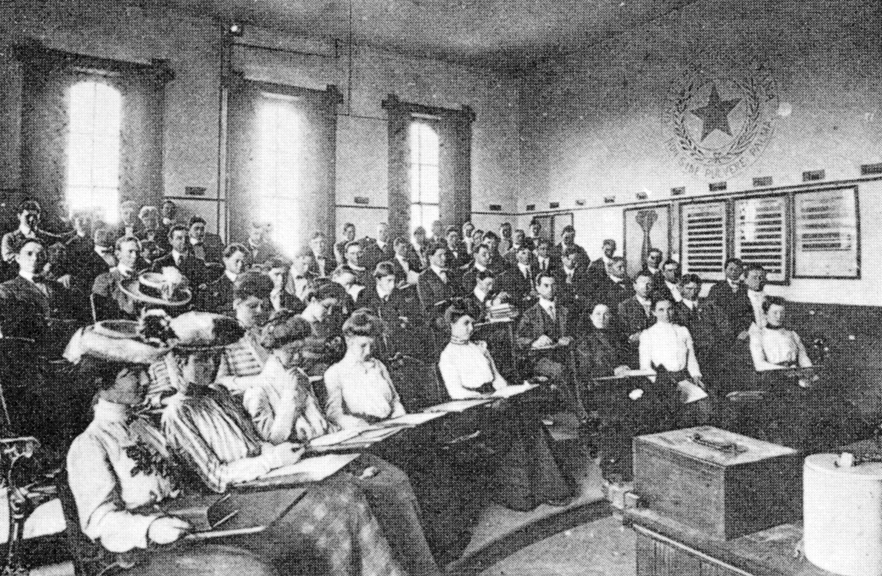
Money was set aside to purchase an embossing stamp, but the University seal wasn’t very popular. Its use limited to decorating degrees and a few other official documents, though a mural of the seal was painted on the wall of the history lecture room in the old Main Building. (See photo above, on the wall to the right. Click on the image for a larger version, and did you notice that all of the co-eds sit toward the front?).

In 1901, Dr. William Battle, a well-known and popular professor of Greek on the Forty Acres, took it upon himself to design a new, more distinctive seal for the University. He may have been prompted by the 1900 vote by students and alumni to recognize orange and white as UT’s official colors, and thought the time was right. Of the original seal, Battle declared, “Except for the word Universitas, it might just as well have been the emblem of the State Penitentiary.”

Battle was thorough. He purchased books on heraldry, and requested copies of seals from universities across the U.S. as well as from Oxford and Cambridge in England. At his own expense,Battle hired a leading firm in heraldic design – the Bailey, Banks and Biddle Company of Philadelphia– as consultants and to sketch prototypes according to his directions.

The process went through several versions, all of which are still preserved in the UT archives at the Dolph Briscoe Center for American History. Battle himself changed the motto to Republic of Texas President Mirabeau B. Lamar’s famous quote, “A cultivated mind is the guardian genius of democracy,” which at the time regularly appeared on the inside covers of most University publications. Battle’s Latin translation of Lamar was Mens Instructa Civitatis Custos, but this sounded a bit clunky. Instead, Battle conferred with friend and colleague Dr. Edwin Fay, head of UT’s Latin Department, who suggested, Disciplina Praesidium Civitatis.

In its final version,Battle described the University seal:

“In conformity with general usage, the design adopts as its central feature the shield form that shows the origin of its heraldic arms. The shield is divided into two fields, the upper white, the lower orange, the University colors. In the lower and larger field are the historic wreath and star of the Great Seal of the State of Texas; in the upper field is an open book, fit symbol of an institution of learning. The shield rests within a circle of blue, the color of sincerity, containing the motto, Disciplina Praesidium Civitatis. This is Professor Edwin W. Fay’s rendering of the apothegm of President Mirabeau B. Lamar, “Cultivated mind is the guardian genius of democracy. Around the disk of blue is a larger disc of red, color of strength, bearing the words, Sigillum Universitatis Texanae.

Battle presented his seal to UT President William Prather in 1903. Two years later, on October 31, 1905, the Board of Regents officially approved Battle’s proposal, though the words, Sigillum Universitatis Texanae, were changed to the English, “Seal of the University of Texas.” Within a year, the new seal appeared on library bookplates, invitations and programs of University events, and, of course, diplomas.

Images: The Seal of The University of Texas at Austin; Seal of the University of Bologna, Italy, among the earliest of European universities; the history lecture room in the old Main Building, from the 1900 Cactus yearbook; an early version of the UT seal, found in the William J. Battle Papers, Dolph Briscoe Center for American History.

Commencement 1912: No Style for a Texas Sundial

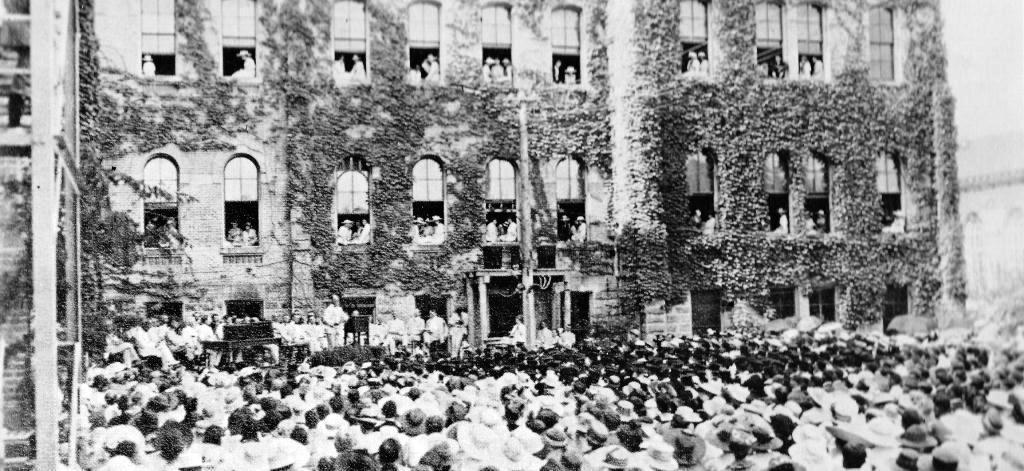
Above: A century ago, Spring Commencement was held on a June morning, on the northwest side of the old Main Building and protected from the early summer sun.

The University’s annual Spring Commencement draws tens of thousands to the Forty Acres. It’s a two-day extravaganza of school, college, and departmental ceremonies all over campus, culminating in a University-wide spectacle Saturday evening in front of the Tower. The deans brag about their schools and colleges, the University President congratulates both graduates and parents on their achievements, and fireworks are launched from the Tower to the delight of everyone.

Though not as grand in scale, the graduation schedule of 1912 was just as packed, and extended over four days in mid-June, starting with a Saturday all-University dance that began early, at 7:30 a.m, to take advantage of the relatively cool temperatures in the morning. A baccalaureate service was held Sunday, followed by Class Day ceremonies Monday morning, which featured the passing of gavels and other symbols of leadership on to next year’s senior class. The alumni association held their annual meeting and luncheon immediately afterward, and divided their ranks into three groups: the “Ancients” were those who had graduated among the University’s first 10 classes, 1884 – 1893; “Mediaevals” finished their degrees between 1894 and 1903; and “Old Timers” designated the rest. Each group had a special ribbon to wear for the week.

The alumni luncheon finished in time for attendees to stroll over to old Clark Field to watch the first-ever baseball game between the current Longhorn team and the alumni. UT grad Will Hogg, son of former Texas governor Jim Hogg (and for whom the Will C. Hogg Building is named), served as celebrity umpire. Coach Billy Disch arranged to borrow “baseball suits” from the local Austin Senators team so the alumni would have a uniform to wear. It didn’t help. Despite the stand-outs on the alumni roster, the Longhorns won the day.

But the day wasn’t yet finished. At 7:30 that evening, a crowd gathered on the campus for the popular student-alumni parade through downtown. Many in the group carried torches or vari-colored Chinese lanterns, and the parade included two brass bands and several floats. “After a thousand torch lights of red and green,” reported the Austin Daily Statesman, “the student body and the old time grads who are visiting, frisked around the campus and back again.” The procession ended on the northwest side of the old Main Building in front of a temporary wooden platform. There, graduating seniors put on vaudville acts, other students offered skits, and held yell leader Teddy Reese lead the group in some UT cheers and songs before the party ended late in the evening.

The official commencement ceremony, Tuesday morning at 10 a.m., was conducted at the same spot as the previous night’s gathering, in the shade behind Old Main. An elegant Final Ball that night at the Driskill Hotel concluded the week’s events.

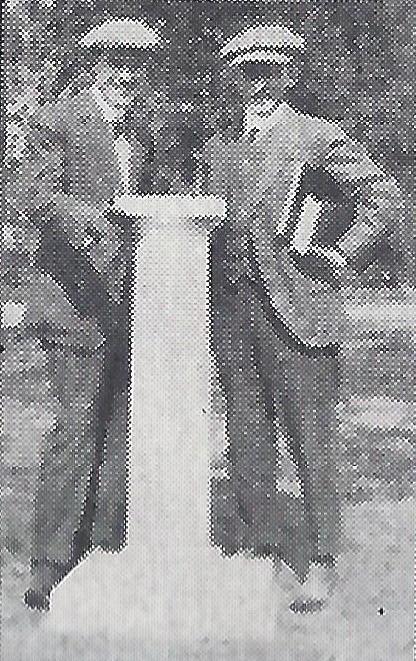
Sprinkled in between the cracks of a hectic schedule were plenty of receptions and other parties, and the formal dedication of a gift to the University from the Academic Class of 1912: a sundial (photo at left). With a marble pillar and a brass plate, it was placed about 100 feet south of the Woman’s Building – the first co-ed residence hall – so that it would have been seen along today’s West Mall.

Unfortunately, the sundial’s style, usually a triangular piece that casts a shadow on to the plate, wasn’t made for Austin’s latitude. “The time of day could not be determined to the nearest hour,” moaned Harry Benedict, then Dean of the Academic Department, “and the time of night could not be determined at all.” This made the sundial’s inscription, “Ye Know Not The Hour,” both redundant and superfluous.

Even worse, within a year, the style was broken off and taken outright, an act that reduced the inscription to being downright hilarious, and prompted accusations from College Station that “Texas has no style.” Despite the heartfelt intentions from the Class of 1912, the poor sundial was quietly removed, and has long since been lost.

Rules for Freshmen . . . in 1908!

A steamy summer has arrived in Austin, and with it comes another orientation season on the UT campus. Starting in June and continuing into mid-July, seven, three-day sessions will attempt to acquaint new students with the inner workings of the University. It’s a daunting task, but UT now provides a wealth of programs to help Greenhorns adapt to life on the Forty Acres. The Gone to Texas convocation held on the night before classes begin in the fall, Freshman Interest Groups (FIGs), Freshman Seminar classes, the Freshman Leadership Organization (FLO), Camp Texas, and more, are intended to support and help new students integrate into the University community.

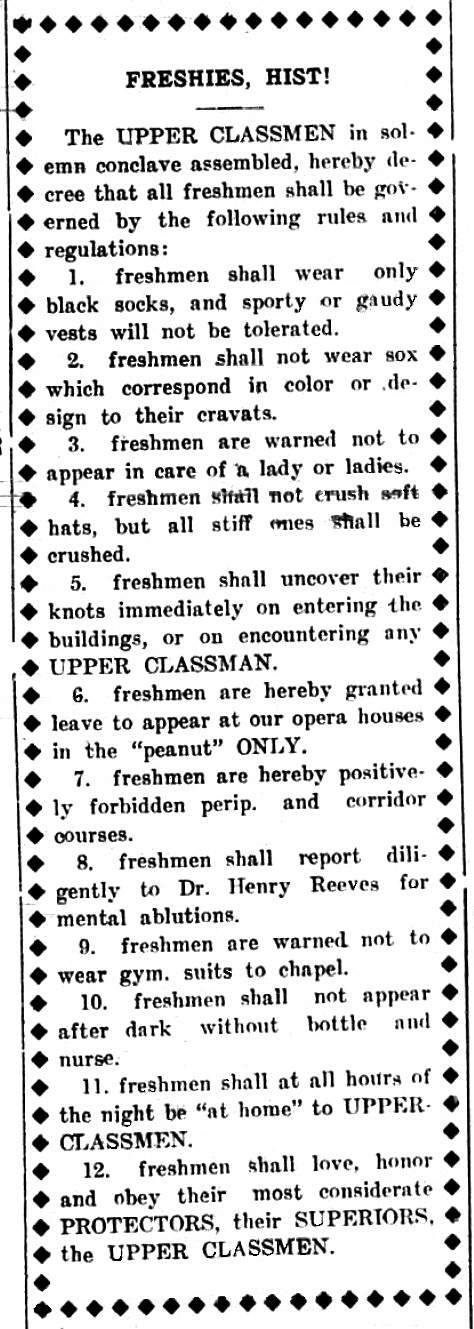
But such was not always the case. The freshman class of 1908 would have perused the Texan student newspaper and discovered a less-than-cheerful set of guidelines penned by some of the upperclassmen. Published in the October 3rd edition, near the start of the fall quarter, were a dozen rules for the male freshmen. (Click on the photo to see a larger version.)

All are silly, and the word “freshmen” is always printed with a small “f”: “freshmen are warned not to wear gym suits to chapel,” or, “freshmen are hereby granted leave to appear in our opera houses in the ‘peanut’ [peanut gallery = back seats] ONLY.”

Most of the guidelines are self-explanatory, but a few might need some explanation.

Rule five: “freshmen shall uncover their knots immediately on entering the buildings, or on encountering any UPPER CLASSMEN.” A knot, in this case, is a head. Freshmen were asked to doff their hats as they went inside, or whenever they met a “higher ranking” upperclassman.

Rule seven: “freshmen are hereby positively forbidden perip. and corridor courses,” refers to the Peripatos, or “Perip” for short, the sidewalk that encircled the Forty Acres. It was a popular activity to stroll the Perip with a date, or follow the Varsity Band on one of its promenade concerts, with stops along the way for dancing and sing-alongs. And the corridors of the old Main Building were the places to meet friends between classes. In short, the rule stated that freshmen shouldn’t be seen at the popular hangouts around campus.

Rule eight: “freshmen shall report dilligently to Dr. Henry Reeves for mental ablutions.” Neither a Ph.D. nor a medical doctor, Henry Reeves was hired on as a custodian for the gymnasium in 1897, and for more than two decades became a popular and valuable assistant to the football team as a self-taught physical trainier. “Doc” Henry patched up injured UT athletes at home and on the road, and was quick to lend a sympathetic ear and offer encouragement and advice to everyone.

After reading the other rules, some freshmen might have been anxious to make an appointment with the friendlier “Dr. Reeves.”

Image from the October 13, 1908 issue of the Texan student newspaper.

Of Regents and Women

Combing through the minutes of the UT Board of Regents can be a tedious process. They’re a great resource for University history, though all too often, what had to be some lively and animated debates are either boiled down to a few dry sentences, or only the final decision was recorded. But sometimes, there’s a peek into the manner and attitudes of the regents, and of their times.

On July 12, 1917, the regents met in Austin to, among other things, meticulously review the University’s budget. The United States had entered World War I the previous April, and the Board was looking to financially trim what it could to help with the war effort. Most salary raises were placed on hold for the duration. Before the war was over, UT would partner with the War Department to host three military schools. The School for Military Aeronautics (SMA) was stationed at the Little Campus. Hargis Hall and the Nowotny Building just north of the Erwin Center are all that’s left of a larger complex. The SMA was called the “West Point of the Air,” and was a prototype for the Air Force Academy. The School of Automobile Mechanics was stationed at Camp Mabry, where instructors included members of the UT faculty. And the School of Radio Operators was located on campus and set up shop in rows of canvas army tents that lined what is today the South Mall.

While meeting in the old Main Building – in an Austin summer and without air conditioning – the regents’ review came to the Department of Home Economics, today’s School of Human Ecology. The department’s proposed budget for the 1917-18 school year was $13,800, most of which went to faculty salaries. (Department chair Mary Gearing was to be paid $3,000.) Two of the regents, John Mathis and William Love, moved to eliminate the department outright. Regent George Littlefield spoke up to defend it, but thought “the salaries were too high for women.” His fellow regents must have agreed. As a compromise, the Board decided to reduce all of the teaching slaries by 20 per cent.

Four years later, Governor Pat Neff appointed Mary McLellan O’Hair as the first woman regent. A vocal supporter of women’s suffrage, and an active member of both the Daughters of the American Revolution and the Daughters of the Republic of Texas, Mrs. O’Hair would likely have had her own opinion on how much women should be paid.

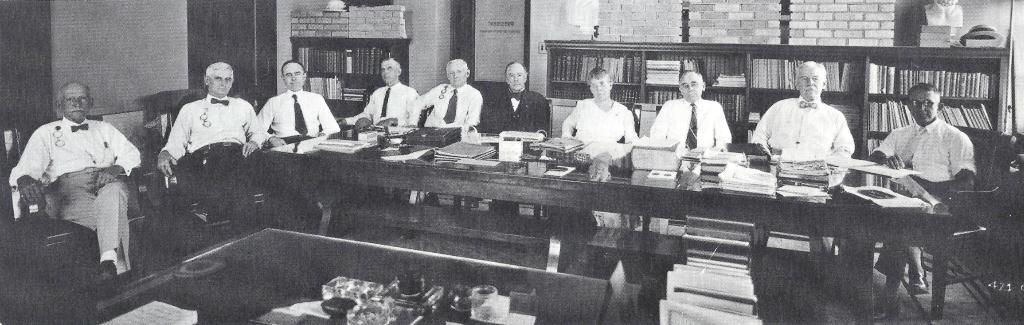
Photo above: The 1923 Board of Regents meets on campus. Mary McLellan O’Hair, the first woman on the Board, is fourth from left. UT President William Sutton is seated on the far left.