
Above: The victorious Whitis Team, which won the first basketball game played on the Forty Acres. Gym instructor Pearl Norvell is in the center with the basketball.
Women’s basketball is almost as old as basketball itself.
 As most fans of the sport know, basketball was invented in December 1891 by Dr. James Naismith, (photo at left), then an instructor at the YMCA Training School in Springfield, Massachusetts, about 90 miles west of Boston. Newspaper accounts of the new game reached Sendra Berenson, a newly-hired physical training instructor at nearby Smith College for women. Looking for new activities that would interest and engage her students, Berenson introduced basketball the following spring, though she thought the style of play used by the men to be too rough. With Naismith’s help, Berenson adapted the rules for a women’s version of the game, which permitted five to ten players on a side. The court was divided into three equal sections; each player was assigned a section and couldn’t move beyond it. To speed up the pace, girls were limited to three dribbles each and could hold the ball for only three seconds before passing it to a teammate. The game relied more on passing and shooting skills than full court sprints or fast breaks.
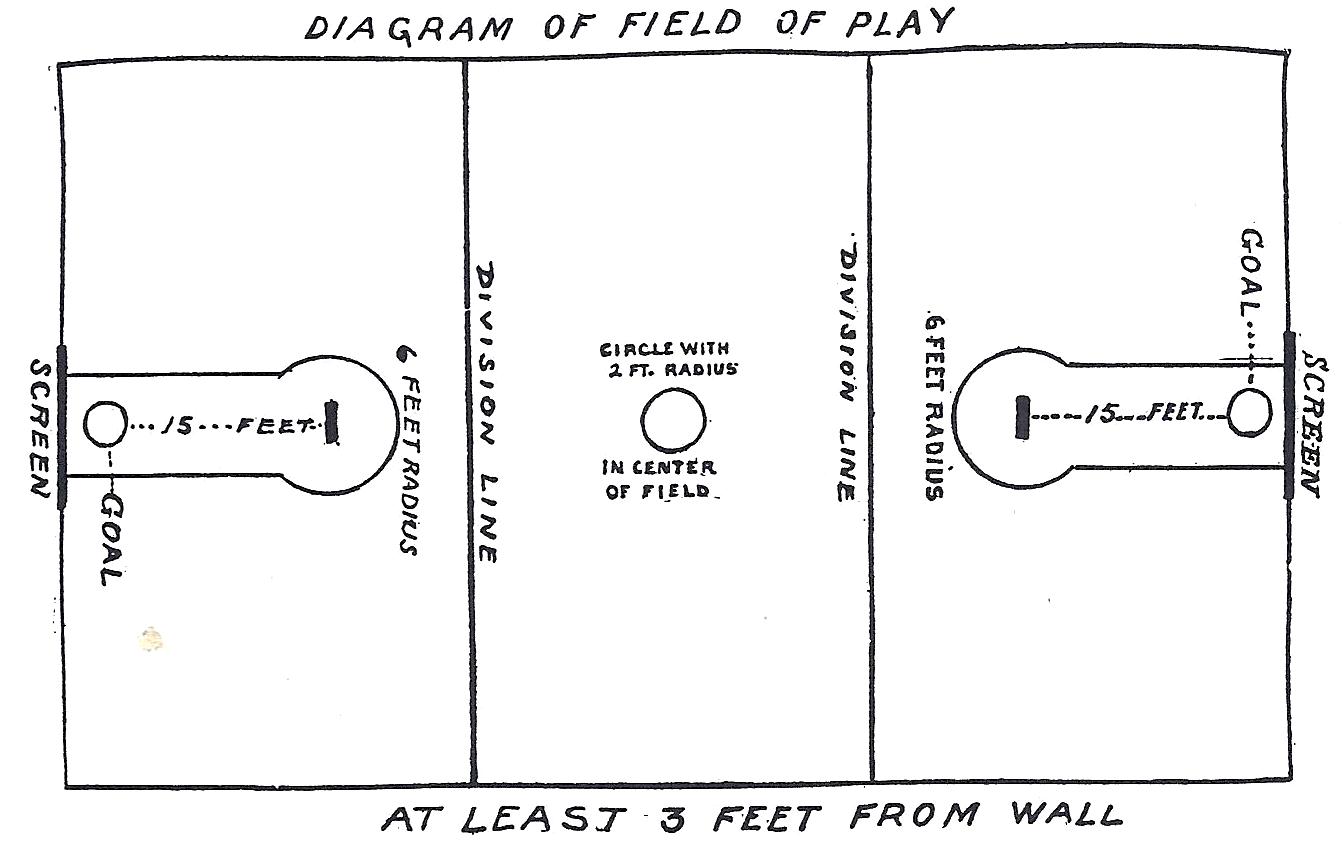
Above: Sedra Berenson’s three-court design, which appeared in a 1901 guide for women’s basketball.
Another early advocate for the game was Clara Baer, who taught at Sophie Newcomb College in New Orleans. Baer published a handbook for women’s basketball in 1895 and taught the one-handed shot not used by the men until thirty years later. Baer, though, also devised her own rules. Taking Berenson’s three-court idea to an extreme, Baer divided the court into as many squares as players on a team. Players usually didn’t have to run more than a few steps, which might have been preferable as Baer also kept the girls in long dresses in corsets, while Berenson opted to keep her teams in loose-fitting bloomers.
Both versions were in response to the prevailing attitudes about women and sports at the time, that young ladies who exercised too much might “break something” and risk their futures as mothers. “You can over-exercise, become too much excited over contests in the gymnasium, use up force to such an extent that your womanly functions become weakened,” explained Dr. William Howard, whose cautions in the early twentieth century were widely accepted. “No girl with a nervous temperament should go into any athletic contest. Such a girl should not play basketball; nothing, in fact, which calls for a strain upon the nervous system.”
~~~~~~~~~~
 At the University of Texas, basketball arrived in the fall term of 1899 with the hire of Pearl Norvell (left) as the physical training instructor for women. Norvell had attended the highly-regarded Sargent School for Physical Training in Cambridge, Massachusetts (now Sargent College, a part of Boston University), and had learned about basketball directly from Sendra Berenson.
Along with Norvell’s arrival, the University renovated the largest room in the west wing of the old Main Building, initially used as the library, to serve as a new women’s gymnasium. Previously, in 1896, UT’s first gym had been constructed in the basement of the building with student support and a timely donation from UT regent George Brackenridge, but the facility wasn’t considered suitable for young women. The new ladies gym was outfitted with its own locker room and equipped with, among other things: fifty pairs of dumb bells, a vaulting box, a set of parallel bars, two climbing ropes, twenty-five pairs of fencing foils, and “one pair of basket ball goals.” Classes were mandatory for freshmen women, but were soon popular among all of the coeds. “The young ladies gym at the University is being liberally patronized,” reported the Austin Daily Statesman, and Miss Norvell is fast improving the young ladies, physically speaking.” The University Calendar, one of several student newspapers that pre-dated the The Daily Texan, agreed: “There is not a young woman in the ‘Varsity who is not proud of the gym and its charming instructress. We wonder which section will play the best basket ball.”

Above: The first women’s gym in the old Main Building. The tall pole in the center is a basketball hoop. Click on an image for a larger version.
Norvell had organized four basketball squads, and taught the game through the fall term using Berensons three-court rules that she’d learned in Massachusetts, with one point awarded for a basket or a free throw. Games would be played starting with the winter term.
On the cloudy and chilly afternoon of Saturday, January 13, 1900, the first basketball game on the University campus was held between the Whitis and Ideson teams, named for their captains: Gertrude Whitis and Margaret Ideson. With seven players on a side, the game was divided into four 10-minute quarters.
A few spectators were allowed to watch – women only! – though it was “with difficulty that they restrained their feelings.” According to The Ranger (another one of those early student newspapers), “As the game was called, each face was earnest and each eye eager.” The match was a spirited but low scoring one. In the third quarter, with the tally 2 – 1 in favor of the Whitis team, a foul was called and the Idesons were given a free throw. Miss Laura Kritser, “took her stand, amid breathless excitement, aimed cooly, and made her goal.” The tie lasted until late in the fourth quarter when Whitis scored again, and despite the “superhuman” efforts in the final minutes, won the game 3-2. Women’s basketball had made its official debut, and was instantly popular.

Above: The 1902 women’s basketball squad, with Pearl Norvell in the center.
Norvell continued to develop the program over the next several years. From the inter-class teams she selected a University squad that played against the “Town Girls” from the Austin Y.W.C.A., and traveled to local high schools, but didn’t engage in intercollegiate competition.
Despite the enthusiasm of the students, numerous concerns about too much exercise were soon raised among members of the faculty. To help allay any fears, Norvell scheduled an open house in March 1901, and invited the professors’ wives so they could witness the activities for themselves and “report back to headquarters.” The gym was decorated with orange and white streamers and flowers, students demonstrated some of the exercises they did in their classes, and the coeds and faculty wives mingled in a reception “with the daintiest refreshments.” Norvell’s efforts helped, but progress was slow.
 In October 1903, the Woman’s Building (photo at left) opened as the University’s first residence hall for women. Positioned west of Old Main (about where the Flawn Academic Center is today), it, too, was controversial. As the Texas Legislature considered a $50,000 appropriation for the building’s construction, many lawmakers believed college women would be better supervised if they stayed with Austin families rather than in a dorm. A tie vote in the House required the Speaker to cast the deciding ballot and approve funding.

Above: The basement gym in the Woman’s Building. The elevated running track doubled as a gallery for basketball fans, though only women were allowed entry. Click on an image for a larger view.
Outfitted with an elegant dining room, full kitchen, parlor, and an elevator, the basement of the Woman’s Building was reserved for a gym. A step up from the cramped quarters in Old Main, the gym included a small pool for swimming lessons, an open area for exercises, dance classes, or basketball, and an elevated running track that doubled as a gallery to watch basketball games.
 Along with the new building came a new instructor. Pearl Norvell was succeeded by Louise Wright as Director of Physical Training for Women, and immediately set out to expand the basketball program. In the spring of 1904, the first season in the new facility, UT hosted its first out-of-town squad, the girls from Belton High School, about 60 miles north of Austin. The Texan printed a headline that labeled the game as being between Texas and Baylor, which has led some to think it was the first intercollegiate game. But the article, and other reports in the Austin Daily Statesman, are clear that the opponents were from the high school. What’s going on here?
Baylor was chartered in 1845 by the Congress of the Republic of Texas and first located in the small town of Independence. After a few years, in 1851, the university divided into two campuses for men and women. The men relocated to Waco, the women to Belton, where it became the Baylor Female College (today’s University of Mary Hardin-Baylor). The connection between Belton High School and Baylor isn’t clear, though it’s possible the two coaches for the high school squad were on the Baylor faculty.
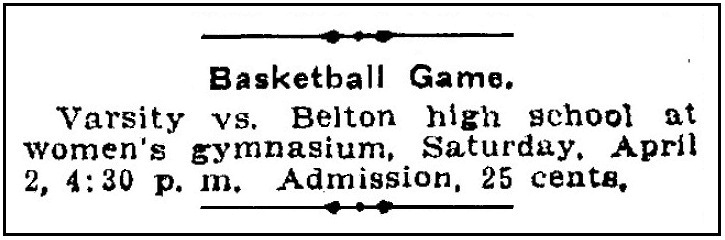
The game was scheduled for Saturday afternoon, April 2nd, with a 25-cent admission, half of which would go to the Belton team to cover their traveling costs. Texas won the game easily, 12 to 6. “The girls won many new admirers,” reported the Texan, “and it is to be hoped that those who have opposed such sports before will have had their eyes opened to the many admirable and beneficial features of the game.” The Texas team did a “zig-zag march” across campus to mark their victory; today the women’s basketball team probably celebrates in a different way.
Along with hosting an out-of-town team for the first time, Wright helped the coeds to formally organize a Women’s Athletic Association to better coordinate all on campus women’s sports,and successfully petitioned the University’s Athletic Council to award letters in tennis. While none of the female sports programs were intercollegiate, women’s tennis appeared on the campus first and was better established. Letters, though, were smaller than those given to the men, and were worn on the sleeve of a letter sweater. In 1906, the Athletic Council formally approved a men’s basketball team, and at the same time approved letters for women’s basketball as well.

Above: The 1906 women’s tennis team, The two girls in the center, team captains, are sporting the letter sweaters then approved for women’s sports.
When, then, was the first women’s intercollegiate game? One source has claimed it was 1906, when the renown Clara Baer brought her squad to Austin from Sophie Newcomb College in New Orleans. Similar to the Baylor Female College, Newcomb was the “women’s department” of Tulane University. But while scheduling a game between Texas and Newcomb was suggested, the contest never actually took place. Baer was still using her own rules, different from the three-court game played in Austin, and she was ardently opposed to intercollegiate competition.
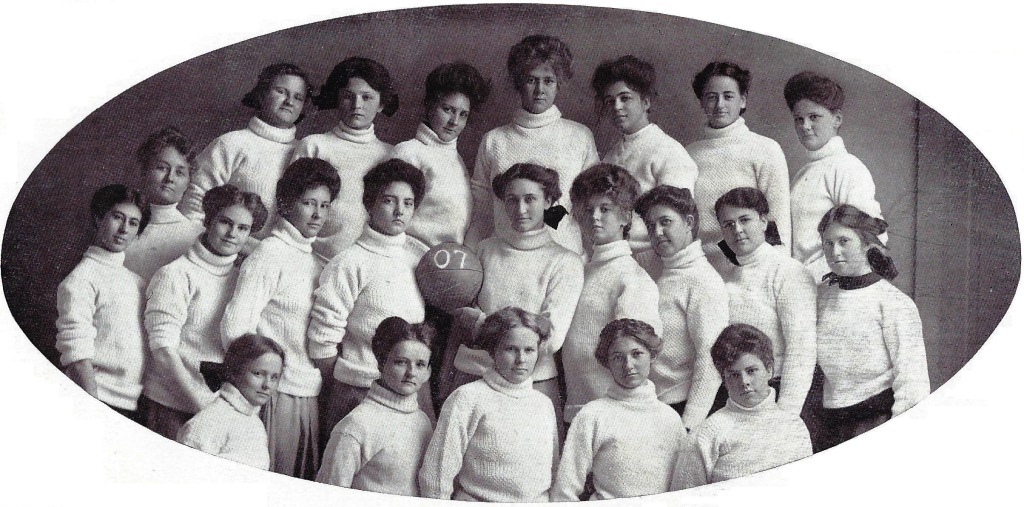
Above: The 1907 UT women’s basketball team.
Instead, the first recorded intercollegiate game for UT women’s basketball was held the following year, in the spring of 1907, when Texas hosted a squad from Southwestern University on Monday, February 18th. “A better exhibition of the game was never seen in this city,” declared the Austin Daily Statesman, “both teams were well trained and were selected from the best material in the respective schools. The gallery above the court was full, “the visiting girls having numerous supporters mingling with the fair wearers of the orange and white,” and the score was close through all four quarters. But in the end, Southwestern scored the final, and winning, basket, handing UT its first defeat 19-18. A post-game dance was held for both teams in the parlor of the Woman’s Building as “the young ladies from Georgetown were given a good sample of ‘Varsity hospitality.”

While the initial game was a loss, today’s Longhorn basketball faithful might take comfort in knowing that UT’s first baseball game, played April 21, 1885, was also against Southwestern and was a 22-6 rout, though the colors orange and white made their first appearance.
The University’s experiment with intercollegiate women’s basketball didn’t last long. Bowing to the common belief that competitive sports for college ladies was too stressful (though some universities, such as Ohio State, regularly played local colleges, while high school girls teams were vying for state interscholastic titles), UT limited the game to intramural leagues. Not until 1967, when a group of UT students petitioned the Department of Physical Training for Women, was a squad allowed to participate in newly created college tournaments in Central Texas. The team, though, was still considered a club. Coaches were faculty volunteers, and the players sewed their own uniforms and paid for travel expenses. Not until 1974, after Title IX was enacted and Donna Lopiano hired as the Athletic Director for Women, was intercollegiate women’s basketball formally established on the Forty Acres.


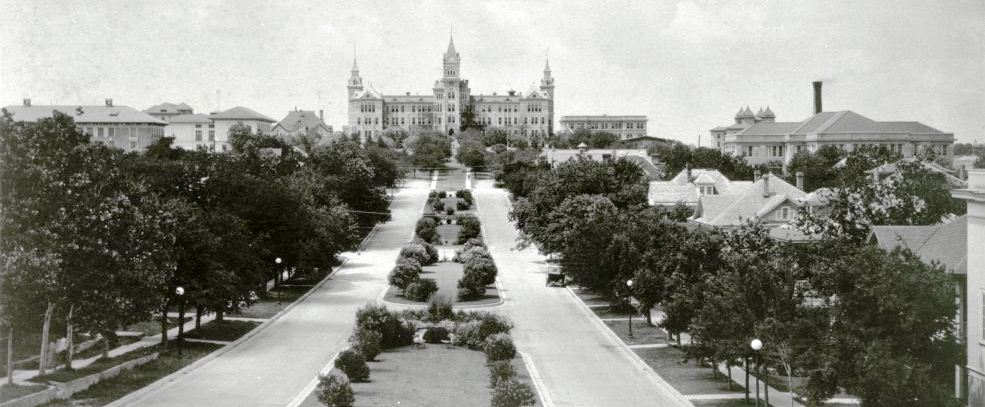
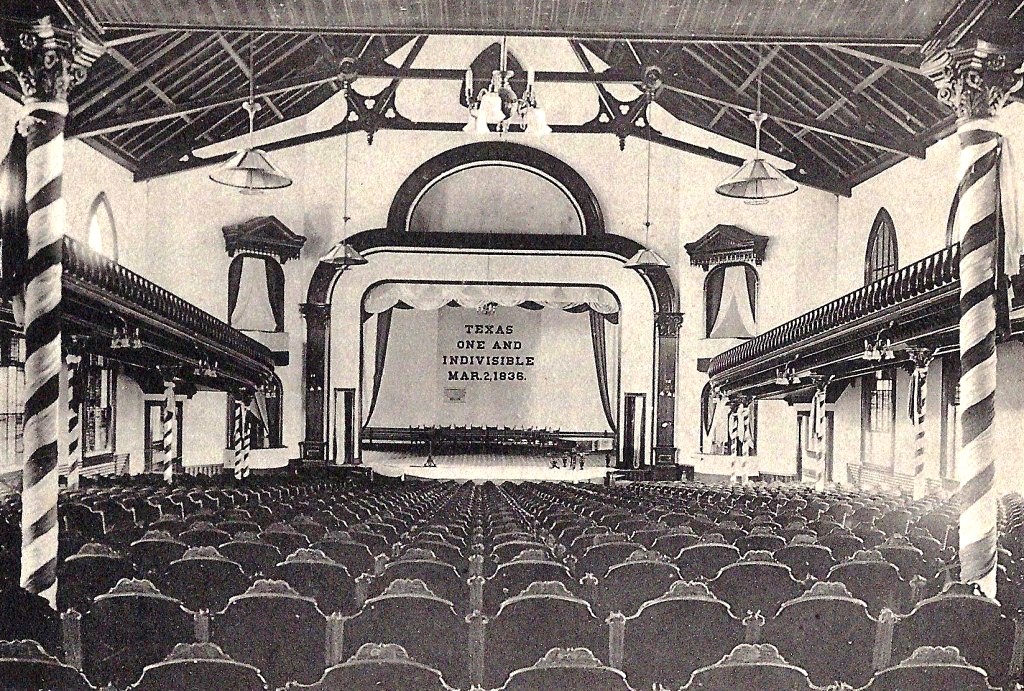
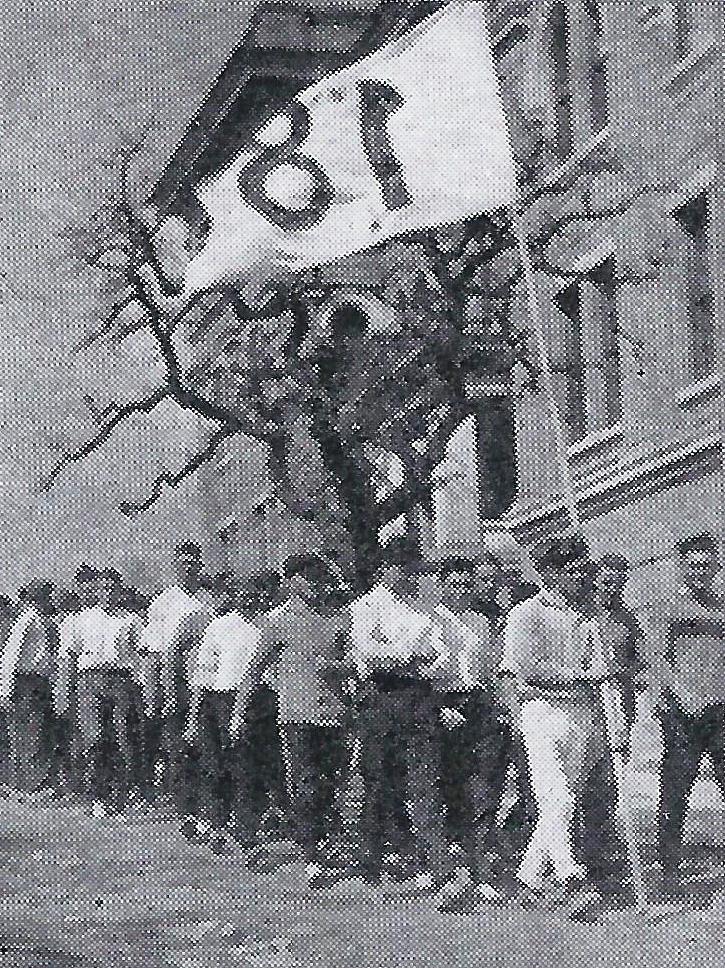


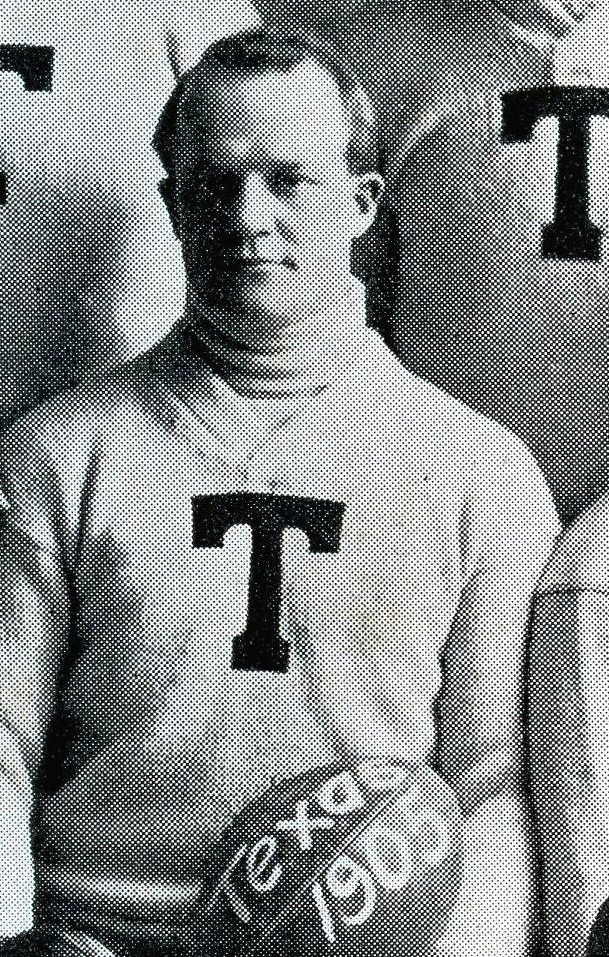
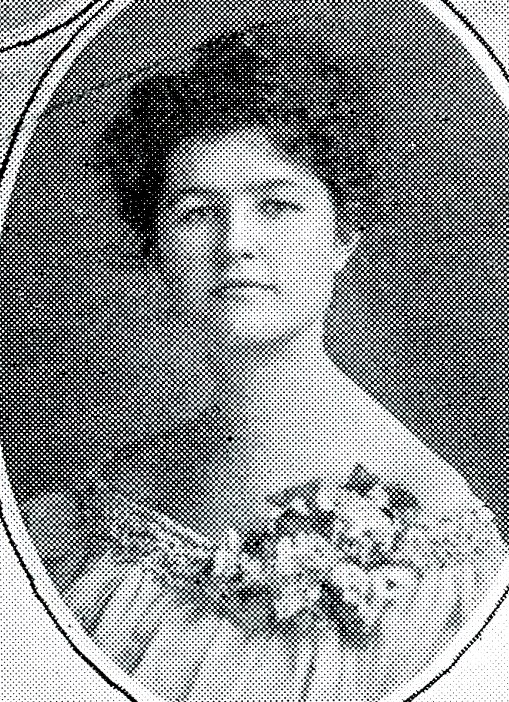
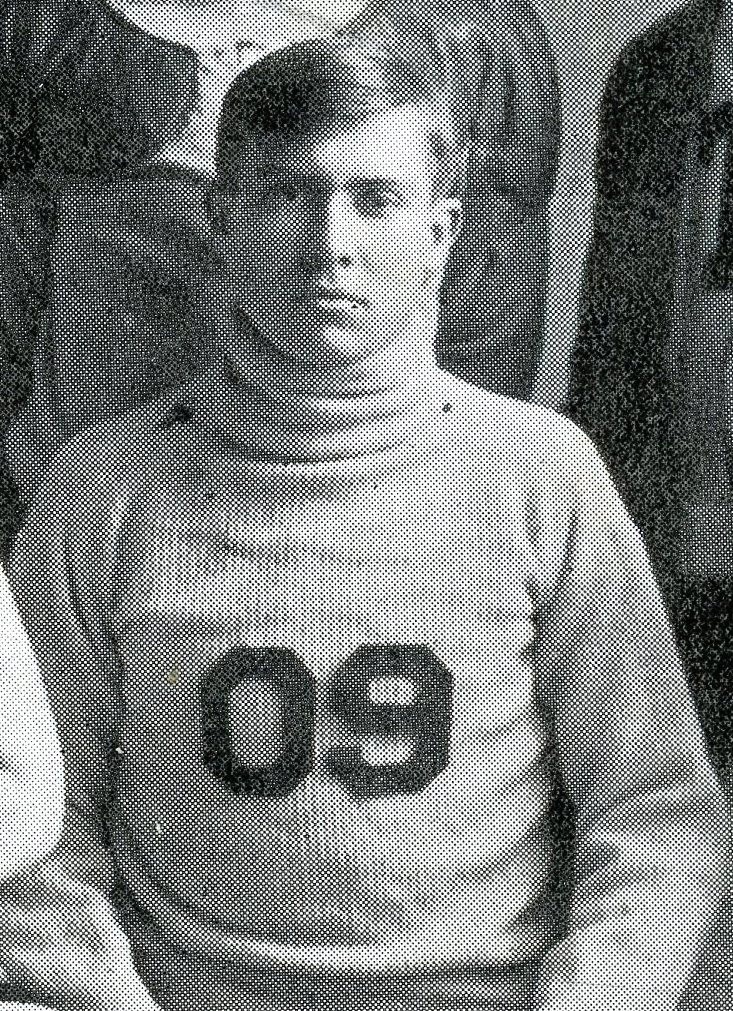

 Dormitories were not originally planned for the University. Ashbel Smith, the first chair of the Board of Regents (photo at left), was flatly opposed to them. “It is even worse than a pure waste of money. Nor should there be a college commons where students eat in mess. Experience is decisive on these points.” By experience, Smith knew of the raucous student rebellions that had plagued Harvard and Princeton and left their dorms in shambles, and of a violent incident at the University of Virginia in which a professor was shot and killed. All of these events involved young men housed together on the campus, which left many college authorities hesitant to build dorms. Cornell’s first president, Andrew White, hoped the hometown citizens of Ithaca, New York would provide room and board. White wrote in 1866, “Large bodies of students collected in dormitories often arrive at a degree of turbulence which small parties, gathered in the houses of citizens, seldom if ever reach.” Manasseh Cutler, a Massachusetts botanist who helped to settle Ohio and found Ohio University, was more direct: “Chambers in colleges are too often made the nurseries of every vice and cages of unclean birds.”
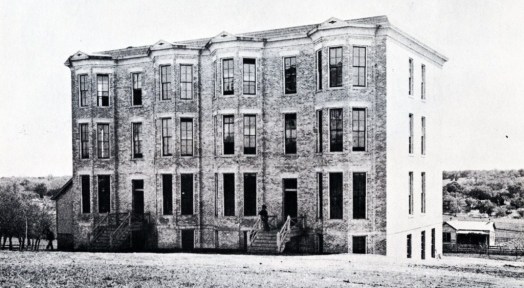


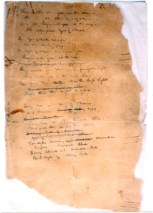 Along with classes, B. Hall occupants took an active part in UT affairs, voted for themselves in student elections, and were recognized as campus leaders. Their contributions to the University were many and long lasting. The origins of The Eyes of Texas,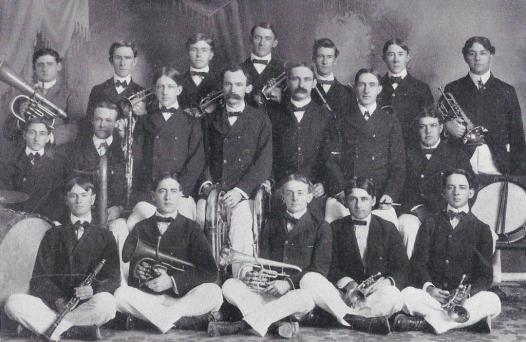
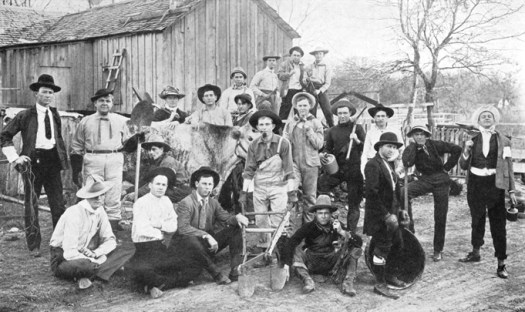
 By the 1920s, as University enrollment surpassed 4,000 students, B. Hall was still the only on campus men’s dorm. Though it was no longer a designated refuge for the “poor boys” of the state, it was still less expensive than other housing options and in high demand. The hall’s popularity meant that most rooms went to upperclassmen or older students, who were solid academically and already involved as campus leaders.

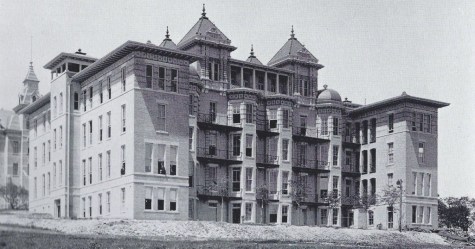
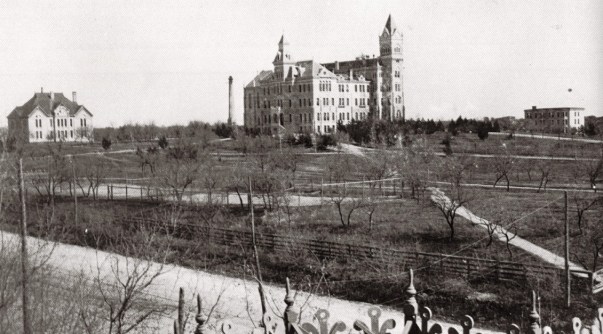
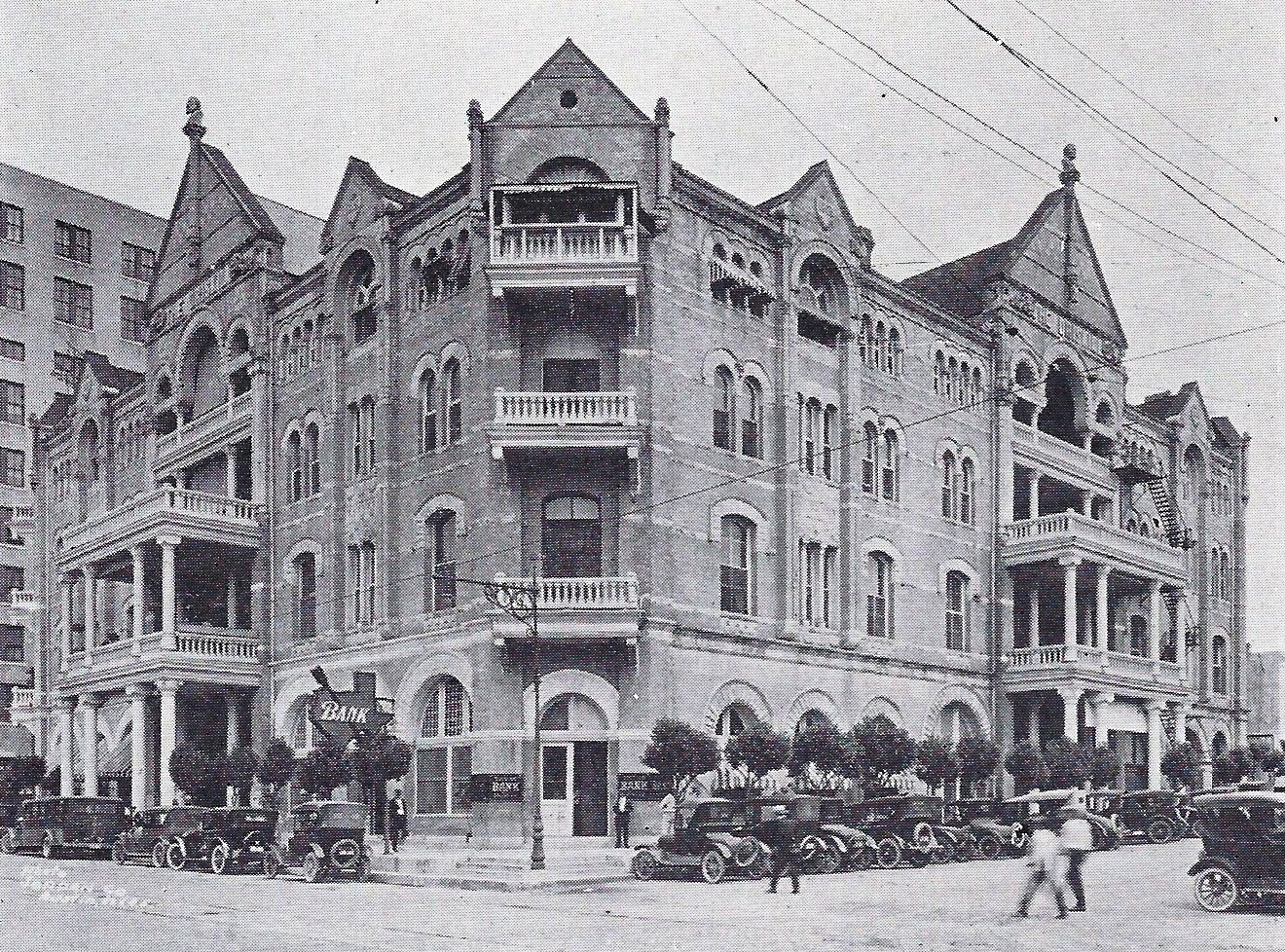
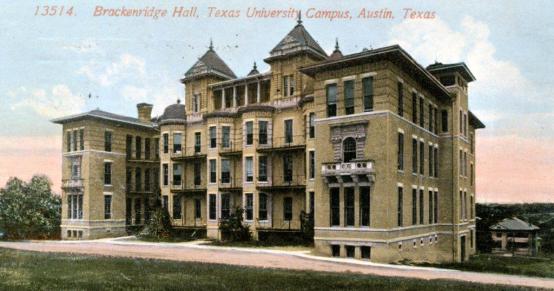
 On December 1, 1890, the University opened Brackenridge Hall, known on campus simply as “
 The following year, November 26, 1891, the first Thanksgiving Day meal was served in B. Hall. As most of the residents were too poor to afford a train ticket home, the hall’s steward, Harry Beck, had a feast prepared and a special menu printed on 4 ½ x 7 inch cards. Though the menu has not survived, it was published in the Austin Statesman.



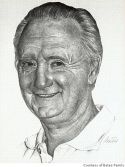 Enter Bill Bates.Originally from Tyler, Texas, Bates transferred to UT for his junior and senior years, 1949-1951. An art major, he had classes with Fess Parker (who would become famous as Disney’s Davy Crockett as well as the Daniel Boone TV series), and for a time dated Cathy Grandstaff, the future Mrs. Bing Crosby. A UT cheerleader, Bates was also a artist for The Daily Texan. He would later travel the world as artist-in-residence for Royal Viking Cruise Ships, then settle in Carmel, California as a cartoonist for the local Carmel Pine Cone. Twice Bates was a finalist for the Pulitzer Prize. He passed away in 2009, survived by his wife and daughter.
 Bates was a regular at Bimbo’s 365 Club (photo at left), a nationally known San Francisco nightclub. Founded in 1931 by Italian immigrant Agostino Giuntoli – nicknamed “Bimbo” by friends who had trouble pronouncing his name. (Unlike the current American slang, “bimbo” comes from the Italian “bambino,” a young boy. The nickname was fairly common.) The 365 Club was a place to see and be seen through much of the 20th century. Hollywood celebrities were frequent customers. Rita Cansino, better known as the actress Rita Hayworth, was discovered there. Now more than 80 years old, the
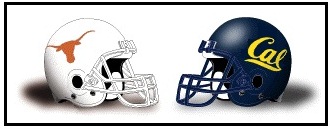
  A football game was taking place on the field, but a good many fans – and players – were more than a little distracted by the spectacle on the sidelines. “University of Texas rooters more or less disrupted the Cal – Texas football game Saturday by hiring a half dozen chorus girls from a San Francisco night club to act as cheerleaders,” reported The Los Angeles Times (photo right). “The girls, scantily clad in lowcut playsuits and wearing high heels, attracted nearly as much attention from the fans as did the football players.During the times-out and half-time ceremonies, thousands of binoculars stayed glued on the field to watch the girls,” which likely included the reporter. “At halftime a mob scene developed where the dancers were sitting as thousands of college students gathered around just to look.”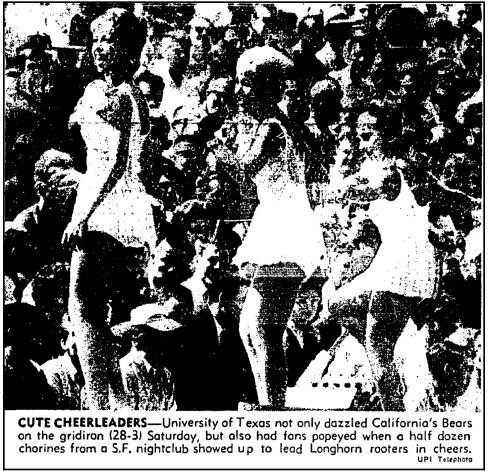




 The UT History Corner